Software
Houzz Logo Print
hzdeleted_19720659

Pernetiana Roses, 1917

9 years ago
last modified: 9 years ago
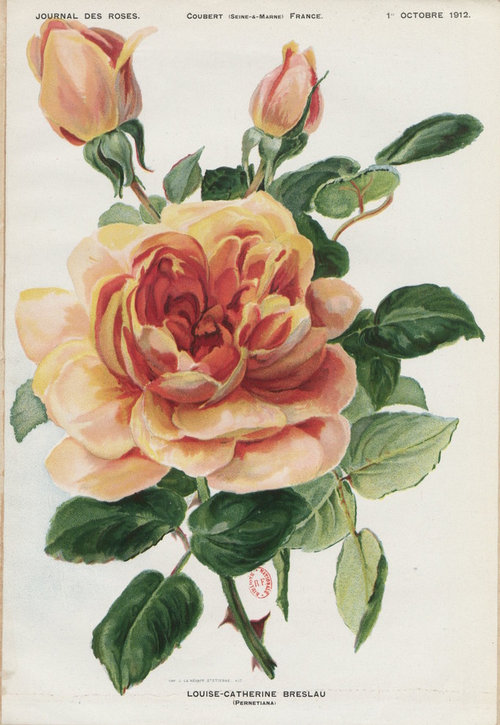
From the Bobbink & Atkins catalog, 1917, p.19:

Pernetiana Roses

A recently introduced class of Roses, peculiar in the richness of the yellow, orange, and bronze-red shades of the buds and blooms. The varieties are mostly hybrids of the very hardy Austrian Brier type. They bloom freely and are of much value. A great French rosarian, M. Pernet-Ducher, is responsible for their origin. They are as hardy as the Hybrid Teas.

Constance. The flowers vary in size from medium to large. They are double in form and possess a very pleasing golden yellow color. 75 cts. each.

Lady Mary Ward. Flowers rich orange, shaded deeper apricot-orange with a metallic sheen. Plant is a vigorous grower and has an erect habit. 50 cts. each, $5 per doz., $40 per 100.

Louise Catherine Breslau. A very vigorous grower of robust constitution and spreading branching habit, rather thorny, fine glossy green bronzed foliage. Large oval-shaped bud of coral-red tint shaded with chrome-yellow; flower very large, full and globular; petals of great depth, shrimp-pink shaded with reddish coppery orange and chrome-yellow on the reverse, 60 cts. each.

NB: Illustration from Journal des Roses, October 1912, p.156

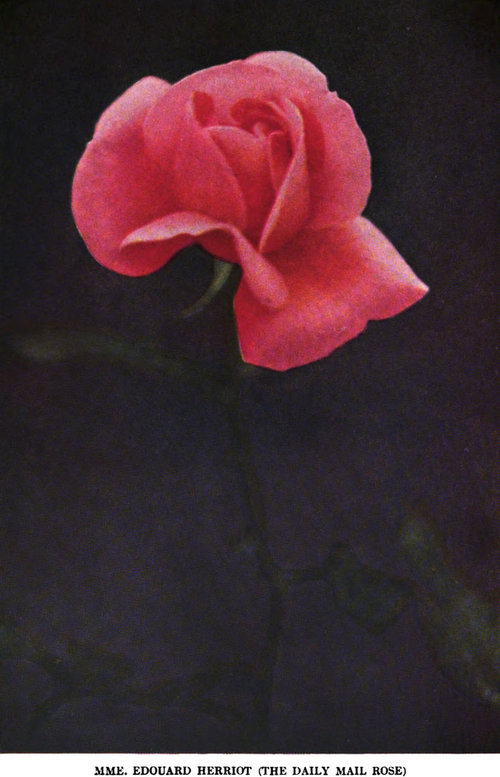
Mme. Edouard Herriot. Coral-red buds, opening to semi-double, medium-sized flowers of coral-red, shaded with yellow and bright rosy scarlet, passing to prawn-red—an extraordinary coloring. Received a $10,000 prize in England as “The Daily Mail Rose.” 50 cts. each, $5 per doz., $40 per 100.

NB: Illustration of 'Mme Edouard Herriot from Thomas' The Practical Book of Outdoor Rose Growing, 1917, frontispiece.

Marie Adelaide, Grande Duchesse of Luxembourg. Deep orange-yellow flowers of perfect form, with a delicate perfume; fine long buds on erect stems. $1 each.

Soleil d’Or. A vigorous straight-branching sort. Buds of lovely yellow, opening to large, full flowers from 3 to 4 inches in diameter, and of a glorious color varying from orange-yellow to a ruddy gold, shaded with nasturtium-red. 50 cts. each, $5 per doz., $40 per 100.

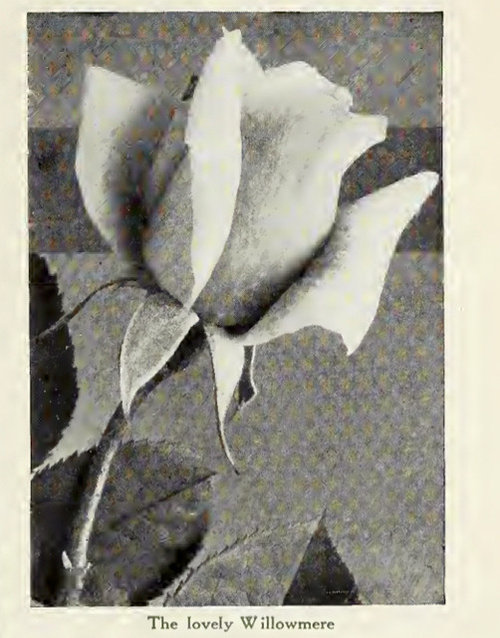
Willowmere. Carmine-coral red bud, opening rich shrimp-pink, shaded yellow in the center and toning to carmine-pink at the petal edges. A very beautiful Rose, always sure to attract attention. 60 cts. each.

Other Good Pernetiana Roses

Beaute de Lyon. Coral-red, lightly shaded with yellow. 50 cts. each, $5 per doz., $40 per 100.

Cissie Easlea. Oval-shaped buds of pale buff, opening to large full flowers of saffron-yellow, carmine center, passing to Naples yellow when fully expanded. 60 cts. each.

Juliet. Outside of petals old-gold, rich rosy red on the inside. Delightfully fragrant; a remarkable Rose. 50 cts. each, $5 per doz., $40 per 100.

Mrs. Frederick W. Vanderbilt. Deep orange-red, shaded bronze-apricot-red. An attractive sort in both bud and flower. 75 cts. each.

Mme. Ruau. Long buds, opening to large cup-shaped flowers of carmine-shrimp-pink, with yellowish shading toward the edges and back of petals. 50 cts. each, $5 per doz., $40 per 100.

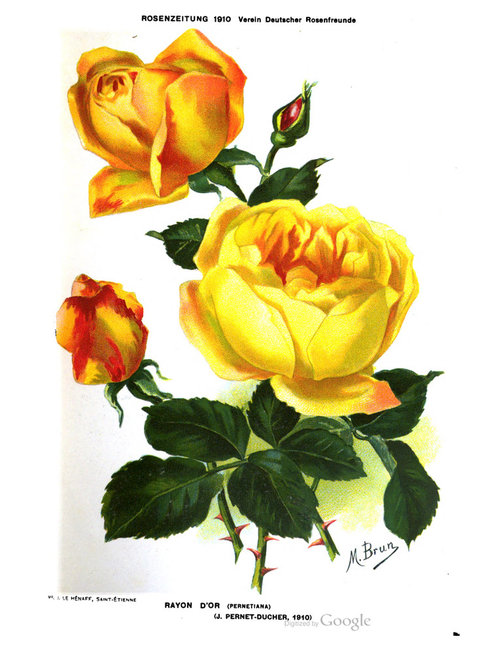
Rayon d’Or. Coppery orange-red bud, streaked with brilliant scarlet bars, opening to large full flowers of superb cadmium-yellow, sunflower-yelPow when fully expanded. 50 cts. each, $5 per doz., $40 per 100.

NB: Illustration from Rosen-Zeitung, June 1910, p.38.

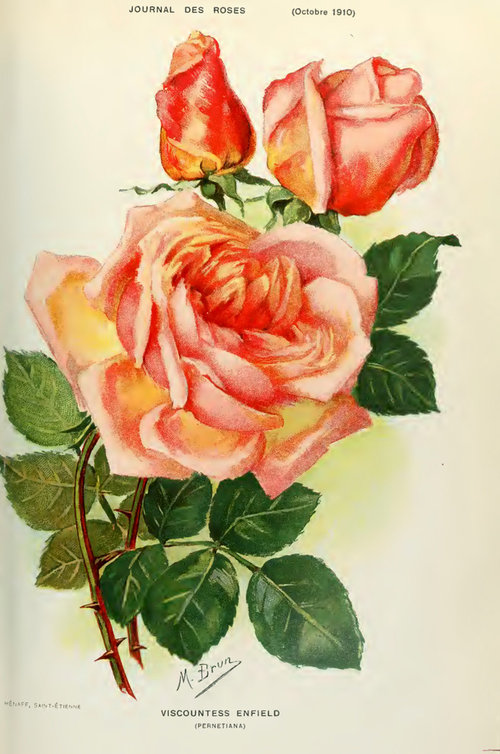
Viscountess Enfield. Large elegant cup-shaped flowers of coppery old-rose, shaded with yellow and tinted with carmine, sometimes striped yellow. 50 cts. each, $5 per doz., $40 per 100.

NB: Illustration of 'Viscountess of Enfield' from Journal des Roses, October 1910, p.156

Comments (23)

  • 9 years ago

    So cool, Virginia! Does Masha still post? I think she grows a number of Pernetianas. Whenever I spot early 20th century hand decorated rose porcelain (old plates, teacups, etc.), I like to try to ID the varieties portrayed. I know that members of my family painted flowers growing in their gardens, and I've definitely seen roses on some antique store pieces that look like Pernetianas. Carol

    User thanked portlandmysteryrose
  • 9 years ago

    The rose portraits are lovely. Of this group, so very few seem to remain. I wonder if many were affected by the blackspot that I believe was introduced with this class of roses.

    User thanked ingrid_vc so. CA zone 9
  • 9 years ago

    Many Pernetianas were/are prone to blackspot in at least some parts of the U.S., but this was apparently surprising to Pernet-Ducher when he was told of it. I guess Lyons is- or was- a good place to grow Pernetianas.

    I don't know if rootstock makes a difference to the blackspot resistance of various Pernetianas- or other HT's, for that matter- but I'd expect that it would make at least some difference...?

    I believe that Kim Rupert has speculated about how differences in a hybrid plant's various ancestries can cause the plant to have conflicts about how to react to its growing conditions. If a rose has genes telling it to go dormant and drop its leaves in hot weather, but also has other genes that work against that trait, a plant can hang onto some rather unsightly foliage. I think he explained it better than this!

    Virginia

  • 9 years ago

    Oh these are my favorites! Thank you for posting! I can't wait to get a hold of Juliet. :)

    User thanked Robin Lemke
  • 9 years ago

    Robin, at $5 per dozen, how can you resist?

    Okay, so Greenmantle would charge a little more, but she is pretty cool-looking...

    Virginia

  • 9 years ago

    Right? I keep having to remind myself that the $5 deposits I keep putting down aren't the entire price of the rose. :) She spoke very well of Soleil d'Or, and I think I might need to add that as well after looking it up, here. I originally looked into OGR's because they seemed more vigorous and less fiddly than modern roses, and then I fall for obscure and hard to grow old roses... le sigh...

    User thanked Robin Lemke
  • 9 years ago

    I do think we should all have a couple of prima donnas, if only to help us appreciate the more self-sufficient roses. But, yes, balance is important unless you are completely in love and enjoy catering to fussyboots. :>)

    And there's always a decent chance that those roses will do fine for you; they have survived more than 100 years, so they must have some stamina. And Greenmantle sells large plants, so your roses will be past the most trying stage when you get them. That definitely improves your chances.

    I hope they do like your garden conditions- fingers crossed!

    Virginia


  • 9 years ago

    Another person here who was especially fond of pernetianas was Luanne. Her health is poor these days, and she doesn't post or garden anymore.

    Cl Shot Silk is the only pernetiana I grow, as far as I know.

    User thanked Rosefolly z5
  • 9 years ago

    OH, Cl.SS is one I almost ordered from ARE, but realized it probably wouldn't do well here. It's so lovely.

    User thanked Vaporvac Z6-OhioRiverValley
  • 9 years ago

    Thank you for posting this! I have a mystery pernetiana rose (accd to Gregg Lowery), and I would love to identify it.

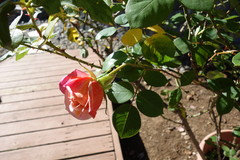
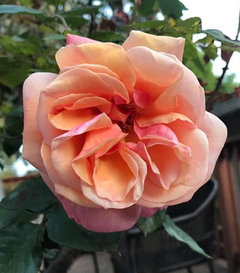
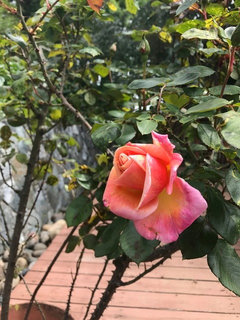
    It was growing at a house built in 1920 which was recently purchased by one of my nieces. It had a completely overgrown garden, with oceans of ivy covering everything. Underneath I found traces of a formal garden. Before she and her family had even moved up from San Diego to move in, we were there with my DH's sister (her mother) looking at the place. In dark shade under a tree, almost completely covered with English ivy and surrounded by a larger bush of Dr. Huey, were a few old old dark & woody canes of a rose, and one bloom. The bloom was so gorgeous that I convinced my DH to try and dig up the bits of the bush which were under attack. He did, and the root ball fell apart, and what was left was 4 separate old ancient canes, each of which had a tiny frill (one inch by one inch about) of roots at the bottom. The old owners had left some large plastic pots and a bag of potting soil behind. Luckily, the soil was enough to fill up a big pot. I put all four canes into the pot, next to each other, on the patio in full sun. Of course, they kept falling over, as they had no support. I found a piece of string, and tied it around the top half of all 4 canes, so they leaned out and balanced each other. Fast forward about a year. The rose(s) grew roots, grew canes, bloomed, and started to throw out 8 ft long canes. I have no idea who it is, but Gregg said it was a pernetiana which he did not recognize. It does BS, but not badly. Last weekend we visited, and I cut it way back, and helped my niece and her DH plant it next to a fence, in case it did want to climb. I took some cuttings then, and have three in plastic bags trying (I hope ) to root.

    The biggest problem, of course, is that many of the pernetiana roses look a lot like each other. Here is ours:

    Jackie


  • 9 years ago

    Gorgeous, Jackie.

  • 9 years ago

    Anyone know how pollution-impacted Lyon was back in the day? Could be the reason Pernet-Ducher was surprised to hear about his roses' black-spotting. In Sangerhausen I heard the story that that old rose garden never worried about rose disease until recently because air pollution kept bacteria down. Pyramids of copper tailings on the outskirts made that tale believable. I've wondered since about lung disease statistics for the town.

  • 9 years ago

    I've seen lists in 19th C. publications of roses that can tolerate the smoky air of town gardens. Yes- free sulfur!- but it seems that quite a few roses didn't care much for it... Perhaps the Pernetianas did...

    My hazy impression is that Lyon was famous for its roses and floriculture, generally, and also was a center of the textile trade- I remember there was at least one large company that manufactured synthetic dyes for cloth... I don't know about air quality, although I assume there was plenty of woodsmoke from residences?

    Virginia

  • 9 years ago

    Jackie, what part of CA does this rose inhabit? I can look to see if I can find a nursery catalog offering Pernetianas, but it helps to know what part of CA to investigate. I am assuming it's likeliest that the rose was purchased locally, although that may not be so.

    Here is a link to a German nursery selling a fair number of Pernetianas; perhaps one will look familiar to you:

    http://www.16-eichen.com/pernetiana.php

    Good luck,

    Virginia

  • 9 years ago

    Thanks Virginia! The rose was and is in Oakland.

    Jackie

  • 9 years ago

    Oh it's so lovely! I hope you get an ID.

  • 9 years ago

    I agree with Robin. What a beauty! Lisa

  • 3 years ago
    last modified: 3 years ago

    @jacqueline9CA

    What a beautiful Pernetiana rose! Wow! Grows 8 ft easily! What a survivor! Pretty tri-colors peach, orange, pink-voluptous bloom! Is it still growing beautifully? How did your cuttings do?

  • 3 years ago

    These are among my favorite roses and some of them are quite easy, vigorous, and quick to repeat, e.g., "Lundy's Lane Yellow", 'Etoile de Feu', and 'Gruss an Coburg'. And, of course, subtle coloration that is to die for. Love the heat.

  • 3 years ago

    The revival of this thread made me wonder how that plant is doing - the house is the home of our niece and nephew, their 11 and 9 year old kids, and a dog. If you have relatives that age with kids you will know that they are busy 150% of the time, and don't have much time for gardening. They also do not have an irrigation system, and have assigned the watering of many plants to the kids (sigh). The last time I saw this rose it was still alive, but suffering from needing water. As I recall, none of the cuttings I had took. However, the next time I am there I will definitely take more cuttings, and see what I can do.


    Jackie

  • 3 years ago

    I think Cl Shot Silk is a Pernetiana. It is one of my favorite roses, and as I have heard many of them all, a rose which likes high culture. It is the only one I have grown, but I must say that your gorgeous mystery rose tempts me to look at others!

  • 3 years ago

    I think of Pernetianas as the quintessentially Californian of hybrid teas, Rosefolly, this being the climate where the pitfalls (esp. blackspot) of being a Hybrid Foetida (their original class) don't matter so much and where they can really reach their full potential.