Software
Houzz Logo Print
mvar07

Meyer lemon repotting

9 years ago

Hello all,

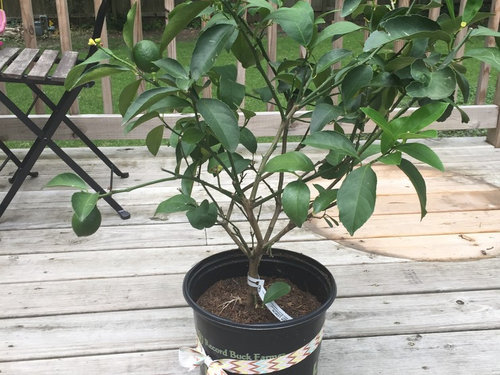
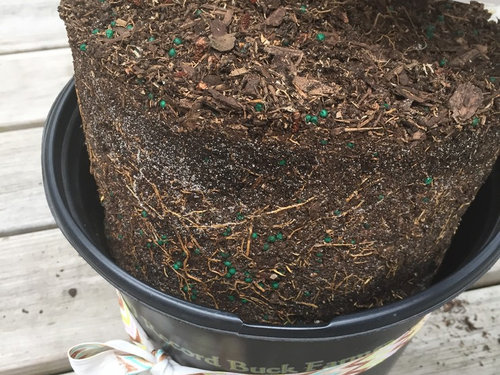
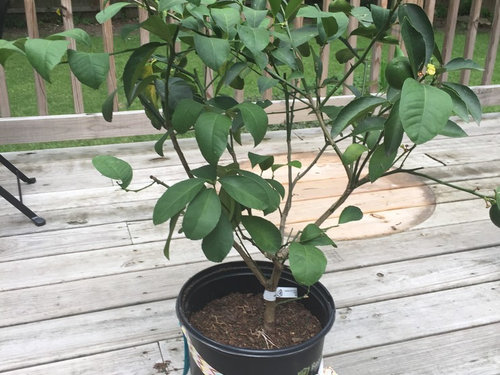
I have a Meyer lemon in a pot that was given to me as a gift 1 year ago. I am in zone 6. Through the great information on this forum it has actually managed to grow! I water whenever the soil feels dry and use 1tsp/gal foliage pro with each watering. It spent the winter inside under a small plant bulb and went back outside in late April. It's grown well since going back outside so far.

I had planned to repot it a couple months ago based on the recommendation of the person who gave it to me, but got busy and it never happened. Now that it's June and pretty warm, is it too late to repot? Also, it's been growing so well over the past few month, the idea of stressing it is a little scary. Is there any good way to tell if it's ready to move up and get new soil? I have read the multiple posts on the container forum and had been planning on using 511 for the new container. If it is ready, what is the next recommended size? The current nursery pot is 10" across the top. Below are a couple recent pictures.

Thank you for your thoughts!

Matt

Comments (15)

  • 9 years ago

    I agree with Vladimir!

  • 9 years ago

    Thank you both for your help! As far as the actual process goes. I feel like I've read that all the old soil should be removed? Then I've also seen mention of cutting off 1/3 the roots in wedges as well. I'm guessing these both don't happen. Is either or both of these necessary?

  • 9 years ago

    You certainly want to wash off as much of the soil as possible, I have had good luck with a strong sprayer attached to my hose and a bucket of water for swishing it about. I usually manage to get 99% off of the tree this way and it doesn't take long. Root pruning is something highly recommend by some and not by others. I think its a good idea and did it to mine when I repotted from soil to 5-1-1 a few weeks ago, unfortunately for me I think I did it too late in the season because we had a heat wave and most of the trees are suffering now but I was also unable to get out and water properly due to an injury, it should have been fine if the heat was less and they were kept properly watered. If you do decide to root prune make sure to move your newly planted tree into the shade for a few weeks until you see its out of the woods for wilting/dropping leaves.

    Matt thanked Sammers510
  • 9 years ago

    Sammers - could you explain what you mean by "root pruning"? I ask because there are various degrees of root pruning. How much of the roots do you remove? How do you remove them?

  • 9 years ago

    I read through a lot of Al's post's on the matter and took about 1/3rd of the roots off with sterilized garden shears focusing on the large, twisted, j hooked roots leaving as many feeders as possible focusing mostly on roots growing directly under the plant. I didn't need a rake as many of my trees are still young and don't have really dense root systems and I was able to wash all the soil away with my hose sprayer and get them untangled. I did take 1-4 larger roots off of the majority of the plants, some didn't have any that were causing any congestion so I didn't prune. I am mostly hoping that by starting while they are young will help set them up for a better root structure down the road. They all took it pretty well except for the limes that wilted after a few days but one had the start of root rot and the other had horribly large congested roots that were starting to fuse. The others showed no signs of decline until the heat wave and lack of watering a few weeks later, even so some that where pruned sailed right on through and others that weren't dried out. But I know root pruning them put some in a more delicate state that made it harder for them to handle the extreme temperatures. If I was going to do it again I would certainly do it in the early spring before the flush of new growth to promote an easier recovery and not have as high of chance of a heat wave rolling through. I was waiting on some back ordered reptibark and had to wait for the delivery which is why I did it so late this year. I used this a guide Al's Post on Root Pruning and made some decisions as I went along. I figure if he does it with good results (on a huge scale) that I should give it a shot.

    Matt thanked Sammers510
  • 9 years ago

    Thank you everyone for your help! I think I have a good grasp on what the process all entails. I'm curious about timing goes though. Al's post mentions undertaking this in the early spring. If my lemon appears to be doing okay, is this something I should delay until next spring? Or is there benefit in doing it soon, even though it's not ideal timing?

  • 9 years ago

    I think repotting should be fine but perhaps wait to root prune to lessen the shock.

  • 9 years ago
    last modified: 9 years ago

    I don' t know if I fully believe in the validity of Al's year 1 to year 3 chart (as shown in Sammers510 post above) . That with each re-potting the tree slowly declines unless the medium is totally removed and the roots are straightened and pruned.. In the great old villas of Europe, there are century old containerized tree's that have gone through 25+ re-potting and look wonderful and thrive. Many are repotted without actually ever being removed from the container.

  • 9 years ago

    @Silica - maybe this is where my n00b comes out - but how do you repot a plant without removing it from the container? To me, repot means you remove it from a pot, then put it back in a pot (new or otherwise)...

  • 9 years ago

    Pluto, I think a lot of those old tree's silica is talking about are planted in some sort of Versailles planter that is able to remove the sides to be able to root prune and refresh the soil without completely taking the tree out. I love the look and function of them but they are insane in cost. If I can ever drop $1000's on planters I would get this style. It would certainly be useful for mature trees that would need a crane to maneuver.

    Silica, I am not sure either but Al's plants always look the picture of health and if it works for him I hope it can work for me too. Since I grow in 5-1-1 now it will be much easier the next time around, but even with the soil it wasn't difficult. I don't know one way or another on which way provides healthier/stronger trees overall but it make sense to me that root maintenance would help with a healthy tree.

  • 9 years ago

    The century old citrus trees long grown by the famous Villas of Italy are re-potted without removing them from the container are grown in conventional round terracotta containers. The method of "re-potting" without ever removing them from the container is addressed in Oscar Tintori's book "Ornamental Citrus Plants Advice on their cultivation from our rural gardening tradition." A 3 to 5 cm slice of soil is cut from around the edge of the container and removed, then refilled with new medium. Many times the length of the knife can no longer reach the containers bottom, and the tree is never removed from the container. These century+ year old trees have been re-potted 25 times or more over their life time using this method. And their long life continues without difficulties.

  • 9 years ago

    @Silica - Thanks for that information! I've never heard of such a thing.

  • 9 years ago

    Tintori's book is a great book, and a much sought after book. Unfortunately, you must be able to read Italian.

  • 9 years ago

    @Sammers - Thank you for the advice. I was in Paris in the past couple months. I couldn't believe the size of the container citrus trees. I didnt realize the Versailles planters were so functional!

    @Silica - Thank you for the information! That method of "re-potting" certainly seems less intimidating than removing all the soil. Looks like an interesting read.