Software
Houzz Logo Print
markus64

Neolith best practices

9 years ago

Reading the occasional lengthy discussions about Neolith, we have come to the conclusion that we really love it both for the looks and for the resilience of the material -- except for the risk of it chipping rather badly, if impacted at the wrong angle. We were wondering if some of the experts would care to give advice on best practices to avoid this issue.

We have four different applications where we would like to use Neolith:

  1. Our cabinet counter tops will be made from Neolith. We'll ask for whatever is the most "eased" edge profile to minimize damage from impact. Also, we are going to have a decorative wood edge underneath which hopefully will provide some additional protection, especially from impact from below:


    Does this sound like a good solution to this problem?

  2. We plan on using thin sheets of Neolith for the backsplash. Our understanding is that this is relatively uncontroversial and once installed, it should be safe.

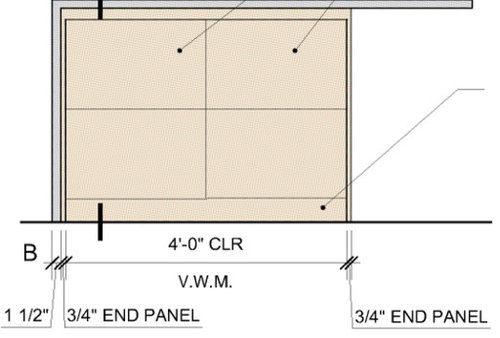
  3. Thanks to extra deep counter tops and a storage space that is recessed in between the studs, there will be sliding panels behind the kitchen sink. We are hoping to make these from MDF (or aluminum?) that is veneered with Neolith. But we are unsure whether this is safe to do, or whether we need to choose a different material. We also are unsure whether we have to "frame" the Neolith at the edges:

  4. We have a kitchen island with a significant overhang, in order to provide comfortable bar seating. On the long side, the overhang is 1', on the short side, it is about 1½'. This will require substantial reinforcement, but we feel confident that is doable with a hidden steel frame underneath the Neolith. My bigger concern is edge treatment. We have a waterfall edge on one side of the island, as that's where a big dining table is going to be permanently installed. The waterfall edge makes it difficult to employ the same trick as in #1. So, instead of an exposed wood edge underneath the Neolith, we'll have a traditional mitered edge.


    I am worried that the combination of a mitered edge (even if eased) with a large overhang that extends into the room is just very likely to at some point suffer an impact -- for instance, if a bulky piece of furniture is ever moved passed that space. Is this safe to do? Is there some way to reduce the risk of damage from impact in this scenario?

We like all the design choices. It'll look awesome. and it'll be very functional. But of course, none of that is any good, if Neolith cannot be used for these applications. I am sure, once we talk to a fabricator to place the order, we'll get more input. But I'd rather go into that meeting well-informed.

Comments (11)

  • PRO
    9 years ago

    You are going to have chipped edges and subsequently repaired chipped edges with sintered countertops. Get used to that idea or pick something else, please. Virtually every stone countertop with a pencil edge at the sink has "chew marks" which, when compared to sintered, are relatively easy to fix or eliminate. You could round the edges and reduce the risk, but you're trading off the radius edge matching the top. In your detail drawing above, I'd specify the fabricator knock the meanness off the bottom edge of the Neolith with a quick pass with a diamond pad. It would reduce the chance of a stress riser which can start a crack and keep a razor sharp cut away from knuckles.

    Were I installing the backsplash, I'd use dime sized dabs of silicone every 18" or so. Just enough to hold it to the wall, no more. If the wall moves, and it will, you want the silicone to accommodate.

    I'm wondering why no one has tried adhering a color matched 1/2" solid surface (Corian) edge to Neolith. It could be profiled and polished, would be highly unlikely to chip, and could be repaired inconspicuously if it were.

    You want to be able to dance a Conga line over your cantilevered metal frame with virtually no deflection. If that means 1 1/2" square tube, so be it.

  • 9 years ago
    last modified: 9 years ago

    M I too really really wanted the Neolith I loved the Calacutta also for the look and the surface durability. I couldn't pull the trigger for my kitchen after learning of the risks and issues associated with it. Also, couldn't bare the thought of having chips around the sink or countertop edges at that cost. One fabricator quoted me $9K for my perimeter only not including the island yikes! This product was new to this fabricator but they have top of the line equipment and back the product 100% for the life of the product. So that is a huge selling point but that cost! Another fabricator I spoke to had no experience with it and I felt like I would be the "test" customer :( No thanks. I honestly have not ruled it out for use in our bathrooms though but I'm really hoping for more improvements/experience with the product and lower cost over time. Hope you get some insight. Please share any info you receive. Thanks in advance.

  • 9 years ago
    last modified: 9 years ago

    Joe, thank you for chiming in. I was hoping you would. And as you might have noticed, some of your previous comments have influenced the design already.

    The edge at the sink hopefully is a non-issue. Since both for this and a couple of other reasons, we had previously decided on a top mounted apron sink. I think it'll nicely address your concerns.

    I'll keep your suggestions for both the bottom of the countertop edge and for mounting the backsplash in mind. That's quite helpful.

    Yes, I think we'll have square steel tubes. And I'll tell the architect that the technical unit of measurement is ">= one Conga line" of strength.

    I absolutely love your idea of combining Neolith with a different material for the edge. That's genius and would solve almost all issues. I think, if the second material was the part that formed the mitered edge, that could look awesome, even if it wasn't a perfect color match. But I unfortunately also doubt that it is practical. I suspect, none of the manufacturers are going to come forward and guarantee that the thermal expansion coefficient of the two materials is compatible.

    In fact, I just checked and Neolith has an expansion coefficient of 5.7µ/°C whereas Corian is 39µ/°C. That's about a factor of 7 difference. I'd expect that to be a problem for anything but short edges. But then, what do I know.

  • PRO
    9 years ago

    "In fact, I just checked and Neolith has an expansion coefficient of 5.7µ/°C whereas Corian is 39µ/°C. That's about a factor of 7 difference. I'd expect that to be a problem for anything but short edges."


    That's why I'd adhere them together with this.

  • 9 years ago

    Thank you very much for the detailed response. That is very helpful. I'll go through it with my architect and make sure all your recommendations become part of the final design

  • 8 years ago

    M did you install Neolith?

  • 8 years ago

    My contractor is still MIA, so while we are done with all the architectural planning, we're still unclear on the start date :-{

  • 8 years ago
    Please see the post entitled "want to see pix of CRACKED NEOLITH?" before making your decision about material.
  • 7 years ago

    M, would love an update on your project!


  • 7 years ago

    Amazingly, things are still not 100% done -- although, we slowly get closer all the time. For example, still waiting for the small cabinet behind the sink that will hold our large assortment of spices and condiments.


    But I can post some 90% done pictures of parts of our kitchen:


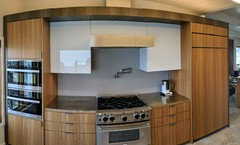
    This shows one side of the galley kitchen. You can see the beautiful eucalyptus veneer and some of our fun large-format tiles. Also, you can just barely guess where the island is, that the kitchen shares with the dining space.


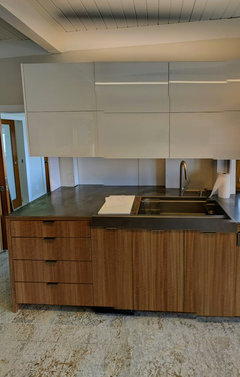
    The other side of the galley kitchen was even harder to photograph for some reason. Please apologize for the potato quality. The counters continue further to the right, without any upper cabinets. Instead, there is a kitchen window. You can clearly see the back wall, where we will eventually have bypassing doors and lots of cubby holes for spice containers. We'll also have a knife block and storage for the paper towels.