

Please help with repotting plan!
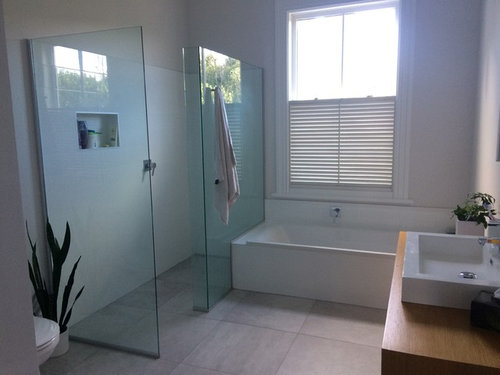
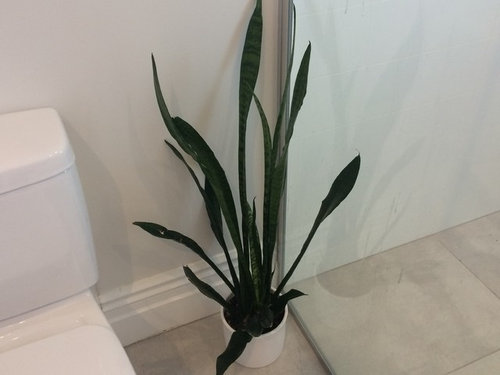
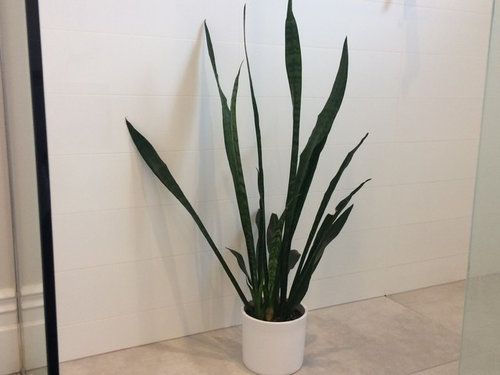
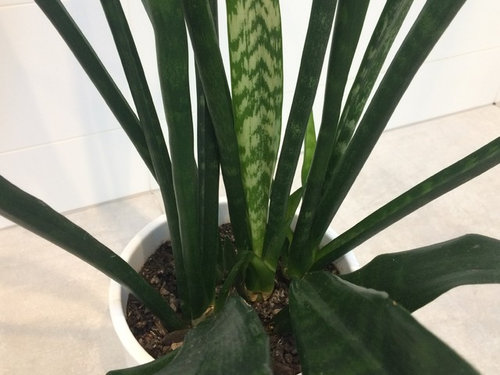
This is my long suffering sansevieria, which I'm quite fond of partly because it hasn't died despite my bad treatment of it. There was no malice intended, it was just my first houseplant in years, so I rushed home and put it old soil and all into a new pot with peaty bagged soil. With a layer of gravel at the bottom. And no drainage holes in the pot (I know, I know...well, NOW I know...). In a bathroom with only one east facing window for light. And, to add insult to injury, right next to a toilet! Not sure if it cares about that part... Probably only good thing is consistent warm temperatures from underfloor heating.
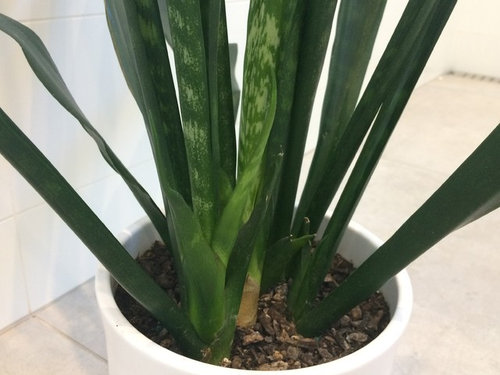
That was three years ago, and somehow it has grown, but now I want to repot it properly, into 511 in a larger pot with drain holes. It may still have to live in that spot though... Anyway, not knowing what the roots might be like I've looked at pictures online and then thought I should ease it out of the pot a little to take a peek. But it's stuck! Help!! I didn't want to get too aggressive as I'm not all ready yet, and didn't want to wreck the roots, so I stopped pulling. What should I expect in there? Should I break the pot off it? When I do get it out should I seperate the crowns - looks like there's 4-5 of them. Eeeek! Help please!!
Comments (41)

robin98
Original Author9 years agoThanks Russ, that's reassuring. As far as fertilising goes, I have fairly recently started DynaGro FP, before that it was a bit haphazard ie. either nothing or something organic I was using in the garden.
As for position : yes, it would get bashed around by towels etc if I moved it closer to the window. I may have to get a different plant for that spot (ZZ?), or, just a thought, when I repot it if I split it into two pots could I rotate plants eg. a month in brighter spot then a month by the toilet? Or would they hate being moved around like that?
Related Professionals
Madison Landscape Architects & Landscape Designers · Corpus Christi Landscape Architects & Landscape Designers · Medford Landscape Architects & Landscape Designers · Sarasota Landscape Contractors · Athens Landscape Contractors · Macon Landscape Contractors · Tupelo Landscape Contractors · Tyler Landscape Contractors · Edison Landscape Contractors · Oneonta Landscape Contractors · Erie Landscape Contractors · Bainbridge Architects & Building Designers · Manhattan Architects & Building Designers · Fort Collins Architects & Building Designers · Casper Architects & Building Designers- 9 years ago
Robin, I would go very easy on fertilizing since your plant is in a low light situation, which is why I suggested only 1/4th of recommended strength. I'm not familiar with DynaGro but I think it's a slow-release granular. If the nitrogen (the first number) is a lot higher than the other numbers, I wouldn't use it on a sans in your situation. Better to find one with a nitrogen number lower than the other two.
Rotating plants in and out of less-than-ideal locations is always a good idea and sansevierias will tolerate moving around. Ficus benjamina doesn't adapt to that very well, probably some others. Zamioculcas zamiifolia does stand up to hard conditions, I see them all the time in mall interiors along with tough aglaonemas and some types of palms here in Florida. Interestingly, you can propagate ZZ's from leaves just as you can with sans.
You could also consider one of the Sans trifasciata Futura group for that spot under the towel, they top out at only 18 inches and are as tough and adaptable as your species. The cultivars Robusta, Futura or Futura Simplex would be good ones, the two latter have narrow and even wider yellow leaf margins. ZZ is probably a more interesting choice since you already have a sans in there, although some folks might choose Robusta as a style choice since it's colors and patterns match your trifasciata.
All the best, Russ
robin98 thanked Russ1023 (central Fla) robin98
Original Author9 years agoHappened to see a Robusta just yesterday, which I quite liked...
DynaGro FP is a non-organic/synthetic liquid fertiliser, NPK 936, popular on the houseplant forum. I use 1/4 dose in my watering water so the plant only gets as much as it as watered - which in this case with no drainage hole is not much and not often. Still not ideal?
Sounds like 50/50 cacti&succulent mix and pumice would be good for repotting, and I'd assume there'd be some CRF in the cactus mix that would be lower nitrogen and be enough for the first few months?
Do you think when the time comes it'll be best to just crack that pot off? Could be fun ;)
Thank you for all your help.
- 9 years agolast modified: 9 years ago
As for cracking the pot part, I'm not sure it could be done safely without hurting the plant. I would use a long knife, doesn't even have to be sharp, to slice around the pot to separate the media and the pot wall. After that, tilt the pot and move out the plant. This is a common horticulture trick. After that, you can shake loose the old media carefully and remove unhealthy roots.
How hot is your underfloor heating? I think the heating has played a very
important role in your sans' survival. Underfloor heating would dry up
your media relatively quickly to mitigate the perched water issue. That should also be considered when choosing your new mix. Shake loose your sans' roots and exam them carefully. If they are healthy, I guess you can use the 50% cactus mix + 50% pumice and keep your old watering schedule. If you see root rot, you probably should switch to a medium that retains less water. You talked about 511 so I assume you are also familiar with Al's 1-1-1 gritty mix. Have you considered that? It retains less water than cactus mix, and you would be able to water and fertilize more often (to show more TLC!). Combined with a wick in a pot with a drainage hole, you can feel the wick to decide when to water.Again, I would examine the roots first before deciding on what medium to use next.
robin98 thanked ElliotLi robin98
Original Author9 years agoOk, no bashing at the pot! I'm not great with a hammer anyway so that's probably wise. I'll pretend it's like getting a cake out of a tin instead ;)
Yes I agree the underfloor heating has probably been its saving grace. It's not that hot, as it is part of the piped water heating for the whole house. So it feels warmish underfoot, but you can't really tell with your hands ie. it's not hot like you can get when it's an electrical pad under the tiles. But it's very constant.
Good point to keep it in mind when choosing next mix. Haven't used (or even seen) cactus mix before, but that combo seems popular here. Have used 511 for a couple of plants so far, with good results, but I'm not quite ready to take the step to gritty just yet. Would 511 would be better than cactus&pumice?
And yes, would love to see the roots first - that's what I was trying to do when I realised it was stuck, and I couldn't just squeeze the pot a bit to loosen the edges like I would if it was plastic. I will try with that knife around the edges :)
- 9 years ago
I agree with Elliot that you shouldn't need to break the pot, a long bread knife down the side should help. Biggest issue is that the pot isn't wider at the top like most other pots, it's a nice modern design but doesn't make for easy removal of plants.
What soil mix is the plant in right now? It doesn't look like a bad mix to me and you've had relative success with it. Pumice is the best aggregate and mixed with cactus/succulent soil should make a great mix. Or maybe add pumice to your present mix or to 511 since you've used that before. I wish I could get pumice locally here, perlite is my main aggregate.
From experience I can't recommend gritty or any mix that requires a large proportion of Turface. Some folks have success with it, many do not.
Russ
- 9 years ago
Ask 10 people here and you would get probably 10 different recommendations for mix. :)
Personally I think either will do fine because sans is just not that fussy as long as the media is well drained.
My personal favorite is 1-1-1 gritty mix because of its superb drainage and I don't mind watering on demand. But if I have to pick one between the two you got, 511 probably would be better. The first reason is that a properly made 511 requires filtering out all the fine particles that can hurt drainage. The second reason is that not all commercial cactus mixes are made same. Some are sandy, some can have a surprisingly high percentage of peat; we just have no way to tell before checking them in person or even trial and error. I'm pretty sure when experienced growers here talk about cactus mix, they mean one or a few favorite bands they like, not just any random cactus mix you can buy.
Another choice is to buy some bonsai mix instead of cactus mix. Certain bonsai mix is gritty and is very similar to Al's 1-1-1 gritty mix. Can you find some bonsai mix locally?
Please keep in mind that the mix has to match your environment and watering habit. The better drainage the media have and the less water they retain, the more often you will need to water them. But hey, we are talking about sans here, even with the most gritty mix, you wouldn't need to water more than twice a month.
- 9 years ago
I saw Russ's comment on Turface after posting my comment. He's definitely right on that part. Among other reasons, Turface can hold too much water. I grow all my sans outside in hot California sun, so I don't mind Turface holding a little more water. If you can get pumice, it is an excellent choice. And you can tweak the ratio between other mix and pumice to fit your need.
robin98
Original Author9 years agoWell I thought it might be rootbound, seeing as it's been in that pot 3 years, the top has doubled in size and it seemed stuck in there. But noooo.
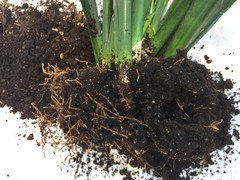
Ran knife around edge, leaned pot over & plant just kinda fell out with loose soil dropping off it and pretty pathetic looking roots. The mix was dark from recent watering but not wet, even so the roots were avoiding the bottom, just staying in the top couple inches & around the edge.
The roots aren't soft or smelly, bit brittle if anything. So I've apologised to my plant, sat it back in the pot propped in a corner & now need to organise a new mix (& a pot with holes). I see they're grown successfully in all sorts. I do have pumice, so it's good to know I can include that in whatever I decide. Good drainage is obviously key
But what should I do with the roots? Do I need to have a good look for healthy ones, assuming there are some, and trim the rest? How do I assess this?
I appreciate all this help :)
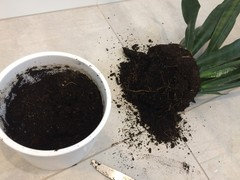
I can see a bit of a rhizome in next pic..
robin98
Original Author9 years agoRuss, currently it's in a general peat based potting mix, which I've since used up. The cactus mix I bought looks just like the seed raising mix I already have. They're both peat with fine bark and fine pumice. The cactus mix says it also does bonsai so that makes me even more dubious. Probably ok as a small proportion of a mix. It's easy to avoid turface - we don't have it here in NZ!
Elliot, I suspect you're right about not all cactus mixes being equal. Im sure I could source decent cacti and bonsai mixes from specialty shops or societies, if I needed to, but hopefully I won't! I'll probably go for a version of 511. I suspect if I use too much cactus mix it would negate the point of the pumice.
Glad you both like pumice - because I have it!
- 9 years ago
Looks like the perched water at the bottom is preventing the roots from colonizing it. Yeah, I think I'd prefer to switch to a filtered bark and pumice mix.
As for the roots, the old mix can be gently washed away using a basin of water. You can even add a little fungicide to the water. Root pruning doesn't look like necessary to me if there's no rot, which usually gives out a fishy smell. Let the root dry for one or two days, then pot up using your new mix. It is a good practice to thoroughly wash your new mix and also let it dry. After potting up, it is safe to let it sit for a week before starting watering.
I'd also divide the cluster equally into two pots and rotate them outside. Hum, no. I think I would just go out and buy another pot and rotate. LOL! But you are in NZ, which is very cold now. It would be a good idea to put off taking it outside until the low temperature is higher than 50F.
robin98 thanked ElliotLi - 9 years ago
Hi Elliot, I think soil mix choices are even more extreme than you indicate... ask 100 people and you wouldn't get the same materials or proportions, and variations would be endless. The International Aroid Society did a survey in their Aroideana many years ago, and the responses were amazing, from the simple like nothing more than bark, to peat and perlite, and to the exotic with mixes containing 6 to 8 ingredients.
To clean old soil from roots I always take the plant in the yard and spray it away with a hard but fine spray from the hose. It will even blow away rotted parts of roots and leave the good ones intact.
Robin, Elliot has offered good instructions, I couldn't add more. Main thing about soil mixes for sansevierias is that it shouldn't have a lot of fine material, especially peat moss. Personally I find that pine bark mulch available here in Florida is okay used as-is without sifting, but there's nothing wrong with sifting the really fine particles out. Sifting the bark to get the fines out and then adding peat moss back in makes no sense to me. I've grown good sans with unsifted bark and perlite, for tropicals like aroids I add a part or two of peat moss or Miracle-Gro.
Keep us posted on progress.
Russ
robin98 thanked Russ1023 (central Fla) robin98
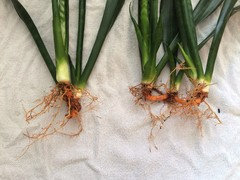
Original Author9 years agoIt's been rinsed off (actually most of the soil and quite a few fine roots just fell off, so not much rinsing required). Remaining roots seem ok, white & firm, not dark or smelly or mushy.
Should I divide the three plants that are connected? Or leave them together for support? Does it matter? If cut, do it in middle of rhizome so each plant has some (well, middle one will have two bits). The two plants on the left came off when I was handling it, I have since cut them apart since the crowns were at different levels.
PS Nice idea about just buying another one for swapping. Initially felt traitorous, but on second thought... Could have Real Sans and Imposter Sans and see if anyone else notices ;)
- 9 years ago
LOL. I like the idea of an imposter sans.
The general idea is that if you want them to grow larger leaves, keep them connected. If you want many new growths of shorter leaves, cut them apart. Sans only grow mature leaves when it has reached a certain age and size. If you keep cutting them apart, they would stay small.
robin98 thanked ElliotLi robin98
Original Author9 years agoThank you! Two hours searching internet re cutting rhizomes or not, everything I found was about cutting them to propogate, not what would happen if you don't. And you gave me a clear answer in one short paragraph. Cheers!
- 9 years ago
Glad I could help. I read that from The Sansevieria Book by Hermine Stover. The ebook version can be found online.
robin98
Original Author9 years agoSo, after two days drying, here it is in its new mix (50% coarse perlite, 25% small orchid bark & 25% peat-based cactus mix ). It can sit in a nice warm bright(er) corner to recover for a while.
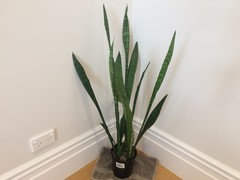
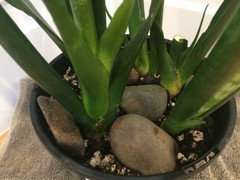
The rocks are temporary, for stability, until its roots grow and anchor it. It may look like all I've done is change a white pot for black one - but now the mix is free-draining & the pot has drainage holes. Much better.
Russ and Elliot, thank you for all your kind, knowledgeable advice, it is much appreciated.
- 9 years ago
Looks good Robin! Don't be a stranger.
Elliot, Hermine is a real hoot, and one of the great collector ladies in sansevieria history. Her sense of humor and style of writing are legendary and so entertaining. Her good friend Norma Lewis was as knowledgable, truly another sansevieria pioneer... I often wonder if she is still in good health.
Russ
- 9 years ago
Yes! Hermine's book is well written and entertaining. I wish Norma still comes here and hope we can hear from her again.
- 9 years ago
Norma was getting way up there in age, I'm thinking she may be living with relatives or (hopefully not) living in an assisted living facility. She seems to have dropped off the radar on sans forums.
Good health and long life if you're reading this, Norma.
Russ
 9 years ago
Shame so many good people came and gone here. Wish I could hear from so many of them. Loved Norma. Best wishes.
Take care of yourself Russ, Your one of my heroes as well.
- 9 years ago
I've been wondering where and how you've been Stush, I'm glad to see you here my friend. We need to do a couple of trades this summer, I wish you had more growing room.
All the best, Russ
robin98
Original Author9 years agoAlmost two months later, my sans hasn't really done anything. It's good that it hasn't shrivelled up and died or rotted and died, and it is (the end of) winter here after all. But it's still really unstable, in all directions, without the rocks and a corner to prop it in. It's back in the bathroom but much closer to the window so there's more light. I've left it alone as much as possible, but I'm bit worried it's still so wobbly.
Is there anything I can do to help that? The smallest single piece fell out when I moved it and it had less roots than when I repotted (I didn't put it back in), so maybe all is not so well under the surface. I have a heating pad and some rooting hormone coming for some shrub propagating I'll be doing - could the sans benefit from either of those things too? Any advice appreciated!
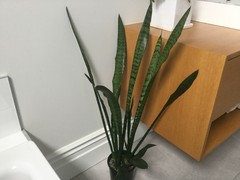
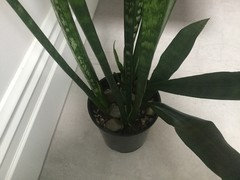
- 9 years ago
Robin, your pot is far too small for such a tall sans, it at least needs to be in a pot with a wider base to support the height. You could also drop the entire plant in a wide clay pot and pour some gravel around it to take up space between the pots.
However, if the plants are loose in the pot with a very small root system, then there's a problem. You're either keeping the mix too wet and roots have rotted, or you're keeping it too dry and roots are held back from growing. The trifasciata group are fairly tropical and do not handle being dry for long periods of time as well as the desert group with thicker and sometimes cylindrical leaves. Obviously a plant in this lower light situation won't need watering often, but it shouldn't stay bone dry for weeks at a time.
So, how often do you water this plant?
Russ
robin98
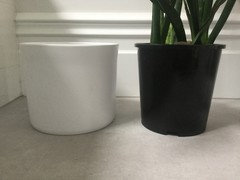
Original Author9 years agoHi Russ, thanks for your reply. The black pot it's in now is pretty much the same internal volume as the white one it was in before, which you had thought was appropriate. Even before I found its roots were small and only in the top part of the pot from lack of drainage (my bad). It's not so much the pots stability that's an issue (I'll put in in a cachepot at some point), but the plants in the soil.
From what you're saying, it's more likely I've underwatered than overwatered, with my eye being more in for the situation it was in before, where I had to be really cautious. It's had two thorough soakings (water flushed right through) and I think 3 lighter waterings, where I was intending to dampen the area where the roots are rather than the whole pot. That's over 2 months, so every 10 days or so. Hasn't gotten bone dry, or stayed really wet... So not sure
 9 years agolast modified: 9 years ago
Your plant is probably doing alright. It’s just that the perlite cannot and will not support the top heavy height of your Sansevieria leaves. This will only happen when the plant has formed a large rootball occupying the whole pot. And that won’t happen in two months, at least six probably. So you need to support it during this time period. Even then, Trifasciatas are not well known for their large and sturdy root mass. Their root mass stays somewhat minimal. Perlite is a nice product and everybody seems to have it, but I don’t use it anymore. Partly due to this stability issue and also due to it’s floating behaviour and stickiness. A solution to this problem is to take a larger pot and to plant the roots slightly deeper so you’ll have more supporting material above the root mass. Or just like you did, with rocks and gravel. Your black pot is too small, the size of the white one is better already. Make sure you have drainage holes. With plain old soil I won't water more often than two to three weeks, but that also depends on how well the soil is drained and your room climate. Can't give more directions about that unfortunately. Good luck!
robin98
Original Author9 years agoOyster, thanks for taking the time to reply. It's actually in pumice, which I talked about in my earlier posts but then when I listed what I'd repotted it in I wrote perlite - no idea why, I've never even seen the stuff! Apologies for the confusion.
So the pot is pretty weighty. The white pot has thicker walls so holds the same as the black pot (the black pot doesn't even fit inside the white one, I think the photos are a bit deceptive) but it sounds like I should have upsized a bit after all.
It's good to know they're not known for much of a root mass, and that it can take a long time to form a decent rootball. I was just expecting (hoping for) a bit more enthusiasm from it in its new mix.
Do you think I need to get it into a bigger pot soon, or let it re-establish more first and pot up later?
- 9 years agolast modified: 9 years ago
End of winter is probably the main reason for their lack of enthusiasm in this new mix. Your climate does not provide sufficient energy at the moment, so they take it even slower. You should expect results when your climate becomes more pleasurable I guess. A pot with the inner volume of the outer volume of the white pot would be fine. I don't support the 'general consensus' that a Sansevieria should be root bound. A Sansevieria doesn't like root bound, it just doesn't like living in a soggy wet soil. Small pots avoid this to some extend. Some people are just mixing up cause-and-effect. If you should repot is up to you, just make sure it doesn't get overwatered in the meantime and is provided with a larger pot as soon as growing season starts. If you do choose to repot again I would leave the roots in open air for a week or so. Just to make sure any damage to the roots has dried and healed. If you can find the time just go for it. Alright, winter is coming. We are currently enjoying (end of) summer overhere. So I really should get out. ;) Good luck!
robin98 thanked Oyster - 9 years ago
Thoughts from another Robin. If I were you, I might easily give it until next spring and see what happens, what takes hold. Every time I size up considerably on the pot with Sansevieria, I always wish I hadn't gone that large. Sometimes there is no choice; you just have tons of roots and rhizomes, and don't want to hack it to pieces, or it takes a larger pot in order not to fall over.
But I do find that my Sans seem to grow best when they are repotted into pots that are just SLIGHTLY larger than their previous homes. I'm not saying they like to be root bound. But mine seem to be best when they are snug and cozy. Especially with Sans, I think they will tell you what they need by how they look and grow (or don't).
robin98 thanked robinswfl - 9 years agolast modified: 9 years ago
If you HAVE to use a large pot but at the same time want to provide a snug condition for you sans, just use pebbles to fill in the empty spaces. Roots can't penetrate pebbles, and pebbles don't hold water or any other thing. If pebbles are making the pot too heavy, use small plastic bottles instead. I always have a few of those smallest pill bottles, and they are a good, light space filler.
Both pebbles and plastic bottles are easy to remove the next time you repot your sans.
robin98 thanked ElliotLi robin98
Original Author8 years agoAnother two months have passed and the sans somehow made its way back into the living room and onto a heating pad and since being there has grown some nice new leaves. But it’s still unstable in the mix, especially the clump on the right. Take its rocks away and it leans over a couple of inches, lifting the soil and the roots of the other ones in the process. The pot doesn’t tip at all, I think the pumice makes it fairly heavy, just the plants are wobbly within it.
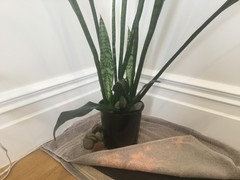
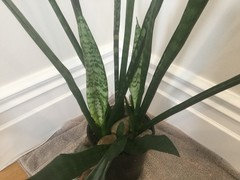
So today I added more mix to see if that will help support the plant bases (which has probably made the crown at the front too deep but it’s not a great one anyway so I might remove it) and am considering cutting a couple of leaves that stick out sideways off in case they’re unbalancing it.
But if that’s still not enough then I may have to take it out of the pot and try replanting it, see if I can position them better. Unless anyone has any other practical tips I could try? I’d prefer not to put it in a cage type of support or use stakes if possible. Just want it to get a better grip on its soil! Glad it’s growing though :)
 8 years ago
I am slowly switching to the gritty mix everyone here has talked about and I am experimenting with ratios. I find the combination of turface, gravel and fir bark holds the plants down pretty well. The pot is heavy as heck though.
robin98 thanked vitoramarobin98
Original Author8 years agoMaybe my mix is staying too loose to anchor them, especially as they’re so tall. It’s 1/2 pumice, 1/4 bark, 1/4 potting mix. I’ve read many growers using 1/2 pumice and 1/2 potting mix - maybe having a bit more potting mix (I’m talking C&S mix here) helps bind the pumice better? Or maybe I need even heavier components like the gravel you mention. Or just a shorter leaved sans...
Thanks that gives me ideas to try if it hasn’t sorted itself out in another month or so :)
- 8 years ago
I’ve not heard of using pumice with potting soil. Has it worked well? I would think the soil holds water, the pumice holds water, where is the drainage?
robin98
Original Author8 years agoPumice, potting mix and bark is very free draining and well aerated, they’re the components of the 5:1:1 mix (with pumice being used instead of perlite and C&S potting mix being the peat part). I’ve been using these three in various ratios for a range of other plants, with my understanding being that to keep the good drainage you need to keep the proportion of finer material (the potting mix) low. I think all the components can hold water but they’re different shapes and sizes - it’s quite a chunky mix - so there are lots of gaps for drainage and air. Al explains it better!
50:50 potting mix and pumice or perlite in theory is too much fine stuff but others sound happy with it and I haven’t used it so don’t really know. I haven’t tried straight gritty either as I need a bit more leeway with the watering if we’re away or get I busy and distracted. Been happy with my mixes up to now, no instability issues, but they’ve all had more bark and less pumice. And either shorter plants or better roots.
 8 years ago
My experience has been that when doing a total repot of Sans, the original plants won't be able to stand upright. That's because the root system has been disrupted. I've learned to love it just the way it is with some leaves going sideways. The upshot of this is that the new leaves and rhyzomes will grow correctly upright. I have mine in a mix of 2/3 turface, and 1/3 pine bark. I can water it with impunity
robin98 thanked hellkitchenguy Manuel 8 years ago
It just needs more time that you think. As Al sometimes says, it's on plant time, not people time.
So pls put the rocks back to keep the plant stable & in place until it grows enough roots. What's the harm leaving the rocks in? Who cares?
It'll stabilize when it's ready; these plants do best when largely ignored.
I use mostly pumice & old C&S mix, keeping out the finer stuff. IME, Sans don't care what their mix is, as long as it's fast draining.
I think the plant is fine Robin, this is bothering you more than it is the plant, there's no issue here, I assure you.
- 8 years agolast modified: 8 years ago
Agree with Karen. You repotted 2 months ago and it was winter. It has not had a chance to establish roots yet. Just forget the plant for a while, check back in fall, you will see everything is fine. And if you can put it outside in summer, that even better, just do not forget acclimate it.
-rockdale
robin98
Original Author8 years agoActually been 4 months (repotted early July) and leaf growth has kicked in so I assumed there had been some root growth.
I can certainly give it more time if that’s all the problem is.






Russ1023 (central Fla)