Software
Houzz Logo Print
hzdeleted_40430536

Questions for Ray

9 years ago

When you do a new install, what do you do with the old unit that's removed? I've always wondered where they end up. Do they get refurbished, sold for parts or tossed away? Do you take and reuse the refrigerant or is it bad or contaminated.

Also, when you move into a home, (or your relatives do), is tackling the AC the first thing you do, or is that like taking work home with you?

Next, when selling a new unit, I would assume you would have some sort of incentive or contract for each brand? Does that sway your opinion on what brand to suggest to a customer? Like you said in your video, you're a service industry, but do you have to upsell?

(Example, when I go out to eat, the server always wants me to get a cocktail and not the free water.)

Are you allowed to say what brand and SEER your home AC is? I've always wondered if HVAC business owners have the Rolls Royce (most expensive) AC units for their home and office.

Comments (18)

  • 9 years ago

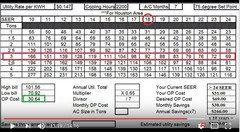
    Where do I find this chart? I'd like to enter my info and see what it says.

  • PRO
    9 years ago

    Tell me your location, and your utility rate in cents per KWH and I will look into posting the chart. This chart is designed for Houston / Katy Texas areas.

    User thanked Austin Air Companie
  • 9 years ago
    last modified: 9 years ago

    Do they get refurbished, sold for parts or tossed away?

    Never refurbished, but taken to scrap yard / recycling for a small amount of cash. (aluminum or copper).

    Do you take and reuse the refrigerant or is it bad or contaminated.

    R22 legally has to be reclaimed and sent in. They use a recovery unit (expensive) to pull it out and capture. Pros know that air and moisture contaminate and ruin an AC system. If you have an AC leak, you normally have to find the leak, pull out the refrigerant, fix the leak, then put a vacuum on the system to pull out any moisture and air that is in the system. It is usually measured with a vacuum gauge which shows micron levels in the system and also shows if there is a leak (micron levels will rise with system closed, vacuum is turned off). Same goes for a burned out compressor, there is usually contaminate inside that caused the burnout so they reclaim the refrigerant and dont reuse it. A new filter dryer is to be installed in the new system to get rid of any moisture in the system after the vacuum is done.

    If refrigerant gets mixed with a different type it is considered contaminated. If it possibly has moisture or air in it then it is also considered contaminated. This is why it is good practice as Austin noted above to use virgin refrigerant. I am assuming when you send in reclaimed refrigerant they reprocess the currently used types for reuse and destroy most of the R22.

    User thanked Vith
  • 9 years ago
    last modified: 9 years ago

    Columbus Ohio

    KWH @ 0.0379

    1.5 TON

    The chart was interesting to see the difference between a 10 SEER what I have now and a 14 or 18 SEER.

    I'm definitely in the market before next summer so I was interested in the cost savings.

    Also - I watched your zone cooling video, and I've heard a lot about it, but what is the difference between zone cooling and just closing the vent to the room you don't want cooled and close the door? I actually had my spare room, 2nd bathroom and basement vents all closed. My HVAC tech about had a heart attack.

    I thought I was getting more air in the rooms I wanted cooled. But he showed me this static pressure reading and that my unit was specifically set to operate with ALL the vents open. I had quite a pressure build up. When I opened all the vents, the pressure was completely normal again.

    So wouldn't zone cooling create a pressure back up too?

    Lastly, question about this chart


    I know you said this is based your area and 95 degrees/75 degrees and ambient temperature. Does humidity play a factor in this (obviously not on this chart). I'm not sure if you're area is humid, but in Ohio we get our share of humidity. If the OAT entering the condenser is 95 degrees and 90% humidity, doesn't the humidity actually help with heat exchange?

    I'm originally from Phoenix, and my uncle owned a car AC repair shop. He showed me how misting the radiator and condenser with water greatly reduced the air temps coming into the car, versus the dry heat Phoenix is known for. I think the point he was making was that the AC in cars driven in high humidity areas generally have colder air than cars in Phoenix. Don't quote me on this, it was in the 1980's so things might have changed. But somewhere that stuck in my brain is that water/humidity cooling the condenser coils helps?

    Sorry for rambling, but I like the videos! I'm getting some education today!

  • 9 years ago

    Zone cooling has ductwork theory as well. A certain amount of CFM is required to operate correctly. Closing off a lot of the rooms without adequate ductwork to handle the extra airflow can strain the blower motor.

    User thanked Vith
  • 9 years ago
    last modified: 9 years ago

    Vith, yup, that's what he told me. I was killing the blower motor. I thought I was just wasting money cooling rooms that are unused.

    I have a full finished basement with 1 register. It kills me to keep that register open because it's always 60 degrees down there. It really stays cool without any help.

  • PRO
    9 years ago
    last modified: 9 years ago

    I watched your zone cooling video, and I've heard a lot about it, but what is the difference between zone cooling and just closing the vent to the room you don't want cooled and close the door?

    Zone cooling is duct work with control design to heat or cool areas of the home you are using and limiting the amount of heat or cool to areas of the home you aren't using. However, zoning isn't necessarily something for every home. There are a list of requirements.

    Looking at your utility rate and the size of your system tells me that zoning would provide little benefit to you. Zoning is costly to implement and you always have to look at prospective pay off... the amount you would save would be miniscule based on 1.5 ton AC tonnage and utility rate of 3.8 cents a KWH.

    You would probably be better off selecting a 2 speed AC system (communicating 16-18 SEER if you plan to keep this home / either as a place to live or lease out.) But again at 3.8 cents a KWH you would just be doing it for better comfort / better humidity control when those needs arise. Zoning for a 1.5 ton AC system just isn't worth the effort. The system is too small to worry about zoning.

    Zoning pressure back up occurs when the duct work system isn't designed properly / controls not set up or installed properly etc. A 1.5 ton AC system could be easily zoned... no problem at all. The cost and the pay off would be the problem.

    I'll cover the other topics and post the chart later... duty calls.

  • 9 years ago
    last modified: 9 years ago

    That one register to the basement, I am wondering if you can install a Y duct, a couple dampers, ductwork and new floor register upstairs. Then you could control which one you want active. So say during summer you have it cooling upstairs and during winter you have it heating downstairs. You would have to make access to the duct and have an appropriate route to put the new register in a decent place upstairs, and a new hole in the floor. Then an access panel to get to the dampers to switch them. If it isnt possible that's fine but it would probably help if it was doable.

  • PRO
    9 years ago

    So wouldn't zone cooling create a pressure back up too?

    Yes, it would if not designed and done properly. There are a myriad of ways to do this. You can oversize the ducts. Which is fraught with misery during 10% of the season when you (home owner) decides I must cool these other rooms.

    Because the ducts are over sized you unintentionally have reduced velocity and throw of the air to cool properly.

    There are dampers that let out some air. Not that this is wrong, right or otherwise... but my opinion of a zone system is to cut waste and allowing air thru to areas you don't want to cool is counter productive. But with that said some *Locations* this really doesn't matter that much.

    There are systems that use what is called barometric bypass to send air flow back thru the system. If pressure builds up enough it forces open this bypass damper. I really don't care for this method either because this is a position sensitive damper. They really just don't perform well enough in my opinion.

    All these things relate to design of the system and what ever method one chooses to relieve (air) pressure of the system it must be designed properly not only to handle low load temps like 80 degrees OAT on up to heat wave temps of 105 degrees OAT. This conundrum is what befuddles most who attempt at zoning especially in my neighborhood.

    For a neighborhood like Ohio it would be quite a bit easier, but only because I know what it takes to do it in Katy, Texas.

    Questions about this chart:

    I know you said this is based your area and 95 degrees/75 degrees and ambient temperature. Does humidity play a factor in this (obviously not on this chart). I'm not sure if you're area is humid, but in Ohio we get our share of humidity. If the OAT entering the condenser is 95 degrees and 90% humidity, doesn't the humidity actually help with heat exchange?

    Humidity doesn't help with anything. It tends to make problems more than it helps. If you reduce humidity heat is less of an issue (to a degree if like pun)

    Too much humidity can be just as bad as too little. Humans tend to be most comfortable in the 50% RH range. Lower than 40% and things start drying out that shouldn't really be dried out. Yes, my area can have 80% plus humidity sometimes all year long as experienced the last 2 years throughout the winter here.

    If the OAT entering the condenser is 95 degrees and 90% humidity, doesn't the humidity actually help with heat exchange?

    No. That humidity will find it's way into the structure. If your AC is a single speed air conditioner it will have little effect to 'effectively' reduce high humidity like that. Any help that humidity provides with heat exchange would be a negative on the inside of the structure that it is trying to cool and or relieve the humidity that is infiltrating it.

    I think the point he was making was that the AC in cars driven in high humidity areas generally have colder air than cars in Phoenix.

    Cars are a completely different application, but humidity is not a factor. The factors are Ambient Temperature and design of the system.

    If you lower the ambient temperature (outdoor temp) any system will cool much better. The ambient temperature is a load. When you mist water over a condenser it lowers the ambient temperature of the air. You can do this your self when you are hot... pour some water over your head. It feels cooler all of a sudden. Now sit in front of a fan. Hello? free air conditioning.

    The way I put this makes you feel silly I know, but I am not trying to ridicule you just so that you fully understand the answer to the question you are asking.

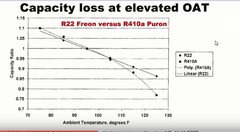
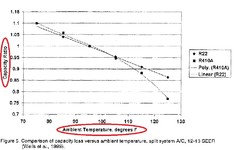
    Look back to that chart... look at the lower outdoor ambient temps. What happens to capacity? It goes up when ambient temps are lower.

    User thanked Austin Air Companie
  • PRO
    9 years ago

    JeCrigler,

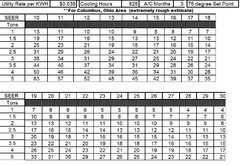
    Here is your chart. This is extremely rough estimate. Your design temp is probably 90 / 70 (90 outdoor / 70 indoor) So this may skew the estimate a little bit. Maybe 5 to 10%.

    Realize your utility rate is very low, the tonnage of your equipment is 'small'. So you probably will realize these numbers aren't going to lead you to any serious savings. Parts of the country pay upwards of 20 cents per KWH as an example.

    My area is currently around 9 or 10 cents depending on usage. So that is an equation that varies a lot. Due to your average season run time of 828 hours this is almost 1/3 of the normal run time for Katy, Texas.

    This is another reason why location is so important and why this can be rather complicated. HVAC is not a one size fits all.

    User thanked Austin Air Companie
  • 9 years ago
    last modified: 9 years ago

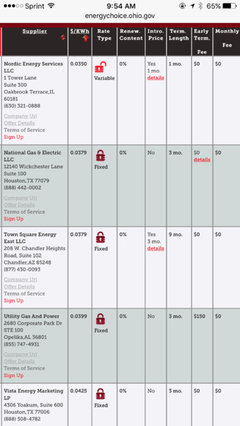
    Thanks Ray! Yah, I really won't save that much going above the legal 14 SEER standard.

    My KWH is super low. I'm not sure about other states, but in Ohio we're allowed to shop different energy suppliers & use them instead of AEP.

    Of course these are only intro rates & don't last forever - but I stay up on it and when 1 rare expires I choose the next lowest rate available.

  • 9 years ago

    These are some of the lowest
    rates I’ve ever seen anywhere!

    Through what other ‘tax’ might you be paying for the true cost of electricity?

    What does the price escalate to after the 3rd or
    9th month?

    Interesting that there’s no ‘Renewable Content’. At this
    price how could there be?

    It makes me think of the old adage, “If it’s too good to be
    true…”

    How is electricity generated in your state?

    Any Carbon Taxes?

    At these rates there’s no incentive to conserve and little
    profit to reinvest in new technologies.

    Something’s wrong with this picture! What’s the real price
    after the introductory period?

    IMPO

    SR

  • 9 years ago

    I think it doubles after the contract is up. But there's 2 pages of providers so I just move to the next cheapest. Been doing it for years.

    Now these is the lowest prices I've ever seen in awhile. My last rate was .06. But I love this KWH @ 0.0379 for 3 months. June, July & August. Amazing.

  • 9 years ago

    The real effective KWH cost is the $-amount of the bill divided by KWH used for the period. That calculation will include the taxes (if any), administrative fees, fudge-factors and whatever else is added to the advertised KWH rate.

    I'm served by the local cooperative. The KWH rate for the generation "energy" portion is stated as $0.04688. However, the actual cost when transmission, local office, and cost-recovery factors are added is $0.09653. That's per the last bill. Every bill is slightly different due to the cost-recovery factors.

  • PRO
    9 years ago
    last modified: 9 years ago

    JeCrigler,

    yeah if you were to jump to 16 SEER 2 speed your bill would jump from $13 a month for a 14 SEER 1.5 Ton to $16 because the 2 speed would be 2 ton... they don't make half ton sizes. The 2 speed would do a better job of keeping humidity down, but for your climate with 828 cooling hours... that's a hard one. If this is a forever home, then maybe it might be worth it.

    You wouldn't be doing it for energy savings at your current rate that's for sure.

    User thanked Austin Air Companie
  • 9 years ago

    Yah, it's a forever home, I've been here since 2002. They'll have to take me outta here in a pine box.

    My bill's going to jump whether I go to a 14 SEER or 16 SEER? That sucks.

  • PRO
    9 years ago

    Well what you're spending for electric is a pittance for what most of us pay. I'm at almost 3 times your rate. June's bill just came in at $127, that's the highest bill I've had since 2011 and I was paying a higher rate then.

    But I am going to be showcasing these bills on my YouTube channel once I make the finishing touches to this house I am in now. So it's a little pain at the moment. I just hope I don't hit $200 by August. It would make for a good video, I just hate the high bills.

    It will be interesting once I get it done how low I can go as I use this system currently a bit differently than the one at my last house.

    User thanked Austin Air Companie