

Fiddle Leaf Fig- repotting or potting up?
I am new to Houzz and I have really been enjoying all of the good advice on the gardening forums. I'm not new to gardening, but I am not very knowledgeable. I mostly just followed my mom around as a kid in her garden. Anyway!
I was just given a FLF for my birthday in early July and I am thinking it needs to be repotted? The root system is swirling around the top parts of the container. I have been reading on here that there are two options: potting up, and repotting. I'm not sure which, and how to tell when to do them? In my understanding, potting up is simply taking the plant and putting it in a bigger container, adding more soil and calling it a day. Whereas repotting is actually removing the soil carefully from the root system and putting it all in new soil? I may be way off here?!??
I have also read comments from Al (tapla) and others regarding a "gritty mix" and a fertilizer in a specific ratio that is really good for FLF's. I can't seem to find those threads now, but I would like to be sure on those before I start any repotting/potting up adventures. What are these soil mixes and fertilizers, and where can I get them?
Also (and hopefully lastly), I have the bush version, and I believe that it has two separate roots, but I can't be sure yet. I am thinking that I might like to separate them so that I can grow them into trees. If I go to repot the plant, how easily should the roots detangle from each other if they are two separate roots? Is it a relatively simple pull apart process, or does it require any particular steps?
thanks in advance!
Kristin
p.s. I live in southeast Michigan
Comments (32)
 9 years agolast modified: 9 years ago
Repot the tree, don't pot up.
A mix such as the 5:1:1 mix would be great for your Ficus.
5 parts pine bark fines, 1 part peat, 1 part perlite and some dolomite lime.
Foliage Pro 9-3-6 would be one of the best fertilizer choices for your tree.
When repotting, you want to remove ALL of the soil from in and around the roots, untangle them and prune any that are problematic. You MUST keep the roots wet during the entire process. Do not let them dry.
Repot into the same size pot, or one just big enough for the roots. Water immediately and thoroughly after repotting.
These links will help you better understand Ficus trees and how water behaves in a container.
http://forums2.gardenweb.com/discussions/1476078/ficus-trees-in-containers-iv?n=223
http://forums2.gardenweb.com/discussions/2842847/container-soils-water-movement-and-retention?n=8
Related Professionals
Westminster Landscape Architects & Landscape Designers · Plymouth Landscape Architects & Landscape Designers · Santa Rosa Landscape Architects & Landscape Designers · Fort Collins Landscape Architects & Landscape Designers · Jackson Landscape Architects & Landscape Designers · Waycross Landscape Contractors · Bowling Green Landscape Contractors · Roanoke Landscape Contractors · Virginia Beach Landscape Contractors · North Adams Landscape Contractors · Springfield Landscape Contractors · Rome Interior Designers & Decorators · Great Bend Interior Designers & Decorators · Beckley Interior Designers & Decorators · Roswell Interior Designers & Decoratorskrdress
Original Author9 years agoThank you for this info both Dave and Al! This has been helpful. And thanks for the links above. I have been reading them and going through all of the comments, gleaning as much info as I can.
krdress
Original Author9 years agoOk, so I did go ahead and repot my FLF about 2 days ago- a very terrifying experience. But I also enjoyed it! I do think that I didn't have enough of the pine bark, and will make a better batch in 2-3 years when I repot again. I also was worried that I waited too late into July to repot.
Anyway, things were looking great yesterday, so my fear had left me...until this afternoon when I came home and saw all the leaves flopping and drooping waay down. I did water it thoroughly the first day, and I decided to water it thoroughly again this morning. Was that a mistake? I also put the tree outside in shade/dappled light. It was pretty hot out today- around 93, so maybe it was the major change in temp? I am afraid now that the leaves are going to start dropping. I hope they don't :/
Should I fertilize with the 9-3-6 now? Or wait til next week and water it with some of the foliage pro then? 9 years ago
Don't fertilize until the plant starts pushing NEW growth, and please supply a picture of the plant. What sort of medium did you put together? I ask because overly water-retentive soils inhibit water uptake and cause wilting; watering when the soil is already saturated would be counter-productive in that it would exacerbate the issue. If you used a soil that drains well, it might be necessary to prune or partially defoliate - that's why I'd like to see a picture. Did you take any pictures of the process - like a before/after image? Did you keep the roots wet during the entire repotting session?
Al
krdress
Original Author9 years ago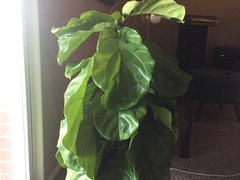 So I don't have any before photos, but I can say is that the leaves were perhaps a little more downward facing than some really healthy looking ones I've seen, but this is a drastic change in leaf-droop here.

krdress
Original Author9 years agolast modified: 9 years agoI did keep the roots wet the entire time- I made sure to dunk the roots frequently during the reporting.
I don't remember exactly what was in the soil mix, and I don't have the bags of soil that i used - I threw them away.
I mixed a bag of spahgnum peat with perlite and lime and also I think some slow release nitrogen? I mixed in a bag of pine bark chips that are fairly small. I ended up needing all of the dirt, so the ratio of bark to the peat and perlite is more like a 1:1:1 or 1:2:2 and I'm worried that might be my problem.
- 9 years ago
Unfortunately, yes, that's most likely your problem.
The pine bark only works when it makes up most of the mix. When you add to much peat, the bark really does nothing at all.
Thats why for this type of mix to really work, you need to follow the directions precisely.
Watering on the second day is only making things worse.
If I were you, I'd make a new mix. Using 5 parts pine bark fines, 1 part peat and 1 part perlite with some dolomite lime.
can you post a photo of your mix?
here is how it should look:

krdress
Original Author9 years agolast modified: 9 years agoI left my house, so I can't post a photo at this time. My soil definitely doesn't look like yours.
So im guessing that it would be fine to repot this shortly after? Normally that would be too much for a plant, but in this case it's just suffocating so anything is better than its current living condition?
It was hard hard to find the ingredients for the mix. Every nursery staff person I asked about pine bark looked at me like I was out of my mind. I did find a big bag of finer particle pine bark. Does it need to be a special kind or have a particular type of treatment? Fine mulch-type pine bark wouldn't work, right?krdress
Original Author9 years agoThe bag of bark that I did buy was not cheap. I believe the bag said it was for orchids.
- 9 years ago
A lot of people who can't find bark locally end up ordering repibark online.
i buy bark from Agway where I am located.
The bark needs to be a certain size. Anything too large should be sifted and any dust should also be sifted.
Nerseries usually aren't the place to find bark. Sometimes home improvement stores, sometimes Farm and garden type stores, etc.
the plant will be much better off moved into a correct mix rather than left in its current mix.
- 9 years ago
K - I'm not seeing a wilting issue that seems worthy of great concern. Let's back up for just long enough for you to confirm that you're sure you were able to wet/moisten the entire volume of soil. Often, bark and/or peat become hydrophobic (water repellent) when they dry down to somewhere near 15% moisture retention or less. When that occurs, the soil can be extremely reluctant to absorb water. I fix this by adding about 1/3 of the volume of soil I'll be using to a pail/tub, then adding enough water to completely saturate the soil. The next step is to stir it with a stick or hands until it's a muddy mess; then, I mix it thoroughly with the dry soil, do the repot, and water thoroughly immediately after it's complete. The moisture transfer into dry particles via diffusion eliminates any hydrophobic tendency in what would otherwise be a dry soil, and the soil readily absorbs water.
Al
- 9 years ago
Yes, before you do anything, give Al a little time. He would put you on the right path.
krdress
Original Author9 years agoHmm, ok Al. So is it a good idea to go ahead and buy more bark to make the correct ratio and pre-saturate the mix, then repot? Or just wait on it a day or two?
I really do think it got plenty saturated with both waterings. I could be wrong though.- 9 years ago
Kristen, don't be deterred when you get that funny look, but once you do find good bark buy a bunch of it, because although good bark in the right size seems to be common in some parts of the country, it's positively rare in other places.
If you don't have other plants to repot you'll do fine with fine reptibark or small orchid bark instead of buying big bags of pine mulch/soil conditioner. Just double check the size before you haul it all the way home. I keep a little measuring tape in the car just for that purpose.
5:1:1 mix is 5 parts bark, 1 part peat, and 1 part perlite. The bark had to be between dust and 3/8". Al says the bark fraction should be no more that 15-20% dust. I think he also says most of the particles should be between 1/8" and 1/2". One function of the perlite is to separate the usually-flat pieces of bark, so coarse perlite is recommended.
krdress
Original Author9 years agoSo good news- the leaves are almost totally perked back up to the level they were before repotting. I didn't do anything, just left it in its normal spot near the window.
- 9 years ago
That's a relief! It's hard to be patient when the patient just sits there and sulks.
Now all you have to do is monitor soil moisture daily to make sure your slightly-peaty mix dries out before watering, and wait until new growth appears to fertilize or consider doing more work on the plant (I can't remember what your intentions were...).
krdress
Original Author9 years agoI am not sure what I should do next. I'm inclined to leave it be and adjust the watering habits a bit. I just don't want to shock it anymore. Perhaps next June I can repot in the better mix? Or would it just be best to do that now?
- 9 years ago
There are ways and tricks to deal with soils that retain too much water.
Wicks can be installed to help draw out perched water. Tipping the pot 45° after watering will also help remove some excess water.
Personally, if it were my plant, I'd get it into a soil mix where I don't have to worry about overwatering and am able the flush at every watering.
Living in a constantly saturated soil that offers little air will be much harder on the plant than another repot.
ive repotted plants sometimes twice within a week for some reason or another. None showed any issues or complained.
- 9 years ago
This post and the discussions that follow it will help you understand more about what's going on and what you can do about it:
I also want to share that I love the small orchid bark that's sold by a nearby garden center. I can use it straight out of the bag for 5:1:1, and only lose a few cups worth if I sift it for gritty mix. It's expensive at six quarts for $4, but the right kind of pine or fir bark is harder to come by in this area than it is elsewhere in the country.
The good news is that I found someone yesterday who says the mini nuggets he's getting next week might be perfect for me...
- 6 years ago
I realize this post is old but if any of you see this I need help! I have basically the same questions that the OP had.
I’m buying the stuff for that mix that Dave suggests. And will repot shortly. I’m also wondering about whether I can separate the stalks? The plant I bought has three stalks and I’d like to take one out, if the roots are intertwined can I cut one free or will that kill it?
I’ll keep the roots wet while repotting then thouroughly water. With this type of mix could i put it into a self watering pot? - 6 years ago
Do you realize, unless it's an emergency, it's always a better strategy to plan ahead for your repot, so you're working in harmony with the plants' natural rhythms. Unless you live fairly near the equator, and you live in the northern hemisphere, repotting around Father's Day or the summer solstice (Jun 21) would be the best timing, from the plant's perspective. Most houseplants are at the low point for reserve energy in the waning months of winter, so early spring is not a good time to repot, though there some exceptions like citrus, money tree, and a few other woody plants. It's not necessarily the fact that repotting now jeopardizes your plants continued viability, more that it's just better for the plant to wait until it's added some energy reserves and is approaching the point in the growth cycle when the plant's ability to make food/energy (a plant makes its own food during photosynthesis) is peaking.
I’m also wondering about whether I can separate the stalks? You can, but an image of the plant will give a better idea re whether or not the roots are likely to be fused where they've come in contact with each other. In most cases, even that isn't much of a deterrent if you can leave each trunk with enough roots to ensure viability. The plant I bought has three stalks and I’d like to take one out, if the roots are intertwined can I cut one free or will that kill it? See comment immediately previous.
I’ll keep the roots wet while repotting then thoroughly water. With this type of mix could i put it into a self watering pot? In order for a self watering pot to work, the plant needs to be in a medium that is water-retentive enough to wick moisture to the upper level of the medium. In most cases, that would be a medium that holds enough water to limit your plant's vitality. You can offer your plants a much better opportunity to realize more of their potential by adopting a well-aerated medium that holds little or no perched water, monitoring moisture needs until you establish a 'feel' for the new medium, and watering appropriately (so you're flushing the soil when you water) from the top.
Al - 6 years ago
Thank you Al! Good tip, probably seems so elementary to you but I’m new to this. I will wait until Father’s Day to do the repotting. I had just picked this up from the store so I thought it was just what you do but I will leave it in the store container for now.
- 6 years ago
Ok... so it’s not going well! I didn’t reply yet but every day it gets worse. Leaves are just a falling like crazy🤷🏻♀️.what do I do?? I feel like it’s g I mf to die if I do nothing but I don’t know what I can do? I bought the plant less than a month ago so I’ve heard it can be the initial stress of being moved which can drop some leaves but this seems extreme.


- 6 years ago
By the looks of it, you’re way over watering, the roots are rotting and not able to pull up water.
How often and how much are you watering? How are you insuring its time to water?
Also, hopefully those blinds are open during daylight hours. - 6 years ago
Some things to consider:
* I don't know what USDA zone you're in, but your plant is right next to the radiator. As the radiator warms the room air, the relative humidity of the newly warmed air drops precipitously, so much so that the air becomes drier than the air in the Sahara Desert ...... and this holds true even if you have a humidifier in the room. So that's a problem.
* Your plant is in a cache pot. If you're not emptying the cache pot every time you water, your plant is sitting in the salt-laden effluent (waste water) that exits the drain hole. This is a problem on several fronts. It causes soil saturation that leads to drought stress; it causes an increase in dissolved solids (salts) that makes water uptake and movement throughout the plant difficult; it raises media pH; and it compounds the low relative humidity issue in the immediate vicinity of the radiator. At a minimum, your plant's pot should sit above any effluent collecting in the cache pot.

* Dave asked, "How often and how much are you watering? How are you insuring its time to water?" The question is so important it's worthy of repeating, so I'll ask that you answer, too; and, I suggest you read about using a "tell" to "tell" you when it's time to water. More on that below.* The symptoms aren't consistent with what minor stress might be associated with a move. Generally, leaf loss due to a new home is related only to the leaf loss that might occur as a result of diminished photo load (light intensity, or in some cases - duration of exposure), though a move during cold weather can be immediately damaging such that leaf loss might occur within 1-2 weeks. Low temps and especially sudden exposure to cold drafts often causes leaf loss within a week or two, but usually leaves are still green when they fall - unless they showed necrotic areas before exposure to chill.
This should be helpful (click link).Using a 'tell'
Over-watering saps vitality and is one of the most common plant assassins, so learning to avoid it is worth the small effort. Plants make and store their own energy source – photosynthate - (sugar/glucose). Functioning roots need energy to drive their metabolic processes, and in order to get it, they use oxygen to burn (oxidize) their food. From this, we can see that terrestrial plants need air (oxygen) in the soil to drive root function. Many off-the-shelf soils hold too much water and not enough air to support good root health, which is a prerequisite to a healthy plant. Watering in small sips leads to a build-up of dissolved solids (salts) in the soil, which limits a plant's ability to absorb water – so watering in sips simply moves us to the other horn of a dilemma. It creates another problem that requires resolution. Better, would be to simply adopt a soil that drains well enough to allow watering to beyond the saturation point, so we're flushing the soil of accumulating dissolved solids whenever we water; this, w/o the plant being forced to pay a tax in the form of reduced vitality, due to prolong periods of soil saturation. Sometimes, though, that's not a course we can immediately steer, which makes controlling how often we water a very important factor.
In many cases, we can judge whether or not a planting needs watering by hefting the pot. This is especially true if the pot is made from light material, like plastic, but doesn't work (as) well when the pot is made from heavier material, like clay, or when the size/weight of the pot precludes grabbing it with one hand to judge its weight and gauge the need for water.
Fingers stuck an inch or two into the soil work ok for shallow pots, but not for deep pots. Deep pots might have 3 or more inches of soil that feels totally dry, while the lower several inches of the soil is 100% saturated. Obviously, the lack of oxygen in the root zone situation can wreak havoc with root health and cause the loss of a very notable measure of your plant's potential. Inexpensive watering meters don't even measure moisture levels, they measure electrical conductivity. Clean the tip and insert it into a cup of distilled water and witness the fact it reads 'DRY'.
One of the most reliable methods of checking a planting's need for water is using a 'tell'. You can use a bamboo skewer in a pinch, but a wooden dowel rod of about 5/16” (75-85mm) would work better. They usually come 48” (120cm) long and can usually be cut in half and serve as a pair. Sharpen all 4 ends in a pencil sharpener and slightly blunt the tip so it's about the diameter of the head on a straight pin. Push the wooden tell deep into the soil. Don't worry, it won't harm the root system. If the plant is quite root-bound, you might need to try several places until you find one where you can push it all the way to the pot's bottom. Leave it a few seconds, then withdraw it and inspect the tip for moisture. For most plantings, withhold water until the tell comes out dry or nearly so. If you see signs of wilting, adjust the interval between waterings so drought stress isn't a recurring issue.
Al
- 6 years ago
Hi, ok thanks for all the info!
The blinds are open during the day. I have it there so that it gets the sun but then it has to be by the radiator. If it’s making the air very dry should I mist it or does that not work?
It’s still in the black plastic pot it came in from the store so there are drainage holes but it would be sitting in the waste water. I will fix that now.
I’ve not really had a schedule with the watering yet as I’ve only had it a couple weeks, I used my finger in the top couple inches and it seemed dry and I also used one of those little moisture meters but in your info I see that both of those could be unreliable. I’ve watered it twice probably 5-6 days apart and both times were about 16 oz. I will definitely get those wood dowels and start using them! I am always so unsure of watering times so I love that idea, I thought my moisture meter was going to help me but obviously not lol.
If the roots are rotting now should I pull it out and let it dry or risk the repotting now just to get it some air? Or just leave it and let it dry out for a while?
- 6 years ago
If you think the soil is saturated near the bottom of the pot, first flush the soil thoroughly by slowly pouring a volume of water equal to at least 10X the pot's volume through the soil to flush out excess salts. Then, lift the plant from the pot and set the soil mass on a stack of newspapers, paper bags, a towel, or something similar. Within an hour, all excess water will have been pulled from the soil. After an hour or so, return the plant to the pot and start monitoring the soil moisture level carefully until you get a better feel for what the proper watering interval should be. Keep in mind it can vary considerably with light levels, RH levels, and the season.
If the roots are badly rotted, you should consider it an emergency and repot into an appropriate medium ASAP. After bare-rooting, prune back all damaged roots to sound tissue and treat with an appropriate fungicide - before reestablishing the planting.
Al











tapla (mid-Michigan, USDA z5b-6a)