Software
Houzz Logo Print
bunnyemerald

Wattage question: "Equivalent" vs "Uses"

9 years ago
last modified: 9 years ago

Cross-posted from Electrical Wiring forum:

I have three new outdoor lights with specs that they take up to a 60w maximum bulb. I have 60w equivalent (uses 43w) in there now and it seems a little dim. I have 75w equivalent bulbs (uses 53w). Could I use them, since technically it's not greater than 60w? I won't use them if it's a bad idea, but curious about the numbers.

Comments (7)

  • 9 years ago

    Yeah, the fixture rating is about maximum allowable power draw, so "uses" is the right number to look at.

    "Equivalent" numbers are only put on packaging because we aren't used to thinking about light output in lumens (the proper metric for light output). When incandescents were all you could get, there was a pretty consistent correspondence between lumens and watts, so pretty much everybody used watts as if they measured light output. Compact fluorescents and now LEDs have thrown a monkey wrench in that, and the industry adapted by including watt-equivalent info, to map lumen output of new lamps back to the old technology we were used to.

    If you want to adapt to lumens, an old-school 60 W incandescent produced about 800 lumens. 40W produced 450 lumens, and a 75 W produces 1100 or so.

    Bunny thanked cawaps
  • 9 years ago
    last modified: 9 years ago

    lazy and cawaps, thank you very much. This bulb thing is really something. I think I've worn a groove between my house and Home Depot as I buy lightbulbs and return them the next day. Say what you will about HD, returns are easy.

    I really like soft warm light, 2700-ishK, in my house. I just had two barn lights installed on the front of my gray and white garage. The lights are black with white enamel interior. The soft white lights seemed too yellow, so I thought I'd try a daylight 5000K bulb instead. Horrible blue, cold, like a prison exercise yard or a meth lab security lights. There doesn't seem to be anything in between. When people paint or get tile or a counter and it doesn't seem like the right color, often the suggestion is, change your lightbulbs. I can't imagine that would work for everyone.

    Another question, about lightbulb bases. I tried to switch out a Philips 60w LED with an EcoSmart 75w incandescent. The EcoSmart would not turn on. Back and forth, testing, testing. Always the same results. I looked at the bottoms of the two bulbs and there's a difference.

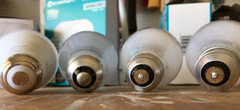
    The following bulbs are all labeled as A19.

    Left to right:
    1. Philips 100w LED (non-dimmable)
    2. EcoSmart 100w Incandescent (dimmable)
    3. EcoSmart 100w Incandescent (dimmable)
    4. EcoSmart 60w Incandescent (dimmable)

    Note the bottoms. 1 and 2 are solid; 3 and 4 have little nipples. The 2 and 3 are both EcoSmart 100w Incandescent, but 2 is in newer packaging.

    The light that wouldn't work in my fixture is not pictured here but it has the nippled bottom.

    Does anyone know what's going on here? Why would they all be labeled as A19 but have different bottoms. Why would one particular fixture know the difference? I should check the specs on that.

    ETA: Checked the specs. Says bulb type A15. Might that explain it? However, the Philips 60w LED bulb I have in there now says A19.

  • 9 years ago

    "A" refers to the lamp shape, not anything to do with the base. An A lamp is your typical light bulb shape. The number after the A is the diameter in eights of an inch. A19 lamps are 19/8 or 2 3/8 inches in diameter; A15 lamps are 15/8 or 1 7/8 inches in diameter. Fluorescent tubes are "T" lamps, and they also give their size in eights of an inch. An old-school T12 is 1.5 inches (12/8), while the more efficient T8s are 1 inch in diameter, and skinny T5s are 5/8 inch.

    There are a bunch of different types of lamp bases, but what you are looking for is an E26 base, or medium screw base. E indicates an "Edison" base, which most household lamps have. The number after the E is the diameter in millimeters (bases apparently are metric, while bulbs use English units of measure). A candelabra lamp also usually has an E base, but a smaller diameter E12. There are also E17 and E39 lamps out there, but you aren't likely to run into those.

    More than you ever wanted to know on lamp bases

    I don't think any of this actually helps you, because the Philips lamp you show I think is an E26 medium screw base (check the packaging). I don't know why it doesn't work in your fixture, though I suspect it is a quirk of your fixture design that the lamp base isn't making contact--I can't imagine that Philips would deliberately make a lamp that didn't work in most household sockets. Did you try the lamp in any other sockets to see if there was a problem? It's remotely possible that the lamp is simply defective (unfortunately a more likely possibility with the electronics in an LED than with a simple incandescent). If the lamp works elsewhere, I would try a different brand.

    Bunny thanked cawaps
  • 9 years ago
    last modified: 9 years ago

    cawaps, thanks. I think I included too many items in my last post. :)

    The bulb that *is* working is a Philips LED 60w E26 A19. It has the same flat bottom as #1 in my photo. It works in the fixture. The bulb that didn't work is an EcoSmart 75w E26 A19 incandescent with a nippled bottom, similar to #3 and #4. Those bulbs work in every fixture in my house.

    It's entirely possible that it's one bulb that's acting up. It is interesting to me that the fixture says it takes A15, but the bulb that's working is A19.

    Bulb technology seems to be a moving target.

  • 9 years ago

    I don't think the diameter of the lamp itself (the A number) has any impact on whether it works or not, only about whether it physically fits inside a shade and has enough clearance. The base E size is what should determine whether it is the right size to screw into the socket and make the proper electrical connection.

    Lamp technology is definitely changing rapidly, and there are way more options to understand with LED than there were with incandescents (where you had brightness and a choice of white or soft white). But the standards for lamp screw bases are one part of it that haven't changed, which makes your problem all the more puzzling.

    Bunny thanked cawaps
  • 9 years ago

    I'll try some different bulbs. It's working just fine with the Philips 60w LED A19. I thought I'd try using 75w for more brightness but I don't need it that much.

Sponsored
Wannemacher Interiors
Average rating: 5 out of 5 stars26 Reviews
Customized Award-Winning Interior Design Solutions in Franklin Cnty OH