Software
Houzz Logo Print
geo_wil

Wilting Philodendron after Repot

9 years ago
last modified: 9 years ago

Hello, I am having issues with my philodendron. After repotting it last week it has started to wilt and some leaves have been turning yellow. A few leaves closest to the stems at soil level even browned up and shrived completely (just three so far).

Some information and images. This plant is at least 22 years old and had been in the same pot for that time. I decided to repot it as the pot and saucer had deteriorated to the point that it was starting to fall apart and water was leaking through the bottom of the saucer and causing mold build up on the surface underneath it even with light watering.

It was a very leggy plant, it had one vine close to 25 feet long with no leaves on it, probably due to being kept for 8 years in areas where there was not much light. I cut it back to three feet and used most of the rest for rooting. I had noticed that over the last two weeks it had started to look wrong. Some of the vines had started to turn yellow and one section of the plant has started to severely wilt.

After I removed the root ball from the old pot using the upside down method I noticed that once I washed off the soil that there were several of the longer roots that had rotted about halfway up and one had some mold growing on it near the top of the root. I removed the damaged sections of the roots and removed the one with the mold a few cm above where the mold was growing. The other thing I noticed was that the other roots were very stunted, but healthy looking, none of the undamaged roots were longer than 4 inches; it was not root bound at all.

I put the plant aside in some water while I cleaned up the old pot and finished preparing the new one; that took about 45 minutes. For the potting soil in the old pot, I have no idea. For the new one I bought some Espoma PTM8 peat moss, Black Gold potting soil, and Miracle-gro perlite and mixed it myself (8 qrts of each).

One thing I did not do but should probably have was to pre-water the soil until it drained from the bottom of the pot. I repotted it directly into the new soil without doing that and then I watered it with the amount of water I usually used in the old pot when I should have probably watered a lot more.

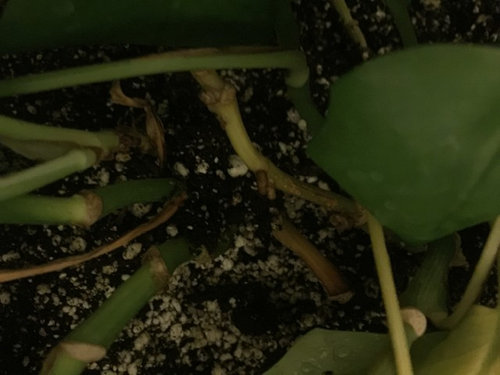
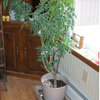
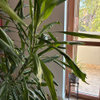
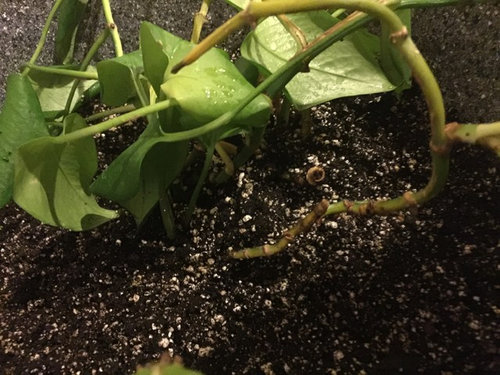
Here are the images now. The first is the area I have the plant in. I think it is about right for a philodendron; there are two windows in this corner which will have bright, indirect, light coming through them during different points in the day and moderate light the rest of the time and then the rest are of the plant. I tried to get as close in on the soil-level stems as possible.

On this one, near the middle left there was a very long vine (8 feet or so) which I made a cutting from as a back up to root in water in case the plant dies. The root has started to, callous I guess is the word I am looking for? It has started to shrink to a hardened black stem kind of think near the end where the cut was made.

In this one I am wondering if I buried the middle slight left plant too deeply.

for what I have done so far:

I have been misting it each night. I read in another post here somewhere that adding a small amount of sugar to the water you give a plant after repotting can help it deal with transplant shock. I did this on the first day I watered it but have not since. After the first watering I noticed that within 3 days the soil was bone dry about three inches deep but I did not water that much as I mentioned above.

Tonight I did water it fully until it started draining through the bottom, the soil was slightly damp down to two inches and a little more moist below that.

I personally think this could be one of two things:

1. normal after-repotting transplant shock

2. result from not watering it enough directly after repotting

or maybe the first exacerbated by the second but this is the first time I have repotted anything so that is why I have come to seek advice from people that know a lot more about this subject that me.

Thanks!

Comments (10)

  • 9 years ago
    last modified: 9 years ago

    Gudang, thanks for the information. I decided I would take some more drastic measures and one by one I uprooted each plant and checked the root system again. I found I had missed quite a few rotten roots which I then removed but I also found on each plant that at least one or two new roots were already growing out. Some were as long as 3 inches.

    The ones that had new roots shorter than two inches and which I had to cut off all the other roots due to rot I removed from the soil and placed in water where I will keep them for a while until the new roots are at least 1 inch long before moving them into a start pot; hoping to stimulate other nodes to root to start these out strong in the new pot but trying to get them to properly grow out roots in smaller pots first.

    I also did some more trimming, removed the lower leaves from most of the plants and cut them all back to no more than 2 feet and placed the cuttings into water. I then moved the plants around the pot so they were not all bunched up and correct the depth for each plant. Some were not buried deep enough while others were buried too deep. Thinking about bagging each plant still in the pot for moisture retention.

    The plant is looking better as of tonight though. Still looks wilted but the leaves are starting to return to their normal shapes and color. I think this soil I mixed also has a high level of drainage as the soil is back to an almost dry enough to water again state even after pouring almost 54 ounces of water into the pot yesterday. I am going to start watering it every three days instead of six and see if it improves more.

  • 9 years ago

    How are you getting on now? I don't think prewatering your mix would have been vital, especially given that you didn't use bark (which does take a while to properly wet) and that the peat was only 1/3 of it. Maybe you could have watered it in more thoroughly after repotting, but I'd be careful not to give it too much now, as it won't be using much until it reestablishes, and leaving it in wet soil will just make it rot further. Better to water as needed rather than on a set interval. Maybe for the first couple weeks, as the soil starts to dry, imagine where the roots are and try to target that area eg. with a squirt bottle. Go back to more thorough watering when it recovers.

  • 9 years ago
    last modified: 9 years ago

    Sorry, but I don't think this is a Philodendron rather a Pothos. Bit too raggedly looking to be sure. But I think both can be handled & propagated the same way.

    I believe this has been made unnecessarily complicated & in short, you're killing the plant w/ kindness & overwatering (overwatering is THE most common killer of houseplants).

    Pothos are usually restarted from cuttings, often discarding the original plant if rather spent & beat up like yours (sorry). After 22 yrs. in the same pot, I wouldn't bother keeping the base part of the plant, especially w/ roots rotting repeatedly, as you've mentioned.

    Likely why that's happening is that pot is too big for the amount of plant material left. I suspect what's happening is this: too much soil for too little plant material being kept too wet all the time. That equals root rot, because the roots can't get any air, they're too wet, so they rot. This plant needs to dry out somewhat btwn waterings so the roots can get some air.

    I would have gone w/ Cactus & Succulent soil (C&S mix) combined w/ Perlite, in equal parts, like 50/50. That's all you needed; peat is not a good idea for houseplants, unless a small amount (it can become too compact & then water repellent which makes drainage problems).

    I am unfamiliar w/ pre-wetting soil, not something I do.

    Also normally, one should fill a pot w/ soil up to just an inch from the top. As is, those plants are potted too low in the pot, but I wouldn't bother doing anything else w/ those remnants. Don't mean to be brutal, but I'd discard those rotting leftovers & focus on the cuttings, of which you probably have many. Shorter is better should you not know that. 2-3 pairs of leaves per cutting is plenty.

    Pls. stop misting, it's not helping & is keeping the plants too wet.

    "I tried to get as close in on the soil-level stems as possible." Sorry, I don't know what this means.

    For now, I'd skip fertilizer, sugar, any extra doodads & just let the poor things get re-established.

    I see you've tried really hard to improve the plants, but now, I'd like you to consider keeping it simpler along the lines of 'less is more'. These plants do well w/ a fair amount of neglect even tho' that doesn't sound right.

    Good to see you know to pot up the water rooting cuttings after they get roots about 1" long . Lots of cuttings in small pots is a good idea. As example, a 3" pot could take 3 or 4 cuttings.

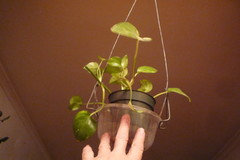
    Let me look for a pic of mine. This is a 4" pot.

    This plant gets watered maybe every 7-10 days, depending when I notice & remember ;>)

    The container that pot sits in has pebbles in the bottom, so I water to overflow into the pebbles ON TOP of which, sits that pot. It matters that the bottom of the pot is not in the water, rather just above it. That set up is referred to as a humidity tray. Some plants really appreciate it!

  • 9 years ago

    Karen, when propagating these types of plants, do you root them in water first or straight into soil? I know both ways are done, I'm wondering if it's personal preference or if there are other reasons. And do you use rooting hormone? I have a heart leaf philodendron that I'd like to grow cuttings from in the future.

  • 9 years ago
    last modified: 9 years ago
    Hi Robin,

    To me it's personal preference, Pothos in particular water root so easily that I prefer it, They seem very strong & I don't have trouble w/ them making the transition to mix. I know folks say water & soil roots are different, but for ME for these plants (& many Hoyas which I also grow, these plants do well).

    The Pothos above was started from small cuttings water rooted in my bathroom which gets some nice light. I always have couple of cuttings goings in there from which I restarted this & moved it into the kitchen.

    I don't use rooting hormone, not necessary for these guys.

  • 9 years ago

    Thank you!

  • 7 years ago

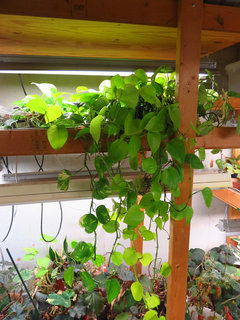
    I never had any luck with philodendrions but I know this much that if your letting it dry out you better get some fungus spray quick any way once that root ball becomes mussy and that sap starts to smell and the stems start to split open you just might as well give up and buy another plant or you hands will be irritated for days from the plants irritating sap gnats to that is if you do not get he plant out you house now and make sure to wear gloves them type of plants are not low light at all most people get the wrong conception ane knowledge of this plant and end of falling here is a picture of the one I now have for an year yes by

    coincidence it live

  • 7 years ago

    The pot is way too big for the plants shown. I haven't read all the comments since they are fairly long. Start the cuttings in straight perlite works well too.


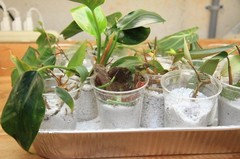
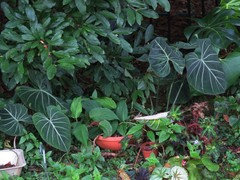
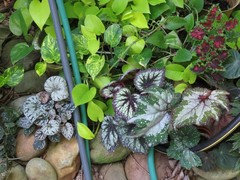
    Here is some of my philodendron/pothos/syngonium starts in clear drinking cups (cheap) and perlite.


  • 7 years ago

    Wow! Nice plants. I want a begonia for my home. :-/. The leaves are awesome. Back to the subject. I agree that water rooting is easy for me too in the bathroom on the windowsill. Lol. I have never tried perlite but want to try that one day too. I think the OP is using a pot that too large and we water when our plants need water not on a day schedule. You have to be careful overwatering. Good luck.

Sponsored
NME Builders LLC
Average rating: 5 out of 5 stars2 Reviews
Remodeling Company in New Albany, Ohio