Software
Houzz Logo Print
andre_papantonio

preventing pipes from freezing

9 years ago

We are more and more gone on vacations from our house in the winter and have no near neighbors to look after the house in case of a power outage in a snowstorm.Generators are too expensive. What do other people from the north do when they leave for extended periods to keep their pipes from freezing when the power goes out?
Thanks

Comments (16)

  • 9 years ago

    Well, I'll tell you what doesn't work - the old wives tail of leaving a faucet dripping while you're away. The linear velocity of water through the pipe is nowhere near enough to stop freezing.

  • PRO
    9 years ago
    last modified: 9 years ago

    Winterize the home before you leave each time.

    Shut off the water at the main shut off, then drain your plumbing supply lines by turning on faucets / flushing toilets before you leave each time.

    The idea is to remove standing water pressure in each supply line and 'if' pipes do freeze there is enough room for expansion so as to not damage the pipe.

  • 9 years ago

    In addition to draining, I put RV antifreeze (non toxic) in the toilet and all traps.

    Due to freezing, I do not have a fridge with a water supply.

  • PRO
    9 years ago

    People from the deep south likely should likely refrain from giving advise on winterizing residential piping.

    FYI, While I live in Katy, Texas now... I was born in Wisconsin.

    I've lived in Colorado, Wisconsin, Illinois, Oklahoma, Kansas, Missouri and now Texas.

    When water freezes it behaves the same way no matter which part of the country you live in.

  • 9 years ago
    last modified: 9 years ago

    Your assertions defy the laws of thermodynamics (and we get freezing weather all the time here in North Carolina and Virginia).

    To the OP, I would follow AAC's advice, not saltidawg's.

  • PRO
    9 years ago

    Saltidawg,

    you're taking my quote about HVAC experience from another thread and using it completely 'out of context' for which it was intended.

    There are many ways in which a pipe that carries water can form a leak, freezing and cracking is only one such way.

    A pipe can not crack by freezing if there is room for expansion within the pipe. When ice forms and expands it will always take the path of least resistance. (like air flow, electricity just as much as flowing water.)

  • 9 years ago

    Imagine a U-shaped pipe, with water filling the bowl at the bottom, and extending partway up the legs. The water in the legs freezes first, because it's colder there (due to less insulation, or cold air movement, or whatever). When the water in the bowl gets around to freezing, what is the path of least resistance for it? Moving the ice plug in the legs, or breaking the pipe?

  • 9 years ago
    last modified: 9 years ago

    Turn off main supply. Flush toilet, no water in tank, RV antifreeze in all traps and toilet bowl (water must be kept in traps to stop sewer gases). Install a drain at the lowest point of both hot and cold lines and drain pipes of water. Drain water heater, possible to drain hot water lines withe water heater drain if that is the lowest item.

    Lots of work but the only true way.

  • PRO
    9 years ago

    Adding Anti freeze is over kill.

    If you put a bowl of water (no top on it) in the freezer will the bowl crack due to ice formation?

    Does it matter if the bowl is made from metal, plastic or china? No.

    If you put a sealed can of coke in the freezer and allow it to freeze what will happen?

    It all depends on how full the can is. I would suspect the can would at very least bulge outward once allowed to fully freeze.

    Take on the science experiment and prove it to yourself.

  • 9 years ago
    last modified: 9 years ago

    AAC, you are wrong on this topic, I would recommend discontinuing.

    Frozen water is able to rip apart concrete, let alone toilet bowels and traps.

  • 9 years ago

    In some ways, frozen pipes are a bigger problem in the
    Southern US, where only occasional freezes happen, than in the North. One time after a cold snap and everyone in
    town had faucets running all night and half the day or had busted pipes, an
    associate of mine said, “You Yankees must have pipes freeze all the time”. I
    told her that up there they don’t put pipes where they freeze so easily. There are open crawl spaces all over the
    place with plumbing in the open. There
    are often pipes in attics over the insulation, especially in slab-built houses.
    Pipes are run through exterior walls.
    They freeze. They flood houses. They cause many expensive plumber calls.

    Running water freezes less readily than standing water in
    pipes for more than one reason. Yes, the
    water entering the pipes is warmer than what it will be sitting in the
    pipes. Yes, running water is less able
    to form crystals than standing water.
    Effectiveness of leaving faucets cracked open depends on a lot of
    variables, air temp, ground temp that determines water temp, and the velocity
    of the water. Blanket statements of
    leaving a faucet open will or will not keep your pipes from freezing are both
    too broad. It can be a good solution for
    a temporary situation, but not a good one for a vacation or seasonal
    vacancy. If toilet is supplied with vulnerable pipe, tie
    a string to the lever, toss the other end into the tank and flush so it holds
    the valve open enough to make flow.

    This is all based on simple logic and knowledge of the basic
    properties of water in solid and liquid forms.
    If you know that your plumbing is vulnerable, turn off the water if you can’t
    do anything else. At least, if the
    shut-off is effective, and many of them leak, you won’t find a flooded building
    on your return. Make doubly sure the faucet closest to the shut off is open
    when opening all the valves so the other pipes have less chance of
    refilling. If you can do a halfway
    decent job of draining the lines, and the shut-off is effective, you stand a
    better chance of less damage because you give the residual water room to
    expand. To get all the water out, you must drain all the local low points not
    just one low point. If you can’t, you
    might still get split pipes, but the probability is lower. The more water you
    can remove, yes with compressed air for instance, the better off you are.
    Sometimes you can get RV antifreeze (non toxic) into the pipes. Yes, you should
    put it in toilet bowls and traps.
    Vessels with straight sides and bottom are more likely to crack with
    contained freezing water than those with sloped sides (V-shaped or round), but
    freezing water can still crack the less vulnerable ones. Remember that in
    toilets, the trap is not exactly bowl-shaped.
    That tank is still a problem if the water shut-off is not totally
    effective and the tank refills.

    For a regularly-idle property the best way is to make sure
    the pipes can all be passively drained, the shut off works, a faucet specially
    placed at or near the service entrance is open and drains to a freeze-proof
    drain (in the basement). The fact is,
    with a poorly-designed plumbing system it is going to cost you to make it
    freeze-proof. The more security you want, the more it will cost and it is an
    exponential relationship. If you can buy a house that is that way right out of
    the gate and you like to leave it in freezing weather, you’ve been blessed.

  • PRO
    9 years ago
    last modified: 9 years ago

    LOL, I can't believe this topic of discussion.

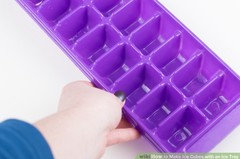
    For years I've used a plastic ice cube maker... it has never once cracked or ruptured over probably more than a couple hundred freezes and twists to remove the cubes.

    How am I this fortunate? LOL.

    It's a miracle of modern science.


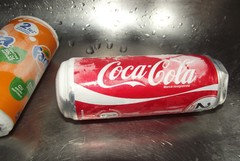
    I even provide you a picture... in a world filled with automatic ice makers.


    Notice the frozen soda cans. No rupture... path of least resistance. The ice doesn't push out in 'all' directions. Say what?

  • 9 years ago

    If we are concerned with pipes and other plumbing fixtures, these items are not very good approximations of them. Placing any chosen experimental model in a household freezer is not a very good way to model freezing of the plumbing materials, the rate of cooling is way too high to generalize.

    A better approach might be to use real copper and plastic pipie, including relevant joining methods and materials. A common chest freezer would work well to approach real freezing conditions, but it would probably be improved by installation that of an easily-controlled, remote-bulb or electronic thermostat. A t-stat that can be programmed to different cooling rates would allow higher productivity while eliminating a lot of tedium.

    While an environmental chamber (higher precision and built-in recording capability) or several of them (parallel testing of conditions to increase throughput) good results are possible with homebrew equipment. Why bother at all if these experiments have been done unless you think you can do them better or for educational purpose.

    With respect to the flowing water dribbling faucet question, I'd be satisfied with computer modeling since the physical principles are very well understood.

  • 9 years ago

    Austin, I once saw the door blown open on a minifridge resulting from a freezing drink can (not mine). There was no real physical damage, only a big mess. How does that affect your conclusions with respect to pipe freezing?

  • 9 years ago
    last modified: 9 years ago

    Pop can expanding is a pliable aluminum. The metal itself can stretch. Rigid metal pipe and rigid plastic do not have room for expansion and will crack. Rigid porcelain will also break. It is that simple. Plastic ice cube tray is not the same as a trap or a toilet. The plastic used in an ice cube tray is thin and has some give to it. This allows you to twist it and loosen the cubes as well. If it was thicker and did not have any pliability it would also crack. Try to bend PVC or a piece of glass and see if you succeed.

    Also, there are times when even the pop can explodes and there is a huge mess. Everyone knows you shouldnt put a pop can in the freezer. People do it thinking they will get it cold faster then forget it and bang you got yourself a mess. Sometimes you get lucky.

    Also, for draining back to the shut off, they make shut off valves w/ drain so you just open that drain to get the rest of it out. Also useful if you need to drain the water out to do some soldering.