

Planning the 2018 Garden
I always like to plan next year's garden while this year's garden is fresh on my mind. I may not plan it down to actual varieties this early, but I do like to formulate a general plan.
So, here's a touch of what I'm thinking:
In order to can and freeze less, I need to grow:
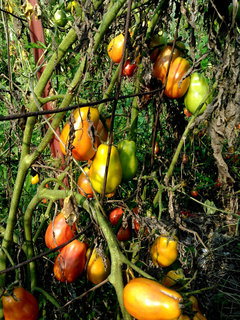
Fewer tomatoes---and I mean a lot fewer. I'm thinking 20 plants max.
Fewer potatoes---I'm going to cut back from three raised beds to one. That will leave me space for more carrots, beets, etc. and I'll even have room to plant the sweet potatoes in one of the hardware-lined raised beds that excludes voles. This year's sweet potatoes are in a regular bed and I'm just hoping the voles don't find them.
Fewer onions---there's so many onions in the freezer that I could skip growing onions altogether next year if I could be content with having only frozen onions, but I can't. So, I'm cutting last year's 5 bundles of onions down to 1 or 2.
Less summer squash. Much less. This year we had the second straight year with no SVBs. That shouldn't be a problem, right? But, if you plant a ton of squash plants, including succession plantings, expecting the SVBs eventually will get it all, and then they get none of it....that leaves you with too much squash. So, I'll use less space for summer squash next year and more space for winter squash.
In other areas:
I'll plant corn earlier next year. I was late with it this year and had more corn earworms, so next year I'll go back to planting it early to try to beat the earworms.
I might plant less broccoli, cauliflower and brussels sprouts. No one really likes the cauliflower and brussels sprouts except me, and it really doesn't take too many broccoli plants to fill up a freezer. I did get the cabbage plantings right this year---enough for fresh eating and yet not so much that I had to make sauerkraut, so I'll plant the same amount next year. I need to plant more collard greens and other greens. More kale.
I planted cucumbers kinda late and didn't like having the pickle-making start so late, so will return to my normal planting time next year.
We had enough melons although they were at the downhill side of the garden, which is a problem in wet weather. I think I'll move them uphill to the area where I usually grow tomatoes. The tomatoes have to go to the back garden next year or to containers in order to rotate them out of soil that I think has had tomatoes grown in it for far too long without proper rotation.
I need to downsize the pepper crop. I grew too many this year---not too many jalapenos, but too many poblanos and bells for sure. Next year I'll focus more on jalapenos and less on all the other kinds.
The kale didn't do as well in the ground as it does in containers, so I think I may return to growing it in containers next year.
More herbs....lots more for the swallowtails. No matter how much dill, fennel and parsley I plant for them, they devour it all, so I need to plant more and probably will add rue and other carrot family plants just for them too.
More flowers---I have a huge collection of flower seeds, so this will be easy to do. We have seven 4' x 10' beds along the eastern edge of the garden, right beside the eastern fence line. I am going to plant flowers there. Either I leave the seven raised beds as is and plant each bed separately sort of like a cutting garden, or we could rearrange the wood edging to make one gigantic bed that I could plant more like a flower border. I haven't decided yet which one to do, but the idea of a gigantic flower border is appealing....and would be a permanent commitment to grow flowers there instead of someday losing my mind and filling up that space with veggies again. If we turn it into one big flower bed, I could plant perennials in there too, and not just annuals or biennials.
Asparagus---the asparagus bed vexes me. It is the best soil in the garden and it grows a huge bumper crop. I have to harvest it daily in season and we get tons more than we can eat fresh, so I have to freeze it. I should just shut up and appreciate it, right? Instead, I look at that soil and wish I had it available year-round to grow something else. I'm the only one who really loves asparagus, though Tim will eat it sometimes. I am toying with the idea of taking out the asparagus one of these years and using that great soil for other things we like more. I probably won't do it this coming year, but it is a thought I've had in mind for several years and it probably will happen one of these years. It is too impossible thick underground to move, so I'd have to cut it down to the ground repeatedly and starve it to death and that might take years.
Crinum lilies---mine have been in place around 15 years and are huge monster clumps. I've never divided them. I want to dig and divide them and spread them around. I'll love to have massive clumps of crinum lilies all along the garden's northern and eastern fencelines. Digging them out likely will require a lot of help from Tim.....or the use of a backhoe (just kidding about the backhoe---it would tear up my garden fence).
The fence---we replaced the southern garden fence when someone drove a car into it in May and destroyed it. We never found out who it was, but we keep our driveway gate locked 24/7 now so that it won't happen again. We need to do the same with the rest of the fence just because the old fence looks so bad compared to the new section, and it is old garden fencing that would need to be replaced just because of age, not only ugliness. In order to replace the fence on the north side, we need to cut back the encroaching woodland....so any trees that fall the wrong way can destroy the old fence before we put up the new one. That's a winter project after it has gotten cold enough for the snakes to not be a problem.
That's a loose description of my current plans for the 2018 front garden. I don't really have a plan for the back garden yet except I do think that's where we'll have our tomatoes.
How about y'all? What will you do the same? What will you do differently?
Comments (20)
 9 years agolast modified: 9 years ago
Dawn - I just started making my plans for my 2018 spring garden.
I am going the opposite direction on Asparagus. I just put in 2 more beds of purple asparagus crowns in 2016. 25 Purple Passion and 25 Pacific Purple and next year will be the first year that I can harvest from them. All total I now have about 85 crowns in 4 raised beds. We really like dilly asparagus so I plan to do at least a dozen pint and a half jars of that and will freeze any remaining that we don't eat fresh. Do you pickle any of yours? I just use the Mrs. Wages Kosher Dill mix.
I am going to cut down a little on garlic from about 220 plants of 10 varieties to about 160 plants of 6 varieties. The 4 varieties I am going to cull haven't done very well in the 3 or 4 years I have grown them compared to the other 6 so they are history.
I'll plant about the same amount of tomatoes (7), peppers (14), broccoli and cauliflower (~20). I usually grow most of my broccoli and cauliflower to freeze in the fall. I'll plant one bed of bush beans in the spring and one for the fall like this year. Not sure if I will plant any pole beans or not. Probably will since they are a good trap crop to sacrifice to the Japanese Beetles and keep them off other stuff and despite the severe damage the JB do to the leaves they are still producing OK this year.
Potatoes will get 3 beds totaling 100 sq. ft. I'll stick lettuce and leeks in on the edges of the pepper and tomato beds. I'll plant around 120 onions (probably just Candy, Red Candy, and Copra) and some bunching onions. Carrots will wait for the fall garden and replace one of the potato beds.
Just like this year I will plant a couple yellow summer squash in late April and then plant some winter squash in open beds after the potatoes and broccoli are done. I'll plant some zucchini somewhere in July to get harvested after the yellow squash is about done.
Pickling cukes will get 2 4' long trellises and about 12 plants which based on this years production should yield about 150 lbs. Sweet Success and Straight Eight will share one 4' trellis.
This fall I am tearing out 3 poorly producing raised beds that don't get enough sun, have tree root issues, and the frames are starting to rot and adding 3 or 4 beds in my main garden area that gets full sun. I should have enough soil from the old beds to fill the new beds but will have to wheel barrow it about 100 yards between locations.
- 9 years ago
Dawn, I almost fell out of the chair when I read 20 tomato plants. That was an error, right? lol I don't see that happening, so maybe you just got too much sun or something ;)
I always look forward to your plans, because you are a great planner, and I get to steal some of your ideas!
LoneJack, it sounds like your garden is as big and bountiful as Dawn's. I'm impressed.
Related Professionals
Gloucester Landscape Architects & Landscape Designers · Akron Landscape Architects & Landscape Designers · Logan Landscape Architects & Landscape Designers · Gainesville Landscape Contractors · Rock Hill Landscape Contractors · Corpus Christi Landscape Contractors · Lynchburg Landscape Contractors · Barnstable Landscape Contractors · Bend Landscape Contractors · Amherstburg Landscape Contractors · Birmingham Accessory Dwelling Units · Montgomery Accessory Dwelling Units · Lafayette Accessory Dwelling Units · New Orleans Accessory Dwelling Units · Asheville Accessory Dwelling Units- 9 years agolast modified: 9 years ago
Oh no Mary, I believe my garden might be 1/4 the size of Dawns at most, but I squeeze quite a bit into it! I have a little under 700 sq. ft. of raised beds.
 9 years ago
I giggled when Dawn said 20 tomatoes, too. I understand it, but am betting that gets expanded just a little.
I am thinking my cukes need to be spread out next year. Maybe sharing trellises with something else so it's not a mass of cucumbers to share diseases. At the very least I have to force myself to plant them further apart. And at least one early one for DH.
I have already ordered my garlic from SESE. No hardnecks. I have bulbils from the hardnecks I may plant, mostly so I have small plants I can move around the garden as companion plants.
I might plant fewer tomatoes next year. Depends on how we feel about the canned tomato sauce. Winners from this year are: Cherokee Carbon (F1), Grandma Suzy's Beefsteak, Gary 'O Senna, Arkansas Traveler (always), and Cherokee Champion (F1), which was used and abused this year and needs a trial in a bed. Early girl has performed well as usual. Jetstar is another hybrid that has done well for me. Defiant was ok. Carbon, while tasty, has not produced well 2 years running. JD's Special CTex also didn't produce well. Since they were next to each other, maybe it's the soil or the location. If I decide to can next year, there will be Heidi plants. Fewer cherry tomatoes. Fewer container tomatoes. I have not been impressed with dwarfs in fabric pots. Of course, I've not been impressed with container grown tomatoes in general. I probably don't feed them enough.
I got Blight Buster (F1) bell pepper seeds as a freebie from some place and they have produced great. Nice thick walls. Figitelli Sicilia, Sweet Pepper is a keeper, too. I've got about the right number of peppers this year.
I've been pleased my spring carrots have kept well. I will plant more for fall. I'm considering planting some root crops in plastic tubs. Early spring, late fall shouldn't be so hard on container plants as the heat of the summer.
I am solarizing a new flower bed. I wanted 2 but it didn't happen.
Need a green house ASAP.
Room for one more bed I think, which will be for cover/mulch producing crop.
Have to go, I have more thoughts, just rambling here.
- 9 years agolast modified: 9 years ago
LoneJack, that is still a good sized garden to me! Considering you aren't having to count the wasted space of rows, which would probably triple or better your 700 sq. ft. My garden, in total, rows and all, are about 700 sq. feet, give or take. I don't have raised beds, so part of mine is just wasted. I do have a permanent trellis on on the north end, so that I can expand upwards with pole beans and cucumbers, although I didn't do pole beans this year.
Amy, how many tomato plants did you grow? I'll be so jealous of your greenhouse! I would love to have one, but I can't justify the expense. I wish I could go to raised beds, and have some of that gem dirt (or something similar) hauled in, but again, I just can't really justify the expense. It's just me, and the only child close by works too much to worry about what produce I have. She did take the last of the zucchini, an armenian cucumber, and the last of my cream peas yesterday (I shelled everything for her so she wouldn't have to bother with it). Oh, and two jars of refrigerator pickles.
Y'all know the old saying, "her eyes are bigger than her belly"? Well, my dreams are bigger than my need. So, there I go. :)
- 9 years ago
Well, Mary, I said I wasn't going to grow as many this year, ahem. I grew in 3 beds. Was supposed to be 5 to a bed, but I squeezed in some extras, LOL. I had 18 varieties in the beds, but I had 3 Heidi plants. So 6 more than planned.
I grew 11 dwarf or determinate varieties in fabric pots and 7 cherries in big pots (15/20 gal?) In the end, I guess there were 30 varieties.
You should look up lasagna gardens. You don't have to have dirt brought in. Heaven knows I did, and its taken 3 years for me to feel like it's decent dirt. The last 2 beds we built were done lasagna style. Not even GOOD lasagna style, LOL, because we didn't know what we were doing. They are my best beds. They've settled and DH wants to add dirt, but they are producing so well I hate to mess with them.
I wanted to try ALL the tomatoes when I started. That obsession has cooled some. I also want to grow ALL the kale. I don't know why, it's kind of a flower in the veggie garden I guess. And ALL the lettuce. Ummm, all the cowpeas. Well you can see, I am not one to grow just one variety of anything! It has nothing to do with eating it. It has to do with growing new things.
- 9 years ago
Some other notes I've made for myself for next year:
Start flowers and herbs much earlier, so they are bigger in May.
WS perennial flowers and herbs.
Start tomatoes early and plant early.
Start peas inside and plant as early as possible.
Use comfrey and tansy for mulch
Mulch cukes and squash with tansy supposed to repel their pests.
Make pickles within 24 hours of picking.
Figure out how to warm soil and cover things for early start on tomatoes and beans. Also work on hail protection.
Okiedawn OK Zone 7
Original Author9 years agoMy front garden has shrunk tremendously over the years because of the way shade has encroached from the west and the north, but it is only a part of the overall garden space. I used to have 5 separate fenced garden areas, and they added up to roughly 10,000 s.f. of growing space, and now I'm down to two fenced in spaces. The large amount of space available allowed for lots of experimentation, which I did tons of during our early years here.
In my 'worst' tomato phase when I was trialing oodles of mostly heirloom tomato varieties to find the ones that worked best for us, I used a lot of the extra space to grow too many tomatoes. My worst year was 600 plants representing a few hundred varieties. I even grew a lot of them outside the garden fence, at least until late summer when the deer began eating those unprotected plants. The problem with that? During peak tomato season, even in horrific drought conditions, I literally spent all day every day picking tomatoes, bagging them up and giving them away. I mean, if a total stranger stopped to say "hi, you have a beautiful garden" while I was down at the mailbox, I gave them a Wal-Mart bag crammed full of tomatoes. If a firefighter from another department stopped back to ask how a fire went the night before because he wasn't home and missed the fire, I gave him a bag of tomatoes. If the lady who delivered our mail brought the mail while I was in the garden, I ran down to the road with a bag of tomatoes for her. (Our road was so quiet, I could hear her starting and stopping at each mailbox up the road, so knew when she was comoing.) If a stranger stopped to ask directions or if a distant neighbor was looking for a lost dog, I handed them a bag of tomatoes. I can laugh about it now, but at the time I was just frantically trying to get rid of them all because it is not in my DNA to waste food. There weren't enough Wal-Mart bags from our grocery shopping to hold all the tomatoes, so we went to a big box store and bought a giant box of similar shopping bags so I could keep giving away more tomatoes. Does that sound as insane to y'all as it sounds to me now? I only had that many plants one year, and then about half as many the next, and from that mere 300 plants, I've continued to cut back and cut back and cut back every year since then. The only part I don't like about cutting back is that it leaves less room for experimentation, and I find experimentation to be fun. On the other hand, very few of the new-to-us varieties we try these days are better than what we already grow, so I don't find myself as driven to find wonderful varieties that do great and taste great to our taste buds, because I think I've already found them.
This year's planned 40-50 plants? It ended up being 80. So, do I think next year's 20 plants will be 20 plants? Probably not, but maybe I can keep it to 25 or 30 or 40. It takes baby steps for a tomato addict to cut back year after year, so I keep working away at doing it. I have no regrets. Well, at seed-starting time and a transplanting time, I have that "oh, I wish I'd grown that variety" sort of regret, but then when harvesting, eating and preserving times roll around, I don't regret having less tomatoes because we still have too many. I spend too much time canning and freezing too many tomatoes and the only way to save myself from doing that is to be more disciplined and to grow less. Significantly less. I'm going to continue working really hard to downsize/rightsize my tomato patch.
Of the three former garden spaces we gave back to Mother Nature for various reasons, we removed the fencing from one of those this year and have let it revert to nature. It used to be my corn cage (just a fenced plot with a fencing 'roof' so the coons couldn't get to the corn). The problem with it? It was across the driveway from the main front garden and its southern edge was the southern property line of our property. Beyond the southern fence is a fallow pasture and also the timber rattlesnake turnpike. Every single wild creature, good or bad, infiltrated the corn cage area from the pasture and I got tired of fighting the beasties. Corn earworms, stink bugs and cucumber beetles were 10 times as bad in that area as in the rest of the garden. I don't know if it is because they come directly into that garden from the adjacent field or if they attack the plants in higher numbers because that soil across the driveway, while somewhat amended, does not in any way have the same quality as the garden space across the driveway in the main garden which has been amended more heavily and for more years. I didn't just grow corn there. Some years I had cucumbers, squash and beans in there and they did fine---but it wasn't necessary to keep growing those there in that bed once I cut back on how many tomatoes were crammed into the front garden.
I've given up a few thousand square feet of the front garden to shade.....so, I no longer even know how many s.f. my front garden is, but it still is pretty big, just nowhere near as big as it once was. I think I've given back maybe 4,000 s.f. there over the last 12 or so years. I think the once smaller back garden is about 2400 square feet, and likely is bigger now in s.f. than the front garden----which once was bigger than it.
The problem is that the back garden is 2400 s.f. infested with devilish little voles, so they can/could/sometimes do wipe out the whole thing in just a matter of a few weeks. So, anything I plant there is iffy and cannot be counted on to survive the voles. So far, there's a few things they don't bother at all, but very few---daffodils and garlic, trumpet creeper vine (deliberately planted on the western fence for shade in late afternoon), apparently, persimmon trees. The persimmon trees are the big issue this year. You know how every year Mother Nature throws us a new challenge? Persimmon trees are this year's challenge.
We used to have a native persimmon grove around our old stock pond turned fishing pond....which no longer holds water because drought in 2008 dried up its spring that fed it....so the persimmon grove has spread across the big pond (it was maybe 1/3 to 1/2 acre, stocked with fish and has a dock) and climbed up the hill to my back garden. This didn't happen all at once, it was just a slow creeping thing. Those wily persimmons spread by suckering underground and this spring about 30 of them popped up in the northwest end of the back garden. (I blame our 78" of rainfall in 2015 for fueling the massive spread of the persimmon grove.) I dug out all I could, back when planting season began, but there's still too many, and more are suckering back into the space from which I had just dug them a few months ago.
I almost cannot comprehend the effort it will take to get rid of all of them. Actually, I can comprehend me but I'm trying to live in denial and pretend that there's a better way. There's two ways to go: Hire a guy with a backhoe to dig them all out, which would compact the soil and destroy the fence. That's not going to happen. So, for Plan B, I suppose we'll cut and dig out all we can this fall and then hit the trunks of what's left with a brushkiller. I worry about what that does to the soil back there because part of the brushkiller that I know works (Tordon) is Picloram. Those of you who ever have encountered or even just read about herbicide carryover in home gardens know that Picloram is one of the herbicides that causes herbicide caryover. To have to comtemplate using it in half of the garden where I want to grow tomatoes next year is scary (hence the decision that they likely will be in containers). I don't even know if we can get all the Persimmon grove's underground suckers/runners out of the ground back there. If we cannot kill them that way, I don't know what we'll do to save that space. Perhaps we could rent a trencher, dig a trence down about 4' just outside the garden fence and put one of those plant barricade materials they make (for halting the spread of suckering plants like bamboo) down 4' deep into that trench. We'd still have to deal with what's already in the garden, but at least we might stop more persimmon grove suckering roots from coming in.
Why does a persimmon grove matter? When we moved here, there were 4 persimmon groves I knew about on property within a mile of us. One was sort of cattycorner across the road, alongside both sides of a ranch fenceline. A couple of fires wiped it out, and drought got the weakened ones that were left. Because persimmons feed tons of wildlife, I hate to see it go. Then, drought in 2008 weakened two of the three remaining groves...one that was SW of us and one that was SE of us. Each of them was about a half-mile as the crow flies from ours. They struggled to come back, and the heavy rain in 2010 seemed to help, but then drought struck again. The drought of 2011 wiped them out. Even tough old sturdy oaks and prickly pear cacti died in that year's drought, so it isn't surprising the two persimmon groves died. I hated to see that---both because of the loss of food for the wildlife and because they provide autumn color, which is in short supply down here.
That left our persimmon grove. I think it survived because of the pond holding water seasonally even if it dried up in drought. So, our little grove kept chugging along and because it was on the other side of the pond from my back garden, I didn't give it much thought---not even when a few new persimmon trees popped up in the old pond bottom and then more popped up outside my garden fence a couple of years ago. The deer usually nibble down the small saplings so I figured that would happen. It didn't happen. Now I have persimmon trees in my back garden. Now, the voles will eat the roots of every fruit tree I plant, so there's only one tree in the back garden on purpose---a fig tree (one of two I planted in 2012) and I have to grow heavy rings of daffodils and garlic around its root zone to repel voles. Why oh why don't the voles eat the roots of the persimmons? That would solve my problem, so they don't do it.
The voles have eaten all the blackberry plant roots repeatedly in the back garden, so now there's no blackberries there, though we still have native dewberries growing underneath the persimmons on the edge of the old pond. I can harvest them some years, but it sure gets snakey back there in that persimmon grove and y'all know how much I detest the copperheads and rattlesnakes.
So, the two tales of next year's back garden will be the effort to eradicate the persimmons and the movement of the tomatoes back to that space.
The little Peter Rabbit Garden we built beside our old garden shed back when Chris was married to Erika and our stepdaughter, Maddie, spent a lot of time with us? I took down the cute fence several years ago after they divorced, but kept growing garlic and potatoes in raised beds left from it. Finally, in 2015, I lost the weed battle to Johnson grass there and started growing the garlic and all the potatoes in the front garden. This fall, I want to take out those two raised beds completely. I'll wheelbarrow the soil elsewhere and leave that land flat so we can mow it.
The other currently-unused fenced garden space is behind the detached garage/shop buildling. It is just west of the dog's yard. I haven't grow anything back there in a couple of years because it is just more than I can keep weeded. It always has been weedier than everything else because there's a limit to how much one woman can keep in cultivation. So, I think the best use of that space would involve raising the 4' fence to 8' (which keeps the coyotes out of the dog yard if you angle the upper 4' out slightly), raking out the raised beds level with the rest of the ground, removing the fence between the dog yard and the fenced garden space, and just letting the dogs have a bigger yard. They'll love it. It is a great space to grow winter squash, but how much winter squash can two people eat?
So, that's sort of the saga of my evolving garden space. We've been here almost 20 years and for most of those years I kept making garden space bigger and bigger and growing more and more. However, as the soil got better, I could get big yields in increasingly smaller spaces....hence, the ongoing downsizing. It is a slow process that we started several years ago---first by letting the Peter Rabbit Garden go fallow (I kept the fountain and rabbit statue and moved them elsewhere), and then by reworking the remaining beds in the front garden to give us wider pathways and narrower beds. Then I let the corn cage area go.
An interesting thing about the corn cage is this: for years we couldn't keep coons out of the big garden, so they got all the corn or most all the corn year in and year out. Growing corn in a corn cage put a halt to that. It became the only way to get a corn harvest. Then we raised the garden fence of the front garden to 8' tall, and the coons quit getting into the garden. I know they can climb the wooden fence poles and get in there if they want to, but apparently they don't want to. They also haven't infiltrated the back garden, which I think we built in 2012, and it has had the 8' tall fence since the year the garden was built. So, have we broken the coon-corn cycle? Can I continue growing corn within the front and back garden without a coon issue? The coons didn't bother the corn in either garden space this year.
We've been here almost 20 summer garden seasons now. This is our 19th summer garden here. Really, it is our 20th garden season here because I had a tiny back garden where the garage sits now, planted in the Spring before we started building the house in 1998. It was just two raised beds, but it had tomatoes, peppers, squash, cucumbers, zinnias and hollyhocks, and I had to haul water from Fort Worth on the weekends to water it because we didn't get the waterline put in until mid-summer when the builder was getting ready to start building the house. It was protected by only a barbed wire fence....and nothing bothered it. I suspect the wildlife didn't realize we had carved a tiny garden space out of a little patch of pasture land so they never found it. What I know now that I didn't know 20 years ago is that a woman in her late 50s cannot work endlessly, from sunup to sundown, every single day of the gardening season the same way that she could when she was in her late 30s/early 40s. I also know that it is possible to build more garden space than you can maintain. So, I'm going to keep working on having a better, smaller garden now, instead of an endlessly larger one.
The asparagus? I have a love/hate thing going on with it. It mocks me in late winter and early Spring by sending up new spears that grow massively quickly. There I am trying to focus on planting, weeding, mulching, etc. and the asparagus sits there screaming "Harvest me, harvest me!" The harvesting is easy. I often snap off young spears and eat them raw right there in the garden. Unfortunately, winter fire season is ongoing at the very same time, so processing the asparagus becomes an issue in a bad fire year. I harvest it, wash it, take it indoors, cram it into Wal-Mart bags, stick them in the extra fridge in the garage and hope that I get a few free hours to cook asparagus, eat asparagus, blanch it and freeze it. Sometimes I do. Sometimes I don't When I don't, I feed it to the deer, who love it. Have y'all noticed how much I feed stuff to the deer lately? My garden is becoming a huge source of food for them, even though they are fenced out of it. So, I feel like my problem with the asparagus is more of a timing issue---it is growing and needing to be harvested, eaten and dealt with at the exact time that I have the very least amount of time available to deal with it.
Unfortunately, for me, the main planting season of mid-February through early April is the same time that our winter fire season goes nuts down here. Some fire seasons are very bad and I struggle to get enough time in the garden to even plant. Other years, they aren't so bad and I don't find myself caught in between the inevitable time crunch of responding to fires versus planting the garden. Most years they are somewhere in between being very bad and not so bad. The one thing that is guaranteed though? Our winter fire season always seems to peak in March (blame the March winds for spreading fires quickly and turning little grass fires or brush fires into raging wildfires), and March is prime garden-planting time down here. I've always got seedlings hardening off, and then when the fire pagers go off, I'm running flats from the outdoors back into the greenhouse to keep the wind and sunlight from killing them if I am going to be caught at an all-day fire. It is almost guaranteed that when I am transplanting tomato plants into the ground, I'll have to drop everything and go to a fire. It's the timing issue.
Making the garden smaller helps minimize some of the above issues. I'm getting too old to work this hard---so, in order to continue gardening, I need to work smarter (and with a smaller garden), not harder.
 9 years agolast modified: 9 years ago
Well, I already know Dawn won't keep it to 20 plants next year. I'm guessing 30-40. But that's a big jump down for her, lol.
I am not planting 32 tomatoes next year. Aiming for around 16. 12 regulars plus 2 cherries and 3 or 4 paste types. Or thereabouts. And probably mostly hybrids, unfortunately. Between the squirrels and disease, I have a lot of nothing to show for all my work and money. Right now eyeballing Big Beef, Early Girl, Creole, and Brandy Boy. And Heidi.
Squirrel warfare. I will be victorious.
I need another trellis. Want to try snow peas, and have extra space for cucumbers and maybe some pole beans or peas.
Sugar snaps are a definite keeper. Must plant more next spring. Definitely going for a fall crop.
One eggplant is plenty. The Italian heirlooms have been pronounced perfect.
I can't grow too much yellow squash for Mom. Must plan on succession planting, and having at least two at a time to help with pollenating. Jury is still out on butternut, and acorn will happen. Will need a bed or another grow bag bed for those. Same with beets, she can't get enough of them.
I can't get a handle on peppers. I'm really the only one who eats them outside of salsa, and how many I need is dependent on how many tomatoes I can grow. I planted enough peppers this year to go with the 32 tomato plants, so now I have too many peppers. Have to re-think this.
More bunching onions. Red and green. Love these.
Pelleted lettuce seeds. Really, any pelleted seeds. Good for old eyes and clumsy fingers. I can keep trying new lettuce varieties.
I either need to have another trellis for pole green beans, or succession plant bush beans. We like these too much. Jade bush beans are still the favorite.
General Lee cucumbers are a keeper, as are Little Leaf. Just need to get enough for pickles.
New next year will be snow peas, potatoes, and garlic. Bought garlic at Cherry Street to use as seed garlic. Potato bags ready.
Herbs were great this year. The more often you make pesto, the less time you spend pinching basil blooms. Also, I must mark the difference between flat leaf parsley and cutting celery better next year.
Winter sowing as much as I reasonably can as well. The flowers are wonderful. Tithonia, zinnias of all kinds, bachelor buttons, black eyed susans, gallardia, calendula, morning glories, gazania, mini sunflowers.
 9 years ago
This was fascinating to me and such a good idea to get our ideas down. With our new and larger raised beds in the fenced area, we'll have right at 400' sq.. I think that will be just about the perfect size for us. And I decided we need to widen the raised 20' bed next to the carport to 4' instead of the 30 inches it is now, and then put veggies in it next year for fall planting. And since the peppers are doing so well in the shop flower bed, I'll leave plenty of room for 3-4 of them there next year. I'm going to focus only on onions, garlic, tomatoes, peppers, summer squash, watermelon, and potatoes for next spring/summer. And follow the same pattern as this year for summer or early fall planting. . . Cucumbers, sweet potatoes, carrots and beets.
I know half of the 10-12 tomatoes next year will be Heidi; need a couple of the Cherokee Carbons, Early Girls, one cherry, and one-two others to be determined. I am so glad to hear all of your recommendations.
The one thing I know I'll be re-vamping for next year are the flower beds. In a big way. I've been thinking a lot about the stuff I'll be giving up for now, and which things I'll be adding--certainly, Roselle, another couple brugmansia and some beautiful datura. And I want some miniature citrus trees. Yes, lots more dill, fennel, parsley for the swallowtails. LOTS. They're hungry hungry cats.
I'll continue thinking of those beds for a while. Mini sunflowers! I like that idea, Rebecca for the carport bed.
- 9 years ago
Wow! Everyone has really given things some thought. I guess I need to sit down and plan, too. Honestly, I haven't looked that far ahead.
I do know that I love these fabric pots, at least so far. So, I guess that my plans will include growing more things in containers.
- 9 years ago
I moved things around which resulted in a smaller bed this year, so I've been steadily enlarging it. By next spring i plan to have the bed cleared another 10-15 ft longer, and start clearing along the fence.
Ground needs to be amended a lot more, and part of where I'm clearing seems to be nothing but playground sand. Maybe the previous owners had their grandkid's sandbox over there? So I need to mix the full sand part with the mostly clay, add some compost amd hope I don't end up with adobe.
And I need to revamp my layout for perennials. Most things I've just plunked down & hope they grow. Now they're growing, so I need to figure out a permanent home for them. I have several varieties of iris, lily and canna scattered around; a small rose bush, a lilac twig (still just a twig but it's larger than last year), and a dew berry (I think) ready to find permanemt homes.
Okiedawn OK Zone 7
Original Author9 years agoAfter so many years of making the garden bigger, it is hard to give in and make it smaller. Of course, Mother Nature is helping by making the shade encroach from the west and north of the front garden. The voles help by making it frustrating to get too fancy with the back garden. All in all, I am on the right path for me.
During all the heavy canning years, I promised myself that when it stopped being fun, I'd stop doing so much of it. Well, canning all the time stopped being fun, so I've cut back a lot, and I'll keep cutting back. I don't think I'll ever give it up completely because it still is enjoyable when done in reasonable amounts, but I can be happy doing much less canning than I have done each year over the last decade or so.
I grew a row of mini-sunflowers right in the garden about a decade ago. I had two kinds. One was Teddy Bear, and the other one was a single-flowered, multi-branching one whose name I no longer remember. They both did great and were so cute. I want to have that sort of fun with flowers again without worrying that too many flowers will equal too few veggies-----it is okay if there's fewer veggies.
George, Some years are just that way. With Jerreth's health issues and the final part of her Master's Degree program, I do not know how in the world she is finding time to help your daughter renovate her house. I bet they are having fun doing it. Like you, I hate growing food and having it spoil because I cannot get to it, but you're only one person and can do only so much, so don't beat yourself up over the lack of canning time this year. Something had to give....and, if canning was it, so be it. My solution this year is just to feed the deer when I have more than I can process or more than we can eat fresh. The deer never know what they'll find on the compost pile lately, and are thrilled with whatever is there.
My Heidi seeds this year probably came from Victory Seeds, but I've ordered them from various sources over the years and never had a bad batch. They seem to be consistent no matter who sells them, so I don't worry or fret about my source.
Jen, Maybe that was a children's play area. Once amended with lots of organic matter, it ought to make great garden soil, especially for plants that love sandy soil (melons, southern peas, etc.) and those that demand great drainage. Things grow well in our amended sand out back, but I do have to water it more than I water the amended clay out front. Most of the sandy soil areas around us that are naturally occurring are deep sand that drains really fast (much more quickly than ours) and are infested with root knot nematoes. Our sandy soil is not infested with rkn's, for which I'm really grateful. I've often wished I just had a gigantic mixer that would mix together the clay from the front garden with the sandy/silty soil from the back, but of course, I don't. Still, adding clay to sand can work (or vice versa) as long as you add lots of organic matter too.
Isn't it fun planning for next year? I love doing it while things are fresh in my mind.
- 9 years ago
The mini sunflowers I've had are Elves' Blend by Botanical Interests. A couple different color patterns in one mix. Stocking up on them for next year.
- 9 years ago
Next year I intend to try and plant more Baker Family Heirloom Tomatoes. I was only able to grow 2 plants this year but they are the best tasting tomatoes I have found in a long time, they nudged out Cherokee Purple and I thought they were pretty good. I hope to grow some more Heidi next year as well, I was only able to grow 1 plant this year but it was loaded and taste great as well.




Macmex