Software
Houzz Logo Print
pinebarrengardener

Question and reassurance, please

A few weeks ago, I found and started reading about Aroids on this forum. I never knew or heard the term. Not new to gardening, but this is my first year growing these tubers and I am in awe of their size and beauty. Hope I can ask some basic questions to reassure myself that I stand a chance of keeping the ones I have for next year and possibly even having them multiply.

1st question: What do you fertilize with and how often? Are both elephant ears and crocodmia heavy feeders?

2nd question: Best to dry tubers or leave in unheated garage in pots. I am zone 7a - NJ.. If I dry, do I litterally remove the roots along with the dried leaves and stalks? Store in peat or in nylon stocking? Any water or misting needed over winter? Same forbEE and crocosmia?

3rd question: When EE get torn or ragged during season, is is ok to cut that leaf off before it dries?

4th question: Do you have favorites and what is your catalog source? If the ones I have survive winter, I definitely want to increase my varieties.

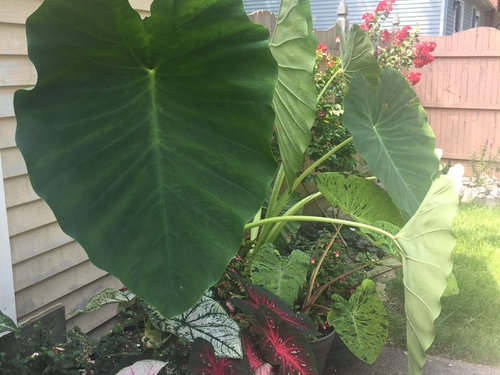
I have 2 Colacasia 'Tea Cups' that I purchased from local nursery. 2 Colacasia 'Black Beauties' that I purchased from Lowes - the stem on these seem a liitle floppy. The others are EE un named and crocodmia from big box stores.

Comments (24)

  • 8 years ago

    Hi PBG, welcome to the world of aroids... my favorite group of plants and one I've collected for over 40 years. I must admit to not growing a lot of EEs, but I do have more than a few.

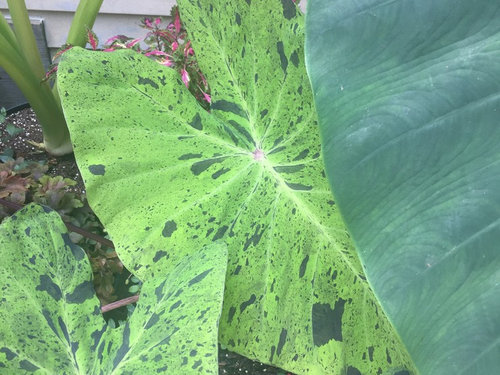
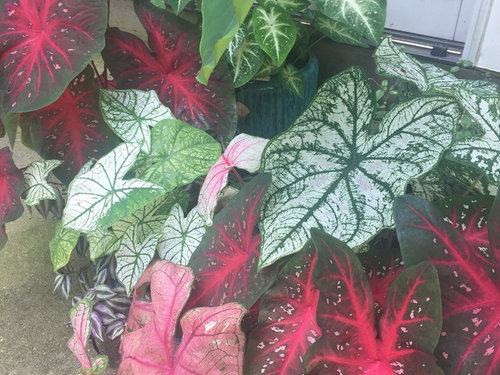
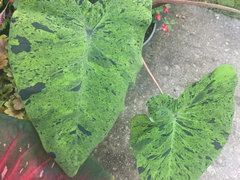
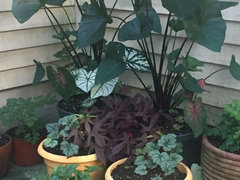
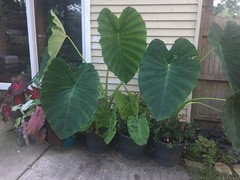
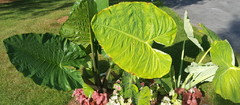
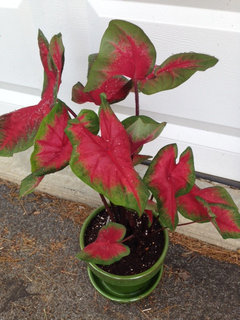
    The mottled-leaved plant in your 2nd pic is Colocasia esculenta 'Mojito'. Plants in your 3rd pic are all caladiums, smaller-growing relatives of alocasia and colocasia. Crocosmia is not an aroid, it is in the iris family. Some other plants in the aroid group are philodendrons, epipremnums (pothos group), dieffenbachias, aglaonemas (Chinese Evergreens), monsteras, syngoniums, amorphophallus and many others.

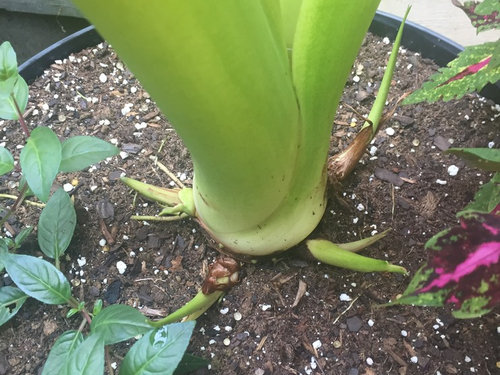
    The EE in your 3rd pic appears to be Colocasia 'Black Stem', if this is what you bought as 'Black Beauty' that name is probably from a vendor/wholesaler.

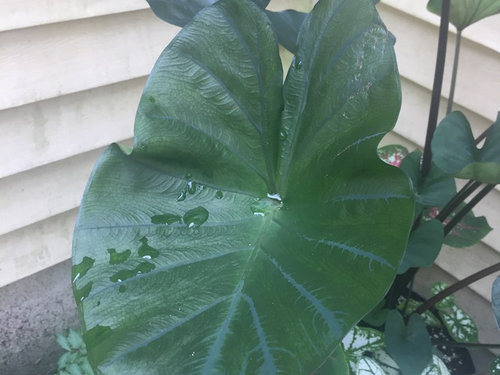
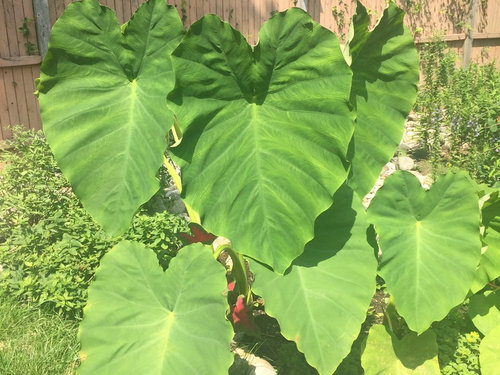
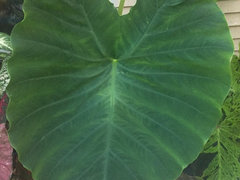
    Your last two pics could be Colocasia esculenta species but I would defer to someone else if they have a different ID.

    All your EEs are well-grown, you're doing a great job. Most EE's appreciate regular feeding, I've read that they are heavy feeders but most are fast-growing and I don't think it's beneficial to overdo it.

    I can't speak to overwintering bulbs since I'm in central Florida, I'm sure someone in a northern state will chime in here and give you some good advice. Don't hesitate to ask more questions as you think of them.

    Russ

  • 8 years ago

    Thank you, Russ gor sharing your expertise and proper identification. I am sitting on my patio now. Seems my Lowes purchase was mislabeled. The one you identified as Colocasia esculenta 'Mojito'. was labeled 'Black Beauty.'. These have a maroon stem.

    Assume the 'Tea Cup' from nursery properly labeled. Very dark stems and the cupped leaves do hold water.

    Now, I will look up esculenta species which you believe to be my largest.

    Maybe none are Black Beauty or Black Stem. Assume the name would fit the stem color and none have a black stem.

  • 8 years ago

    Quite a while back there was a study done on Colocasia esculenta varieties and they recorded around 2000. The majority were grown as food plants (Taro) since they've been under cultivation for about 4000 years. In recent times there's been a lot of development of plants purely as ornamentals. That's why there's so many names being thrown around these days. I have "Tea Cups", it was a sport found in Thailand and cloned to keep the exact same characteristics. They're great growing over a pond during rain. As the "cups" become full they tip spilling the water out. It sounds great and worth getting wet while watching.

    About your question re cutting off damaged leaves, it's best to leave them until they dry. While still green they photosynthesise and provide food for the plant which is stored in the tuber for next year.

    PineBarrenGardener thanked tropicbreezent
  • 8 years ago

    Jay, since we are in similar zone, when you bring the elephant ears inside for winter do you keep them in unheated area?

    Tropicbreeze, I long for a pond feature and imagine the 'Tea Cups' adding to the serenity. I did look up Colocasia esculenta varities to determine which ones I have - lol! I guess with over 2000 I may never know! I was leaning towards 'Giant' as mine, even first year in pots, are larger than any I have seen.

    Thank you for the warm welcome.

  • 8 years ago

    Jay, I use Expert brand too on some of my plants, because it's cheaper. It also has minor elements, which I always look for in a fertilizer. The 15-30-15 is touted as an all-around fertilizer but is normally used on flowering or vegetable plants since it has a high middle number. My opinion... your EEs will be fine on it but Peters 20-20-20 (if you can find it) or any fert with a higher first number (nitrogen) than the middle would be better for foliage plants like EEs. I think Expert makes a high first number fert, so you might look for it.

    Russ

  • 8 years ago

    PineBarrenGardener - I bring mine inside to a sunny west sliding glass door. I don't have much space though so the rest will go to friends' and relatives homes by sunny windows / sliding doors if they agree. My largest one at present (a monstrous 6'-4") was in a not so sunny NE window over the winter and shrunk to only 2 spindly sick looking leaves.


    Russ1023 - thanks for the info on the Peters 20-20-20. I will look for it. I'm having an issue with my sole Thai Giant EE. All of it is getting a yellow tint with yellow-brown spots on the older leaves. That EE stopped sending out new growth too. None of my other EEs have this issue. So I don't know if it is seasonal or environmental. But one of my Desert Sunset Caladiums started putting out some small yellow-green leaves recently. The normal leaves are completely a faded rust color.

  • 8 years ago

    Jay, I am reading so much and everyone seems to vary in technique. I was thinking the EE tubers needed a period of dormancy in the winter.

  • 8 years ago
    last modified: 8 years ago

    PineBarrenGardener - Waiting for some frosts forces an EE dormancy which is a plus if digging & drying bulbs (corms) or transplanting to pots indoors. I don't want these to go crazy where space is limited. Caladiums should go dormant no matter what you do. So if you want them as house plants this winter, acquire & pot some bulbs inside now.

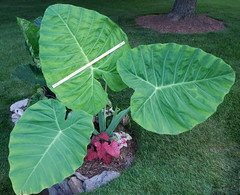
    Russ1023 - My Thai Giant pics - 3 from today are below. Did it just stop growing for the season or do I need the 20-20-20 fert or less water...etc? I also noticed today that 2 of the older leaves began dropping a little:

    Thai Giant is on the right showing the new yellowing:

    This is how it used to look on July 12, with a glaucous blue green color. That's a yard stick on that leaf:

  • 8 years ago

    Jay, have you had any cool temps lately? Night temps staying consistently warm? If they're getting cooler this might be the reason for the yellowing. I don't grow these types of aroids as well as I do philos and others, so I hesitate to advise fertilizing this time of year with the high nitrogen formula. Lack of fertilization could cause the yellowing though, or badly needing a potting up to larger size. Can you tell if it's severely root-bound? Losing lower leaves can be a sign of needing repotting, cooler temps, or over/under watering.

    Russ

  • 8 years ago

    2 nights that were 54-55 degrees this month for sure and maybe a couple more. This is not in a pot. But might get too much water so I'll try changing that.

  • 8 years ago

    Jay, too much water could produce the yellowing and losing lower leaves, hopefully you've diagnosed the problem correctly.

    Russ

  • 8 years ago

    PineBarren, my EE's are in containers, after our first frost kills them back, with the help of friends we dig out the bulbs, I wash them thoroughly and separate them, I do let them dry in the sun as long as its not to cold and then I just store them in brown paper bags in the bottom of my fridge,I mark on my calendar to check them every 6 weeks and mist them a little so they dont completely dry out, I've read where some people will store them in peat moss in their basements. I do give a lot of the bulbs away since they multiply like crazy over the summer and I'm a renter so I dont have a yardto plant them in. Your collection is outstanding.... I've learned a lot from the folks here and the search engine is easy to use, also check out the tropical forum, lots of useful info there.

    PineBarrenGardener thanked christine 5b
  • 8 years ago

    I am in NJ a bit further north of you. I grew 'Mojito' for the first time last year. From what I understand it doesn't like to form big storage tubers of some of the others and it is best kept growing over winter. I dug up a couple of larger side shoots that formed and tried keeping them going under lights over winter. This probably would have worked better except they were spider mite magnets inside. I did barely get one to survive though and it has only recently recovered into an acceptable garden plant. I also had a bunch of caladiums and unlike the others they prefer to be kept warm while dormant. After the first frost I dug them up, dried and wrapped in dry newspaper and kept at room temp. In spring I started them in pots inside and then moved them out after frost. You need to get yourself some Amorphophallus konjac bulbs next year....... : )

    PineBarrenGardener thanked woodnative
  • 8 years ago

    Based on advice given, I am going to bring the EEs inside in their pots after first frost, leaving only a small leaf, and cutting back on water while inside over winter. The calidiums I will dig after frost, clean off dirt, wrap in dry newspaper and store in badement until spring. Woodnative, I am looking up Amorphophallus konjac now!

  • 8 years ago
    last modified: 8 years ago

    I'm outta sunny rm when it comes to bringing all my EEs in for the winter. So most of their corms will be cured which I'll try for the first time. But I will bring some in. The first one will be the Mojito because I don't want to chance losing its tuber after reading that...thanks. It's just 2ft tall and only keeps about 3 leaves up at a time. Spider mites have been a problem on my indoor plants over the past 2 winters so I'll be looking for a better solution for that.

    My Freida Hemple Caladium was full grown on April 20 of this year when I bought it and that's when the below pic was taken. It nearly doubled in size before it went dormant:

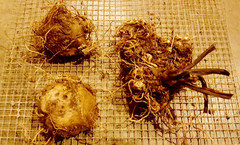
    Around Sept 1 its last leaf died. So I removed the root/soil mass from the pot, let that dry for a few days, then removed the dirt & cut the longer roots and dried it a few more days. I'll probably pot it again soon so I can have it growing inside for the winter. But how long should I wait before potting it again? What's the minimum time?

    Below are the 3 bulbs/rhizomes that are from the above plant and are shown on 1/4" mesh. The 2 on the left are upside down. There are less roots on the bottoms and more near the tops. The one on the right has 3 large main nodes. I left some of the petiole remnants on them so I know which way is up:

    None of my other Caladiums are at this point yet, but my Thai Giant EE stopped growing in early August...it still has 2 good leaves on it.

    Hmm. I may try a Amorphophallus konjac if it grows well indoors in the winter. Why do some have green leaves only, some have green leaves and an inflorescence, and others have only the inflorescence?

  • 8 years ago

    Amorphophallus is an interesting/fun aroid to grow. It doesn't have the variety and colors of Caladiums etc., but it is attractive with its tall mottled "palm tree" like stalk. There are a coupled selections out there with some variation including the variegated cultivar 'Shattered Glass'. The Amorphophallus tubers store easily at room temp over winter......you don't even have to wrap them in soil etc......you can just put the bare tubers in a cabinet or drawer somewhere......replant next Spring. I started with tiny, quarter size corms a couple years back. Mine are not flowering size yet.......but when they are big enough they throw out their large, somewhat stinky but interesting flower usually prior to leafing out in the Spring.

  • 8 years ago

    Amorphophallus have either a leaf or a flower (actually an inflorescence) but not both at the same time. There are some plants that look a bit similar, such as Dracontium or Typhonium, that have leaf and flowers at the same time.

    There are a couple of hundred species of Amorphophallus. Some go dormant and need to be kept dry. If they get wet during dormancy they'll rot. But there are some species that need to be kept damp and warm when dormant, otherwise they'll shrivel and die. You need to know which you have.

  • 8 years ago

    Based on all that info I have a clearer picture. They remind me slightly of of Jack-In-The-Pulpit flowers which I've seen in the wild. My focus would be the inflorescence. Which I'd try to grow as a houseplant. Then bring outdoors until fall for the foliage. So I'd want to try a cultivar that sends out inflorescence stalks first. Before the foliage. The things for me to do are: a. Identify a species that would do well indoors while sporting an inflorescence first and has corms that can be kept dry when dormant. c. Find a reputable supplier that sells ones old enough to 'flower'.

  • 8 years ago

    A. konjac and A. bulbifer are commonly available ones that need a dry dormancy. But unless you start off with a very large tuber you may have to wait some years before you get flowers. They leaf up each year but need to develop a large tuber before they'll flower.

  • 8 years ago

    PineBarren,

    I'm in NJ too, Toms River. Lowe's was really messed up this year with their EE's. I'm a contractor and frequent Lowe's throughout the state and always hit the garden center. Most of them carried 4 varieties of EE's and every one in every store was mislabeled. A real Black Beauty is basically an Illustris but with more black in the leaf. The tea cups are supposedly Z7 hardy with mulch so if you get a bunch of runners which you should have by this time of the year you can try leaving a few in the ground right where they are. Your big one is most likely a Colocasia Mammoth if it's from a big box store. Going into last winter I had multiples of a bunch of different varieties so I tried keeping at least 1 of each awake under grow lights in a 65° storage room and the others I potted, cut down and put under a tarp on the floor of a room that stayed about 50-55°. Most of the ones I tried to keep awake looked like garbage throughout the winter. This summer there was no noticeable difference in size and vigor regardless of the overwintering method used. Out of a 100+ colocasoa/alocasia/xantho I lost maybe 5. Moral of the story: these things are tough as nails so try whichever way is most convenient and you will probably be fine.

  • 8 years ago

    I got tea cup bulbs this season and they were dead - nothing came up. Irritating, because it's the one variety I really want. Glad others mentioned the bit about mojito - it doesn't seem to be as string a grower as others. But I'm pressed for indoor space so I may still store it as a bulb at the end of the season. I have quite a few different varieties of amorphophallus, including konjac, so we shall see how big they are at the end of the season.

  • 8 years ago

    the absolute min dormant time for caladiums is 6 weeks. the standard dormancy is more like 8-10 weeks. the soil warmth is the key for getting them to root (soil temps above 75, but better on heat mat tented AND very moist..soil temps on heat mat are 85-90F :)..). if you just put them on cool sunny window sill like in march - it might take them 1 mo to root and another to produce the 1st leaf (mostly because nights are still cool and the mix will not be warm enough 24/7).

    And they do need full sunlight for half a day at this stage in spring indoors.

  • 8 years ago
    last modified: 8 years ago

    Thanks. The min dormant time is exactly what I was looking for. Some of my March Caladium bulbs took 8+ weeks to sprout and other larger ones took 13 days to sprought. But I think the latter were potted in mid April.

Sponsored