Software
Houzz Logo Print
opaone

Ceiling exhaust in kitchen?

9 years ago

Has anyone installed a standard ceiling exhaust in their kitchen? We often find ourselves running our hood for a couple of hours after cooking to get rid of cooking odor. That's unnecessarily loud and annoying as after cooking is completed there should be no major bits of grease or stuff in the air and so no further need for noise producing baffles.

It seems that after cooking is completed a 300 cfm exhaust (ceiling vent, silencer, inline blower near exterior of building or fed to air-to-air exchanger) or two would be a much better option.

Comments (8)

  • 9 years ago

    Food prep, spice grinders, dirty dishes, microwaves, crock pots, coffee makers, wall ovens, steam from dishwashers... all produce kitchen odors.


    A fan in the ceiling is more common that these people that advocate an industrial range hood that will pull your skirt over your head would lead you to believe.

    http://www.broan.com/products/lifestyle/kitchen-f5c683f7-b0ea-4cf8-904c-e336feac67f2/problem-solution/food-preparation-odors-c63ee2ad-18c2-463b-abbc-9e70260c20a1

    .

    As you suggest, it is actually more practical since you can use it in conjunction with an energy recovery system - unlike a range hood. A 1200 cfm range hood, if installed correctly needs an additional (large) MUA system that brings unconditioned air from outside with no ability to run it through an HRV/ERV. That adds up to a lot of energy to completely recondition the air.

    As a side note, even if you made the range hood quieter by using an in-line or external fan, you would have more options available to make a ceiling vent in the middle of the room quieter, such as silencers that would technically not be allowed in an over the range hood installation unless it was an integral part of the listed hood assembly.

  • 9 years ago

    Thank you guys. I def agree with capturing at the source. Still working on that piece.

    Yes, 300 is on the lite side, though somewhat better than nothing. Could also go bigger.

    @Fred, this is in addition to a properly sized range hood and MUA, not a replacement in any way.

    I don't think that code bit would prohibit a silencer. OTOH, they probably do need to address silencers as I think it'd be a good idea for them to be accessible for cleaning. Another question is how much they help. The bulk of the noise is likely the air moving through the baffles. I'm not sure that the blower itself would even be noticeable above the baffle noise. Kaseki may know? I'm also not sure that the pressure drop is worth it. A silencer is very likely be worth it for an unbaffled exhaust like in the kitchen ceiling, bath, etc.

    Def agree with this being able to run through an HRV.


  • 9 years ago
    last modified: 9 years ago

    "@Fred, this is in addition to a properly sized range hood and MUA, not a replacement in any way." - I don't believe I suggested that it was meant to be a replacement, but I doubt you turn on the range hood when using the microwave or running the dishwasher etc. Neither did the link I provided. - "There are many kitchen ventilation needs that often go unaddressed, apart from what is handled by your range hood."

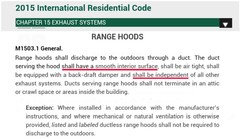
    "I don't think that code bit would prohibit a silencer." - It is EXACTLY why the word "smooth" is in the code. Do you see any mention of the word "silencer" in the exceptions??? Just because someone makes something and markets it as such, does not mean that it conforms to the building code. They can be a significant fire hazard if not cleaned weekly. (But, they can not be cleaned even if they are accessible.) A residential range hood system is not subject to frequent cleanings and govt inspections like a commercial system is, therefore the requirement and what may be allowed are different.

  • 9 years ago

    What did you cook? Also, what is the spec of your current rangehood and the size of your range. If they are somewhat matched and your hood can suck decent amount of air (300 cfm barely works for serious cooking), you don't need anything fancy beyond opening the kitchen window (if you have one). For reference, I run my hood at 400cfm with moderately odorous cooking. I need to crank up to 600cfm when I am doing some serious searing with onion and garlic around. I believe the key to successful odor removal is to source an unobstructed route for the air intake. It works great in my case because the kitchen window works as a quick path to fresh air that is getting sucked into the hood.

  • 9 years ago

    Fred S: I was responding to the OP's sentence: We often find ourselves running our hood for a couple of hours after cooking to get rid of cooking odor. I wasn't addressing chopping onions or cilantro outside the zone of the range hood.

    I have no objection to using a separate kitchen ceiling exhaust system; I have one myself. It interfaces with the kitchen ceiling through a pair of registers located roughly over the wall oven stack. I presently believe (because I can't find the description) that the zero static pressure rated flow of the NuTone down-blast blower being used is 600 CFM, and hence with adequate MUA the actual flow is roughly 400 CFM. I can assure you that this flow rate is not effective at quickly clearing smoke from broiling when an oven door is opened. (Wolf requires broiling with the door closed.) Fortunately, one can sear on a cooktop and bake in an oven and let the cooktop ventilation handle the dominant effluent source while still ending up with a nice steak.

  • 9 years ago

    My apologies @Fred. I think I got that impression from "...these people that advocate an industrial range hood that will pull your skirt over your head..."

  • 9 years ago
    last modified: 9 years ago

    "Fred S: I was responding to..." - I know. That is why I wanted to point out the other side of the story. The industrial range hood comment was not directed at anybody in particular, just the common attitude on this site.

    The obvious differences between a range hood and a ceiling exhaust can be, and often is, seen as an advantage when designing the ventilating system for the entire house, and not just focusing on the range hood. A range hood works best when there is a massive amount of MUA dumped directly into the kitchen, effectively short circuiting the ventilation of the rest of the house. A separate ceiling exhaust can be run at lower cfm for a longer period (after the range hood and dedicated MUA is turned off.) and serve to ventilate the whole house while getting the lingering odors out of the kitchen. From an energy conservation standpoint, it is better to allow the ceiling exhaust to remove some of the lingering humidity and odor in the kitchen, than to deliberately design a system to have to do double duty conditioning fresh air from outside that is drawn into the house by the two seamingly separate system functions. Of course, if you live in a moderate climate like Hawaii, non of this matters, but if you live where it gets to -20° it does.