Software
Houzz Logo Print
lisajrough

help! luna moth cocoon...

9 years ago

Hi there... i'm looking for someone who knows about luna moths... A little over four weeks ago, we found a luna moth caterpillar on our patio, and presumed a bird had been planning to eat it, but dropped it after hearing us coming. We placed the caterpillar in a jar with some hickory leaves, and only a day or two later, it built itself a cocoon, on one of the little branches we put in there, wrapped in leaves. We kept the jar inside for a couple of weeks, until I became worried that she wasn't getting enough light and temperature cues from outside, so we moved it out into our mudroom close to a window, and have since built a larger screened box for her. It's been four weeks today since she built her cocoon. She's still active when I move the cocoon, so I know she's still alive. Since she hasn't eclosed yet, does this mean she's diapausing? Or could the first couple of weeks in our house thrown her rhythms off and she's simply a late bloomer? Should her cocoon be laying flat on the bottom of her box, or is it okay to have it propped up on some sticks? (p.s... I am in the mountains of North Carolina).

Comments (37)

  • 9 years ago

    Take this post to the Butterfly Forum....lots of butterfly raisers over there.

  • 9 years ago

    Hi Lisa....I too have a critter to comfy to come out of its cocoon!!! My story is oddly similar to yours....a bird dropped the caterpillar onto my patio, put it in a container and two days later it spun itself into a cocoon. That was at least 6+ weeks ago. We have since brought it in as the night temperatures got a little too chilly. I know ours is still alive because I can feel the movement when I pick up the cocoon.....I have the cocoon hanging (it's attached to a leaf) and I added a place for her to hang once she emerges to allow her wings to unroll. Will she ever come out?!??!?!?!

  • 9 years ago

    Hi Elizabeth! In the last couple of days, we've had a little more action here... the cocoon has been wiggling and I hear a lot of scratching, but no emergence yet. The other day, I picked it up, and it made a strange, loud noise that freaked me out, as if to say, "leave me alone!" Ha! I've heard that changes in the barometric pressure can trigger eclosion, which we've certainly had with the aftermath of Irma blowing over here part of the week. I was told by a specialist in Canada that what I have is more likely a polyphemus than a luna, due to the cocoon being harder, and the polyphemus tend to take a little longer in their cocoons, especially further south. So we shall see. The suspense is killing me! He said that if it didn't emerge over the next couple of weeks, that it'll probably overwinter, although mine didn't turn dark or pink before it made the cocoon, which I've read is a sign that it will overwinter. So who knows? I have heard that when the temperatures start dropping, if they do overwinter, it's important to keep them in a non-heated place like a garage, or even outside under a shelter so that it doesn't become snow covered, so that the lower temperatures help them become dormant and live through the winter. Some people even keep them in the fridge over the winter! I don't think we're there yet.... and have also heard the next couple of weeks are going to be unseasonably warm here, so who knows how that will affect things. :) I'll let you know if anything happens!

  • 9 years ago

    so if it doesn't emerge, are we to wait until the spring? seems so crazy! lol

  • 9 years ago

    I guess so! After several days of scritchy scratchies and rockin' and rollin', today my cocoon is still and quiet. Hoping everything is okay in there. Only time will tell. Patience is certainly not my forte! I keep telling her that today would be a beautiful day to come out... in the upper seventies and sunny, with a promise of a clear evening ahead. We are between 5 and 6 weeks now. I suppose we need to get used to this if they are overwintering. Sigh.

  • 9 years ago

    hahahaha, right!!!

    I shake mine every few days, just to be sure! By the time she comes out she'll hate me for sure =|

  • 9 years ago

    Mine emerged!!!! Unfortunately I missed it.... he came out while I was off picking the kids up from school. It's a boy! Polyphemus moth! I suppose we'll release him tonight. He's stretching out for now. <3

  • 9 years ago

    Very nice! Congratulations.

  • 9 years ago

  • 9 years ago

    wow, super cool! i'm def. jealous....mine is still in hiding!

    so what would happen if I opened the cocoon? I don't want to kill it, but my impatience is overwhelming!!!!!

  • 9 years ago

  • 9 years ago

    Elizabeth, I've heard of others doing that. Where are you located? If you're further north than me (I'm in North Carolina), I wouldn't risk it.... the cocoon is what will help shelter it through the winter if yours is overwintering.


  • 9 years ago

    So Po, our male polyphemus, stayed on a tree outside all night long, and didn't fly. We brought him back in this morning just before the birds came out, and will try again tonight. Any advice from you experts on how to coax him?

  • 9 years ago

    Hi Lisa....how's Po? I live in IL (north of Chicago). I've had mine indoors for about 3 weeks....it's still shaking/moving around.....so I still have hope it'll come out before winter! lol

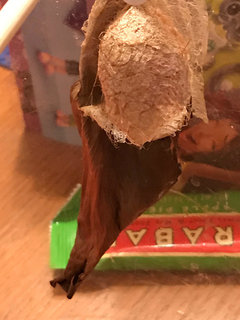
    Here's the cocoon....sighhhhh come out come out =)


  • 9 years ago

    Hi Elizabeth! The second night, after offering us lots of photo ops, Po flew out into the darkness! Funny thing is, when we woke up the next morning, I was waving goodbye to the family, and noticed he was hanging out on the soffet just outside of our front door. There he stayed for a couple more days and nights. We just left alone, but he just didn't seem to want to go anywhere. We thought he'd die there, knowing they only live around 4 days. But he was gone this morning. We like to think perhaps a recent drop in barometric pressure gave him the burst of energy he needed to move on and find a lady friend to continue his legacy. I miss him!!!!

  • 9 years ago

  • 9 years ago

    He certainly looks super cool....I can't wait to see if mine will be like yours or green!

    I was gone all weekend...I hoped to come home to find 'it' flying around! lol


  • 9 years ago

    Hi Elizabeth! I was wondering if you had any news regarding your cocoon! Has it hatched yet?


  • 9 years ago

    nope, still hiding! another source told me to expect 'it' to overwinter! we'll see what happens in the spring I guess :(

  • PRO
    7 years ago
    last modified: 7 years ago

    Advice depends on what type of moth you ended up with.

    Note that the original post over 2 years ago started with a Luna moth caterpillar and ended up with a Polyphemus moth. There is no way for us to know what your huge green caterpillar turned into. Neither of the above-mentioned moths eat.

  • 7 years ago

    @kellbellsb! It does seem a little late for the moth, but no matter.... it still might have a chance to find a mate and reproduce before winter truly hits. If it's a giant silk moth (i.e., a luna moth or polyphemus moth), they do not require food, as they do not eat. The best thing to do would be to release it in the evening after sundown. They only live for a very short time (if it's a luna, it'll have roughly 10 days from hatching to find a mate, only 4-5 if it's a polyphemus. If you're not sure what it is, is there a way you could take a picture? I'm happy to help in whatever way I can!

  • 7 years ago

    It is a Polyphemus. It’s 25-35 degrees here should I really release it? I am trying to load a picture but it’s having a hard time doing so.

  • 7 years ago

    Good question. I'm not sure. That is awfully cold! No matter what you do, it will die within just a handful of days.... I think I'd release it just to give it its best chance to find a mate. That being said, there's also something to be said for giving it a warm and peaceful place to die. What a difficult decision!


  • PRO
    7 years ago
    last modified: 7 years ago

    Outdoor temperatures would have to be way above freezing for sustained flight. Body temperature for flight is around 60 degrees.

    https://bugguide.net/node/view/427/data

    ^ scroll to bottom and note Wisconsin flight time for this species is only May-August.

    Consider preserving the moth as a memento of your experience.

  • 7 years ago

    Thank you kindly Lisa and The Logician for your insight and comments. I will keep him inside and yes I agree to keep him preserved as a memory. Thank you!

  • PRO
    7 years ago

    Individual preserved specimens are often kept in a small paper box with clear cover and filled with cotton. The box must be securely sealed to prevent dermestid beetles or other pests from chewing on the moth's body. If just the wings are kept, pests will not bother those as much.

  • 6 years ago
    last modified: 6 years ago

    I found a beautiful green caterpillar in late August. I brought it inside and put in in a bowl to show my daughter. Within hours it made itself into a cocoon. I have never seen this kind of huge green caterpillar nor a cocoon before in all my 48 yrs. So, I thought we would have a butterfly soon. Nothing happened and in October I thought it was dead. We moved it and the cocoon started hopping around! We were so excited! I researched more and realized I must have a moth who was waiting winter out. I know nothing! I put it in the garage to keep the temp stable for it and then we had a very cold spell (Illinois) so I brought it back in thinking it would die. Well tonight it emerged! Its a big beautiful moth.. now what?? Its too cold here to let it go, right? Its supposed to be in 30's this week and colder at night. Does it need food? I think as I read here it will only live a few days? I put a cage around it so it does not take flight when Im not here, Im afraid the dogs will kill it. I dont know what kind of enclosure is proper, if it eats and what it eats, and if I am supposed to let it go? Its not flying yet its just sitting on the stick. But it has opened and closed the wings so I know its coming around.


    Lisa Rough thanked HU-810995105
  • 6 years ago

    Hi there HU....


    Your moth will not eat.... as an adult, it has no working mouth parts, and its only purpose in the few days it is alive is to reproduce. I'm not sure what region you live in, butI think your moth's best chance would be to release it tonight, after it gets dark. I know it's cold, and the ones around here (North Carolina mountains) are certainly overwintering. As cocoons, they are used to freezing temperatures (I have some overwintering cocoons in the crisper drawer of my fridge!).... so next time, no need to worry about bringing it inside. Your garage was probably perfect. That being said, no worries... if your moth eclosed, there may still be others in your area for it to mate with. I wish you luck! Enjoy its release. :)

  • 6 years ago

    Ok thank you. We are in Illinois and it is supposed to be in 20's tonight. How do I know if its a male or female?

  • PRO
    6 years ago

    You would have to research images of the Polyphemus moth and compare key gender markings and coloration to your moth.

  • 6 years ago
    last modified: 6 years ago

    HU, it's hard for me to see in your pic, but if the antennae are like bushy feathers, it's a male.... if they're thin, it's a female. From what I'm able see, I'd guess it's a female.

  • 6 years ago

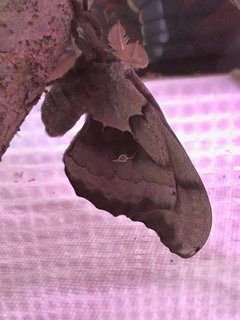
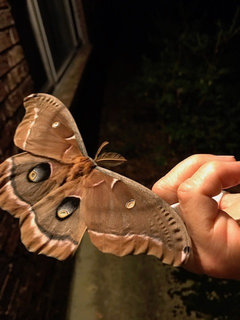
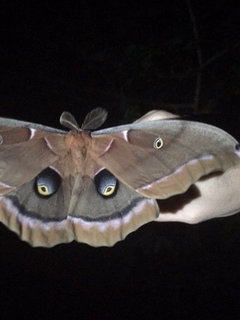
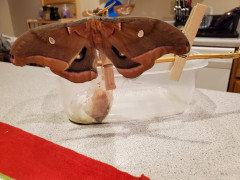
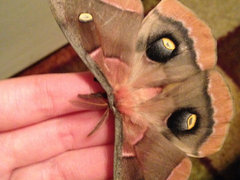
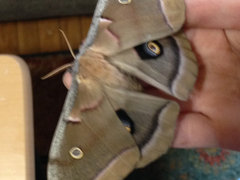
    Hi HU. I'm pretty sure your moth is a male. The females have much sparser, smaller antennae. These were some of our winged friends this year. The top pic is a male & the bottom is a female. Color variation is individual & not specific to gender. Did you ever release yours?


  • 6 years ago
    last modified: 6 years ago

    For the record, don't bring overwintering cocoons or chrysalids inside. They're made to withstand cold temps. I foolishly thought I'd stash my Polyphemus & Luna cocoons and some black swallowtail chrysalids in my attic last winter to keep them safe. I ended up with moths, butterflies & some nasty parasitic wasps all hatching out in March (icy & cold here in MO). Best not to mess with Mother Nature.

  • 6 years ago

    Yep mine is a male then. He is getting sluggish now. He has always shaked since he was born. Like when i let him out to fly when hes sitting he trembles. Why does he do that? Im guessing he wont be here a lot longer. He does not fly much anymore.

  • 6 years ago

    Those awesome antennae are to pick up the pheromones the females release. I think they're really cool! I'm not absolutely sure why he shakes, but my guess is to warm himself. Same reason people do. Unfortunately, he's probably nearing the end of his life cycle. My male made it about 12 days, but that is unusually long for them & the last 3 days or so I only knew he was alive because when I touched him he would slowly flap his wings a time or two. I was hoping to at least get eggs from mine, but the female didn't hatch until the day after the male died. If he doesn't beat his wings up, you might consider preserving him. They are so beautiful.

  • 6 years ago

    I was going to google that. I remember doing that in school many moons ago, but I forget how we did it. Thank you!

Sponsored
More Discussions