Software
Houzz Logo Print
hzdeleted_1333051

Drainage around house

9 years ago
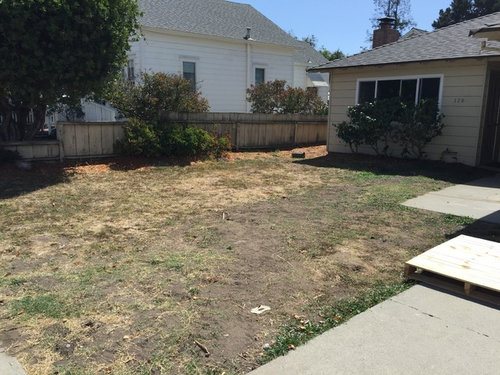
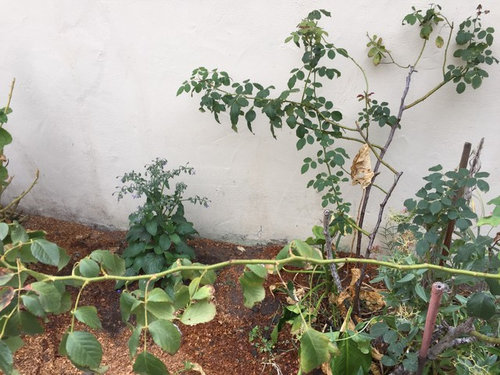
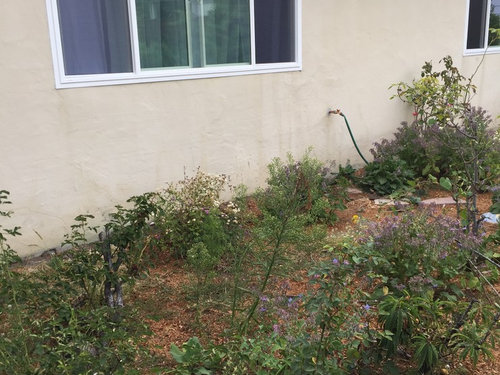
We just bought a house (coastal California) and have moved in after doing lots of much needed repairs and upgrades. Next on the list is exterior paint. The house is wood siding on the front and stucco on sides and rear - the previous owners added topsoil and mulch to create flower beds go against the house. The soil and mulch is piled up against the siding and stucco and will have to be dug away for repairs and painting.


the question is what to do after paint- should we leave "trenches" and fill with gravel or will that just encourage sitting water?


New rain gutters and downspouts will be added after the painting, and downspouts will be directed well away from the foundation.


What's the best way to handle the foundation area? The overgrown shrubs in front will be removed and so will the lawn, we are installing a picket fence and water wise plants.


Other curb appeal tips welcome - we are in sunset zone 17, I believe.


Comments (16)

  • 9 years ago

    The surface of the ground will just have to slope away from the house. I don't think it matters whether the surface is gravel, mulch, or dirt, as long as it slopes away.

    I hope you plan some new landscaping after you remove what's there, which is WAY too close to the house. I try not to plant anything under the eaves and make sure nothing grows to touch the house.

  • PRO
    9 years ago

    I would not create trenches next to the foundation and fill them with gravel. As Littlebug said, the soil must slope away from the house, a factor of proper grading. One cannot suggest where water would travel beyond that without having a comprehensive knowledge of your yard's grade.

  • 9 years ago
    last modified: 9 years ago

    Yes we will be removing those shrubs up close to the house. We will do landscaping once rainy season starts but first is painting and making sure the house is not being damaged by wet soil up against it. There does not seem to be an overall drainage or grading problem only that the previous owners mounded topsoil and mulch up against the house. I'll see how it looks when we've removed that.

  • 9 years ago

    A trench with gravel next to the house will actually fill up with water when it rains and then it will drain away right next to your house. Slope away is the most important thing. I usually keep any plantings at least three feet from the house to provide good air circulation and allow me to get behind the plants for maintenance of both the plants and the foundations. In your case, I believe you want to keep plants away from the house and each other so they don't spread fire.

  • 9 years ago
    last modified: 9 years ago

    Yes that's what I thought - no gravel. We will remove the extra soil and mulch along with the shrubs near the house, and hopefully that will be sufficient.

    We are not in a fire zone, thankfully.

  • 9 years ago
    last modified: 9 years ago

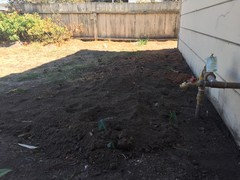
    The shrubs were removed yesterday and there is a bit of mounded soil left but that can be graded when we get the go ahead for the lawn removal. It looks fairly level to me, otherwise.

  • 9 years ago

    I used to work for a finish grading contractor in SoCal. You need a contractor with a tractor and box blade to resurface and bring it down where it should be. And then a tractor with a front end loader and dump truck to haul away the several yards of excess soil apparently brought in by the previous owners. If you dig down against the siding you will find a spot where the siding stops and there is an inset to the foundation. That inset is called the sill. The foundation below the sill should be exposed 4 full inches. Then from that point measure out 10 feet from the house. The soil level should fall another 6 inches over that distance. So you have a lot of soil to remove. This is not a DIY job.

  • PRO
    9 years ago

    But before doing any of that you must develop a physical plan on paper so that you know things will end up correctly when finished. It can be a simple plan. It just needs to cover the essentials.

  • 9 years ago
    last modified: 9 years ago

    The side and back yard are not accessible to a tractor or even a small bobcat - the lot is too narrow we only have a few feet either side of the house. So, what options do we even have? Also we can't make our yard lower than the level of the sidewalk - that would create more drainage issues from the street and sidewalk as well as probably damage the sidewalk. There are shared fences with neighbors on all sides, and we can't have our yard dug down lower than neighbors or we will end up with a pond in the rain! I'm not really seeing how we can grade the whole lot aa advised without actually reducing the elevation of most of the lot. Having a grading contractor come in sounds like a 10's of thousands job and it's simply not in the budget, and like I said there is no way they could access most of the sides of the house with machinery. Only that small front lawn is accessible.

    We are applying for the CA lawn removal rebate so we can start removing the lawn until we are approved, either.

    The house is on slab BTW and there are no signs of water/drainage issues in the past, we know the soil being up against the house is not good, and that the ground should slope away.

  • 9 years ago

    Thanks - I've called a couple landscape contractors to get estimates, any grading will have to be done by hand on most of the house - the lot was turned into a flag lot back in 1963 (when our house was built) along with most of the large lots in this neighborhood. The flag lot behind us has a driveway that takes up frontage leaving us only 4' on either side of the house, so it's just not easily accessible.


    im not sure what the drainage looks like in rainy season since we justbought the house a little over a month ago and it won't really rain here until November or December. The neighborhood is on higher ground than surrounding areas (a few miles from the beach upslope) but the surrounding lots appear level with ours and landscaping and drainage are of a similar vintage (i.e. No one has done much but plant new plants now and then),


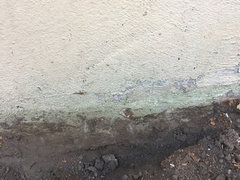
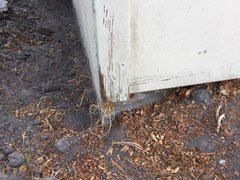
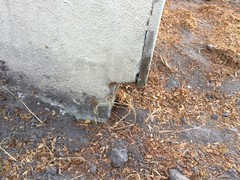
    i dug down on the stucco side and found no sill - the stucco goes down to the bottom of the slab and I was able to find the bottom of the slab without seeing a sill. The yellow paint is 28 years old and the green paint underneath is probably the original house color. You can see the gap below the green is actually below the slab, the stucco ends roughly just above it. Does this need some kind of flashing added?


  • 9 years ago

    Regrading would not be even $10,000. If it was more than $1,000 I'd be surprised. Ask the landscapers when they come out.

    But if you don't have a sill to go by...hmmmm?? Clearly this neighborhood was built before the standards were being enforced. If they were being enforced then every house would be built up on a pad that allowed for the 6-inch drop off, and there would be swales between houses to keep drainage off each other's property.

    Just out of curiosity, where do you live? There's 1,000 miles of coastal California.

  • 9 years ago

    What YV said although you can retain some water on site and do a rain garden, depends on the slope of your yard and how much space you have. I imagine rain gardens are getting more common in CA as folks go for xeriscaping.

  • 9 years ago

    Yes this house was not built to modern code, it would have been a semi rural area at the time it was built.


    dchall we live south of San Francisco, and labor is very expensive here. I am pretty sure grading the whole lot will be $$$ especially as it's mostly not machine accessible. Any time a contractor sets foot in our house it's over $1000 for the simplest tasks :( unfortunately with a curious 14 month old following me around I can't DIY much any more.


  • 9 years ago
    last modified: 9 years ago

    So there appears to be a sill on the front wooden siding portion but as you can see at the corner here the stucco part continues down to the base of the slab. So I guess we should consider that point on the stucco to be the "sill" and have the soil level to a few inches below that. I know we don't want to dig down below the slab because the dirt may shift and crack the slab.


  • 9 years ago
    Had to switch to the app to get photos to attach...