Software
Houzz Logo Print
hiccup4

Which Switch? Planning open concept lighting

9 years ago
last modified: 9 years ago

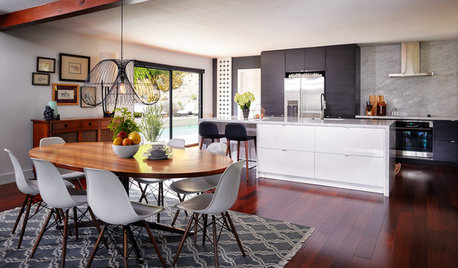
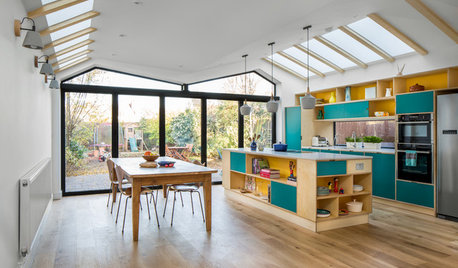
Which lighting switches do you have when you enter your open concept main floor? So far we are thinking: 1 switch for ceiling cans which are predominately in the kitchen (so none in dining/living) 1 switch for dining and kitchen island chandeliers on dimmers All other lighting will have switches near the source or done manually. A suggestion was made to have living lamps on the same switch as the chandeliers instead of operating them manually. Hmmmmm.... What do you like about your main floor entry lighting switches and what do you wish you could change?

Comments (11)

  • PRO
    9 years ago

    Everything depends on your floor plan arrangement and the locations of fixture, furnishings and equipment. Keep in mind that in most house plans, one often enters a given major public space from more than one direction, i.e., coming and going.

    Take your floor plan and some tracing paper and mark-up your major circulation patterns, coming and going, for the major functional activities during the day and night. Locate your controls where you major circulation lies.

    Also consider your major public lighting to be controlled on rheostats so that you may adjust the light levels depending on circumstances.

    Good luck with your project.

  • PRO
    9 years ago

    I would think that open concept or individual rooms would still have the same lighting needs, and that an architect would know where to put switches.

  • 9 years ago

    @mrspete. Thank you so much for the detailed response. It's exactly the type of response that I was seeking!

  • 9 years ago

    I have a 2,000ft2 home with a 'T' shape. The switches were also strangely located in some areas. I had my electrician relocate what suited meh add some breakers to the box and also did 'smart' outlets which I can control from a 'smart switch', my car and my android. My eyes have some damage and I need lights- it has made life so much easier! Just my opinion/experience.


    hiccup4 thanked Ed(Edwina) and Stephen Ci
  • 9 years ago

    I put switch for exterior flood lights by my back door, which is good, but should also switched them by the front door for easy access when guests are coming or going after dark. Luckily, it's a small house so it's only a short distance. And I think this is really old-school but we have a flood light switch at the head of our master bed. If we hear something outside at night, easy to switch the floods on. Motion sensors are an option, but problematic if you're in an area where there are critters.

    hiccup4 thanked crcollins1_gw
  • PRO
    9 years ago

    It also depends on how many switches you want on the walls. It's always wise to wire half of a few outlets so the table lamps go on when you hit a wall switch. In this case I prefer as many things on switches and dimmers as possible. It's also great to get a lighting system such as Lutron with preset settings for different lighting modes: entertainment, watching tv, cleaning, bedtime etc. Good luck with your project!

    hiccup4 thanked Gray & Walter, Ltd.
  • 9 years ago

    @mrspete. Thank you so much for the detailed response. It's exactly the type of response that I was seeking!

    Glad to be helpful.

    I put switch for exterior flood lights by my back door

    Off-topic question: Does everyone have flood lights? Every house I've ever had has had them ... but I never, ever use them. Oh, I use my porch lights, which are attractive lights that fit the house's look ... but those flood lights on the corner of the house, are they kind of "a standard"?


    hiccup4 thanked mrspete
  • PRO
    9 years ago

    "Flood lights" mounted on exterior walls, and/or roof soffits are, indeed, an all too common approach to exterior lighting, both for evening activities and security (when controlled by a motion sensor). In most cases, they are very functional, cheap and usually very unappealing from a visual point of view.

    A much better approach, IMO, is a carefully chosen range of low-voltage fixtures ( ground mounted, wall washers, tree up- and down-lights, suspended over activity areas and lights mounted under overhanging roof fascias). The low voltage fixtures are very flexible in terms of lumens and cut-off angles, economical and long-lasting in operation.

    Low voltage fixtures are small, don't call attention to themselves, but provide illumination where and when it's needed (when controlled with a timer or photo-cell).

  • 9 years ago

    @Virgil Carter Fine Art. Can the various exterior low voltage fixtures be decided after the build...down the road? or is this something I need to plan ahead before the build from a wiring persoective?

  • PRO
    9 years ago

    Yes, absolutely, exterior low-voltage fixtures can be planned and installed after occupancy, provided there are 120-volt outlets on the exterior in the vicinity of the areas for lighting. Installation will include the various fixtures, wiring and a conversion transformer/timer to turn 120-volt line current into the 12-volt low voltage current for the lighting fixtures. Every experienced landscape architect and contractor knows how to do this.

    hiccup4 thanked Virgil Carter Fine Art