Software
Houzz Logo Print
abelia2zamia

Two Zone 8B Hardy Bromeliads

In addition to dyckia, hechtia, and puya I have been trialing some more

"traditional" bromeliads. Aechmea is the most promising genus so far.


Aechmea disticantha is the hardiest and showiest. It's been in the garden for over a decade with no freeze damage. Likes bright light/partial shade. Very drought resistant. Foliage can reach three feet in height and is vicious with nasty teeth. Working with this plant almost always requires a blood donation. Blooms in spring and the red bracts retain their color for at least three months.


Aechmea gamosepala. Sorry for the blurry photo. So far I have only grown this in shade under live oaks. Gets about one foot tall and has bloomed in winter. I have been growing this one for five years and last years 18F freezes did not bother it. Bloom color lasts about 3-4 weeks. I also planted a variegated form last year, but it took a significant hit in the freeze and is trying to recover.


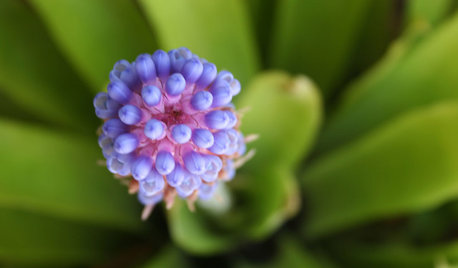
Aechmea calyculata. This began blooming in this last week of September. Photo taken yesterday. It is also growing in shade under live oaks and about one foot tall. This is its third year. It had one bloom last year and my memory is that it also lasted about 3 weeks. Both gamosepala and calyculata are essentially unarmed and friendly.

Comments (25)

  • 9 years ago

    Are they monocarpic (flower then die)

  • 9 years ago
    last modified: 9 years ago

    The Achmea gamosepala died at 13F for me in 2010. We also had three days of it , a break and then another equally hard freeze. I should try it again. I find protecting with a frost cover easier than irrigating all summer. It is my trade off. Usually these clump at such a rate that dieing of the mother unit is not an isssue.

  • 9 years ago

    The flowering unit will not flower again. It may continue to live for several years and feed the pups but will eventually die.

  • 9 years ago
    last modified: 9 years ago

    If you ever pull a section out, Ragna. it is similar to a purple leafed one that I have, but the leaves are thinner on mine, which could be environmental. The leaves have a bit of frosting on the underside. I also have it in a pot and bringing some to Eric this swap. I have thinned this out this year by three one gallon pots worth of cuttings and the darn thing looks the same. It was getting really dense. I have had that in my mom's pot for almost 40 years now. I have changed out the dirt on occasion when things start to look tired.. It really liked the last mixture. I wish I could remember what I put in it. It also has a fair amount of hardiness. I should take some of my torn out clumps and put them in the ground as a test. I bring this one in when things go below 26ºF to be on the safe side. Sorry I do not have a name. Yuccadoo used to sell it.

  • 9 years ago
    last modified: 9 years ago

    Wow Mara -- I think I have the exact same cultivar as what you posted above and I love it. But it's not the same as the wider leafed reddish bromeliad ...

    I bought it many years ago from Chip Schumacher's Hill Country Nursery.

    Since it's light weight and easy to carry I take it into the greenhouse in winter, stick it under a shelf, forget it, and it never skips a beat. It has bloomed when in more sun. And yes, you can't even tell when you separate a few pieces out of the clump so if anybody wants a start let me know.

    Come to think of it the blooms looked like the Bromeliad x cryptbergia Red Burst shown in the link "THIS" so that might be the ID of ours.

  • 9 years ago
    last modified: 9 years ago

    I think I gave you that plant in a swap or so I remember..

  • 9 years ago

    OH dear , I advertised it to Eric as a purple aechmea. Sorry Eric.

  • 9 years ago

    Lusting big time over that reddish purple brom

    i once inherited an outstanding collection which, I'm embarrassed to admit, killed by neglect. These days I only have 2 aechmeas

  • 9 years ago
    last modified: 9 years ago

    Bossy, I'm not sure which reddish one you are referring to.

    Been looking around and found a photo on this site: "Subtropicals" in New Zealand, that looks exactly like the one the neighbor gave me down to the slightly serrated leaves. Scroll down and click on Aechmea 'Burgundy' to see the photo.

    "A large graceful rosette with dark, waxy, burgundy coloured leaves which glow with colour when grown in good light. The inflorescence is a very attractive purple and white. Bright light indoors or bright shade outdoors. Can handle morning sun. VERY HARDY."

  • 9 years ago

    I can send you starts of mine easily. enough to fill a gallon.

  • 9 years ago

    Mara posted one that's atop a metal cylinder and you posted one inside a blue stand. Aren't they the same? That's what I was admiring

  • 9 years ago

    I've also have what might be Cryptobergia RedBurst. Mine was obtained long ago at a Houston nursery with no id. I'm thinking it's a sort of pass along plant.


  • 9 years ago

    I love cold hardy bromeliads and a. distichantha is tough as nails and even the deer won't mess with it! I've had good results with growth and cold hardiness from a. distichantha x a. recurvata, a. caudata 'melanocrater', 'O'rourke' (distichantha x androlepis). I'm also growing the reddish leaved bromeliad that Ragna has pictured above- I got it long ago from a friend in Houston, but didn't know it's identity- it burns from cold in temps of low 20's so I bring it in.

    Melanocrater

    Distichantha x recurvata

    O'Rourke

  • 9 years ago

    Nice collection, Matt!!! Melanocrater is a beauty!

    Which one like mine do you have, Aechmea 'Burgundy' or Cryptbergia Red Burst, if those are indeed their correct names?

  • 9 years ago

    Eric, Just curious what kind of (if any) soil modifications you make to grow these under oaks? Things we are trying to get established under our Shumard have once again been badly damaged or killed by the squirrels during their fall rampage; so something that "requires a blood donation" when messed with is appealing at the moment... well, that and it's a beautiful plant.

  • 9 years ago

    Bostedo, the thorny A. disticantha likes more sun. It does best in bright, filtered shade to part day full sun. I am growing it in many types of soil, all well drained, some very dry, decomposed granite amended soil, some regular, loamy garden soil. The more "traditional " bromes are planted under live oaks in an area with heavy, black clay. I amend the planting site with a bit of decomposed granite, making a slight mounded area for the new plant and position the plant on the mound slightly elevated above surrounding grade.


  • 9 years ago

    Everyone's bromeliads are beautiful. I only have 3 types of billbergia. One is a variegated cultivar called, 'Kyoto' and two types of nutans. One of the nutans had outgrown its pot so next year I'm going to separate it and plant some of the offsets as a hardiness experiment. Should I amend the soil with lots of compost? I'd like to grow some under my cedars trees. Here's a picture of the nutans bloom that I'm going to experiment with.


  • 9 years ago

    In Dallas you will probably fail on a normal winter but, hey, what the hell. I have killed them here. Maybe on the south side , but my garden is mostly on the north side. So it goes.

  • 9 years ago

    I'm even further north than bostedo so I'll probably fail miserably. I had a monstera survive for 4 years in my shade garden. It survived ice storms and snow so that gives me a little hope for growing tropical plants in my garden lol.

  • 9 years ago
    last modified: 9 years ago

    Thanks - the raised mound of decomposed granite amended soil over clay makes great sense. Sounds like may be best to start off with pots before experimenting with north Texas temps and exposures in the ground.

  • 9 years ago
    last modified: 9 years ago

    Question #1: Generally speaking how long can THIS bromeliad survive as a bareroot?

    Question #2 is asked in reference to: "The flowering unit will not flower again. It may continue to live for several years and feed the pups but will eventually die". If separated from the clump will the single 'flowering unit' produce more pups?

  • 9 years ago

    Not sure about an answer to either question.

  • 9 years ago

    Okay ... I have a feeling the broms will be okay bareroot for a couple of days. As for the flowering unit's ability to produce pups after separation from the clump guess I'll have to test one and see.

  • 9 years ago

    Roselee, I think I remember reading something a few years ago when I was researching billbergia nutans. I think on a couple of sites, people said they can survive without any type of media and one even said theirs survived being trampled and browsed by cows. If they're anything like tillandsias, then they should definitely be ok bareroot.

Sponsored
Innovative & Creative Custom Closet Designer Servicing Franklin County