Software
Houzz Logo Print
loveplants22

Plumeria growers are asking this question...

I thought this might help with some growers asking.. "

What is a Systemic and how does it work?"

Growers in Southern California are dealing with a huge Leafhopper infestation.
Foliar Spray is also recommended

From Texas A&M Agri Life Extension ~

What is a systemic insecticide?
If you’ve gardened for a while, chances are that you’ve heard the term systemic insecticide. When applied to pesticides, the term systemic means that the chemical is soluble enough in water that it can be absorbed by a plant and moved around in its tissues. Movement of systemic insecticides, like all transportable chemicals in the plant, takes place principally in the plant’s vascular system, which includes the phloem and xylem.

Not all chemical compounds are soluble in water. Most chemicals are going to soluble in water to some degree, or soluble in oil to some degree. Solubility is not an either/or thing. Some pesticides are highly soluble in water, some moderately so. Most pesticides have relatively low solubility in water.

What are the pros and cons of a pesticide being highly soluble in water? On the down side, being highly soluble in water means that a pesticide is more likely to be washed off of a plant by rain or irrigation. Also, high water solubility means that a pesticide may be more easily washed into a stream or (especially in places with sandy soils) seep into ground water. On the plus side, water soluble pesticides may be absorbed more easily into a plant, since plants are largely made of water and the sap is mostly water.

Pesticides that can be applied to the soil beneath a plant and transported in the xylem sap tissue can reach pests that are otherwise hard to kill. Many sap feeding insects, like scales, don’t move around much and may be protected by wax, or by the plant itself, from insecticides sprayed on the leaves and stems. These insects do take in lots of plant sap during feeding, however, so a pesticide in the sap can be easily ingested by the pest.

When systemic pesticides are applied to the soil, beneficial insects, birds and even pets and people are much less likely to encounter the pesticide in the form of residues or spray drift. The treatment of some trees (for example the big oak over the swimming pool) would be difficult to do safely without a systemic pesticide option.

Some of the common house and garden insecticides that are systemic include acephate (Orthene®), imidacloprid (Bayer’s Tree & Shrub Insect Control™, Merit®) and dinotefuran (Greenlight Tree and Shrub Insect Control™, Safari®). You should be especially careful when using systemics if you have a shallow water table under sandy soils, or if you are applying the product near streams, lakes or water features. As with all pesticides, it is important to read and follow the label of a systemic pesticide carefully at the time of purchase, before use, and before discarding any leftover containers or product.

Laura

Comments (11)

  • 8 years ago

    I just hope this might help some growers asking.

    Thank you, Roxanne!!

    xoxoxo


  • 8 years ago

    remember the Seinfeld episode about TWIRLING...????? LOL

  • 8 years ago

    You've taught me so much this first season of growing Laura. Thanks heaps for all you give :-)

    Nancy

    Loveplants2 8b Virginia Beach, Virginia thanked Nancy
  • 8 years ago

    Laura, do you have any experience with any of these systemics?

    Nancy, I bet these would be a great option for your indoor growing! Surely you battle spider mites!

    Loveplants2 8b Virginia Beach, Virginia thanked Chris Harkey
  • 8 years ago

    Chris, I spray with neem oil every other week and really seems to do the job for spider mites. Plus it makes the leaves gleam :-)

    Now watch me get a big batch of them!

    Nancy

    Loveplants2 8b Virginia Beach, Virginia thanked Nancy
  • 8 years ago

    Laura, test from my new phone and posting pix

    Loveplants2 8b Virginia Beach, Virginia thanked rox146
  • 8 years ago

    I'm out in the skies.. be back in a couple hours to say hello!! ✌️


    Laura

  • 8 years ago

    Fly the friendly...

    Loveplants2 8b Virginia Beach, Virginia thanked rox146
  • 8 years ago

    Rox!! Lololol!! I was laughing as I was working yesterday/ last night thinking of you and the twirling episode... oh, how you make my day! Have you been talking to Jackie about my twirling?? Lololol! I just had to make a video on my hand pollination " Twirling" for a friend who wanted to post it on a FB group! You know I'm not one who likes to make these kinds of things, but I have been stalling for three years and I finally decided to make one. This is my third year twirling ( hand pollinating) to make seedpods!

    Nancy!! Thank you so much for your kind comments! It makes my day knowing that I can help in some small way. So many wonderful people helped me when I started growing many, many years ago, so it's always fun to share... xo

    Hi Chris!!

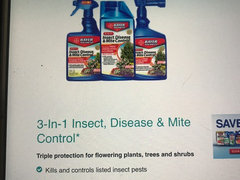
    I have not used those systemic mentioned in this article, but I have and do use the Bayer products. I will post a picture for you to see. These also act as a systemic and if I feel I need more, than I will use the granules ( systemic from Bayer) for the container. I will use the Bayer 3 in 1 that attaches to the hose to prepare my trees before I bring them inside for the winter after I defoliate and then again in ten days. If I have a spider mite issue or any other problem, I'll use the spray bottle . In the picture you can see the spray bottle for hand spraying and also the concentrate for attaching to the hose for many trees that are outside.

    Always remember to spray in the early morning or on a cloudy day. If spraying the hand bottle inside, make sure you have good ventilation and keep your animals away while applying.

    I don't need to apply this during my growing season unless I have a major outbreak of rust or spidermites, so I don't knock down any natural insects that help keep everything in check! This is only used on a ' need be basis' when Mother Nature needs a helping hand!!

    i hope this helps!!

    Laura

  • PRO
    8 years ago

    You know it is a serious topic when we start posting studies done by Aggies.

    I have used the tree and shrub product before and it works well on plumeria. Also the Bayer Rose disease works but I am not 100% certain it's a systemic. I think it is.


Sponsored