Software
Houzz Logo Print
kristinemomof381

What annuals do you overwinter?

8 years ago

I was just given a fuchia plant & just read about overwintering it. I also plan to take cuts of my coleus & overwinter 2 geranium pots. What else is easy to overwinter?

Comments (37)

  • 8 years ago

    All the plants you list are perennials. You can't overwinter true annuals. So first you need to know whether the plants you want to keep are perennials, botanically speaking.

  • 8 years ago

    They are not perennials in zone 5.

  • 8 years ago

    They are not hardy in zone 5, but they are perennials.

  • 8 years ago

    I'm overwintering coleus cuttings in water on the windowsill, geraniums under a growlight, a few cordyline (spikes) which keep getting bigger and bigger, various wandering jew type plants which I take in as cuttings, begonias, asparagus ferns, and probably some more which I can't think of right now or that will be added at the last minute. It used to be much worse but over the years I've decided to not bother with a few things such as impatients... years ago I used to fill the windowsills with impatients, salvia, and petunia cuttings just to keep myself busy during the winter months.

  • 8 years ago

    kitasei--They are perennials--tender perennials.Just because they won't survive in cold climates doesn't change their classification.

    No they won't survive in zone5 but they would in a climate that doesn't have frost. Many plants that we grow as annuals are actually tender perennials. That is why we can save them until the next growing season. If they were true annuals they would die over winter.

    The next time you want to save a plant look it up to see if it is a perennial or an annual. Perennials you can save--annuals you can't

  • 8 years ago

    Thanks everyone!

  • 8 years ago

    Angelonia cuttings. I overwintered 2 plants last year, and may pot up one of the originals too.

  • 8 years ago

    Here are some plants that I will put in the greenhouse for the second winter. begonias, purple heart, vinca, cannas, geranium and a few marigolds.. All these are very easy.

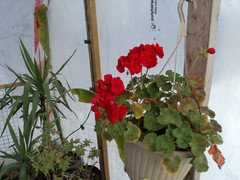
    Here is the geranium near full bloom early February 2017. It was such a nice red I had to keep it.


  • 8 years ago

    Downinggram, it was the OP who suggested these plants became annuals in cold climates, not Kitasei. I also explained that these plants are perennials botanically. My point was that to know if a plant can feasibly be overwintered you need to know if it is botanically perennial.

  • 8 years ago
    last modified: 8 years ago

    Exactly what I said and I was just backing up your comment about plants being perennials. The Op asked what annuals do you save and she did not say anything about perennials being annuals in cold climates. Before you jump in to correct people read what is said!

  • 8 years ago

    Dowlinggram, I have read and reread the thread.

    kristinemomof381, the OP, clearly made this statement They are not perennials in zone 5.

    Kitasei wrote this:

    They are not hardy in zone 5, but they are perennials.

    You (dowlinggram) wrote this:

    kitasei--They are perennials--tender perennials.Just because they won't survive in cold climates doesn't change their classification.

    Your words certainly had all the appearance of being directed to kitasei since you named him/her. I'm unsure how I can be accused of not having read what you said. However, if I misinterpreted your post, sorry. I did it because you appeared to correct kitasei rather than the OP.

  • 8 years ago

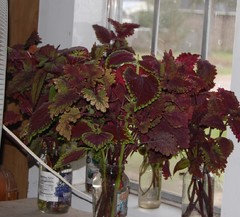
    Coleus cuttings.


  • 8 years ago
    last modified: 8 years ago

    Ah, I do overwinter a LOT of annuals...inasmuch as I sow them in late summer to flower early(ish) next year - technically going through a growing season in less than a year...but ambiguously, actually being sown specifically to overwinter (in our relatively mild climate here in the UK)...while not falling under the (contested) category of biennials either. This year - Venus's Looking Glass (Legousia pentagonia), phycelia campanularia, candytuft (iberis umbellatus), centaurea annua, lathyrus opdoratus and tingitanus,, echium plantaginea, consolida ajacis, Papaver rhoes, somniferum, corncockle (Agrostemma githago), Ammi majus, Orlaya, euphorbia oblongata, ridolfia segetum, gypsophila, red flax (Linum grandiflora), Omphalodes linifolia. There is a huge difference between an autumn sown hardy annual and a spring down one - cornflower, for example, make a gigantic, multi-stemmed 4foot high clump of thousands of blooms...whereas the spring sown ones are slender, single stemmed versions and anyway, I do a spring sowing of most of them, along with the more tender annuals such as coreopsis, cosmos (although tbf, I will usually see overwintered seedlings from even the more tender varieties (not zinnias though).

    eta - I guess it depends on what is meant by 'overwinter' though. My seeds are sown and germinate before winter so technically, these little seedlings 'overwinter'...but then again, if 'overwintering' implies some sort of special effort in coldframes and greenhouses, then nope, nothing of that sort.

  • 8 years ago
    last modified: 8 years ago

    I've overwintered a potted geranium in a sunny window with success. Needed a good, aggressive trim before being set outside again in the spring, but still is thriving. I brought her in again this fall (cold, frosty nights already), but may take cuttings instead. Have taken cuttings of annual (for my zone) salvia, that works too.

  • 8 years ago

    I don't have the room and can't be bothered so nothing gets overwintered unless it will tolerate being outside all winter. Fortunately for me in my climate, that's not much of an issue with anything other than my houseplants, which do spend summer vacation outside. They have a reserved place indoors but everything else is a no-go!

    But I grow very few annuals anyway and those are often changed out seasonally as well, so I just replace each season with fresh stock.

  • 8 years ago
    last modified: 8 years ago

    There's no way I could afford to buy a hundred Coleus plants every year, and I don't know where I would have to go to find that many. But on rare occasions when I see one I don't have that's not orange, I get it. It's so rare because the closest owner-operated store is 2 hours away. BBS's usually have the same rainbows & wizards when I see any at all, but I did find 'Burgundy Wedding Train @ L's. None of those stores are in the town where I live, or any stores that sell plants.

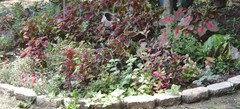
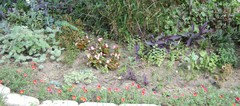
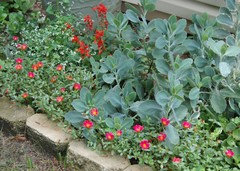
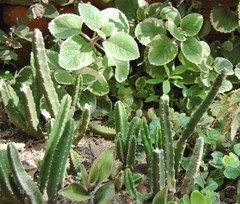
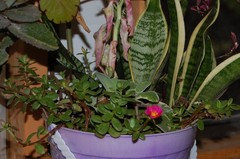
    Another plant that I love that I haven't seen since I got my current batch 4 yrs ago is ornamental purslane (the other moss roses,) Portulaca umbraticola, bottom left in above pic. This is all from saving a few stems in a pot that will be very near a south or west window. The stems usually look suicidal over winter, but as long as they're alive, I cut them off again in the spring & put them back in the ground, and as they grow, take more cuttings to spread to more areas.


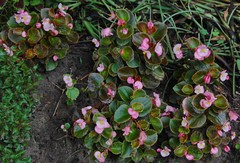
    If wax Begonias are not hardy in ones' location, it's easy to pop them back up & stick in pots, or just cut off stems and put them in house plants that have room along the surface.

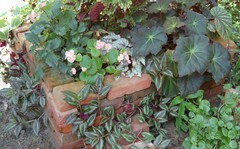
    Begonias of any kind, really.

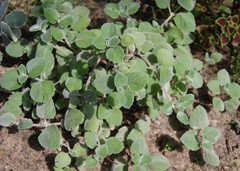
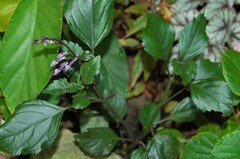
    Plectranthus plants can easily abide coming inside near a window for winter, like "Swedish ivy/creeping Charlie" at bottom right in above pic, or this fuzzy NOID.

    'Mona Lavender'

    or variegated "Cuban oregano" (P. amboinicus.)

    And on, and on, and on... :+)

  • 8 years ago

    with additional lighting (LED) I managed to overwinter a shrubby Basil African Blue (Oc. purpurascens x kilimandscharicum?)

    and could even get cuttings to root without extra heating.

    One can buy them in May aorund here, but I raised about a dozen plants myself.


    we moved and got other rooms, I will try to overwinter 2 trailing Pelargoniums (geranium) just in a pot in a kind of well lit (with enough windows) , cold store room, as I managed to find 2 very "long limbed" cultivars, one judging by the flower color a modern cultivar. Pelargonium cuttings never work for me, or rather I tend to forgett to take them early enough when it is still warm. Probably a heating matt would help with rooting.

    apart from that it is quite a lot of work, and I hate when the struggeling overwintering plants get pests and stuff,

    I gave up on Fuchsia, as it was overrun by black flies.


    friends of ours kept regular Basil for at least 3 y, just keeping it in the kitchen on a cool window sill, clipping off the flowers in fall, they got pretty woody stems and seemed to do quite well

  • 8 years ago

    True annuals, as has been mentioned, cannot be overwintered (not counting "winter sowed" seedlings). But, as far as tender perennials that could never survive my winters (and excluding my the more standard "houseplants"), I have overwintered a tropical hibiscus for about 10yrs and have a Lantana that is going on its 3rd or 4th year with me. Both plants are potted which may be a disqualifier but living in a 3rd floor apt doesn't leave a lot of planting options.

  • 8 years ago

    Yes, I think the "true annuals" vs. tender perennials thing was well-covered upthread. I think the term "overwinter" implies that the plants are potted.

  • 8 years ago
    last modified: 8 years ago

    Well now that I know Lobelia erinus is a perennial (didn't know that!), I'll be overwintering them in the future. I've gardened for decades and didn't know, so that's why I am adding it here. There are so many that are even labeled as annual when they aren't. I've never seen it labeled as anything other than annual, even on seed websites. You'd think they'd at least tell you.

  • 8 years ago
    last modified: 8 years ago

    Darn. Now I'm upset I didn't choose to save the purslane. Nice gardens, Tiffany.

    Campanula, how long are your seedlings growing inside? What kind of light do you provide?

  • 8 years ago

    Loretta, Campanula I believe is talking about growing hardy annuals outdoors, not inside and not under lights. 'if 'overwintering' implies some sort of special effort in coldframes and greenhouses, then nope, nothing of that sort. (Lights are rarely used by home gardeners in the UK). You'd probably call it 'winter sowing'. We just call is sowing.

  • 8 years ago

    Winter sowing is typically done with/in containers, not on the ground. Directly sown is called sowing.

  • 8 years ago
    last modified: 8 years ago

    Loretta, TYVM!

    A pic I took yesterday, ornamental purslane (Portulaca umbraticola) cuttings, rooted, perked back up, and even a little bloom!

  • 8 years ago

    Looks good, Tiff! You sold me although I always promise myself to cut down on my winter collection.

    I think we have two different ideas going back and forth here. The OP is talking about tender perennials sold as expensive annuals here in the US, not fall planting hardy annual seeds. In the US special cultivars of fancy coleus, geraniums, salvias, fuschia, etc are sold as single blooming plants and can be pretty pricey.

    Some tender perennials/annuals I have found not worth bringing in are mandevilla - by the time they recover and start to flower, its fall for me. Rosemary and spanish lavender don't do well for me either. Some salvias like pineapple salvia do much better as a new plant most of the time plus they tend to bring in whitefly.

  • 8 years ago
    last modified: 8 years ago

    Rob333, the terminology varies between the US and the UK I think. ‘Winter sowing’ is not a term we use because it isn’t considered to be a special technique. Many hardy plants are routinely sown in autumn, usually in containers simply for practicality, to provide optimimum soil conditions and some protection from wet and pests. It’s just normal gardening and isn’t given any special label. We just call it sowing seeds. I spent quite a long time when I first came to these forums trying to determine what exactly made ‘winter sowing’ special enough to have a name of its own before I concluded that there wasn’t anything. Sowing is sowing whether in the ground or in a container.

    As to overwintering tender perennials, I keep my Pelargoniums and Fuchsias from year to year in an unheated glass porch but they’re still out at the moment. Some succulents like Aeoniums and Agaves are still outside too but may need to come in for a few nights after Christmas.

  • 8 years ago

    floral_uk, I don't know how many years you've been a member here but 'Winter Sowing' was a phrase actually coined here on GW by a poster named Trudy maybe in the early 2000's. She started posting her methods of saving plastic containers and turning them into mini greenhouses. She would plant certain hardy seeds, perennial or annual and start them outside during winter and they would germinate a little early because of the greenhouse effect. I think she used plastic baby pools too. Anyway, the approach was new to many here and she gained a following. The term stuck around. But really she just organized an old approach I suppose.

  • 8 years ago
    last modified: 8 years ago

    TY, Loretta! And yes, I understood winter-sowing to be an alternative to trying to tend flats inside in the spring, and for the increased control/organization of being able to install plants in the garden instead of letting the scatter-pattern of seeds determine the appearance. There is a forum here just for discussing it:

    http://forums2.gardenweb.com/forums/wtrsow

  • 8 years ago

    I’ve been here many years and have followed the W.S. forum all that time just out of curiosity. Since the phrase was on a US based site I had assumed it was common parlance in the States. Seems not, until Trudy invented it. I think the difference is that raising plants indoors under lights is very unusual for home gardeners here so there’s no need to make outdoor sowings in autumn a separate topic or giving the technique a name.

  • 8 years ago

    floral, some of us utilize all three methods: direct sow, winter sow, and grow indoor under lights. What better way can you differentiate among the methods? Regardless of continent?

  • 8 years ago

    @floral: I think the term had become very common in many gardening circles though not outside of that. Most non-gardeners would have no idea. Have seen a couple sites which seem to credit Trudi with inventing the method of winter sowing as opposed to the term. That she invented the method is highly unlikely, as Loretta mentioned.

    Not surprised the starting of seeds indoors is not "a thing" in the UK. In many parts of the US, the length and severity of our winters necessitates either "winter sowing" (in either sense of the word) or starting of seeds indoors if one does not wish to or cannot afford to spend a lot of money on young to mature plants.

    @Rob: I have known quite a few folks who do refer to direct sowing when done in the fall or after freezes (even into true winter) as "winter sowing" as well as the container method. Personally, I totally understand why. The term implies it.

    @Tiff: " I think the term "overwinter" implies that the plants are potted."

    My thought at the time, Tiff, was that my Hib. is permanently potted as opposed to being dug up and brought inside or having cuttings taken and rooted in pots. ;-)

  • 8 years ago

    Yes, to me isn't just a method of sowing but a state of enthusiasm.

  • 8 years ago

    Kristine, have you received more or less food for thought than you had imagined when starting this discussion? :+)

    "a state of enthusiasm" this made me giggle! I'm there, just not about sowing seeds in general.

    Paul, "permanently potted as opposed to being dug up and brought inside or having cuttings taken and rooted in pots" = houseplant to me. LOL!

    Good point about season longevity being a factor in the necessity of dabbling with winter sowing vs. starting flats of seeds indoors. Often very basic advice about both veggie & flower gardening says to start seeds indoors x number of weeks before hardening off outside. Although I agree, most people don't do this, the many instructions include this step. Often mentioned on the seed packs. Very intimidating, who's house includes a grow room? And if it does, why would they be looking for basic instructions?

    https://images.food52.com/Ifmr1oFfWOqODx_LuvAuXWpVr9c=/fit-in/800x0/9b15e879-f860-4a1c-919c-f6afbf37c0b2--IMG_0720.JPG

    If it's not a true annual, and not hardy here, I'm going to keep it indefinitely if I paid for it. It doesn't always work out, but nothing is purchased outside of this goal. Just because the store needed to sell it as "an annual" so nobody would expect it to survive in the ground here, it's a houseplant to me if it survives the regime for plants @ my house. The number of plants that do fit this goal is nearly infinite, I always have a full house and the last few years, a small but full structure I loosely refer to as greenhouse. I see no reason for my personal genré to go beyond this, when it comes to buying already-growing plants. Every year I buy a few different things, and even though there are few stores that sell plants near my home, I usually find something when I go, in either the houseplants section (emphasis foliage) or with the annuals (emphasis blooming.)


  • 8 years ago

    "... in either the houseplants section (emphasis foliage) or with the annuals (emphasis blooming.)"

    Perspective varies. :-) I have a Lantana I picked up a few years ago (definitely not for its foliage) for my balcony. Surviving the winters here would be impossible for it and I don't wish to repurchase every spring. So it toddles on inside until weather warms up in spring whereupon it returns to balcony duties. :p

  • 8 years ago

    how fast does the lantana freshen up and does it increase in size each year?

  • 8 years ago

    Loretta, it does loose much of its summer leaves -- no doubt due to both the lack of sunlight (MI winters aren't known for a plethora of sunny days) and the very dry air once the heat has to go on. Perks up pretty fast once it goes back outside in the spring. Doesn't seem to have grown much, but that could be due to the aforementioned dieback.