Software
Houzz Logo Print
clarion23

Experimental planting palm trees in Russia.

8 years ago
last modified: 8 years ago
Hello!
Welcome all users of this forum! As I wrote earlier, I live in the Russian cold subtropics on the Black Sea coast. It is a small town Tuapse. At minimal winter temperatures, it is similar to the climate of the American Dallas or even
Memphis (USDA zone 8a). In January 2006, for the first time in 50 years, the temperature dropped by four hours to -16 ° C (3.2 ° F). Usually the winter morning temperature is at least from -3°С (26.6F) to -9°C (15.6F), but young
oleander bushes are regularly damaged by such frosts (-9°C). Although adult plants suffer such colds almost without damage.

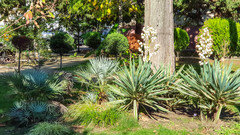
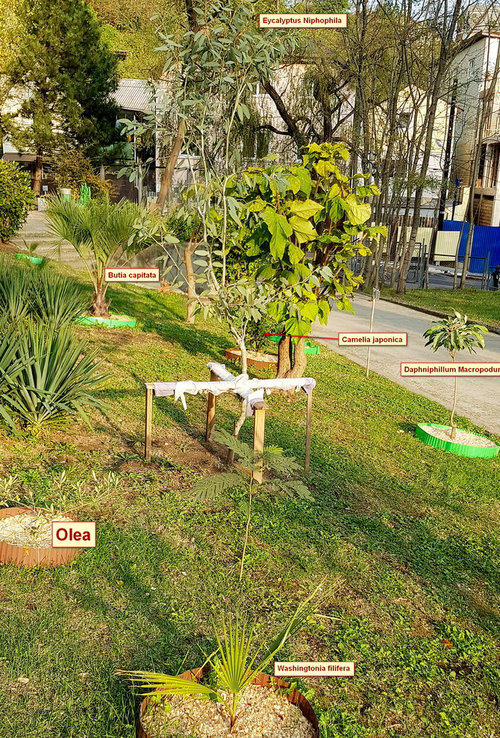
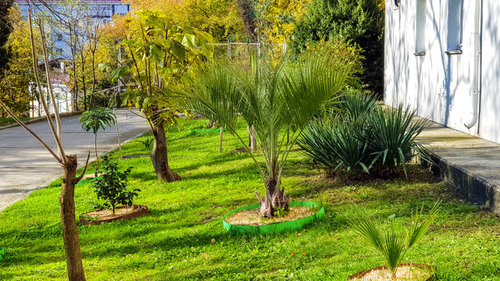
For a long time I was trying to understand whether some palms could survive in the climate of Tuapse. In the end, I decided to conduct an experiment and planted several plants near the southern wall of the building in the hope of creating a microclimate in the winter. In Tuapse, for many decades, evergreen plants such as Magnolia grandiflora, Сupressus sempervirens, Prunus laurocerasus, Trachycarpus fortunei, Trochodendron aralioideis, Mahonia quifolia, Cortaderia and other plants of climatic zone 7a, 7b have been grow and prosper. Planting of such plants as Washingtonia filifera, Eucalyptus, Butia capitata, Chamaerops humilis, Daphniphillum macropodum and Olea europaea in Tuapse - a real adventure that can be very bad finish. By the way, I purchased three-year-old seedlings of olives in the autumn of this year in the nursery of the Nikitsky Botanical Garden in the Crimea. This olive in the
Crimea without damage passes through the winter with a decrease in temperature sometimes up to 15F, and also fructifies. Olive groves were planted about 200 years ago by Count Vorntsov and many trees are still alive.

So, I planted these plants of the climatic zone 8a in Tuapse near the southern wall of the building in September 2017. However, Eucalyptus Niphophila and Hamaerops humilis were planted in April 2016. They perfectly passed through the winter, snowfall and temperature -9 ° C (15,6 ° F) without damage and eucalypts reached the height of two and half meters. During this winter, I will constantly monitor the condition of these plants and post here information about it. The temperature will be measured by Netatmo individual weather station.

And further. In the spring of 2018, I plan to plant seedlings of three species of evergreen oaks, which you can not find in Tuapse today. It is Quercus virginiana, Quercus chrysolepis and Quercus ilex. I hope they will live on forever.

Thank you.

Comments (25)

  • 8 years ago

    Don't forget you can also try the silver Med Palms to add exoticness and the warm tropics look.

    I'm not sure if Wine palms can take that cold..but worth a try.

  • 8 years ago

    Chamaerops humilis is in our garden and passed through the winter of this and past


    year, without damage sustained a temperature of -9 ° С. But Wine palm... Thank you. I will think about it.)

  • 8 years ago
    last modified: 8 years ago
    Very old, established Jubaea have survived rare freezes of roughly -15C in parts of Europe. Montpellier, FR, I think was one of those locations. But are definitely more of a zn 9 palm, or the very warmest zone 8 areas. Like El Paso and environs, though I don't know if there are any there. The incredible dryness and overall yearly warmth of places like that meant a sheltered date palm,for example, could come back from roughly 0F/-18C. They would never survive that in a place like Virginia Beach or Seattle, which is why they aren't seen there ;-) . So it's a zone 9 palm in terms of where they are actually seen on this Earth. My guess is they would be much harder for Igor to establish than Fan palm or Trachycarpus...if he really wanted one, being prepared to protect it for the first decade or two (!) might be a requirement. Meaning, cover it during severe freezes as people in the zone 8 of the SE US do.

  • 8 years ago

    It will be a great miracle if Washingtonia filifera begins to grow in Tuapse. And I hope so! But the Wine palm tree, I think, is from the country of fantasy.) Unfortunately.

  • 8 years ago
    last modified: 8 years ago

    Yeah I would agree that the true W. filifera are hardier than Wine Palm. But I wonder if some of the seed available throughout the world is 'contaminated' with W. robusta genes?

  • 8 years ago

    I hope that the seeds that I bought on ebay from a seller living in the town of Thermal in the Arizona desert will be pure and not containing Robusta genes. The second source of "pure" filifera genes, I hope, may be Sochi, where Robusta was first planted only in 2014 in one compact place. In September of this year, I bought the W.filifera seedlings in Sochi and planted them in Tuapse. Let's see what will come of this.) And at home in the pot I have four-month-old seedlings from the Thermal, which I raised from seeds.

  • 8 years ago
    last modified: 8 years ago

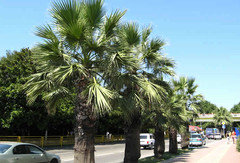
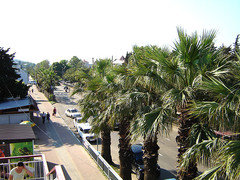
    This is photo of


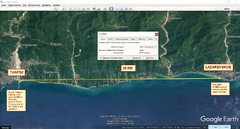
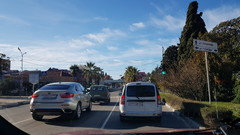
    W.filifera, which grows in Lazarevskoe, 28 kilometers from Tuapse.

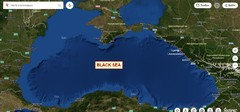
    And this is a map on which Tuapse and Lazarevskoe are designated on three scales.

  • 8 years ago
    last modified: 8 years ago

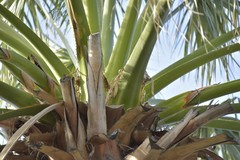
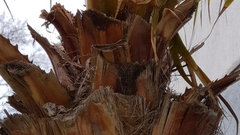
    Photo of the branches of W, filifera convinces me that in Lazaravskoe real filifera


    grow up without robusta genes.

  • 8 years ago

    Good job Igor. Looks like you planned ahead when you sourced your W. filifera. Good luck with them and keep us updated.


  • 8 years ago

    OK.

  • 8 years ago

    You might try some of the even hardier American Sabal palms. They take frigid in stride as they grow natively where continental Arctic fronts push through almost every year.

    You have warm enough summers looks to me.

    Igor Smirnov (8a zone, Tuapse, Russia) thanked stanofh 10a Hayward,Ca S.F. bay area
  • 8 years ago

    Thanks for the advice, stanofh! I was thinking about planting Sabal Palmetto or Birmingham in Tuapse, but these are rare palm trees for Europe, and for Russia - even more so. So while I'm looking for them.) I think today I made another mistake.) I bought two Washingtonia filibustas of about 10-12 years old each. I'm not sure that they are as hardy as "pure" Washingtonia filifera. But what's done is done.)

  • 8 years ago

    Try ebay or some palm club's seeds. There are VERY,VERY few Sabals in the San Francisco bay area..and they were seed grown. Even in moderate summer heat they seem to be doing fine.

  • 8 years ago
    last modified: 8 years ago

    Awhile back, due to a significantly larger parted, therefore tender looking clone or strain of Camellia sinensis offered as 'Sochi' being on the market here - with it being said that material under the name first came from the northernmost Russian location for tea plantations - I looked the town up on the web. And soon got photos of Sochi that included numbers of fully developed looking feather palms.

    As in it being at least USDA 9 level mild there.

    Meanwhile it is also being claimed by commercial sources that because this form of tea plant is being grown in Russia - which is always cold, right? - it is hardy to USDA 6. (And that results from plantings in the US are showing this to be the case also).

  • 8 years ago

    In Sochi, on the slopes of the mountains, the plantations of the world's most northerly tea grow. Even under Tuapse there are old, abandoned, small tea plantations. Some varieties of this tea are very tasty. Camellias in Sochi are grown in different varieties, in the arboretum there are even camellias in the form of trees.

  • 8 years ago

    Sochi is 9a-9b USDA zone.

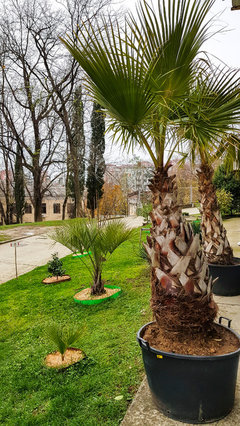
    Today, in Tuapse, we brought two Washingtonia Filibustas. I'm not sure, but it seems to me that they are ten years old or so. I think it's filibustas. Or are they robustas? I do not know. Confused.) I'm afraid they will die this winter. I will be very sorry ...

  • 8 years ago
    last modified: 8 years ago

    >Sochi is 9a-9b USDA zone<

    Yes, it would seem that with feather palms a feature of the planted landscape there it would have to be. And probably anywhere tea plantations are a significant part of agricultural efforts this serves to indicate the presence of a mild climate also.

  • 8 years ago
    last modified: 8 years ago

    "And probably anywhere tea plantations are a significant part of
    agricultural efforts this serves to indicate the presence of a mild
    climate also."

    Well, somewhat mild:

    http://www.tching.com/2016/03/mission-impossible-reviewing-teas-from-north-korea/

    Have seen a whole bunch of tea plants over the years at Cam Forest, what made the so-called Sochi teas moderately notable is that they had the bigger, bolder foliage of the more tender cultivars, but were said to be fully zone 7 hardy. Obviously that testing didn't occur within the immediately environs of Sochi itself, but somewhere else in the world that was colder.

    Anyhow, I'm trying one of the Sochi and another from somewhere else in the Caucasus mountains. Cam Forest has offered all sorts of teas in recent years - probably a wise move for them, branching out so much into the 'edibles' category. I don't drink tea but just want them as further representatives of the Theaceae in my garden. Those were interesting to me because they are so far from the traditional tea growing areas.

  • 8 years ago
    last modified: 8 years ago

    Flavor is said to be affected by climate regime, with types grown in the mildest climates producing the mildest tea. And plantations have to of course be where the plants can be picked over and over, induced to make tender new growth for extended periods - without being adversely affected. So it would seem there's where you can get the plant to survive and then there's where you can sustain marketable production.

    As can be seen at your above link Camellia Forest is claiming Zone 6 for 'Sochi' and hardiness (so far) in Virginia and Maryland. Although they don't specifically state that the locations in those states are USDA 6. Or that the plantings there have been completely without damage.

  • 8 years ago
    last modified: 8 years ago

    It's interesting that you don't have to go very far from Sochi to have a terribly cold climate: https://en.wikipedia.org/wiki/Krasnodar  As is the case with the "insubric" climate of the Italian lakes and the Alps, the Caucasus Mountains are perfectly situated to provide a lot of protection to Sochi. Along with the water of course.

    Yes, agree CF's claim of zone 6b hardiness is probably somewhat dubious at this point. Still I took the reported resistance to cold in NoVA at face value and decided to try one. Also see your point about production vs. merely being able to grow them. I certainly won't be producing much tea with mine!

  • 8 years ago

    Tuapse is located between Krasnodar and Sochi. The distance from Tuapse to Krasnodar is 170 kilometers, and from Tuapse to Sochi, 120 along the mountain road and about 70 kilometers along a direct virtual line. But the Caucasus mountains also protect against the cold and Tuapse, although Sochi is much better protected.

  • 8 years ago

    Igor,

    Interesting thread! Your pictures are gorgeous and your posts are enlightening.

    Igor Smirnov (8a zone, Tuapse, Russia) thanked kinzyjr {Lakeland, FL - 2023 USDA: 10a, 2012 USD
  • 8 years ago

    Hello, kinzyjr! I'm also very interested in what will come of this venture.)

  • 8 years ago

    Today, on December 2, 2017, I went to Lazarevskoe (28 km from Tuapse) and collected from the ground the newly fallen seeds of the Washingtonia filifera. This is the northernmost in the world of Washingtonia filifera and this is the northernmost seed in the world.) I'll try to plant them in Tuapse in the spring. Maybe they can live with us. Also I found in Lazarevskoe several Mediterranean oaks, from which I collected ripe brown acorns. I'll try to put them in Tuapse as well.) Sometimes it seems to me that I'm a little crazy ...

    Washigtonia filifera in Lazarevskoe on December 2, 2017


    Washingtonia filifera fresh seeds from Lazarevskoe today

Sponsored