Software
Houzz Logo Print
e32285m

Replacing large fixed windows on a budget

8 years ago

We're trying to decide what to do about the windows on the front of our house. Each of the four windows is 36" wide x 78" tall.


Each of these windows has significant condensation, to the point that I would not be surprised if there is water damage to our house framing in the vicinity of these windows. We also had a leak in the ceiling of our first floor front room that may or may not be related to the existing windows. The current windows have wood frames and I don't know how old they are. The windows are double pane, so I assume they have been replaced at some point, but I don't know when between 1968 and 2008, and I'm guessing it was just the glass, not the whole frame.


We got quotes for replacement fixed pane windows from Pella, Andersen, and a local window/siding company. Every quote was more than I expected, with Pella vinyl windows coming in at the lowest, but still over $5k. I might wind up installing new windows myself at those prices. I was expecting closer to $1k/window including any potential repairs.


We're now wondering if we should replace the existing windows with operable single or double hung windows that are 24" shorter, so 2' off the floor. But then what would we do about the exterior siding? The vinyl siding was installed in the early 2000's, and we don't have any extra pieces. Is there something we can do to not make it look ridiculous?

Comments (9)

  • 8 years ago
    last modified: 8 years ago

    Erin,

    Are you seeing condensation between the two lites of the dual pane glass, or is the condensation on the glass inside your home, or is it on the outside of your windows?

    If the condensation is on the inside surface of your windows, meaning you can wipe it off with a towel, then likely you don't need new windows or new glass in your windows, but you do need to find out why your homes humidity is too high.

    If the condensation is on the outside surface of your windows, exposed to the outdoors, then that is perfectly normal and not something that you need to worry about.

    Finally if the moisture is between the two lites of your IGU or dual pane glass and you can't touch it to wipe it off, then you will need to replace the glass, but maybe not the entire window.

    Based on the comments in your post I am guessing the condensation is on the interior glass surface and you do spend a lot of time wiping it off...I am including a rather long and (hopefully) simple explanation of why you have window condensation that I wrote a while back. Hopefully you may find it useful.

    Window condensation occurs when the glass
    surface temperature is below the dew point – simple explanation, but not always
    a simple fix.

    Dew point is defined as saturation vapor
    density or when the air reaches 100% relative humidity; relative humidity being the ratio of the actual vapor density versus the saturation vapor density at a
    particular temperature. In other words how much moisture is actually in the air versus how much the air can hold at a specific temperature.

    If air has reached vapor saturation (100%
    relative humidity), then moisture will be released as condensation...be it on
    the outside of a cold beverage container in the summer time, or be it on a window
    glass surface, or inside walls, or anywhere the temperature is below the dew
    point when its getting cold outside. If the surface temperature of the material happens to be below freezing,
    then that moisture becomes frost or even ice on that surface.

    No matter how it’s accomplished, ensuring
    that the glass temperature is above the dew point temperature is the only way
    to prevent window condensation – whether it involves lowering the moisture
    level below the dew point or warming the glass temperature above the dew point,
    those are the only options. And whether lowering relative humidity will
    eliminate condensation depends increase air
    temperature (may not help) or decrease moisture content (adequate ventilation will
    work). Or its simply a matter of keeping shades up and curtains open allowing air circulation over the glass surface, you need to keep the glass warmer than it was when condensation formed.

    Increasing air temperature will lower relative humidity but increasing air temperature doesn’t change the dew point which (again) is based on the amount of water
    vapor in the air and is not affected by temperature change.

    Example:

    A home kept at 65° F with a relative humidity
    reading of 40% equals a dew point of 38°F. A dew point of 38°F equals 6.25
    grams of water in a cubic meter of air.

    A second home is kept at 75°F. That second home also has a moisture content of 6.25 grams of water per cubic meter in the air. The relative
    humidity in this home is 29% - versus 40% in the first home due to higher air temperature, but the dew point
    temperature in this home is also 38° due to the actual amount of moisture in the air.

    There is no difference in dew point
    temperature between the two homes despite a significant difference in relative
    humidity.

    While the relative humidity in the second
    home is much lower than is the relative humidity in the first, if the glass surface
    temperature in either home is 35 degrees the windows will have condensation. If
    the glass surface temperature in either home is 42 degrees, the windows will
    not have condensation.

    If the first homeowner increases the air
    temperature to the same 75° of the second home in order to lower relative humidity in an attempt to eliminate condensation, it won't work unless the rise in air temperature also results in a corresponding rise in
    glass temperature to a level above the dew point. If it doesn't raise the temperature of the window glass above the dew point then changing temperature, and subsequently relative humidity, will have no effect on the window
    condensation. The home may feel “drier” to the occupants at the higher
    temperature, but the dew point is unaffected.

    The second home’s relative humidity gauge
    reads (correctly) only 29%, but they also have a condensation problem – despite
    believing that keeping RH below 30% will eliminate window condensation. The homeowners may be unhappy and complain that they have “bad” windows, but it’s
    really a problem of too much moisture and the only way to eliminate the condensation is to eliminate the moisture.

    As alternative to lowering the moisture level inside the home, installing newer higher efficiency windows that result in warmer glass may eliminate the condensation problem. And adding high efficiency storm windows that result in warmer inside glass surface may also eliminate condensation.

    You may also find that installing new windows or storm windows didn't eliminate condensations because there is so much moisture in the air in your home that the dew point is too high even with the window upgrades.

    If you have water on the inside surface of your windows, you have too much moisture in your home. Eliminate the excess and no more condensation.

  • PRO
    8 years ago

    Oberon is a....

  • PRO
    8 years ago

    Oberon: Yes, the condensation is inside the house. The front of the house faces East. These are the only windows that get condensation. There are heat vents under each of these windows. We don't spend much time in the upstairs rooms with these windows, so we don't wipe the condensation off as much as we probably should to prevent water damage. And because the upstairs rooms are bedrooms, the shades are usually down for privacy. The leak in the ceiling is what is prompting me to consider replacing the windows, the condensation is just something I've found annoying for the past several years and would like to alleviate if possible. I'm actually more concerned about the window frames from years (decades?) of potential ponding water than the glass. I really can't tell from your response what your recommendation is in my situation.

    My question is if replacing these windows with elevated operable windows (which are significantly less expensive than 78" high fixed windows) will help my issues? And if so, how do I not make the outside of the house look silly?

  • PRO
    8 years ago

    There is nothing about the operational aspect of the windows, short of being able to possible ventilate, that will help with the condensation issue as long as we are talking about similar glazing schedule and efficiencies in the glass. The fact that you have dual pane (albeit clear) and you are having these issues tells me this is a "home" issue and not a glass issue. Even in the case of glass without Low-e/argon, you should not have this much condensation out of a double pane window.


    I think you need to look critically at the humidity levels in the home, the air circulation in that room specifically with regards to the HVAC, and the venting of the home with regards to moisture control. If you don't, you could be equally as disappointment with a replacement window with updated glass.

  • PRO
    8 years ago

    Let's ignore the condensation for now. If water (rain) is leaking in around the window frame, can I just replace the frame without replacing the glass?

    It really sounds like y'all don't want me to replace these windows.

  • PRO
    8 years ago

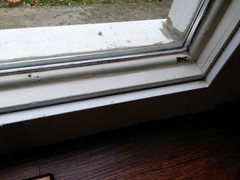
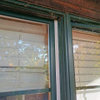
    This is a close-up of one of the windows from inside. Without any demolition, it appears that it is just quarter round keeping the glass panes in. It doesn't look like a real window to me, if that makes sense.

    I might try just re-caulking the windows to see if that helps this winter. I looked in the ceiling this morning, but I don't see any clear paths of water, so I haven't been able to figure out where the leak is coming from. I only know it isn't the roof, so I'm just suspecting the windows, since it only seems to leak with heavy rain.

  • PRO
    8 years ago
    last modified: 8 years ago

    Your caulk/trim job on the exterior looks pretty messy and that would be where I'd focus my attention. It's hard to tell from here but If that exterior trim isn't sloped forward away from the home then the rain that lands there will roll back and that old dry caulked will allow easy access into the home. You are correct that the 1/4 round is what is holding in the glass.

    Erin thanked Windows Direct USA of Cincinnati

  • PRO
    8 years ago

    That kind of direct set unit, the water damage could just as easily be from capillary leaks from between the glass and exterior glazing trim. Probably more likely to be honest.

    Erin thanked Windows on Washington Ltd