My builder uses Houzz Pro to plan the timeline and give detailed estimates and daily updates with photos of progress, and provide invoices at pre-agreed key points in the build. This made the whole experience much more efficient and stress-free.
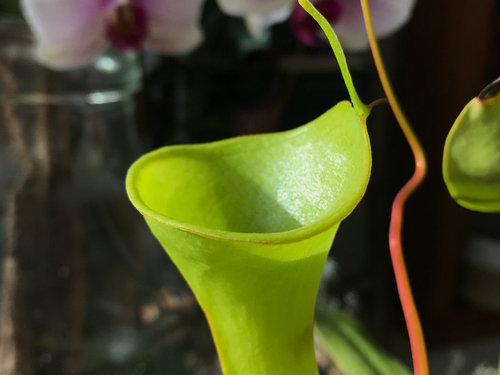
I’d like to try (again) to propagate my Nep. Inermis (pictured). I made a few cutting and all three have failed. I didn’t use any root promoter. Hopefully this is the reason they did not make it...
I always take a cutting with at least 3-4 leaves. Cut off the bottom 2 leaves and make a 45 degree cut at the end and stick in moist peat/perlite mix until the 2 leaf nodes are buried. I water to settle the soil around the cutting. Put in bright light (indirect Sun) and wait.
I would add that I enclose the cutting -- pot and all -- in an inflated clear bag tied shut with a twist tie. Open the bag once every couple weeks or so to allow fresh air into the bag and check to make sure the moss is still lightly moist. (Btw, I usually use pure lightly moist sphag or sphag with a bit of perlite.)
I've had about 50% success - when using a rooting hormone. The take-away from the the above posts is to use a media that is more or all sphagnum, rather than the usual mix for growing neps - I think.... The mini-greenhouse tip is a good one that I'll try.
I think that there might be 'seasons' when a greater chance of success is possible. My neps are happy in the greenhouse for the winter - but probably not actively growing.
My problem may have been that I used cuttings of one leaf only. I also cut the leaf in half. I think I read this in one of my carnivorous plant books. I will have to try two or three leaves and the soil composition that everyone has recommended.
You want more than one leaf node because roots tend to grow from leaf nodes. So if you have 1 or 2 or more nodes being covered by the propagation media, you'll have that many more chances of root growth. Also the leaf node may create another basal growth, so that you'll then have more than 1 stem coming up out of the growing medium. So having a few nodes buried could be helpful for those reasons.
Then, for the remaining leaves, you can cut them in some way (such as cutting them in half) because that will reduce moisture loss for a new cutting that so far, didn't have its own root system yet.
As an aside, this method of cutting can be used with many plants, not just Nepenthes. This is a common form of propagation for many plants, and once you have it down to how to get the cutting, you can do it for many things. No longer are you limited to just buying from the store, or growing from seed. Instead, you can reproduce many times over (other than the ones for which there are legal patents on to not do your own reproduction).
An example is when you are pruning tomato or pepper plants, don't just toss that cutting away (or don't just compost it). Turn it into a new plant!
I bag many plant cuttings like neps -- especially if done in winter -- as it enables me to maintain higher humidity. That way the rootless cutting doesn't become dehydrated as easily. (Particularly a big concern for me in the winter as my RH is typically around 10-15%.)



tommyr_gw Zone 6
Paul MI
Related Professionals
Ashland Landscape Architects & Landscape Designers · Morgan City Landscape Architects & Landscape Designers · Cambridge Landscape Architects & Landscape Designers · Frisco Landscape Architects & Landscape Designers · Laconia Landscape Architects & Landscape Designers · Syracuse Landscape Architects & Landscape Designers · Spring Landscape Contractors · Saint Cloud Landscape Contractors · Jamestown Landscape Contractors · Bainbridge Stone, Pavers & Concrete · Plainfield Stone, Pavers & Concrete · Pittsfield Stone, Pavers & Concrete · Orange County Stone, Pavers & Concrete · Redding Stone, Pavers & Concrete · Pocatello Stone, Pavers & Concreteapg4
tommyr_gw Zone 6
oldmangroot
S AOriginal Author
purslanegarden
Paul MI