Software
Houzz Logo Print
mail4kcc

Outdoor Winter Worm Bins

8 years ago
last modified: 8 years ago
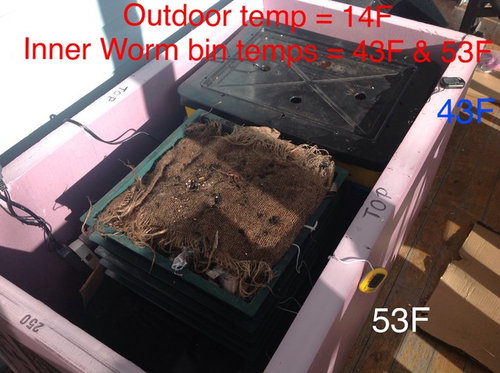
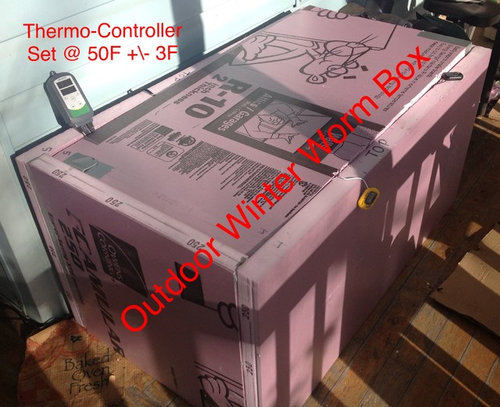
My wife & I didn't want worm bins in house over winter.

Attached photos show box made from a 4x8 sheet of 2 inch thick insulation board.

A thermocontroller, set to 50F, turns on two heating pads as needed. The larger bin h

as a seedling heat pad standing on edge in the dirt. The worm farm has a reptile heating pad ( glued to a piece of ceramic tile), located in the bottom most section were fluids collect.

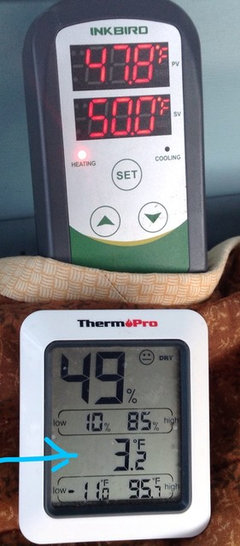
Last night the outside temps dropped to 14F. The two inner worm bins were at 43F and 53F.

Comments (16)

  • 8 years ago


    This morning the thermometer reads 3F, and the bin is still warm.

  • 8 years ago

    Here is a link to more project detail Project Notes

  • 8 years ago

    Recently the temps went down to -6F. For good measure I borrowed some cushions from our patio furniture and put them on top of the worm bin. It maintained 50F.

    A word of caution about soil moisture in a heated winter bin. It can dry out quickly due to the heaters and the fact that winter air itself is quite dry. When I add water to the bins I try to match the water temp to the soli temp, to avoid thermal shock to the worms.

  • 8 years ago

    Very clever Kevin. Great Idea. I'm not sure the worms will die when it gets below freezing and that is a topic for another time. I do know to my amazement red wigglers survive the winters in CT and just resume living in my outdoor compost bins which are left idle all winter after they cool.

    btw - I was originally told when we were done with our red wigglers to put them in the freezer to kill them before placing them in the garden.

    May I ask why the box doesn't have a bottom to it? I'm wondering if a bottom would help insulate a bit more.


  • 8 years ago

    Yes having a bottom would help - but as it is the box already easily maintains 50F. But with a bottom is would take even less energy to maintain that temp. The real reason it is bottomless is I was able to make the whole thing with only one sheet of insulation board.

  • 8 years ago

    You may have heard red wigglers loose in the wild will eat all leave litter in a Forrest. This causes the ground to because hard packed dirt rather than remain the soft spongy Forrest floor it needs to be a healthy Forrest ecosystem.

  • 8 years ago

    <I was able to make the whole thing with only one sheet of insulation board.> That makes sense.

    <You may have heard red wigglers loose in the wild will eat all leave litter in a Forrest> IF the freeze will kill them that just isn't possible.

    What I do know is I didn't put the red wigglers in my compost pile so they migrated from the soil on their own. Which reminds me when I began gardening in this soil back in 2000 I noticed the worms were much smaller than the ones I remembered from childhood which I now think are called Crazy Snake worms.

    btw - I have been told there are (were) no worms which are native to North America. Hard to believe.

  • 8 years ago

    Gumby - Yes I'd hear that too - no worms in old America. Amazing ! I wonder how they've changed our Eco-cycle from the old days.

  • 8 years ago

    Most of the half dozen sites I scanned said that the last ice age wiped out the worms and that there are none native to the forest of North America. None seem to explain further. Are the any native earthworms in the jungles of central America, for example?

  • 8 years ago

    I find it interesting that there was an "Ice Age" before there was a gasoline engine to cause "Global Warming". Could this all be part of a normal weather cycle?


  • 8 years ago

    That could be but the life span of my worms and I, as well as recorded history, is too short to know. But there's always science . . . personally I find it frustrating that big money and the false news they buy deny any scientific fact that interferes with their financial gain.

  • 8 years ago
    last modified: 8 years ago
    I have 2 plastic bins outside year-round. No insulation. In winter, I bottom-heat with Rope Light. This is my system.

    This is my heating system for keeping my 2 bins warm all winter. My bins are outside
    all year long.: Get a wooden pallet large enough to hold your bins. Put some
    insulation on the floor to keep the heat from being wasted, or use a wooden table as I do with the pallet on top. Now get a length of Rope Light with the little incandescent bulbs (not LED's). It gives off heat. My rope light is rated at 16w/meter and I have 5 meters. That
    gives me a total of 80w. You can buy it as long as you want, just do the math to figure out total wattage. Coil or snake the rope light underneath the pallet and block the side openings with Styrofoam or some other insulation, so that the only place for the heat to go is up (between the slats). If you think 80w isn't much, try holding a lit 80w light bulb. I also installed a dimmer switch between the electrical outlet and the rope which gives me a full range between 0-80w. Using long-stemmed oven thermometers ( with the dial on top), I can regulate the temperature up or down. I also cover the bins with a plastic table cloth in Winter (just enough to keep out the rain but not enough to prevent airflow). I’ve also found that Solar-Reflective Mylar works well for covering the bins as it keeps the heat in and with the Dimmer switch, that means you can achieve the same heat with less wattage. My bins are outside and this system keeps them toasty warm, even through snow and sub-freezing temperatures. Bottom line: Use the system that works best for you.

  • 8 years ago
    last modified: 8 years ago

    You might just be able to put your bins into a 4 ft deep hole in the ground and cover it with styrofoam and call it good. For a while I lived in a cabin in northern Michigan in which the well pump was housed in a 2 foot deep pit with a wooden trap door over it and the relays never froze... on super cold clear nights (temps dropping into the negative twenties) I'd turn on a drop light in the pit with a 25-watt bulb and that would do the trick. The ground is not only good for insulation but can provide some geothermal heating if you go down at least 3.5 ft.

    In another thread I recently related a story of my worm bins freezing solid (bedding) this winter and yet to my amazement my worms didn't die... so, apparently there is some validity to what gumby suggested earlier. However they won't "work" at temps that low...

    Anyway, I just thought I'd throw out the idea of a simple pit as something that's easy to do and should work if all you're looking for is to keep the worms alive through the winter outdoors... however if you want them to work through the winter then likely you will need to apply some heat source.

  • 8 years ago

    Thanks. This is a useful idea. Here in Northern Virginia we hit -4F one day this winter. I took the precaution of moving the worm condo 'indoors' to the garage, and applying a seedling heating mat. This is an interesting alternative. However, I know I'd be less effective as a provider of kitchen scraps to the worms if it meant spending time outside in a windy -4F ;) Popping out to the garage was fine, mostly :)

  • 4 years ago

    sorry, there were worms here. red wrigglers are not native, they compete for groud and annihilate native species. this is why we are told to kill before putting in garden or compost.

Sponsored
Kuhns Contracting, Inc.
Average rating: 5 out of 5 stars26 Reviews
Central Ohio's Trusted Home Remodeler Specializing in Kitchens & Baths