Software
Houzz Logo Print
ficusgw

Favorite fungus gnat control?

8 years ago
last modified: 8 years ago
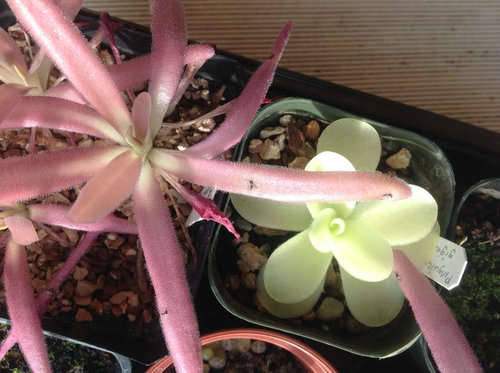
I know fungus gnat "issues" crop up for many folks, and different folks have different solutions to that problem. Personally, these are mine...


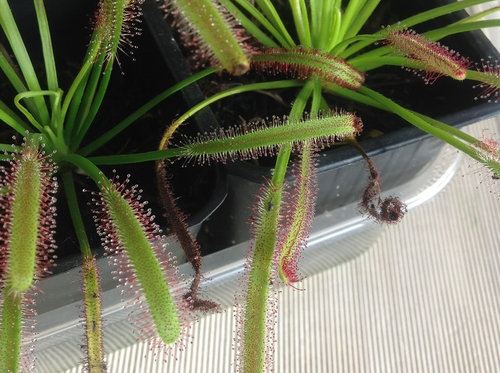
The black dots dots on the leaves are gnats which made the mistake of landing on the leaves. They are now fertilizer. Heh

Comments (51)

  • 8 years ago
    last modified: 8 years ago
    Cool.

    I have yellow sticky strips on windowsills. They catch all the fungus gnats. It's an entomological education on those strips during the summer. I live in the forest.

  • 8 years ago

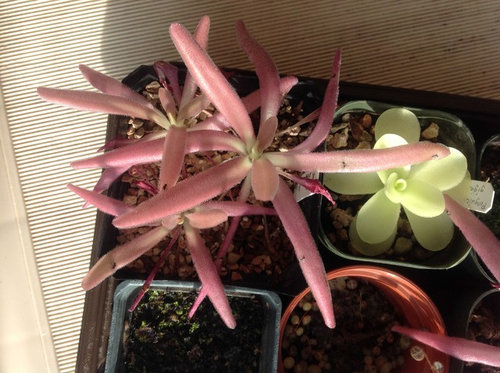
    @DViolet: The first two photos are of Pinguicula -- aka "butterworts" -- and the last two are of Drosera -- aka "sundews". Both genera are carnivorous plants. I have quite a few of both currently but especially the Drosera as I will be selling them off at the orchids shows in the spring or individually to people here and there. The pings also have rather attractive, simple flowers and typically flower quite easily as an added bonus.

  • 8 years ago

    Very cool! Plant shelf justice!

  • 8 years ago

    I envy you. I kill every one of those "carnivorous" plants I buy. I kept one alive from spring to summer outside on my porch and it did well. However I brought it in and it is now dead. I guess. Well there is no green anymore. But I can see where they would be effective! Rosie

  • 8 years ago
    last modified: 8 years ago
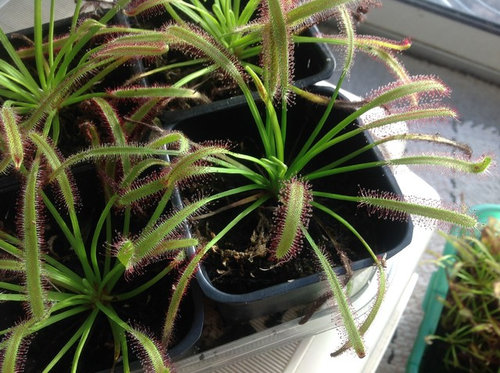
    Depends upon which cps you tried, Rosie. Dionea (venus flytraps), for instance, desire lots of strong sun during the summer but require a cold winter dormancy for long term health. The Drosera I grow are incredibly easy provided you never let them dry out. I grow mine sitting in containers of water. My Pings are also very easy but if grown on a windowsill will likely enter a non-carnivorous "resting" period but grown under lights are more likely to remain in bug catching mode.

    With most cps, the critical issue is water quality. Because many, like the Drosera, are bog dwellers where total dissolved (mineral) solids --TDS -- are very low to negligible, they are extremely sensitive to dissolved salts in soil and water. Well water is typically high in TDS and as are most city water sources. In addition, city water often has fluorides and chlorides present. These can quickly reach toxic levels for cps. Mine get either rain water, distilled, or RO water on account of this.

  • 8 years ago

    Paul mine were Venus Fly Traps. I used tap water, never let them go dry and they looked good! They even caught a fly or two! Now they are dry in their pots, probably dead. What is RO water? Rosie

    PS. I know this is not the forum for this but "this" overlapped into violets!

  • 8 years ago

    Vfts don't make good gnat catchers ... gnats are typically too small to set off the traps.

    The tap water very well may have been an issue as vfts are, like many cps, sensitive to mineral salts in the water. Would depend on what the TDS concentration is like. RO = reverse osmosis.

    The potting media may also have been an issue. Were they the "death cube" inmates found at a BBS?

    They like very strong light -- full summer sun in our latitude can be done all day long once hardened off. At least a few hours of direct sun is desirable with more being better. Indoors, they would want to be very close to the lights on a plantstand. Weaker light leads to etiolation.

    They prefer deep pots -- a 6-8" pot is usually deep enough.

    Never let them dry out during active growth. You can leave them sitting in water.

    For long term health they require a cold winter dormancy. Our winters a generally too harsh. They can be overwintered in a refrigerator, a chilly basement window, even a cold garage. During this time, the media should be barely damp.

  • 8 years ago

    Thanks Paul. Rosie

  • 8 years ago

    Buy
    a package of "Mosquito dunks" at the garden center. Put one
    quarter of one in your watering can. This will kill the larvae in the
    soil and stop future generations. It is all natural and safe. Use
    sticky traps and manually kill the adults.

    The carnivorous plants won't eliminate your problem. They will help a LITTLE though.

  • 8 years ago

    I'd have to disagree with you, Tommy, fungus gnats are rare for me so I do think the cps have done more than a "little" to keep the gnats in check.

    Watering with mosquito dunk water is always a good control.

  • 8 years ago

    The only thing I'm finding much success with at the moment is a shop vac. I'm rotating various plants through my enclosed closet grow rack. Even though I zap the soil for my seed starts in the microwave first, I also have pots of lettuce I've been growing for a while with soil that didn't get zapped and it always seems to produce gnats. I tried the little bowl of apple cider vinegar but that did nothing. Got frustrated one day and grabbed the small shop vac that I keep stored in the closet and just made some passes above the plants and around the lights and sucked probably a dozen of them up that were flitting around.

    Doesn't get them all (nothing does), but it seem to get most.

  • 8 years ago

    Tim, watering with water inoculated with BT via using chunks of a "mosquito dunk", as has been mentioned, will go a long way towards controlling or even eliminating your gnat probs. Effects aren't immediate, though.

  • 8 years ago

    The flittering ones already had lots of hot gnat sex and put hundreds of gnatty eggs... so vacuuming them will give you a satisfaction, but not the permanent solution. More is coming in a week

  • 8 years ago

    Oh my Irina! I am blushing! (Victorian) Rosie

  • 8 years ago

    Love the info. All my plants have been in isolation this week. All soil sterilized and repotted. I still found a litter buggar flying. Mosquito dunk coming up. I use a gallon jug. Is 1/4 ok for a gallon of water?

  • 8 years ago

    Yes 1/4 is fine, even 1/8th is fine. Remember, that will only kill the larvae in the soil not the already flying adults. Kill them manually or with sticky traps.

  • 8 years ago

    great!

  • 8 years ago

    Cheryl

    " Mosquito dunk coming up. I use a gallon jug. Is 1/4 ok for a gallon of water?"

    tommyr_gw Zone 6

    "Yes 1/4 is fine, even 1/8th is fine"

    I agree completely with Tommy on that. You will want to leave the chunk of dunk soaking in the water overnight or longer as they do not dissolve instantly. (Keep in mind the dunks are meant to float around in one's pond providing protection for a week or more -- can't recall the time frame mentioned on the package -- so they are designed to dissolve fairly slowly.) Also, I recommend that before watering you agitate the water jug a bit to make sure the bacteria are mixed more evenly throughout. If the piece you have in the jug is still more or less intact -- hasn't broken up completely -- it can be used again to inoculate the next gallon of water.

  • 8 years ago

    I plan on getting some myself -- very helpful posts. Does one watering with this solution do it, or do you repeat the application and if so for how long?

    So if it's an insecticide does it break down, wash away or eventually dilute to nothing in the soil? I ask because I wonder whether once you start using the dunks, you have to always be wearing gloves when repotting and handling the potting mix. Or is this relatively safe to handle, maybe like Cutter's or Off spray you use to repel mosquitoes?

    I know you're supposed to wear gloves but I never got in the routine of using them. This sounds like a game changer, but maybe not?

  • 8 years ago
    last modified: 8 years ago
    Repeat and use every watering. I never use gloves with the product. Just wash your hands when done. It's safe. Of coarse AS ALWAYS read and follow label directions.

  • 8 years ago

    Mosquito dunk is Bacterium thuringensis. After you activate it - dissolve in water - it is primed to attack gnat's larva. But it will not stay alive in soil for long. So if you have a major infestation - repeat the drench weekly until you do not see them. Since it is not a systemic - and works on contact only - persistence pays. Since it is not dangerous to humans and pets - washing hands is enough.

  • 8 years ago

    K, went to Home Depot. The nice man is going to share his with me. I didn’t even have to buy. Happy dance. He bought on clearance and in bulk, just have to pick up tomorrow.


    Now, here a question. I’ve brought in water spikes for my plants. All r n good draining sterilized soil, ( I sterilized myself recently) . The spikes only give when soil is dry and needed so I am thinking I can drench and drain every so often and it should not interfere with spikes? They should pick up where I leave off. Reasonable?

  • 8 years ago

    Plus don’t think bacterial solution would work thru spike system

  • 8 years ago

    I have a strong suspicion that the best thing you can do with these water spikes is - return them now.

    Since they are not that expensive - you can try on how it works - and probably chuck them later.

    If you read the description for these spikes - you need to prewet the soil. They do not promise that spike will be only watering the soil if it is dry. If it is dry - the water will just run out through the narrow channel without wetting the whole pot. The spike is a porous cone with a water coming from the bottle above. The amount of water getting out and into the soil depends on the size of these pores and the water pressure - full bottle will push more water through than almost empty. Works on gravity.

    Some of these water spikes work OK, some run out of water in 2 hours... imagine the mess. They are designed to help you to care for your plants if you are going for a vacation and do not have anybody to ask to come and water your plants.

    If you want to do automatic watering - wicking or Oyama pots work better - water moves up against the gravity by capillary action and when the soil is as wet as the wick - the movement stops. It adds water only to replenish evaporation and what plant takes,

    Irina, Very Skeptical.


  • 8 years ago

    K, that’s new. I understood that the reservoir was below the plant and that it also worked by capillary action. If the reservoir is above the plant then it works by gravity and will drown the plant. I certainly was hoping that it would work. We do travel. Trying to prep for that. My begonias need to be evenly wet. I soaked them for a couple of days and have tried 2 so far.

  • 8 years ago

    Irina - they came highly recommended by Summer Raine Oaks off of Plant One on Me. - haha, I bought 45 of them altogether. 15 the 1st time then an addition 35. Could b a big boo boo I guess. Live n learn and return,return ,return ,return. ; )

  • 8 years ago

    I am with Irina. Rosie

  • 8 years ago

    K, I reread the post. Understand the small channel. Might look at the Oyama pots although I am impressed with the wicking too. Just would need to see how to do it on larger pots. I thought would be the same principle. Back to the drawing boards.

  • 8 years ago

    irina_co(z5 CO)

    "Mosquito dunk is Bacterium thuringensis. ...- and works on contact only ..."

    A small correction here. It does not work on contact but rather by ingestion. After being consumed, the bacteria proliferate in the larva's gut at a an extremely high rate. So much so that the larva quits feeding and starves to death.

    It is harmless to humans, vertebrates, and most invertebrates as well. There is a strain that is used to kill off caterpillars as well.

  • 8 years ago

    Good info to know. Thx Paul

  • 8 years ago

    Thanks Paul and Irina. And very interesting about it being Bacterium... and not insecticide.

    The procedure would seem pretty straight forward, however, still wondering a few things. Maybe I'll find the answers in the instructions when I get it, but hope you don't mind me asking anyway...

    1. Is there a difference between a 'watering' and a 'drench'? Both are top-watered or can a bottom watering be done, too.
    2. Does Irina's drench mean letting water run out bottom and Paul's watering does not? Are plants taken to a sink for a drenching, and a watering is just done where the plants sit?
    3. How does having wicked violets that are already moist play into a weekly MD drench? Wouldn't weekly drenching on already moist soil keep the soil too soggy? Should a watering/drench be done on somewhat drier soil?

    Seems to be in my nature to take a simple process and start complicating it, LOL. Thanks again everyone.

  • 8 years ago

    You can top or bottom water but CPs normally sit in water trays (except for nepenthes) so just add the MD water to the water trays.

  • 8 years ago

    To drench it efficiently you need to take it to the sink - I use a dedicated turkey baster - you can use something else - apply it the solution to the surface of the soil slowly enough and in different points of the surface to make sure the first inch of soil where gnat larva lives is thoroughly drenched. Probably the solution will run out of the soil - I just keep the pots in a sink until they drip out. I think if you water from the bottom - when the water reaches to the top - the concentration of bacteria would be lower than if you water from the top, And turkey baster - because sometimes water runs down leaving pockets of soil not soaked. I want to make sure the every nook and corner is treated - and bacteria give indigestion to every single wormie, not only to ones to the left.

    You can use the turkey baster without taking plants off the tray, but some of the soil will run out and make your solution dirty. BTW - if you have your plants on wicks and mats - wash the mats often - the green algae or cyanobacteria - as we know now - is a good feed for gnat larvae - if it is very green - the gnats will put eggs on the mat and then you will have clouds of them.

  • 8 years ago
    last modified: 8 years ago

    Personally, I would water from the top. If you allow your media to dry a slightly between waterings, then I would have the pot sitting in a saucer or small bowl. Top water but allow pot to sit in the water that drains out the bottom for a couple minutes to absorb water that runs through then drain.

    Have never tried this with wicked plants.

    Also don't bother using MD with my cps ... no reason to.

  • 8 years ago

    Got my MD’s yesterday!!!

    good info on Cyanobacteria and larvae. Awesome to know. Love this cite.

  • 8 years ago

    Got my MD's today, from Amazon. So I took one and ground it up with the blunt end of a tool handle -- in part to make it dissolve better, and in part to measure how much is in each cake to make it easy to mix smaller amounts. For my smaller pots in my grow rack, I use a smaller 32oz (quart) water bottle to reach in the back.

    The ones I got measured to almost 9 teaspoons each when ground up. I'll just round that to 8 to make it easier. Since the recommendation was 1/4 cake per gallon, that's about 2 teaspoons per gallon, or 1/2 teaspoon per quart bottle.

    I'll mix it up now and see how it does over the coming weeks.

  • 8 years ago
    last modified: 8 years ago

    So is the Mosquito Dunk suppose to dissolve in water? Mine isn't, even after grinding it up. Even after letting it sit in the water can overnight, it just sits on top like little styrofoam balls or something.

    Is it supposed to be more like a tea bag, where you let the chemical in it leach out into the water and then discard the dunk cake?? Doesn't look like there's any way this stuff is totally dissolving. Here's the type I got...

    https://www.amazon.com/gp/product/B0000AH849/ref=oh_aui_detailpage_o00_s00?ie=UTF8&psc=1

  • 8 years ago

    Over time it will but it is working even though it isn't dissolved. Give it a hour or so to inoculate the water.

  • 8 years ago

    I suspect some of it has dissolved but at least half just sits on top of the water and kinda creates a mess. That's after soaking for almost 24 hours now. I probably shouldn't have ground it up. I thought that would help but it just made it messy. I'll try again without grinding it up.

    So when you put 1/4 of one in your water can, does the chuck just stay in there slowly dissolving for days/weeks, such that you use that same piece for multiple can fill-ups? Or is yours dissolving completely in less than a day?

    If it's multiple-time use, I'm thinking of hanging a chunk in a piece of cheesecloth to let it leach for each can filling until it's mostly gone.

  • 8 years ago

    The chunk will slowly fall apart over time. It lasts a while. It'll dissolve and pieces will come out with the water. Perfectly normal and fine.

  • 8 years ago
    last modified: 8 years ago

    That would be OK for my bigger water can but my quart bottle drip nozzle has very fine holes for gentle watering of my smaller pots and seed start containers, so I need to minimize the gunk so it doesn't clog. But I ran it all through a funnel with cheesecloth and that filtered it much better. From now on I think I'll just tie it up with cheesecloth and dunk it like a tea bag to inoculate the water. Should work.

    Thanks for the MD idea.

  • 8 years ago

    Yes the cheesecloth will work fine. I use an aquarium filter bag sometimes.

  • 8 years ago

    Thanks for the info everyone. Tim, I plan on going the turkey baster route (thanks Irina) so using something like that shouldn't present an issue with any MD particles, if any, clogging the tip. It's a fairly good sized opening yet the tip is small enough to get it between the leaves to the soil. Also, if you have particles floating on top in the MD jug, the baster tip can draw water from below the surface. That's my thinking in theory at least -- haven't tried it yet.

    This morning I found 3 small insects with wings in a reservoir, like tiny flies but big enough to see the wings. Guess I should have taken a pic before disposing of them. They seemed bigger than gnats, IDK, maybe they were, and I'm sure they were up to no good whatever they are. So I'm thinking I need to do the MDs sooner than later.

    The only issue I'm running into right now is finding room for all these gallon jugs -- anyone know if these jugs of solution and mixtures can be kept outside in a garden shed? We get some extreme heat in the summer so I'm wondering whether Physan, MD, fertilizer, etc. solutions would remain stable outdoors.

  • 8 years ago
    last modified: 8 years ago

    Most chemicals need to be stored in a cool, dark area. Heat and light can promote chemical reactions which can render a chemical ineffective. Regarding MD, in its dry "doughnut" form, I would expect heat would be less of an issue. However, once the bacteria have been "awakened" in a water solution, I would think high heat would likely kill the bacteria off.

  • 8 years ago

    I put a little diatomaceous earth in my soil mix and don't have problems with gnats anymore. It's supposed to kill the larvae, not adults.

  • 8 years ago

    I have the jug issue too. Hubby loves the plants but tired of all the jugs at watering time. I moved them to garage but like to water with warm not cold water. Not happening in cold garage. Looking for solution. Just bought diatomaceous earth too. Is there a prob to use both. Seems DE would simply mix with dirt add calcium and drainage. Sounds like a winner to me. Where as MD’s would act quicker by water traffic.

  • 8 years ago

    Paul, makes perfect sense about the heat -- guess I was more wishful and less rational about the idea I had about storing the jugs. I'll think of something else for storage.

    In Cheryl's case, she could always warm the jug to room temp when she needed to use it, but couldn't extreme cold be as bad as heat in keeping the bacteria viable?

    Good idea about using the DE. Used to have giant bags of DE laying around but not after we switched out our pool filter type. Either way, DE or MD, looks like sticky tape is needed for the adults.

  • 8 years ago

    Cold could indeed be an issue though I don't know what the bacteria's tolerance is.

    Do be careful when using DE. You DO NOT want to breath in any of the dust nor get the dust in your eyes. DE is made from diatom deposits. Diatoms are microscopic aquatic organisms which construct a silicon (glass) "house" around themselves. When they die, their glass houses accumulate in areas and is harvested as DE. Because these teeny glass structures are fragile, getting DE in your respiratory system or in your eyes is the equivalent of getting small amounts of ground up glass in them and can cause irritation.

  • 8 years ago

    Paul MR - so good to know! I thought ground egg shell. So much for google,- hehe!