Software
Houzz Logo Print
redneckgirlgreenthumb

Maybe a dumb question.....

This may be a dumb question, but here goes....If you have two trees, both seedlings, and you inarch graft them together, will the rootstock influence when the top will bloom and produce? Or will it take just as long as the top of the graft would take on its own roots before it would bloom? Am I making sense? Not sure if I am asking it right. Lol.

Please, can someone explain how this would work? Would it be beneficial to even inarch the two together?

Thanks


Comments (12)

  • 8 years ago
    last modified: 8 years ago

    From reading redneck's post I don't think he wants to cut one of the seedlings. He is asking if you graft the two seedlings together will the "scion" grow faster/stronger because it has two root stocks to nourish the tree.

    redneckgirlgreenthumb thanked Silica
  • 8 years ago

    I am assuming that the seedlings are both the same and one of the tops would be blessed with 2 rootstocks. My guess is there will be a boost in growth till the top catches up with the sum total of the 2 root masses. If the one seedling is rootstock and the other seeding is scion and you cut the top of the rootstock without cutting the roots of the scion the tree will stick with its own kind and the rootstock roots will not be fed and will die.

    I asked a similar question If I took a seed grown kumquat and side grafted a mature calamondin scion near the roots would I trick the whole tree into thinking it was mature enough to fruit. I had access to calamondin scion back then.

  • 8 years ago

    We can try to find out :))

  • 8 years ago

    Think I may have found the answer to the question I asked, then again I may have just created more questions.

    https://books.google.com/books?id=U3pRAAAAYAAJ&pg=PA4&lpg=PA4&dq=finger+lime+inarch&source=bl&ots=5I_SoqV_Es&sig=WEtfbxtjj9IVrNwpKTZO938acig&hl=en&sa=X&ved=0ahUKEwi4juLbubjYAhXK6iYKHZsTDHgQ6AEIXzAN#v=onepage&q=finger%20lime%20inarch&f=false

    "One of the finger lime seedlings was inarched upon a vigorous two year old lemon tree. All the strength of that tree was diverted into the slender shoot. IN TWO YEARS IT HAD RIPEN ITS FRUIT..."

    "The inarch is accomplished in this way: the seedling is grown to the age of but three or four weeks. It is a weak little plant of but four or six leaves. Nature has stipulated that many years must pass before it comes to maturity, blossoms and bears fruit. Under the inarch process this stripling is taken up with a ball of earth about its roots sufficient to maintain its life for a few weeks. The whole is transferred to a stalwart, vigorous tree of a kindred species. This tree may be two or three years old."

    It is then inarched to the "nurse" tree.

    "In two or three weeks the plants have grown together. The dirt from from the seedling may be removed.....eventually its roots are cut off smoothly below the point of union....After the union is firmly established the plant juggler cuts the top off the great vigorous nurse tree.'

    What I'm not sure I understand is, how does this shorten the wait from seed to bloom? Is it because the nurse tree is two years old already? So then it would only take two more years to get fruit?

    Sorry, if this seems like a newbie question. I am fascinated by the ways a person can manipulate the fruiting of various plants, but don't always understand the science of it.

  • 8 years ago

    That is wyhat grafting is. You take a bud from a tree and put that tiny bud into a several year old rootstock and divert all the nergy into the new bud,

    Fukushu in c35 roots

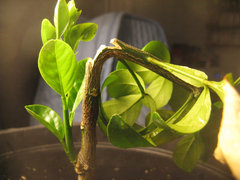
    bend but not kill to force trees energy into the highes bud that is on good rootstock
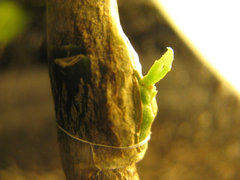
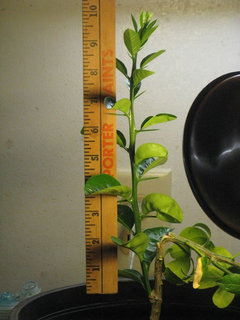
    very rapid growth of scion with no growth to rootstock, .Rootstock top is left on to generate food for the roots to keep the scion growing fast.
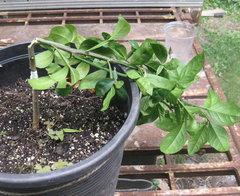
    Still shooting up like a weed Tree grows outside in the sun and is given 4 hours additional light as seen to complete its 16 hours daylight.
    Fukushu out grows seed grown kumquat tree 2 to 1 in 1/3 the time.Fukushu between to Meiwa trees
    Yes your idea will work very well. once the graft has taken break the top of the root stock over without killing it so it can feed the roots while the scion grows. The small scion will not be able to feed the roots on its own.

    Steve

    redneckgirlgreenthumb thanked poncirusguy6b452xx
  • 8 years ago

    I did more research, and found that the inarch method is also called a splice approach graft. Most sites say it is an almost fool proof way to graft the two plants together, however they have to both be in active growth to do this type of graft. Soo... maybe more research on this subject for me. As I am not confident enough to do bud grafting, yet.

  • 8 years ago
    last modified: 8 years ago

    I believe the answer is essentially 'no'.

    Grafting immature scion wood (despite the grafting method) to a rootstock will likely not significantly promote earlier blooming of the scion, except perhaps it might grow just a bit faster if the 'rootstock' has a healthy root system. So, if we're talking a variety that may need 14 years to bloom, then maybe it could be reduced to 13, LOL!

    Since the scion 'wood' is still a seedling and of juvenile growth, it still needs to grow significantly in size before it undergoes the transition from the juvenile phase to the reproductive phase to develop flowering buds ... a process that can take several to up to 12 years or more, depending on variety.

    What specific citrus are we talking about here? And is one of your seedlings significantly larger than the other one? And since both are seedlings, they are likely BOTH of immature wood.

    Perhaps you are wondering whether you can graft an immature scion to a mature rootstock and are hoping that maybe there are some hormones or chemicals in the rootstock that might work their way into the scion to promote the mature growth? I do not believe that occurs. But I could be wrong. But if it would work, I would think breeders would be injecting hormone into seedlings to promote early bloom. As far as I know, they aren't doing that.

    There was one study I read about where they were able to promote earlier bloom by introducing a Citrus leaf blotch virus into the juvenile seedling.

  • 8 years ago

    Well, I was wanting to graft a finger lime on to key lime root stock. But I only have a few finger lime seedlings, and really wanted a "for dummies" type of graft. LOL. Since I am new to grafting. Plus in my research, I read that if the graft doesn't work, both of your trees are still alive. So I wont feel as if I killed my babies. LOL The key lime seedling is about a year and a half old, and the finger lime seedlings are still very small. Plus, I was hoping to cut down the wait for blooms and fruit on the finger limes? I am hoping to germinate some flying dragon seed this spring, to try grafting with, but don't have any right now, hence the use of the key lime seedling.

  • 8 years ago
    last modified: 8 years ago

    OK. Well, I do not know the average time for finger limes to grow before they can fruit. I did see on one site that said up to 15 years. Yikes! So, this is one reason why most citrus is typically NOT grown from seed. LOL! Is it really worth that time for you? Maybe you should consider purchasing a mature finger lime plant or work out a deal with someone to provide you some cuttings of mature wood.

    redneckgirlgreenthumb thanked Dave in NoVA • N. Virginia • zone 7A
  • 8 years ago

    I will probably order one this spring. But I do like the challenge of growing from seed, although the wait for blooms and fruit is a real bummer. I have read various articles that say anywhere from 5-15 years for them to fruit, so I don't know exactly how long it will take. In the article "Hastening the Development of Trees by Inarching" from the California Fruit News, that I linked to in the above post, states it take 8 years under normal conditions. But that by inarching, (slice approach grafting), that they had blooms in TWO years. So who knows, guess I can try and see.?

  • 8 years ago

    The wait time depends on the type of seed was planted. Calamondin and Key lime 2-3 years, grapefruit 7 - 10 years (n a container much longer if at all), mandarins 3 - 5 years and oranges 8 - 15 years.