Software
Houzz Logo Print
alex_g76

Potted Benjamina Ficus losing leaves

8 years ago
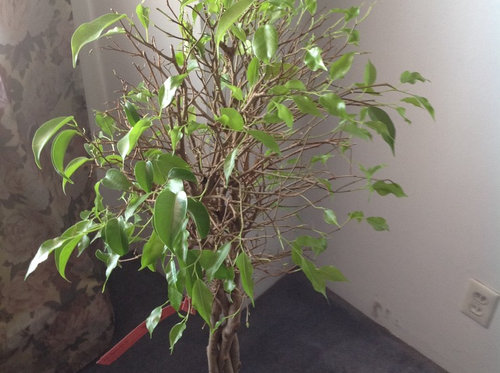
Hi everybody!


Happy New Year to all!


Late last November, I purchased from the Fast-Growing-Trees a beautiful 3'-high Benjamina Ficus tree, which was delivered to me in a 3-gal standard pot on December 2nd. The tree was in a great shape with a nicely trimmed crown of dense leaves. A week later, I re-potted it into a larger pot with good drainage. Soon afterwards, it started to loose lots of leaves. And in spite of the fact that many new ones continually appear, the tree is far from looking happy. I water it approximately once a week and only when the soil is completely dry about two inches down. The thing is that when I stick my finger into the soil and feel that it is dry some two inches down, the root ball is still a bit wet. Therefore, I am not sure when to water it: when the 2" layer of the soil is dry or when the root ball is a bit dry.


Although I am not much of a gardener or house plant expert, I have read a lot about how sensitive to any change (temperature, humidity, light, location) Benjamina Ficus tree can be and that losing leaves is its response to any change. The problem I am facing is twofold: I live in an apartment where none of the windows provides bright sunlight (the tree stands now near the biggest window). In addition, the air in the apartment, esp. now in winter time, is pretty dry. So, in the course of past month, the tree had to acclimatized and adjust to these rather uncomfortable conditions.


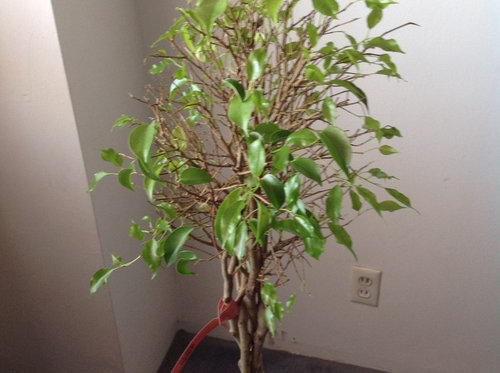
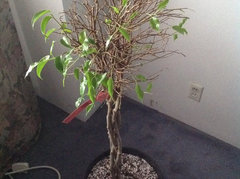
I'd appreciate any educated advise on how to revive and bring back this nice tree, which feels rather miserable now, which you can see on the attached photos. Shoul I start to fertilize it? Fast-Growing-Trees site recommends using a 10-10-10 ration fertilizer, but I have no clue as to whether there is a commercial product with this ratio.


Thanks much in advance for reading this rather longish post and for any help with this problem.


Comments (21)

  • 8 years ago
    last modified: 8 years ago

    You’re over watering if you’re watering on a set schedule and can still detect moisture deeper in the pot.

    How much light does it get?

    What part of the world are you in?

    Repotting in December isn’t advisable if you’re in the northern hemisphere as this would be the time of year the tree is at its weakest state.

    Lastlg, did you fully repot or just pot up (where you only add new soil to the bottom and sides)? If the later, the extra layer of soil is likely helping to drown and smother the roots.

    If you potted up, I’d get it back in it’s original pot for now.

    Don’t fertilize now while the tree is in this state. A 10-10-10 fertilizer is not a good choice for this tree. A 9-3-6, 12-4-8, etc has the correct NPK ratio.

    read through these:

    http://forums2.gardenweb.com/discussions/1476078/ficus-trees-in-containers-iv?n=223

    http://forums2.gardenweb.com/discussions/2842847/container-soils-water-movement-and-retention?n=8

    Lastly, this is the edible fig forum so you may not get much help here. F. Benjamina is not an edible fig.

    ill come back and check this thread later.

  • 8 years ago

    Thank you, Moses.

    This is exactly what I am now trying to do, i.e. I am trying to avoid overwatering. I really hope the tree will come back from this misery. I am attaching today's photo.

    Thanks much again.

  • 8 years ago

    I agree with suggestions above.

    Also there seems to be way too many branches some are probably dead. You should trim off all the dead branches and prune some of the live branches so that the tree is open in the centre so light and air can freely penetrate.

  • 8 years ago

    The thing is that its branches are too thin. Some - thinner than a toothpick. Hard to say which ones are dried up as many of these thin ones have just dropped their leaves. I am afraid of damaging the tree by pruning it at this stage. Also, as you can see, the "head" of the tree is pretty bare already. There's no problem getting air or light.

  • 8 years ago

    I strongly disagree that the tree is “fine.”

    These trees will loose leaves for a few different reasons, but the tree above has lost an alarming amount of leaves.

    If no action is taken, you will lose the tree. I can just about guarantee that.

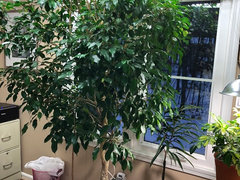
    I grow a few of these trees and have a good handle on their care. A soil made up of large particles that is extremely fast draining is just about the best thing you can do for the tree. They also want as much possible light as you can give. My tree below is in front of a south facing window, gets direct sunlight and has 3 grow lights overhead.

    I would also highly recommend Dyna Gro’s Folliage Pro 9-3-6 highly over any MG fertilizer.


    This one was smaller than yours 3 years ago and I now keep it trimmed at 7 feet.


  • 8 years ago

    Dave,

    Thanks, of course, for your reaction and willingness to help, but this is precisely what I was saying when I turned for outside SOS advice. What you're saying is precisely what I described in my original post. If you have read it prior to looking at the photo, you will notice that a) I have already raised alarm that my tree didn't seem to be fine at all; b) that I mixed in a lot of perlite (albeit not very coarse) to aerate the soil all the way down and provide drainage; and c) that indeed the tree was additionally stressed by limited amount of light because, unfortunately, I do not have a better/brighter spot in my apartment. Hence my concern.

  • 8 years ago

    Alex, I wasn’t starting you didn’t do any of those things.

    My response was mainly due to what Moses wrote. Making it seem completely normal and not to worry.

    I wanted it to be clear that you should in fact worry.

    Get the tree in front of your brightest possible window.

    For watering, use the dowel method to check to see if you need to water.

    Sharpen a wooden dowel and stick it in the soil all the way to the bottom. If it comes out damp, dark with soil stuck to it, don’t water.

    Keep checking every day or so and water when it comes out nearly clean and dry.

    Your plant will be using VERY LITTLE water right now since it doesn’t have much foliage to support.

  • 8 years ago

    I understand, Dave, what you're saying. My serious concern, however, is that the leaves are falling off too fast and, before I know it, there won't be any need for checking the level of soil dampness. But I shall certainly keep watching closely. Thanks.

  • 8 years ago

    Did you repot or pot up?

  • 8 years ago

    What I did was this in steps: 1) I took out probably 3/4 of the soil it was in, carefully lifted the tree; 2) very carefully cleared the root ball of the wet soil attached and set it aside for a short while; 3) mixed the soil remaining in the pot as well as the soil I had taken out in Step 1 with a lot of perlite; 4) created a comfortable enough little crater for the root ball; 5) planted the tree into it; 5) covered with the soil already mixed up with perlite. That I did on January 8. On January 10, I checked the soil - it was completely dry, including around the root. I watered it just a bit around the trunk so that the water trickles down a bit directly to the root.

    Measuring the soil dampness with a dowel may very well be a widely used and in some cases dependable method, but the problem with it is that when you stick the dowel in and take out the soil around the root may be completely dry (making you think that it is proper time to water the tree), but the root may remain wet much longer

  • 8 years ago

    How long did you set side the tree out of soil? You need to always keep the roots wet or they will die quickly.

    I’m not sure what you mean with the last comment about the dowel method.

    It’s probably the best way to check. Are you misunderstanding, maybe?

  • 8 years ago

    It was out for about 20 min, but the roots were slightly moist all the time.

    Re the dowel, I mean that when you stick the dowel into the soil to check the its wetness you wouldn't normally stick it right down where the root ball is (so as not to damage it). In other words, you would stick it in somewhere on the periphery of the root. The soil there may already be dry all the way down, but the root itself may still be wet and you may not be aware of that. In this case, if you conclude that it is time to water, there's a chance of overwatering.

    I do have Foliage Pro, but from professionals and amateurs I hear strong advice that there's no need to fertilize in winter while you're suggesting doing so. A bit confusing.

    From your pictures, I note that you live in a private house. I live in a city apartment. Therefore, it is not an option for me to install overhead lighting, humidifier and any other such contraptions. I just do not want to turn my apartment into a plant nursery. I need a more practical yet workable solution to the problem at hand.


  • 8 years ago
    last modified: 8 years ago

    No, you DO stick the dowel through the root mass. It sharpened and will just push the roots aside and not damage them.

    You can check for moisture anywhere in the pot.

    If you misted the roots or dipped them in water during that 20 mins, they’re fine. If they were just moist and you left them without re wetting, you may have lost some of the fine feeder roots.

    If you give the plant fovorable conditions, it will grow all year all. Therefore, you fertilize all year long. You don’t need to fertilize at the same strength as the summer months, but saying you should not fertilize in the winter is misinformation.

    i wasn’t saying you need to buy and instal any lights or humidifiers. I was showing what a healthy indoor Ficus Benjamina looks like.

    It all depends on how you want to care for your plant and how you want it to look.

    A lot of people want a beautiful full looking tree stuck in a dark corner of their living room because it “looks nice” to them. Sadly, said tree would decline and look terrible in a short period of time.

    You simply can’t force it to tolerate something it’s not genetically programmed to do.

    These plants have limits to the cultural conditions they can withstand and yours is obviously at the very limits as it’s shedding all its folliage.

    Can you post a photo of the window and position of your tree?

  • 8 years ago

    I'll keep in mind what you're saying about the dowel. As I said, I watered the tree the other day. If it doesn't shed all the leaves by the time I decide to water it again, I'll use the Foliage Pro. Hopefully, I'll have something to water ...

  • 4 years ago

    I know this is an old, old post, but I'm hoping that the OP might have an update; did your plant survive? Mine is in a similar situation and I'm trying to figure out how much intervention I need to do vs. trusting that it knows what it's doing and will survive.

  • 4 years ago

    Knowing whether or not the OP's plant survived really doesn't provide you with information you can draw conclusions from. There are a number of cultural conditions that promote loss of foliage from containerized trees in general, and Ficus in particular. Among the causes are sudden changes in light levels - especially from high light conditions to low, poor nutrition - particularly a N deficiency, over-watering, under-watering, root congestion, soil compaction, sudden chill, et al.

    Generally, trusting that the plant will 'straighten things out on its own is a low odds bet. Plants are reactive organisms and as such require a proactive grower whose only job is to identify and correct existing cultural conditions that require the plant to operate at or near the limits the plant is programmed to tolerate.

    You'd need to provide something of a history time line that starts when you acquired the plant and includes info re all aspects of your care regimen - how you water/fertilize, light levels, when last repotted or potted up, and anything else you can think of. Images are invaluable, too.

    Al

  • 4 years ago

    Fair @tapla (mid-Michigan, USDA z5b-6a), part of my inquiry was understanding whether a plant in OP's circumstances does in fact survive. In my case, I purchased a 5 foot ficus benjamina online because none were available in my area after months of waiting. Knowing that being shipped is about as upsetting as it gets for a plant I fully expected it to lose many leaves. I've had the plant for ~60 days and it's lost almost all of them and though I see a few small leaves beginning to grow, there is not a lot of active new growth. I give it about 1 liter of water once a week, and for the last 3 weeks have been mixing in small amounts of miracle gro. It's in the corner of my office and gets indirect light through a window. I have not repotted it as that is beyond the time or energy I have to put in at this time.

  • 4 years ago

    As growers, our only job is to identify what is stopping our plants from realizing as much of their genetic potential (in terms of growth, vitality, ability to defend themselves against insects and disease, and eye appeal) as we'd like them to, then, fix the limitations. IF the op's plant survived isn't as important as knowing if it could, and the answer to that is a definite yes.

    Plants have a system, which is a group of things (items, elements, processes) which might or might not be related but, nonetheless, work together collectively to help keep the plant running smoothly. Processes depend on order, so when stress factors disrupt the orderliness of a plant's processes, the plant's system begins to wobble like an unbalanced top/ dreidel. Our Drs keep track of human systems and help us keep them orderly by reviewing labwork, prescribing meds, providing advice we can act on, surgeries, etc.. Fortunately, plant systems are simpler than those of humans.

    When an organism is asked to operate at or near the limits it's programmed to tolerate, it leads to stress. When an organism is asked to operate at beyond the limits it's programmed to tolerate, it causes strain, a condition under which the organism is using more energy than it creates, which is unsustainable, so strain always leads to loss of viability unless someone or something interdicts to relieve the strain.

    So, there can always be a point where a plant's system is badly out of balance it cannot be pulled back from the brink, but a plant has to be pretty far gone before it can be considered categorically unsalvable.

    I'll link you to a thread I started about caring for F benjamina. If you want to work on a plan that can keep your tree(s) humming along in a high state of vitality, I'd be pleased to help you with that.

    Ficus Trees in Containers

    This thread should also be helpful: Good Growing Practices - An Overview

    Al

  • 4 years ago

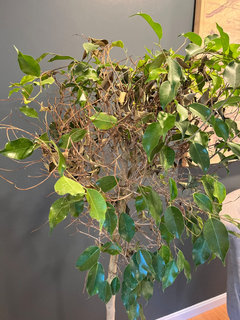
    Thanks @tapla (mid-Michigan, USDA z5b-6a). What an excellent resource. I will review carefully; unfortunately I have young kids and a busy job which makes it tough to prioritize plant care but I would love to see this one survive for sentimental reasons (...I had a ficus benjamina growing up and was given this one recently for my home office). I've now thoroughly commandeered this thread so apologies to the OP. Here's a pic of the plant I'm hoping to salvage.


  • 4 years ago

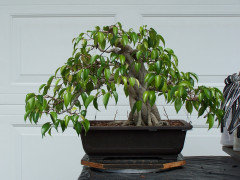
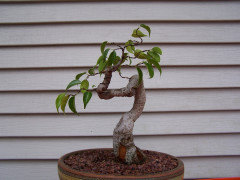
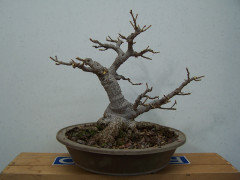
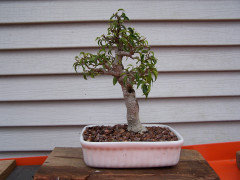
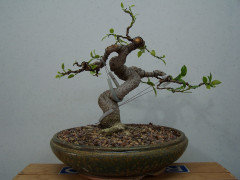
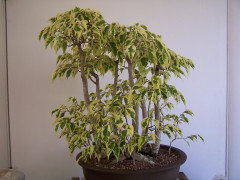
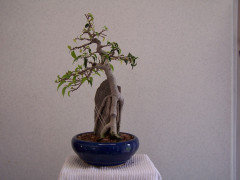
    It's not happy, but not hopeless, either. If you're interested in starting a dialog at your leisure, one that results in you having the tools you need to keep the plant happy, you can find me at the thread I linked you to. Some misc Ficus of mine:


    It's alive and well ^^^ - I just defoliated it so the image would show the trees progress in terms of branch numbers and placement.


    Al

Sponsored