Software
Houzz Logo Print
webuser_355114

DON'T FORGET to FLUSH

8 years ago
last modified: 8 years ago

I bet I write instructions that describe how to flush a planting's soil at least once every other day, and probably more often than that. I think it will be much easier to start a thread I can link to than what I've been doing.

For the most part, regular forum contributors and participants are miles ahead of Grower Average, who navigates the growing experience more by feel than faculty. One thing that is poorly understood by Grower Average is the impact that his/her chosen soil has on the ability to keep a plant healthy. An extremely high % off-the-shelf soils hold too much water for extended periods; so much so that root function and root health are negatively impacted by the lack of oxygen that accompanies soggy soil. Root metabolism and water/nutrient uptake is an energy driven process. Plants "burn" food in the presence of oxygen to fuel these processes. Insufficient oxygen levels in the root zone = poor root health = a suffering plant. The plant cannot be healthy unless the roots are healthy.

So, Grower Average often devises a work-around to avoid soil saturation and poor root health. (S)he accomplishes this by watering in small sips - just enough to moisten the soil, but not so much it creates the soggy conditions that sap vitality. The problem with this strategy is, the solution creates a different problem; that being, watering in small sips ensures that ALL of the salts found in tapwater remain in the soil. As the level of salts in the soil solution increases, the plant's ability to take up water and the nutrients dissolved in water decreases. Normally, water moves through cell membranes TOWARD a higher concentration of salts inside of the cell. If the level of salts in the soil solution = the level of salts in the cell, no water moves into the cell. In the case where the level of salts in the soil solution is higher than the level of salts in the cell, water actually moves OUT of the cell. This kills the cell by a process commonly referred to as fertilizer burn. Curing salts actually pull moisture from meats to the surface, where it can evaporate, this is an example in the extreme of how salt affects water movement into and within the plant.

Fertilizer solutions contribute to this issue because all the salts that go unused by the plant also accumulate in the soil, contributing to salt levels. A sister issue to a high level of salts in the soil is a skewed nutrient ratio. Plants do best when the ratio of nutrients in the soil is as close as possible to the ratio at which the plant absorbs the nutrients. When the 2 ratios become divergent, a excess of nutrient A can cause a deficiency of nutrient B; this, while contributing unnecessarily to a higher salt level.

**************************************************************

When it comes to providing a healthy environment for roots, you can see there is plenty of incentive to control soil salt levels and prevent nutrient ratios from becoming skewed. We can easily do this by flushing the soil with some regularity, which is the equivalent of pushing the salt level and nutrient ratio reset button. With an appropriate soil, this can be done with little thought and virtually no worry, every time we water. With soils that simply hold too much water and demand that we water in sips to prevent root health/function issues, we need a plan. Different circumstance sets require different solutions, so be sure to ask. You can find much more about soils if you click me.

To flush the soil of a planting: Water with room temperature water until the soil is completely saturated. Allow the planting to rest for 15 minutes to an hour to allow as much of the salt accumulation as possible to go into solution, then pour a volume of room temp water equal to at least 10X the volume of the pot the plant is in slowly through the soil. This will remove most of any accumulation of offending salts and resolve any skewing of nutrient ratios. It's a good idea, no matter what time of year, to fertilize most plants immediately after flushing the soil. Try to be sure you're using a fertilizer that has a ratio as close as possible to the ratio at which the plant uses nutrients. The NPK % listed on fertilizer packaging is not its ratio. 7-7-7 and 14-14-14 are 1:1:1 ratios. 9-3-6, 12-4-8, and 24-8-16, are all 3:1:3 ratios. Container growers should try very hard to avoid use of fertilizers advertised as 'bloom-boosters', or any number with a middle number (Phosphorous) higher than either the first or third numbers (Nitrogen or Potassium). These fertilizers can badly skew nutrient ratios with even the first application). On average, plants use about 6x as much N as P, so there is NO potential for a positive outcome when supplying many times as much P as the plant requires. I, and a large number of other members, use Dyna-Gro's Foliage Pro 9-3-6. It's designed to closely mimic the uptake ratio of the average plant, and has many other attributes not commonly found in other fertilizers. It also has ALL of the nutrients essential to normal growth. Summarized, it makes fertilizing as easy as it can be, and from 1 container.

The reason for flushing can be traced to the fact you're watering in sips, trying to avoid over-watering; so now that you've over-watered by flushing, what to do? You'll want to get rid of the excess water in the pot. The picture below will supply a visual that should help clarify different methods. Image A represents the soggy layer of soil that refuses to drain from overly water-retentive soils by the force of gravity. Simply put, varying soil properties result in varying heights of the water colume that produces soil saturation. This level is always the same ht for a given soil after the soil has been saturated. Simply by tipping the pot (see B), you can see the level of saturation is the same ht, but the volume of soil that CAN contain saturated soil is greatly diminished.
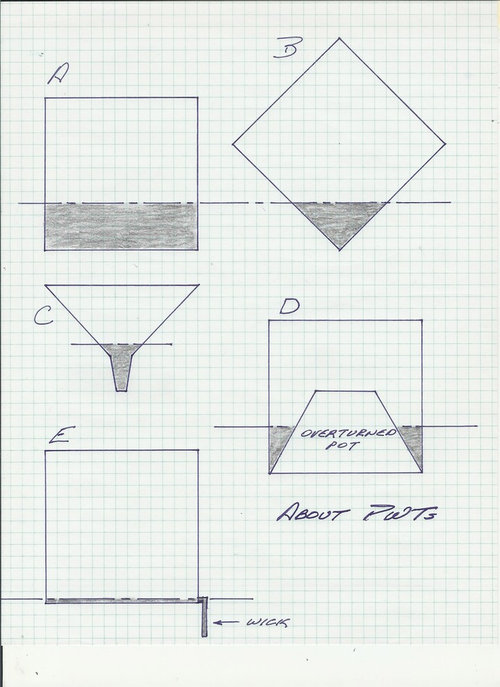
Figure D represents how reducing the volume of soil in the pot that CAN remain completely saturated, thus reducing the volume of excess water the planting can hold. Adding a wick through a hole in the bottom of the pot where bottom meets side wall can further reduce the amount of water a soil can hold.

If your planting is easy enough to handle, flush the soil over the sink any time you wish. Then, put Newton's First law of Motion to work. In part, it states that an object (the water in the pot) continues to move at a constant velocity (and in the same direction) unless acted upon by a force ..... After flushing the soil, hold the pot in your hand and move it up and down over the sink. You'll immediately see that on the reversal from downward to upward, a measure of water exits the soil, and the sharper the reversal, the greater the volume of water. You can remove all excess water from a pot using this simple trick.

I mentioned ballast above. It's a VERY effective method of eliminating almost 100% of excess water retention if done correctly, and you can find more detailed info here.

Al

Comments (12)

  • 8 years ago

    I forgot to mention that, if your planting is established to the point the soil/root mass can be lifted from the pot intact, you can depot the plant after flushing and allow it to rest on a stack of something absorbent (stack of newspapers, paper bags, old towels, clean rags) for 10 minutes or so. This will 'pull' all of the excess water from the soil. When done, simply replace the plant in the pot & you're good to go.

    Al

  • 8 years ago

    Re water quality parameters: These are desirable levels/ ranges of nutrients and other components of irrigation water, which are broadly published by universities for greenhouse production, and should serve as an excellent guide.

    Desirable Range
    pH - 5.8 to 6.0
    Alkalinity - 0.75 - 2.6 meq/l CaCO3
    Soluble salts - (EC)<1.5 mmhos/cm
    Hardness - 100 to 150 mg CaCO3/l
    Calcium (Ca) - 40 to 100 ppm
    Magnesium (Mg) - 30 to 50 ppm
    Sodium (Na) - < 50 ppm
    Sulfate (SO4) - < 50 ppm
    Chloride (Cl -) - < 100 - 150 ppm
    Boron (B) - < 0.5 ppm
    Fluoride (F -) - < 0.75 ppm

    I'd suggest you look for the Ball Publishing book: A Grower's Guide to Water Media and Nutrition for Greenhouse Crops. I've had mine for more than 20 years and have used it so often as a reference that I practically have it memorized. It's written in language and uses terms that the average hobby grower shouldn't have difficulty understanding. It's sort of pricey new (>$100), but you should be able to find a used copy for a fraction of the price new commands.

    Al

  • 8 years ago

    I never water in sips but I didn’t know to let it sit 15 minutes. I collected a HD bucket of rain water and look forward to using it in lieu of chlorinated water.

  • 8 years ago
    last modified: 8 years ago

    Disclaimer: I don't water the way I'm about to describe because I have too many plants and won't take the time; but, the best way to water is:

    Slowly pour water over the entire surface of the soil, just until the soil is saturated. Return after 15 minutes to an hour and water a second time so at least 15-20% of the total volume of water applied exits the pot. This is very effective at flushing salts from the soil. If you cannot water this way w/o worrying about soil saturation affecting root health/function, your plant wants you to think about a different soil, or at least a way to mitigate the volume of excess water a soil can hold (there are many ways to do this). This is also the best way to flush the soil, excepting that those using soils that can't be flushed with each watering would be using much more water (at least 10X the volume of the pot you're flushing) during the exercise.

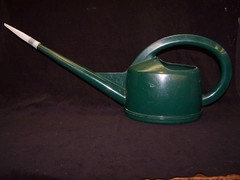
    Outdoors, I use a hose and water as fast as I can w/o blowing the soil out of the pot, but indoors, I need to be careful about how much water exits the drain hole, so I use more care and a 1 quart/ 1 L water can with a caulking nozzle adapted to reduce the diameter of the water stream.

    I can accurately direct a slow stream that covers the entire soil surface. I very quickly learned (and so would you) how long to supply additional water after the pot started to drain, in order to ensure I was using enough water to flush the soil every time I water. I also fertilize every time I water at a very low dose.

    For all plant needs in winter and for all of our drinking water, I use a small reverse osmosis (R/O) filtration system that's capable of making 75 gallons of water with 0 ppm dissolved solids per day. Essentially, it's the same as using distilled water, but at a tiny fraction of the cost. The R/O system would also serve those well who are using a very water retentive medium, this, because it allows watering in sips, as there is no concern about salt build-up with R/O or distilled water (except when it's part of a fertilizer solution). It's also much more effective when used for flushing a soil.

    Al

  • 8 years ago

    For indoor plants in the winter., most are new and repotted within 3months. And scheduled to be repotted with new soil every 6 months. How often would you flush the salts at a minimal? I don’t beleive I am ready to do at every watering as you do yet.

  • 8 years ago

    Some plants notably benefit from repotting annually, but bi-annually, or every 3 years is probably more along the lines of a compromise that doesn't burden the grower too much and doesn't force a lot of significant limitations on the plant.

    Rather than referring to a calendar to determine when it's time to flush the soil, let me suggest instead to consider how many times you've watered as a more realistic guide; this, because how many times you water is what ultimately determines the level of salt build-up. About every 6th time you water would be about right if you can't flush with every watering. To keep track, just toss a marble or other marker on top of the soil of any plant you water. When you're about to add the 6th marble, collect the marbles from the soil, flush, and start over. Keep in mind that making a break from soils you have to fight for control of your plants' vitality and moving to soils you can water to beyond saturation at will, is a BIG step forward and makes growing proficiently far easier.


    Al

  • 8 years ago

    So excited for this informational!!! The marbles are a wonderful idea. For other micro mini plants that are being wick watered. Simply run clear water? I also read but would like your thoughts on a peroxide mixture to discard water contaminents especially found in city water. Currently, I run water a week ahead to let chlorine disperse.

    tapla (mid-Michigan, USDA z5b-6a) thanked Cheryl
  • 7 years ago

    Simply run clear water [when flushing a planting]? Yes - clear water at room temp. Cold water from the tap isn't as effective as warmer, room temp water as a solvent. I also read but would like your thoughts on a peroxide mixture to discard water contaminents especially found in city water. It really doesn't get rid of contaminants like fluorine (yields hydrogen fluoride), chlorine (yields chloride), ........ though it is effective as an antimicrobial when mixed with irrigation water.

    Most municipalities use a derivative of ammonia called monochloramine to disinfect drinking water. It's much more stable than chlorine and would take a very long time to gas off. How rapidly these two products gas off is closely related to temperature. Free chlorine in 10 gallons of water will gas off after boiling for about 1.8 hours. Monochloramine, OTOH, would take about 26 hours at boiling temps. Imagine how long it would take at room temps. Fluoride doesn't measurably gas off at all, so letting water sit out isn't an effective strategy. A R/O water filtration system is, though.

    Al

  • 7 years ago

    Yes but the $$ r remarkable too as well as the amount of water needed for R/O. Mb catching rain water is a much more eco friendly and husband friendly conversation here. Thx for the insight. As always it’s very much appreciated.

  • 7 years ago

    I've often wondered about aquarium water treatments. They remove chlorine, chloramine, and ammonia. The "good" ones also claim to detoxify nitrates and nitrites. Flourine/floride is not mentioned on labels, because it probably has no effect on aquatic life. I have yet to find a reliable source for what chemicals they ADD to water, though. While they do make tap water safe for fish and invertebrates, what do they do to or for plants?

  • last year
    last modified: last year

    I'm resurrecting this very interesting old discussion (after all, it's a topic you return to often).

    I have two ficus benjamin in two cylindrical pots 33 centimeters high and with a diameter of 48. I calculated that their volume is approximately 65 litres. The fertilizer I use is the closest I have found to Foliage Pro 9-3-6: the ratio is 7-3- (therefore 2.3-1-2). The problem of this fertilizer is more the absence of magnesium and calcium (and other microelements, for example zinc). So I don't think the problem is the fertilizer (do you agree?), but the way I watered. Normally I follow the instructions you always provide: I let a lot of water come out of the holes in the jar to eliminate the excess salts. Since these vases were very large, I stupidly didn't put enough water in them to allow them to drain during the last 12 months (it dismembered me too much, I know it's wrong). I repotted them last summer and so they definitely accumulated salts, but can I ever pour 650-1000 liters of water into each of them? How do you do it in the presence of such large vessels? Could it be that instead there is not a large accumulation of salts in the soil? The two ficuses appear to be very healthy.

    I wanted to do it now because the temperatures here these days are very high and I think the soil dries out quickly (I still use a soil with perched water, one revolution at a time, dear Al, I'm already changing many things in the way I grow plants).


    I can't put the clod of soil on newspapers as you recommended because a month ago I removed the earth from the sides of the root ball (around and below). They are the ficus that I repotted last year (I also opened a discussion). I know that for you you have to get your hands into the root ball like I did last year. Since I wouldn't have repeated the repotting this year, did it make sense to remove the surrounding soil and put new soil back in or was it useless?

    When you flush the soil, is there a risk of root rot with a soil with perched water or not because beyond a certain amount of water with which you water (in other words: once the saturation point is exceeded), the risk of root rot remains the same as the perched water always remains the same?

    it allows watering in sips, as there is no concern about salt build-up with R/O or distilled water (except when it's part of a fertilizer solution).

    Even if you didn't have to fertilize and could always only use distilled water, wouldn't watering in small sips still risk creating a water imbalance inside the pot, with the lower part of the soil always dry or almost dry? You cannot know what quantity of water is sufficient to wet all the soil...