Software
Houzz Logo Print
hiccup4

Ravine garden planning

8 years ago
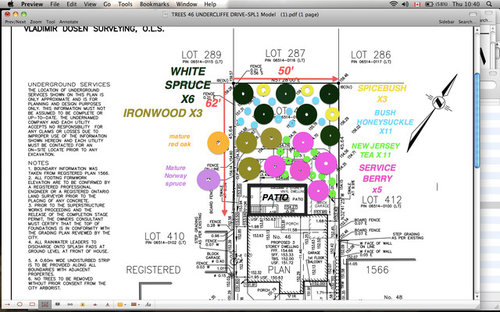

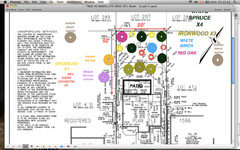
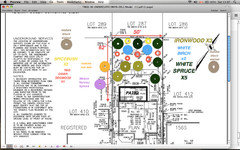
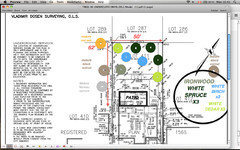
We are building a new house on a reverse ravine. The ravine authority require us to plant at least 8 trees and 40 shrubs...or 9 trees and 30 shrubs. I've gone with the later. The area is generally part sun. We live in zone 5. There are houses that look over onto our property and I wanted the evergreens for privacy. Does this spacing for the trees/large shrubs work for the space? I have made each larger trees/shrubs circles 10'. I was hoping for a grove like effect...very natural with lots of privacy.

Thoughts?

Comments (30)

  • 8 years ago
    last modified: 8 years ago

    Pfttt on bush honeysuckle. It doesn't go with white spruce at all, and I don't even know of a variety that is not invasive big time. White spruce mixed with birches and pines and firs is what is natural. I'd go with fothergilla, a maple-leaved viburnum, redtwig dogwood, some red cedars (low growing), and blueberries. I'm restoring a ravine and that's what I'm using, along with witch hazel and some other dogwoods in the shady areas. I also got a bush called coral berry, which is supposedly deer resistant. Another shrub that is doing well for us is bayberry, (Myrica cerifica) which would look good with the spruces. If you must have smelly flowers, fringe tree, or fothergilla would fit the bill, along with pinxterbloom azalea. All about pinxterbloom azalea from Missouri Botanical Gardens Plantfinder Database

    Note: you don't have to pick all of these, just some prettier options from honeysuckle.

  • 8 years ago

    If the spruce is happy, it is going to be bigger than drawn. However, given the shade, it may very well not be happy. Also, anything planted behind the spruces are going to be for the benefit of your neighbor's.

    Agree there are much nicer shrubs than honeysuckle.

  • 8 years ago
    last modified: 8 years ago

    I have a specific list that I have to draw from. I cannot use any fancy cultivars. Just what is listed. Two important notes: Any plants that I choose must be happy ish under black walnuts (juglone tolerant) and they must be good for soil erosion. I love viburnums but I don't believe they are good for erosion control. Birches are beautiful but I'm pretty sure they are happier in full sun. One author from Fine gardening magazine seems to really like Diervilla lonicera so I'm surprised that there two votes against it.

    I doubt the neighbors will plant anything large as it will block their view of the lake.


    http://www.finegardening.com/plant/northern-bush-honeysuckle-diervilla-lonicera

  • 8 years ago

    You need better information. A website many people here use is the Missouri Botanical Garden Plantfinder. It will give you more impartial information on where things will grow, and how big they are going to get. You'll also have to have a realistic assessment of how much sun plants are going to get, particularly after the trees start growing.

    To my mind, this is very overplanted, with too many plants that are going to be fighting for sun.

    hiccup4 thanked mad_gallica (z5 Eastern NY)
  • 8 years ago

    Re bush honeysuckle. If by this you mean the huge old tartarian honeysuckle, it's wildly invasive and should NEVER be planted. And Diervilla is a great choice for difficult areas; it suckers freely.

    hiccup4 thanked laceyvail 6A, WV
  • 8 years ago

    I mean the Northern Bush Honeysuckle which isn't a true honeysuckle at all. It's Native in Ontario and grows to 3'. I live on a reverse ravine that is currently covered by the VERY invasive garlic mustard.

    Diervilla lonicera

    https://duckduckgo.com/?q=nothern+bush+honeysuckle+http%3A%2F%2Fwww.finegardening.com%2Fplant%2Fnorthern-bush-honeysuckle-diervilla-lonicera&t=ffnt&iax=images&ia=images

    http://www.finegardening.com/plant/northern-bush-honeysuckle-diervilla-lonicera

  • 8 years ago

    z5 is about half the US ... and somewhat divergent ..... could you narrow it down a bit ...


    what is a reverse ravine??? .. forgive me if i missed it.. but i cant read your pix very well ...


    since the goal inflicted on you appears to be soil conservation ... i would suggest you contact your COUNTY soil conservation office .... they ought to have all kinds of state specific ideas ... [of course if its z5 MO .. i guess you are already there.. lol]


    where are the jugulone plants that restrict you /????


    ken

  • 8 years ago
    last modified: 8 years ago

    Hiccup, I responded to your post because I am in the process of restoring and planting a ravine under a black walnut, shady, subject to erosion, and have planted a white spruce there, along with many other plants. I don't even see honeysuckle on your list and I have no experience with it, but it sounds great, similar to the bayberry I mentioned but with flowers. Yes, small trees eventually get big. And are replaced by other things. The issue is what will work in the short term. Nothing planted too close to white spruce is going to thrive for long, they grow big fast. I posted some ideas of what has worked in my situation. Take it for what it's worth, you asked for ideas. As for the garlic mustard, that is a ground cover issue, not a shrub issues. Garlic mustard is very difficult to control, heavy shade suppresses it somewhat. To really control it, you have to establish the overstory, and work like heck to tamp it down in the understory, which in your case will probably involve Roundup if you really want to go after it. If it were me, I'd worry about the overstory getting established first. Around here, black locust is one quick and dirty way to hold in ravine soil. I hate it from an aesthetic perspective, but it all depends on your conditions. If the honeysuckle suckers (that was fun to type) then it will greatly help control the garlic mustard. Good luck.

    hiccup4 thanked l pinkmountain
  • 8 years ago

    Ken - if you could read the images the OP added, you’d see that the location is in Toronto, Canada.... One thing that means is that using Round-up or other herbicides is not an option! And there is no equivalent to a county soil conservation office, other than the Toronto Region Conservation Authority - which, presumably, is the group requiring the OP to plant from specified lists of plants. Reverse ravine is a local term meaning a steep hill (i.e. the opposite of the steep ravines common in the city...)

    hiccup4 thanked woodyoak zone 5 southern Ont., Canada
  • 8 years ago

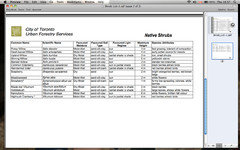
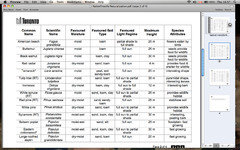
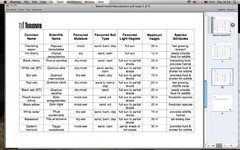
    Yes, my hope was that the bush honeysuckle would help me deal with the garlic mustard. The Diervilla lonicera sounds like a good ground cover...? It's on p.1 of the shrub list posted. My concern is the trees/large shrubs spacing. I must plant at least 8 trees. What would you do given the space privacy concerns? The tree list are 2 pages posted above. Thank you so much everyone for your help!

  • 8 years ago

    Reverse ravine...I live at the bottom of a steep hill (ravine). :)

  • 8 years ago

    Okay here is another go at it. I was trying to avoid planting more messy trees and stick with evergreens as we already have to deal with one oak and 2 black walnut trees...however if you think this might work and look better then I'm all ears.

    Would cedars and hemlocks work for screening? I didn't add them.

    I placed the ironwoods 10' apart...they are extremely slow growing. I used just larger shrubs and trees in this pic.


  • 8 years ago
    last modified: 8 years ago

    So one cannot use Roundup on personal property in Canada? Can you use 2-4-D? (Note: I'm not talking about broadcasting this stuff, highly selective application). We use it on shrubs in areas too steep to dig them out, we pull garlic mustard but I have a crew of workers plus volunteers. Pulling or repeated mowing is the best method for garlic mustard but hard to do on a steep slope. http://www.ipm.msu.edu/invasive_species/garlic_mustard/management_options

    Love white cedar (arborvitae) and hemlock but around here they are deer candy. Hemlock is all over the ravines but I just don't know if you could get it established. A friend of mine has a hemlock hedge on her property-gorgeous but it isn't preyed on by deer. One plus about mixing species is that if one thing doesn't work out, others might. I just had a herd of deer decimate my most deer-hardy plantings, so all you can do is hope for the best sometimes. For the record, I have seen some mass white spruce plantings in my day, they are stunning! I don't know if the white birch and red osier dogwood will survive the deer, but that combo along with white spruce, if it survives, would be visually stunning year-round. Sometimes folks around me prefer river birch, Betula nigra, since it looks good even when small, unlike white birch which takes some time to develop trunk color. River birch is actually fairly drought tolerant. I'm not that fussy, YMMV.

    Edited to add that either plan will probably work, just depends on your aesthetic desires. The first plan had a yellow flowering theme, would be pretty. Second one a bit more diversity, but who knows how well that stuff will survive. I have no experience with the honeysuckle so don't know how it works in a large scale situation. It's devilishly hard to keep garlic mustard down, even in shade with good groundcover. Seems like a thicket of connected shrubs would be a good idea all around, but like I said, I don't know how well that works. I have a very specific aesthetic I am going for which is different than yours. I have a reference site (inspiration picture, if you will) that I am using for a template.

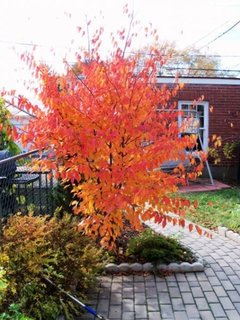
    BTW, I once planted an ironwood in my yard back at my old place. I always thought they were slow growing, but it was surprisingly fast growing, to start. But it was in full sun, so that may have been a factor. It also had stunning red-orange foliage, which I had never seen in that tree species before, usually it's yellow in shade. Do redbuds grow near Toronto? I know they are pushing it in my zone 5. But they grow fast too. Both of these small tree species will slow down eventually, but first ten years they take off like gangbusters.

    Photo of my ironwood. May you get so lucky with color.

    hiccup4 thanked l pinkmountain
  • 8 years ago
    last modified: 8 years ago

    10 ft. across is medium shrub size, large growing shrubs will eventually occupy a larger area. And a true tree - even a small growing kind - will become even bigger still.

    Trees and shrubs don't shade out weeds until they get big enough and fill in, so new plantings still have to be weeded for years after installation.

    Strong autumn color is generally a feature of sunny locations, shaded examples of the same kinds that may look as though on fire in the sun are typically much less orange and red.

    hiccup4 thanked Embothrium
  • 8 years ago

    I love redbuds but, alas, not on their list of shrubs at this time.

  • 8 years ago

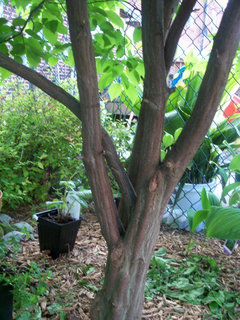
    I pinkmountain, your Ironwood looks like a multi stem tree in the pic. I thought it was a singular stemmed tree.


  • 8 years ago

    The form varies. Here's a close up of the trunk of my tree. It is about six years old in that photo. But this may be a case of scientific names mattering. My tree was Carpinus caroliniana, also known as musclewood and blue beech. The other tree commonly known as ironwood is Ostrya virginiana. That may be the notoriously slow growing tree, which does make more sense now.


    hiccup4 thanked l pinkmountain
  • 8 years ago

    I pinkmountain - re herbicides and pesticides- each province has its own rules. You can find Ontario’s rules here.


    hiccup4 thanked woodyoak zone 5 southern Ont., Canada
  • 8 years ago

    hiccup, I must urge you to do some research on the Wooly Adelgid which has devastated all the New England hemlocks and now I find reports that this difficult, very expensive to treat moth is spreading hemlock destruction throughout the Appalachians and has been found in Rochester and Buffalo, NY. It is just a matter of time before it jumps the border into Toronto. Maybe it already has. Ask. Sadly, planting hemlocks should be removed from your list. Based on my experiences with this moth I would not plant hemlocks in Toronto, especially in a native wooded area.

    hiccup4 thanked nandina
  • PRO
    8 years ago

    Q: I noticed that, according to your plat, it appears your back lot line is higher than your house foundation. Is that what you mean by "reverse ravine"? Just curious on terminology.

    Also, Carpinus caroliniana and Ostrya virginiana while entirely different are both wonderful ornamental trees in most residential settings. All of us commenting here have different experiences with plants based on our local cultural conditions.

    @Mad Gallica's mention of the Missouri Botanic Garden http://www.missouribotanicalgarden.org/plantfinder/plantfindersearch.aspx

    is a great reference for you.

    hiccup4 thanked KD Landscape
  • 8 years ago
    last modified: 8 years ago

    Yes our ravine lot line IS higher than my house....as we term reverse ravine. The reverse ravine is what makes privacy an issue as I would prefer to have some all through the year. What would be your thoughts on my choices? I'm not a landscaper and I have a list of trees/shrubs that I must choose from...see above. I thought I did my homework. ;) Now I'm not sure. Once the trees are planted there is NOTHING I can do to change it. It will be permanent. Yikes. Gulp. Ahhh. Help!

  • 8 years ago

    @woodyoak walnut trees on adjacent properties(now listed). Gorgeous trees albeit messy. Trees/shrubs that need to be removed...will be. Water drainage/grading has been addressed. There are full windows across the back of the house for full view of the ravine. Lot 286 and 285 have a direct view onto our house. I'm thrilled that you think I shouldn't worry about spacing!! :) Here is another go.....

  • 8 years ago

    I didn’t say to ignore spacing, but to think about it in the vertical dimension too as that is probably as much or more important than the horizontal dimension :-). Your first post said you needed a lot of shrubs, but only 9 trees. If I’m counting right, you now have 10 trees but not many shrubs showing...? I’d be inclined to remove one of the ironwoods - or shift it back considerably. The red osier dogwoods are likely going to need more sun. Gray dogwood would work better for the shadier location I think. New Jersey Tea and Snowberry could be used to make up a lot of the shrub numbers needed if you put a collection of them at the front edge (i.e. facing the back of the house...) The white berries on the Snowberry bushes should be visible from the house all winter.

    hiccup4 thanked woodyoak zone 5 southern Ont., Canada
  • 8 years ago

    Part of the problem is you are trying to make a pretty picture in the piece of paper. So things are too evenly and symmetrically spaced. If this was a perennial garden you were planning, it could be more of a learn-as-you-go experience since it is much easier to edit those gardens.

    I don't like the white spruces at the back. Imagine the neighbor's Norway spruce every place you have a white spruce. They are big. If they aren't limbed up, they have an enormous footprint, and limbed up will not provide privacy. I really wish you had the option of evergreen shrubs, but don't see any on the list. Of what I do see, the Thuja occidentalis would probably be my first choice simply because it is one of the smallest.

    I'd put the Ostrya virginiana closer together in what would read as one, large mass. The same is true of the Cornus stolonifera.

    Lindera benzoin is a squish plant here. I have it on the edge of my swamp, and it grows wild in similar locations. I don't know how well it would do on a dry hilltop with serious water competition.

  • 8 years ago

    I can plant smaller evergreens down the road...but I would rather accomplish my goals with the tree list given as I have to buy them anyway. The white cedars do okay on the ravine..they are a bit sparse and we do have deer. I could trim them over the next few years to encourage initial denser growth..? What do you guys think of pagoda dogwood, downy serviceberry tree as shrub choices? The DS is on the list because of erosion control..not sure if it 'goes' with the woodland theme. Here is an 8 tree layout. I have not included shrubs. Thoughts? Or am I doing more of the same? They are evenly spaced because I am trying to give them their own bubbles for water/nutrients etc. So they get around between 12-20' each.


  • 8 years ago

    No help from me, just an aside about the "Ironwood" -- I immediately imagined a tree that was introduced from Australia to Hawaii and is commonly called Ironwood -- Casuarina equisetifolia. And I wondered why anyone would purposely want to plant one. VERY different from the others mentioned. This is why I trouble myself to learn botanical names. Fortunately your lists provide both scientific and local common names. Conversations about a particular plant can go sideways when people are unwittingly discussing totally different plants.

  • PRO
    8 years ago

    Yes, downy serviceberry certainly works with a woodland theme. They are native across much of the eastern U.S.

    hiccup4 thanked KD Landscape
  • 8 years ago

    How about Hawthorn? Crataegus spp. Yes, it has thorns...but I'm wondering if it could be planted as a hedge on the perimeter of the property? I have dogs that I don't want leaving and we have coyotes that I don't want entering. My only concern is that I'm not sure of the city rules for thorny plants? Well...that and, of course, the maintenance of keeping the hawthorn useful as a barrier (ie. shearing).

  • 8 years ago
    last modified: 8 years ago

    White cedar, genus Thuja, not Juniperus, is gorgeous but deer browsing totally destroys the line/silhouette of the tree. I would focus on spruces and red cedars (Juniperus) as opposed to firs, hemlocks and white cedars if you have deer browsing. That has been my experience. Some of the pines are nice too, but white pine is deer candy too. Other pines are hard to come by in the average nursery place.

    Hawthornes do very well in the lower midwest where I plant. Gorgeous tree. Really needs its sun though.

    hiccup4 thanked l pinkmountain