Software
Houzz Logo Print
biondanonima

Broadleaf, flowering evergreens for casual hedge?

Our house is built into a hill with a backyard that slopes steeply upward from the house. Near the top of this hill is a cement retaining wall, which used to have a privet hedge just behind it. I ripped out the privet last summer and installed garden beds on this area, which is the only flat, full-sun area on the property.

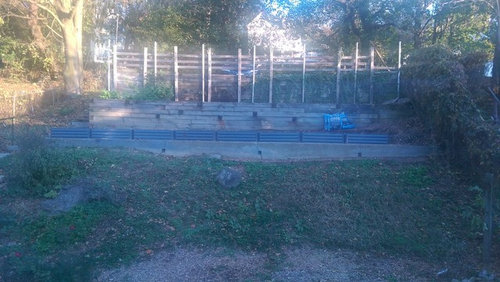
However, DH misses the hedge! I admit that it was nice to have something evergreen back there, and that while the garden beds are useful, they are not the most attractive things to look at. So, I'd like to plant a new evergreen hedge downhill of the retaining wall, so that it blocks the view of the wall and beds from the house/patio. Here's a photo of the area:


For the new hedge, I want a plant (or plants) that won't require all the trimming that the privet needed. I prefer a more casual look anyway, and trimming is a pain on the slope. I was planning to plant approximately in line with that large rock in the center of the photo, which would put the base of the plants 4-5' below the top edge of the metal beds (and give me a bit of space between hedge and wall for a walkway). Plants that reach a height of 4-6' naturally would be ideal. This area gets more or less full sun after around 11am, though the right side is a bit more shaded due to the neighbor's shrubs.

Would love your suggestions on which broadleaf evergreen(s) might look best. I have considered kalmia (Keepsake is a favorite), rhododendron, azalea, pieris, viburnum, etc., but I am having a very hard time visualizing how a mixture of these would look, or if a simple hedge of just one thing would be a bit more cohesive. The slope is currently planted with vinca as a ground cover, although I have a feeling there might be more weeds than vinca for at least another year or two. Thanks in advance for your help!

Comments (27)

  • 8 years ago

    Do you want to continue to use the beds? If so wouldn't the new hedge cast them into heavy shade?

  • 8 years ago
    last modified: 8 years ago

    Depends on the direction the picture is facing.. if it faces south, and that tree line behind it is far enough back that the sun can get over it from 11AM onwards, then the hedge won't affect anything. Otherwise, it certainly looks like the hedge will shade the garden.

    What direction is the picture facing?

    A useful link for calculating shadow length (but not direction) throughout the day, based on your location and the time of year:

    https://planetcalc.com/1875/

    This can be a helpful way to determine if the things you want to plant will end up shading the things you already have planted.

  • 8 years ago

    Sorry, the orientation is way important here, and I forgot to include it! The slope faces west. During the growing season, the sun comes up behind the hill and clears the trees by about 11am. The entire yard gets full sun until about 3pm, and then the house slowly starts casting a shadow that creeps up the hill all afternoon.

    The beds get more sun than any other location, and the new hedge shouldn't shade them unless I allow it to get too tall, which is why I'd like shrubs that naturally stay around 4'. I just went out to measure and 5' is probably the max height I'd want just to ensure that no shade encroached on the beds. The big rock is also about 4' from the wall, so if I use something that stays around 4' wide, that wouldn't encroach too much on the narrow walkway behind the rock either.

  • 8 years ago
    last modified: 8 years ago

    I'm having a hard time understanding this. So the hedge is going in front of beds? What's going in the beds? Something you need to see from the house? Veggies? Ornamentals? Maybe what you really want is a low border?

    I'd want something to hide that fence in the very back.

    biondanonima (Zone 7a Hudson Valley) thanked Dave in NoVA • N. Virginia • zone 7A
  • 8 years ago
    last modified: 8 years ago

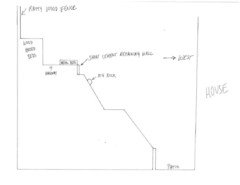
    It's a confusing yard, for sure! Here's a not-to-scale drawing of the area as it would be from the side, if you were standing on the stairs that lead up to the parking area behind the ratty wooden fence (they are just to the left of where the photo stops. BTW, the wooden fence should largely be hidden by clematis, ivy, blackberries or a combination of all three within a couple of seasons.

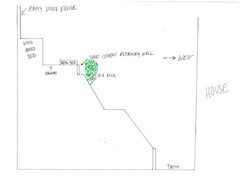
    Anyway, I want to plant the new hedge parallel to the cement wall, with the bases of the plants approximately even with the big rock, so that it would hide the cement wall and metal beds just behind it from view when you are standing on the patio or looking at the backyard from inside the house, like this:

    The slope is not nearly as steep as it is drawn but that should give you an idea. The big rock is about 4' west of the retaining wall and 4' downhill from the top edge of the metal beds sitting on atop the retaining wall. I don't need to see what is in the metal beds from the house/patio, but it's fine if I do - the metal beds will be used for blueberry bushes, vegetables, herbs, etc. I just don't really want to look at the cement wall or the beds themselves from the house/patio.

  • 8 years ago
    last modified: 8 years ago

    To my mind, one of the advantages of using Rhododendrons is that there are so many varieties that you can most likely find ones that meet your height limits. A slower growing choice will be easier to keep in bounds, but will also take a few years longer to reach the size you want. You may want to plant whatever you use on a bit of a shelf so moisture has a chance to sink in rather than all run off down the hill. A good layer of an organic mulch will help with this also.

    You have a fair amount of variety going on up there already, so I would most likely choose one variety of shrub for that location.

    biondanonima (Zone 7a Hudson Valley) thanked NHBabs z4b-5a NH
  • 8 years ago

    Thanks Babs! I like rhododendrons, but I have noticed that the ones I see in my neighborhood tend to be just a bit leggy and open, and I was hoping for something fairly dense. A quick google search does show about a zillion different varieties, though, so perhaps the ones I am seeing are just not the variety I should choose. Kalmias seem denser overall, though, and I find them more interesting than rhodies - are they more difficult to grow? They are so lovely, it seems like they would be more popular.

  • 8 years ago

    I don't know how easy it would be to keep Kalmia under 5,' and all mine are in spots that get a good amount of shade, so I don't know how they do with winter sun or how quickly they grow in your area.. Legginess of rhodies (and I include azaleas in that) is partly a matter of cultivar, part how happy they are, and part their pruning.

    Your particular choice may end up being determined by a combination of what is available and what the deer won't eat, though a black net barrier may help protect from deer. Just don't get something like one of the Roseum rhodies or similar since they want to be 25' tall.

    biondanonima (Zone 7a Hudson Valley) thanked NHBabs z4b-5a NH
  • 8 years ago

    I'd be inclined to go with either the kalmia or the pieris........maybe because rhodies are omnipresent in my area to the point where they have become exceedingly boring. And both the mountain laurel and pieris come in a lot of dwarf varieties that will fit your height requirements (may very rarely need some pruning) and also offer a much longer flowering period than do rhodies, whose trusses last maybe 2 weeks, if that.

    biondanonima (Zone 7a Hudson Valley) thanked gardengal48 (PNW Z8/9)
  • 8 years ago

    There is an Azalea and Rhododendron Forum.

    To my mind, they are all variations on a theme, and which one you want depends on personal preference and size. Kalmias have a reputation of being more difficult to establish, and aren't cheap. If you are looking for somewhere to start the search, PJM rhododendrons are a lead. Just watch mature sizes very carefully.

    biondanonima (Zone 7a Hudson Valley) thanked mad_gallica (z5 Eastern NY)
  • 8 years ago

    no conspicuous flowers on either of these suggestions but they make attractive, natural evergreen hedges. dwarf yaupon holly will grow to about 3'-5' high and wide and dwarf wax myrtle maybe 4'-6' high with a suckering habit. both look good with minimal to no pruning and can handle full sun to less than full sun. drought tolerant and deer resistant, too. the wax myrtle are a favorite of some birds (cedar waxwings for one) and have fragrant foliage.

    biondanonima (Zone 7a Hudson Valley) thanked jeff_al
  • 8 years ago

    Rhodies and azalea are pretty common in my neighborhood too, which was one reason I was looking at other options. I love them in bloom, but their flowers are so fleeting! I bought a couple of reblooming azaleas last fall for my front yard in the hope of getting a bit more color, but they either aren't truly evergreen in my zone or they suffered a lot of leaf drop due to transplant shock, because they are looking seriously ratty. I love the variety of colors available, though, and they seem to be naturally compact, so maybe they would be a contender.

    Kalmia seems to be available in a lot of dwarf varieties and I like that it is native, although the more I read the more I'm worried it might be a little too finicky for my taste, especially in this location. The expense is also a factor - the hedge will be 35' long, so I'm going to need quite a few plants. The only nearby nursery that I have found with a good selection of kalmia is a pricey one, too. Are there any good online sources?

    Jeff, I really like the look of that wax myrtle - thank you for the suggestion! Deer resistant would be a plus, though probably not a requirement. We don't have a serious deer problem, but last season I had an occasional visitor or two, and they can eat an incredible amount of greenery in a single night! I have a baby sweet cherry tree that got stripped overnight, and a couple of hostas that were eaten to nubs. Unfortunately, there's no way for me to really fence off my entire property, but deer spray has been reasonably effective (when I remember to apply it).


  • 8 years ago

    I have been meaning to get up to Broken Arrow - they have a great reputation locally. Perhaps a New Haven style pizza will be enough of an inducement for my husband to take a trip up there soon!

  • 8 years ago

    And just when I think "meh, rhododendrons are so overdone," I find this beauty: https://www.singtree.com/plants/details/blue-baron What a stunning color! I could imagine a whole hedge of that in the backyard...

  • 8 years ago
    last modified: 8 years ago

    "maybe because rhodies are omnipresent in my area to the point where they have become exceedingly boring."

    A nice problem to have, but, when my brother who has lived in Seattle for years sends me 'random driving around' pictures from the PNW, I feel like I see the same varieties over and over. Maybe he just likes 'Jean Marie'??? LOL. (he doesn't know the name of course, but what he sends always looks like a big hedge of it in near full sun) Is the problem omnipresence, or lack of variety? Does every other gas station have a 4' 'Nancy Evans'? I could find out myself: was thinking about going out there this spring (I've been at other times of year to the PNW, never spring) but have had to delay that another year now, for various reasons.

    Anyhow, from driving around Long Island in spring, one of the rhodiest areas of the east coast, I wouldn't quite say rhodies are quite omnipresent enough to have become boring. The lack of variety is a problem...95% of what you see are old 'ironclads' and usually just mauvy-pink 'Roseum Elegans'. So when you see something like the garden of Richard Murcott you realize what a shame that is.

    To the original poster, why not just plant a variety of whatever evergreens you like. Kalmias, Ilex, a hardy camellia or two, a clumping bamboo, some of the easier dwarf conifers, and maybe a couple rhododendrons of a more noteworthy type than is typical. 'Vulcan' or 'Vulcan's Flame' are nice reds that should be obtainable. As for determining what you like, a local public garden is always a good place to start. Have you been to Wave Hill?

    biondanonima (Zone 7a Hudson Valley) thanked UpperBayGardener (zone 7)
  • 8 years ago

    david, it really doesn't matter what varieties are planted........and there's a much wider selection than you seem to have encountered ;-) For 11 and half months out of the year, they are just big green lumps. And since it seems every garden of a certain age has numerous plantings of these, almost to the exclusion of any other BLE's, yes, the omnipresent big green lumps are exceedingly boring. And I am not the only one that seems to think so.......many of my design clients request NO rhododendrons be included in their planting plans!

    biondanonima (Zone 7a Hudson Valley) thanked gardengal48 (PNW Z8/9)
  • 8 years ago
    last modified: 8 years ago

    Davidrt, no, I haven't been to Wave Hill - thank you for the suggestion! As for the hedge, right now I'm leaning toward using just one thing as a sort of backdrop, to block the view of the wall, then once that is established I can work my way down the slope with other plants to create some variation.

    I showed my husband a few ideas tonight and he's basically on board with anything green that doesn't require pruning, lol. He does like flowers, though, so now I'm leaning toward Autumn Monarch Encore azaleas since the area gets a lot of sun. I love orange with purple and I have a lot of other purple plants in the backyard, so hopefully it will make a nice background for them.

  • 8 years ago
    last modified: 8 years ago

    Be careful...not all of the "Encore" azaleas are really zone 7 hardy at all...especially up where you are...maybe the problem has been fixed now. (In the sense of the varieties being better chosen for retailers in certain areas) If you're seeing mature plantings of that one in your area, you can assume they are hardy enough I suppose. Azaleas, generally, are a good choice for 'shrubbery that doesn't need to be (and/or shouldn't be) trimmed.' Albeit not terribly fast growing.

    Gardengal - I will tell my brother to photograph something other than 'Jean Marie'. ;-)

    Anyhow, I see that boring green blobs could get boring...but I guess it begs the question, what replaces them? Escallonia? Pittosporum? Dwarf conifers? I guess compared to objectionable things I've seen driving around various parts of the USA, Seattle and environs wasn't like, "oh god, there are too many rhododendrons", though they were obviously common. Seems like the "stereotypical" PNW yard is looming douglas firs shading rhododendrons.

  • 8 years ago

    I may not be reading the diagram correctly, but wouldn't the runoff of water from the cement wall be a problem changing the ph for rhododendrons? If you're going to Wave Hill (where I used to be a docent), make a short trip to see Untermeyer Garden in Yonkers, being restored under the guidance of Marco Stefano who put Wave Hill's gardens on the map! Lots of examples of shrub borders, and interesting affordable ideas as was Marco's trademark. (I've been copying his over the top marigold border ever since being bowled over by it. Hey - marigolds!! There's the orange you want!! High and low, cascading over the edge... Lit by the sun setting over the Hudson River! mixed with purple cosmos and lantana and whatever...

    biondanonima (Zone 7a Hudson Valley) thanked kitasei
  • 8 years ago

    Untermeyer is within walking distance from my house - we are regular visitors there! I absolutely adore their gardens. If Wave Hill is anything like that, I'm sure to love it!

    As for the water issue, that's something I hadn't thought of. Rhodies and azaleas are common around here so I assume the natural pH of the soil suits them, but the proximity of the cement wall could change that. Holly tone to the rescue, perhaps!

  • 8 years ago
    last modified: 8 years ago

    I think the warning about cement or mortar changing pH is probably overstated in many cases. It would depend on how acid a soil you are starting with, the buffering capacity and structure of the soil, the age of mortar, etc. etc. I can tell you from experience, with my very acid soils, you have to add a huge amt. of Ca ions to alter the pH much. There would have been obviously physical deterioration of the cement. I have seen many gardens where acid lovers grow right next to mortared brick or stones.

    Maybe, before spending a lot of money* on Ericaceous plants, use a soil pH test kit in a few spots. If the soil proves to be very basic, I'd more likely blame it on the area limed in the past for grass or vegetables. Who knows though, perhaps right near the Hudson there are calcareous ridges. I know of a neighborhood in the Philly suburbs, near a large creek, and the soil at the ridge top has actual chunks of lime in it. Easy way to know the effect of that would be the absence of any rhodies or azaleas from your neighbor's gardens! Most of the east coast of the US, of course, is acid to very acid. Here's a large (4M) map: http://www.bonap.org/2008_Soil/pH20110321.png

    * -NYC area most expensive market for plants in the US, probably

    biondanonima (Zone 7a Hudson Valley) thanked UpperBayGardener (zone 7)
  • 8 years ago

    There can be problems with alkalinity leaching from new concrete. In other cases, it is definitely overstated.

    To be honest, I find the pH preferences of kalmia to be confusing. If you drive along the river north of West Point, there are places where the steep limestone faces above you and clothed in kalmia. Near New Paltz, there are parks full of kalmia growing in cracks on limestone. This matters to me because there is a finger of alkaline soil running down the Hudson, and I'm near the southern end of it. My soil isn't merely less acid, it is actually alkaline, which tends to freak some people out. You do see the real rhododendron warhorses here, like Roseum Elegans, but very little else.

    biondanonima (Zone 7a Hudson Valley) thanked mad_gallica (z5 Eastern NY)
  • 8 years ago

    David is probably correct in that assessment that concrete leaching has less of an effect than many assume. While we have naturally acidic soils in my area, they are only slightly to moderately acidic - a far cry from the very low pH along much of the east coast. And yet ericaceous plants thrive here, even those planted close to concrete foundations and walkways. I keep an eye on foliage color and growth on those most exposed to these sorts of situations but it is seldom of sufficient concern to address specifically. I have more of an issue maintaining the blue coloration on bigleaf hydrangeas in these locations without attention than I do with the truly ericaceous plants. While growth and foliage color looks fine, the lime leaching will change the flower color to a purply pink unless aluminum sulphate is routinely applied.

    biondanonima (Zone 7a Hudson Valley) thanked gardengal48 (PNW Z8/9)
  • 8 years ago

    Gardengal, your comments about hydrangeas are interesting. I see a variety of hydrangea colors in my neighborhood, but I happen to have one that I inherited from the former owner growing in my backyard. I have not done anything to it in terms of soil amendment, and didn't know what color it would be until last summer, when it bloomed a very lovely medium shade of purple. Not a pinky purple, either. From what I understand, hydrangeas only bloom purple in a narrow pH range from mildly acidic to neutral, so I'm guessing that's what I've got (or at least that's what I've got in that particular spot).

    Rhodies and azaleas are common in my neighborhood, so I'm not too worried about the soil overall. I will test some samples before I lay out a fortune for plants, though! Regarding the hardiness of Encore azaleas, I have two Autumn Sunburst (rated to 6a) in my front yard that are looking pretty sparse after a harsh winter, but I think they will survive. They were also planted late in the fall and may have suffered some transplant shock in addition to hideously frigid temps this winter, plus they are exposed to a good bit of wind. The new hedge will have a more protection from the wind, at least. Autumn Monarch is another of the varieties that is rated to 6a so I'm not hugely worried.

  • 8 years ago
    last modified: 8 years ago

    To the OP: I'd consider putting in some of the Blue hollies, maybe China Girl and China Boy as well. They remain bright green in winter. Slower growing. They will stay reliably evergreen. Azaleas are not 100% evergreen..some hold on to maybe 20% leaves. Also, leaves can turn dark maroon on some. The Encores may look ratty at end of winter and some are not reliably hardy.

    biondanonima (Zone 7a Hudson Valley) thanked Dave in NoVA • N. Virginia • zone 7A
  • 8 years ago

    Dave, thanks for your post - for some reason I didn't get a notification about it until today! Anyway, good call on the hollies. Both of my neighbors have some nice mature holly plantings and they look fabulous year round. I actually saw a few varieties of ilex at Home Depot today that had beautiful glossy green leaves, and full from base to top - they were far too large to be appropriate for my space, but something smaller with similar foliage would be lovely. I have a couple of Encore Azaleas that I planted last fall and although their foliage stayed green, they did drop quite a lot of their leaves.

    I am actually going out of town tomorrow for a couple of months so I have lots of time to decide! I'm looking forward to seeing what the local nurseries have to offer when I get back, and browsing lots of inspiration photos in the meantime.