

H. hippeastrum reticulatum care
Though I'd start a new thread for the care of this species.
From the Pacific Bulb Society
http://www.pacificbulbsociety.net/pbswiki/index.php/Hippeastrum_reticulatum
The link includes the following, " The plants grow in sandy soil underneath a vegetation type known as Forest Mussununga. The trees in this forest have smaller diameters with the canopy rarely exceeding 15-20 m which allow ample light to reach the floor.'
Also, I have a terrestrial orchid (considered invasive) growing well under a lychee tree with lots of leaf litter with flowers and seed pods (which I will remove). This area looked a lot like Maria's photo of H reticulatum in situ. So I changed my potting mixture to include more pine fines (mulch) to try to copy. Also when the leaves on the offsets started to yellow, I backed off watering, copying our dry winter climate. I moved the pot to a table away from the window (lower light). All growth stopped and all leaf yellowing stopped. Now, a few weeks later, the mother bulb (which I thought was dead) is putting out a new leaf! These are just my observations, but what do you think? - Jody
Comments (43)
 8 years agolast modified: 8 years ago
They grow so well in other Asian countries so must like tropical-ish weather? Must like organic fertilizer too.
jstropic (10a) thanked mariava7jstropic (10a)
Original Author8 years agoMaria, thanks for your help in understanding this little diva :) I don't mind growing it for its beautiful leaves (secretly praying for a flower). But I would like it to grow! This is the first one that is not only holding its bulb size but has put out offsets that are growing. Trying desperately to figure out what I did differently before it developes the shrinking bulb syndrome. Your photo helped a lot. So far, this is what's working (I say so far as we know how quickly this can change).
Added fine orchids mix to soil (bark and clay pellets). Put high lipped saucer under small pot And fill whenever top of soil is dry. Give it an hour or so to soak up water and almost never have excess water remaining. Likes the north facing window in summer, can take south for part of winter. Hated being put outdoors in summer in the shade - not sure why - might not like change. The mother bulb lost its leaves in the fall but the offsets continued to grow so I continued to water. Offsets grew quickly until December when growth stopped. Then leaves started to turn yellow last month so I stopped all watering and yellowing stopped. Also moved it away from direct sun. Now, the mother bulb has started growing a new leaf. Slowly adding water but still in indirect sun.
So I am not sure if I have 'discovered' a good method of cultivation for her or that she is just growing and everything I have done is no better than chanting and waving a wand :)
Related Professionals
Portsmouth Landscape Architects & Landscape Designers · Norfolk Landscape Architects & Landscape Designers · Elgin Landscape Architects & Landscape Designers · Laconia Landscape Architects & Landscape Designers · Ithaca Landscape Architects & Landscape Designers · Westerly Landscape Architects & Landscape Designers · Glenwood Springs Landscape Architects & Landscape Designers · Edmonton Landscape Architects & Landscape Designers · Victoria Landscape Architects & Landscape Designers · Panama City Landscape Contractors · Fort Myers Architects & Building Designers · Philadelphia Architects & Building Designers · Lufkin Architects & Building Designers · Toledo Architects & Building Designers · Queens Architects & Building Designers- 8 years ago
I tried growing this specie but successfully killed all of them... as usual. LOL But that was way back then that I had no experience with growing it's hybrids. Maybe it's time to grow some again.
jstropic (10a) thanked mariava7  8 years ago
Well I don't know which particular Gods I should chant to...but I have not had any luck with these little beasties at all. I have tried so many things over the years, but nothing seems to work. Short of leaving them the heck alone and see if they respond to the "oops I forgot you were there" technique...I'm all out of ideas.
jstropic (10a) thanked Fred Biasellajstropic (10a)
Original Author8 years agoMaria, if anyone can grow them and create beautiful hybrids from them, it would be you. So I think you should try again and share your beauiful babies with the rest of us!
Fred, I know! And the advice, " just treat them like a houseplant"!!??? Seriously what does that even mean Lol. So it is going to be up to us brave hippie growers to break the code and grow these babies!! Ok, now I've talked myself into buying another one in case I kill this one. LOL
- 8 years agolast modified: 8 years ago
Jody,
I can't even begin to tell you how many times I've done what you're about to do :-))) Every once in a while, I go completely off the deep end and buy two or three thinking this time it will be different...sigh...and then the poor little thing dies. Please don't let me discourage you, get one or two. Who knows, you may get really lucky and have all the rights in the world to say "Neener neener neener I got mine to grow" :-))))))
jstropic (10a) thanked Fred Biasella  8 years ago
How do they die? Do they just rot? Mine is not dying (yet), I just discovered a new offset today but the motherbulb isn't growing neither. It was doing much better last summer and I'm sure about one thing - it doesn't like cool temperatures.
I put the link to the H.Silhouette thread here because there you can see that is possible that they may flower one day...https://www.gardenweb.com/discussions/1722733/problem-with-amaryllis-silhouette?n=55
Jody and Fred, I really like the idea of you waving a wand and chanting for your plants :-) And I cross my fingers that it works! The "oops I forgot you were there" technique sounds like a good idea too. I always have the feeling that my plants grow better when I'm away for a few days...
jstropic (10a) thanked catsandhippies- 8 years ago
I’ve been growing a couple of small bulbs of this species for 1-2 years. They shrank a little due to having to peel a layer with red blotch on it, but otherwise have been ok. I have read that they like warm, shady conditions, and they need a small pot since they never grow an extensive root system (which I have confirmed when reporting them, I had to pot down to a smaller size).
jstropic (10a) thanked everado jstropic (10a)
Original Author8 years agoNow I don't have to disturb my mother bulb to find out about their root system. More clues! Thank you,
Anja, that's what mine did. I thought the mother bulb died but since the offsets looked good I kept on watering. When the offsets started to get yellow leaves I stopped watering and let the pot go dry (gasp) for a couple of weeks. Then the mother bulb started a new leaf. Since the offsets are not growing yet, I am only watering lightly from the bottom. I am cautiously optimistic :)
Fred, I thought I had sworn off this species and anything connected to it, but then, this one started to, dare I say it, grow and.......Jody
- jstropic (10a) thanked Fred Biasella
jstropic (10a)
Original Author8 years agolast modified: 8 years agoOh Kristi, a bloom! What is your secret??? How long have you had them, tell us everything :)
 8 years ago
Uh..., I’d had the pot for a couple of years and it was purely a surprise!!
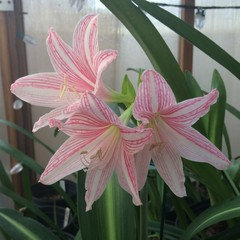
- 8 years ago
I have one with a few spindly leaves. I think I need to move it to a place with better light. At least it has leaves this year... last year it just sat around looking a bit like a rock! It sulked for MONTHS after I bought it.
jstropic (10a) thanked berkeleysgr8 - 8 years ago
I do not have species, but there are 2 hybrids: Mrs. Garfield and Bangkok Rose. Both are harmful. At first they did not want to grow roots, one bulb - 2 years sitting without roots, the other - 3.
Then, one grew well and a year later gave a bunch of offsets.
After that, the tortures began: the leaves do not grow, the bulbs lose their roots. It would seem that the substrate is suitable, from pine bark, perlite, good drainage.
Yes, and it grows better in full sun.
Still, the shadow in the forest in Brazil is our full sun.
But the conditions of watering (rains in southern Brazil) - they are different.
And it is difficult to understand - when periods of growth, when a drought, watering is not necessary?
jstropic (10a) thanked oleg9grower jstropic (10a)
Original Author8 years agoTina, what did you change that started it growing? Watering? I know we can break this code.
Oleg, when mine stop growing and leaves begin to yellow, I stop watering until I see new growth. So far it has kept them alive lol. Also they like it warm, but not hot since they don't like to be outside in my hot summer, even in the shade. They are the divas of the hippeastrum world :)) Jody
- 8 years ago
Jody,
How much months during the year do they grow, how much rest? I'll show you the photo as they now look:
- 8 years agolast modified: 8 years ago
Well as I have mentioned several times...H. reticulatum is not a hippeastrum but a relative of it. That is why it was reclassified as Eusarcops reticulata. So that explains it's different likes and dislikes in growing conditions than hippeastrums. In their natural habitat, they don’t grow much leaves either but still blooms. Pic borrowed from Facebook again.
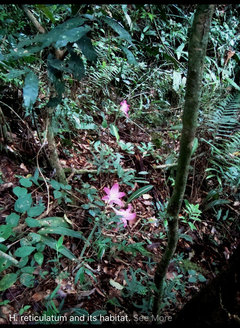
- 8 years agolast modified: 8 years ago
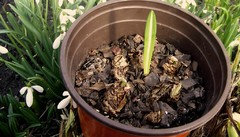
Here is a snapshot of today. With the snowdrop (galanthus pliсatus).
In the pot you can see one leaf of small bulb .
The remaining bulbs have a piece of green old leaf, or
completely without a leaf. Some bulbs do not have roots, these move in the substrate if I press my finger.
What should I do to grow leaves and roots?
- 8 years ago
I always see their pictures in habitat growing with ferns. Maybe ya'll can try growing it like a fern? just a thought...
jstropic (10a) thanked mariava7 - 8 years agolast modified: 8 years ago
Also only thoughts. Ferns arose about 400 million years ago. Monocotyledons (including amaryllidaceae), appeared about 110 million years ago.
Ferns reproduce with the help of spores, higher plants with the help of seeds. Ferns have no flowers, amaryllidaceae have flowers. Most ferns have a long-term
root system, the roots of most Amaryllidaceae live not more than 1-2 (3) years.
So all the same: what should I do to grow leaves and roots?
Maybe Hans (haweha) will tell me?
jstropic (10a) thanked oleg9grower - 8 years agolast modified: 8 years ago
What I meant is growing these reticulatums in a growing condition that ferns like. Not that they are the same plants as ferns.
jstropic (10a) thanked mariava7 - 8 years agolast modified: 8 years ago
Thank you Maria, especially for the desire to help. I appreciate it!.
Ferns are also different. Their requirements for environmental conditions are also different. For example, their roots are perennial, they can take moisture from the subsoil layer.
I, for example, do not know how they endure the dry period. Roots of reticulatas others.
Maybe Hans (haweha) will tell me?
jstropic (10a) thanked oleg9grower jstropic (10a)
Original Author8 years agolast modified: 8 years agoOleg, this is what I have found
They bloom late summer to Autumn
Have active growth autumn to winter
Semi-dormant 4 to 6 weeks late winter to early spring.
They grow in shady places (maybe your sunny place would work :))
The soil is vegetation (organic matter) over a base of sand (which holds moisture) . I have a ground orchid (exotic-invasive) growing under a lychee tree that I think might be a similar environment and I am going to plant an offset there to see how it grows in the ground. I will pot up another offset in a similar soil. This might help us understand the soil it needs.
Here is a picture of the orchid growing
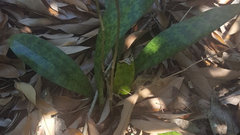
The one thing that I noticed is its desire for a lot of water (bottom water only) when it is actively growing. And liquid seaweed (micro-nutients) while growing. And then requiring a dry period when it stops growing.
I repotted two weeks ago. Mine are just coming out of dormancy and they are showing the start of new leaves. Still keeping them dry until more active growth or I see red developing on bulb.
Here are my bulbs just waking up
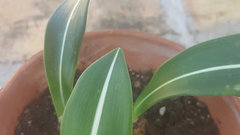
I hope this little bit of information helps you.
And yes, Hans please help if you can!
Jody- 8 years ago
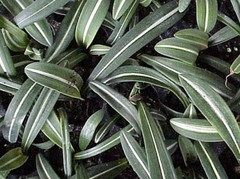
Now this is Glasshousework's picture. They can be successfully grown in a greenhouse. First step I guess is to get good healthy virus free bulbs. I know I bought bulbs of this on eBay coming from Thailand. They were sick and did not last long.
 jstropic (10a) thanked mariava7
 - 8 years ago
"Semi-dormant 4 to 6 weeks late winter to early spring".
"And then requiring a dry period when it stops growing."
Does this mean that the plant has 2 growth periods and 2 rest periods? One winter and another summer?
jstropic (10a)
Original Author8 years agoOleg, in the winter to early spring the go dormant (4 to 6 weeks) and require a dry period. I don't water until I see new growth (spring). They bloom late summer to autumn and continue to grow until winter when their growth stops and they enter dormancy again.
Mine have followed this pattern but I have not bloomed them yet.
- 8 years ago
So it means only one period of rest in winter 4-6 weeks, and then you write that it "semi-dormant"..What does this mean in practice? If it's completely dry to keep without watering - then this should be called completely "dormant". If "seven-dormant", it means that some watering plant receives these 4-6 weeks?
jstropic (10a)
Original Author8 years agolast modified: 8 years agoDifferent places on the web define this period as 'semi-dormant' as well as 'dormant'. For me, I have found my bulbs do better with a 'dry' period. For me, the correct watering has been critical. If I begin watering before new leaf growth I risk rot. But remember this is only my experience as I try to learn more about this bulb.
Oleg, I love your snowdrops!
- 8 years agolast modified: 8 years ago
Thank you.
Galanthus plicatus I brought from the Crimea many years ago. His flowers are twice as large as that of G. nivalis.
I also have G. elvesii, but it is early and already fading. This largest of all, this year bloomed in January, there was no snow and frost.
I'll try a dry period for reticulatum. I want to ask how to be with a leaf of a small bulb, it will not wither?
Still about pieces of old leaves - this is not a sign of readiness for a new growth?
jstropic (10a) thanked oleg9grower jstropic (10a)
Original Author8 years agoYour galanthus are especially nice for me as my climate is too warm to grow them so I can only look at the beautiful pictures:)
Oleg, there is a risk until we learn more about these bulbs, so I won't tell you what to do, but I will tell you what I did. My bulbs had a mother bulb without leaves, two offsets with leaves yellowing and one with the beginning of a new leaf. I decided to clean up , repot the bulbs and stop watering. I am glad I did because I found a lot of moisture around the basal plate and a lot of roots missing. After I cleaned the bulbs and replanted them in fresh soil, I did not water them. I have not watered them for three weeks. There is no growth, but they are not wilting and leaves are not turning yellow. If I see wilting, since we are going into their growing season I will give a little water. As I notice increased growth (leaves) I will increase the water. If they grow like last year, by the end of summer/autumn, they will be taking up a lot of water (they are in a small terra cotta pot). If I kill them I will let you know lol, but so far so good.
Another option you might consider is to separate the one growing a leaf and treat it differently than the ones that appear to be dormant. Just a thought.
I am sorry I couldn't be more helpful, but I am learning too.:))
 8 years ago
I thank everyone who shares their valuable information about the cultivation of this "treasure". I bought a "silhouette" again because I want to try it again. The first bulb I had, I killed years ago because I did not know nothing about his cultivation.
Fred, do not let yourself be discouraged! It's a challenge! :) :) :)jstropic (10a) thanked Pavel- 8 years ago
I'm enjoying this discussion very much...I just hope my bulbs of this little one are paying attention too :-))))
jstropic (10a) thanked Fred Biasella - 8 years ago
Jody, I haven't really done anything differently to get the reticulatum to put out leaves. I think it needed a period of sulking. It poked out a tiny nub of a leaf... and then stalled out. I think the heat of summer (even though it's indoors) caused the stagnation. In the fall, as the weather cooled off and the days got shorter, the leaves started slowly growing. So far, the growing conditions for this one seem counter-intuitive.
Jody, is that a Phalaenopsis schilleriana in your photo? At one point, I was growing more than 120 orchids. When I retire or win the lottery, I'll go back to that hobby!jstropic (10a) thanked berkeleysgr8 - 8 years ago
I know this is completely different than what everyone has said, and it is insanely complex, but it did work and I was able to force them to grow roots, so I thought I would add it to the discussion:
My small bulbs refused to put down roots when I tried to repot them. Two months and nothing. I got a plastic ziploc bag, and put about an inch of pine bark dust inside. Another soft, decomposition-resistant moisture-retaining material like sphagnum moss should work. The correct material is really important because mold will grow really fast in the conditions I am about to describe, so make sure to pick something that will not decompose. Don’t do this using dirt or regular potting mixes. I moistened the dust until it could retain no more water, and squeezed as much as I could out with my hands. I laid the bulbs on top of this moist dust, and set the bag on a seedling heating pad. I put this on a timer that turned the pad on and then off at 30 minute intervals, and put it by the window. This maintained a temperature of about 95 F with very high humidity. After 1-2 weeks, new roots emerged and rapidly grew. After the longest ones were over an inch long, I potted them into 2 inch clay pots in Al’s gritty mix. I placed those in plastic bags with no dust, to gradually acclimate them to lower humidity, outside in the shade with no heating pad. Temperatures ranged from 50-80 F. I watered enough that the soil never became totally dry. After 2 weeks I removed the pots from the bags, and kept them in the same location. I allowed them to dry out between waterings and there was no growth for 2 months. Then I began watering enough that the soil was not allowed to dry out, again. After 1-2 weeks, new leaves emerged with healthy, deep green sides. Unbelievably, the existing single leaf each of these bulbs had was never lost during this process.
jstropic (10a)
Original Author8 years agoEverado, thank you for this information. Did your bulbs have roots when you first received them? What time of the year did you first get them?
Can you tell us the time of year for each step ie. when you alowed your plant to dry out, (months, season etc) when you noticed no growth and when you noticed new growth.
Thank you for reminding us of the 'sphag and bag' method, it has saved bulbs that I thought were unsaveable.
- 8 years ago
They did have roots when I first received them, but not many of them. This species grows the least roots out of all of the bulbs that I grow. I received them in December of 2015. They really haven't grown much at all since I got them since it took this long to figure out the right conditions, but they are still healthy and alive. As others have mentioned here, their requirements are very different than all of the other Hippeastrums, and they do not do well when treated like the others.
Here is the timeline, as best as I can gather from my notes. I live in Florida, so seasons don't apply here like they do further north.
December 2015 - received them and potted in Al's gritty mix (made from chicken grit, pine bark, and perlite) in a 4 inch clay pot. I gave them frequent water.
September 2017 - dug up and peeled away red blotch-infected layer. The previous mixture did not drain well because it was not properly screened. The roots were not extensive enough to require a 4 inch pot, so they were repotted in 2 inch clay pots. This time I used a properly screened version of Al's (chicken grit, pine bark, pumice).
November 2017 - The bulbs kept popping out of place because there were no roots. Began the sphag and bag with pine bark dust.
November/December 2017 - Had roots, removed from bag and replanted. Kept in bag for 2 weeks.
December 2017 - Removed from bag and given water, but I allowed them to dry out before watering again.
Late December 2017/Early January 2018 - The weather became very cold for my area. I brought the bulbs inside during the nights where there was a frost. Otherwise they were left outside. Not sure whether these temperatures mattered, I know that some species have really specific requirements.
Early March 2018 - Began watering enough to keep the soil mixture moist. Leaves began emerging about 1 week ago (mid March).
jstropic (10a) thanked everado jstropic (10a)
Original Author8 years agolast modified: 8 years agoSome conflicting/ clarifying information (from the web).
According to Diana Chapman's (Telos) blog she grows H. Reticulatum and H. Reticulatum var. striatifolium differently. H. Reticulatum requires dormancy in the winter while h.reticulatim var. striatifolium grows year round for her.
I suspect mine is h. Reticulatum as I bought it at a plant sale from Gardino Nursery and their website says that their bulbs go semi-dormant in Spring. "They wake up at the end if summer and bloom in rhe fall. We don't do much at the dormancy stage. We don't water them much, they get water when it rains or if the soil becomes dry. You can water more often once they wake up."
So it's likely that when we expected our bulbs to wake up in the Spring and grow in the Summer they wanted to sleep. And when we expected them to slow growth in the Winter rhey were ready to grow.
So I am going to water sparingly until late summer or until I see a lot of growth. And hopefully have fall blooming bulbs -- unless I kill them...., or some one comes up with another option lol
Jody
jstropic (10a)
Original Author8 years agoWell, it was hard not to water but I was rewarded with new leaves on three of the bulbs
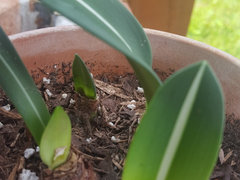
I also had a chance to speak with Gardino nursery yesterday and they cautioned me regarding regular watering at this time. They said the new growth was showing they were starting to wake up but not fully awake and that I should water very sparingly until they are fully awake in the summer, when growth speeds up.
So it seems we are starting to better understand this bulb that seems to be on it's own schedule.
Jody
- 7 years ago
Heya, long time no see. Most probably won't remember me (snarfie), but i recognized some names here, so thought i might offer you guys my experience with growing Hippeastrum reticulatum var striatifolium. It all started halfway through february 2013, when i received two potted plants of it. Grown in cocopeat by the grower, i saw them slowly getting worse, so i repotted them and found out all the roots had rotted. The new medium i planted them in was 2/3 peat-based soil and 1/3 cocopeat. They stabilized, but their roots didn't like the soil mix, and bulb size wasn't increasing either. However they did get loads of offsets. I watered them approx once every two weeks at the time, and managed to keep a status quo until sometime in the autumn of 2015. That's when i decided to try repotting them in the peat-based mix i used for my other plants (doesn't have too much added fertilizer like the cheap brands, and also has around 1/5 sand in it). The first four or five months that worked great, but due to their watering needs the soil quickly compacted. That's also where my mother bulb gave up and decided to stall, halfway through growing a leaf. Eventually lost that bulb at the end of 2017. The offsets were repotted in the spring of 2016 in small pots with a slightly more open peat based mix, and that's where the first consistent (albeit very slowly) improvement was seen. By that time my watering frequency was a soak in water around ten days to two weeks after the top of the soil became dry to the touch. Meanwhile i had been growing Schlumbergera since early 2016, an epiphyte that grows in the brazilian (coastal) forests. After two years with much trail and a lot of errors, finally found a soil mix almost all schlumbergera species and hybrids liked, which consists of one part fine chipped bark and one part of the peat-based soil mix (the one with 1/5 sand). It was in january of 2018 that i first made that soil mix for a few 'difficult in cultivation' species, and by april i had changed almost all of my Schlumbergera to that soil mix, with good results. So on april 9 this year, i also repotted my two remaining rooted offsets of Hippeastrum reticulatum var striatifolium in that soil mix, and watered them thoroughly to let the new medium settle around the roots well, and put them back in the place where their leaf liked it best (1m away from a south facing window). At this point i was starting to get cautiously optimistic about the future of the two little bulbs. Two weeks later the first new roots poked out of the drainage holes and at that moment i knew i finally got everything together in the correct way :)
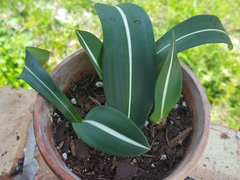
Weird how they turned out to behave so similar to Schlumbergera, despite having a completely different physiology. Over this year the leaf size has increased with 20% with each new leaf, roots stayed completely healthy (as opposed to all years before, where they always showed red on parts of the root, let alone produce long roots) and each leaf now stays on for close to a year. Mine have a short (semi?)dormancy during the height of summer and during winter, but they keep their leafs. Am hoping for maybe a flowerstalk this autumn, but i'd be more then happy if i get one next year. Picture made last night :)
So in short this is what made them grow well for me: 1 part fine chipped bark, 1 part peat-based soil mix with 20% sand and hardly any added fertilizer. Watering one to two weeks after the top cm of the soil becomes dry (i put them on a dish with 3-4 cm of water, and let them sit in that until the top layer is becoming saturated again). And i grow them 1m away from a south facing window, where they get (kind of) direct sunlight for four to five hours a day, at temperatures between 16°c (during winter) and 30°c (during summer). Also they don't like being half-naked, so make sure you also submerge the neck of the bulb ;)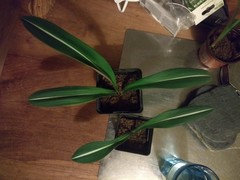 jstropic (10a) thanked Frans



kaboehm (zone 9a, TX USA)