Software
Houzz Logo Print
a1an

Who here starts Annuals@ Home

8 years ago
last modified: 8 years ago

I've only started the veggies indoors ....and have always bought annuals@ the nursery.

This year, bought some seeds figuring I would get a head start, bigger plants, more variety, etc...

LOL, this weekend, got the lights all rigged up, etc....and I'm second guessing myself . Even got a new timer plug for my light setup, etc.


Between X, Y, and Z, I don't think I'm saving money starting annuals@home .

Comments (29)

  • 8 years ago

    you should start them 6 to 8 weeks before they can go outside ..


    but alas .. you will never tell us where you are.. so who knows ...


    the worst thing that can happen.. in my experience.. is that they bolt .. or etoliate ....


    ken

  • 8 years ago

    Other than sweet peas or peony/breadseed poppies, which do not require winter sowing and just get seeded directly, I never bother. I never need more than a couple of any individual plant and prefer a wide assortment so growing from seed is just not as practical. And I tend to select my annuals based on what other plants I see that I like and will combine with them in containers. Except for the poppies and sweet peas, I don't plant annuals in the ground :-)

    the "X, Y and Z" are often a hefty initial expense but should pay off in the long run if you do much winter sowing or start your veggies early.

  • 8 years ago

    I actually had the ~ XY ~components

    For the Z component, I am out of BX, so I ended up picking up a bale of BX. I did spend some extra money as instead of my CFL lights I had on hand, I did buy some of the newer lights just to see what the difference would be.

  • 8 years ago
    last modified: 8 years ago

    That bale of BX will last along time and grow a lot of plants. As for whether it's worth the cost to start annuals from seed is individual and up to you. I've done it for years and I don't count the cost. I have many flower beds and to buy annuals as fillers would probably cost more.

    Cost aside one good reason for growing your own is the end product. Seed companies offer varieties I can't buy at a nursery or big box store. For instance for the last 2 years I've been growing Fireball Marigolds. They are 12 inches tall and the first true red Marigolds and can have as many as 3 different colors on 1 plant. The first flower is a deep red, almost a burgundy. The next flower is true red and successive flowers may be red or an orange red. It's quite stunning in the flower bed. I've never seen them in any nursery. I've also started perennials from seed and that's cheaper than buying them.

    My suggestion is to save your growing space for the unusual annuals or perennials or ones where you want a lot of the same plant and buy the common ones.

  • 8 years ago

    Hello a1an,

    " I did buy some of the newer lights just to see what the difference would be. "

    Can you tell us more about those newer lights? I am still using T8 fluorescent lights exclusively, mainly because they were cost effective when I started buying them back in 2004. I got 2-bulb 4-foot T8 shoplights for about $6.00 each back then, bulbs not included. But T8 bulbs were about $2 each when purchased in boxes of 10. Prices have risen steadily since them, but T8 lighting is still "affordable."

    Since then, T5 fluorescents have been touted as "better". And now LED lighting seems to be the "wave of the future". But I will continue to use my T8 lighting because I already have it and it is paid for.

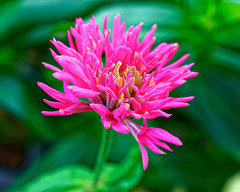
    I start all of my zinnias from seeds, because they are home-hybridized varieties that are not available commercially. I have been "going for" new flower forms in zinnias. This zinnia resembles a Cornflower.

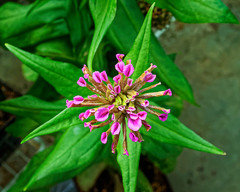
    I have also been "going for" improved zinnia plants. This specimen has un-zinnia-like narrow pointed leaves.
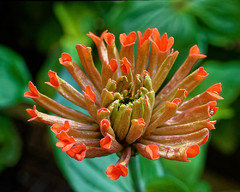
    It also has "tubular petals", although that one is not so great. Some of the tubular petaled zinnias can have attractive bloom forms.
    So, for me, starting my zinnias from seed is a natural thing to do. I use green seeds to speed things up.

    ZM


  • 8 years ago
    last modified: 8 years ago

    ZM -

    Jump on Amazon as a starter. Then on Youtube. You might find alot of links to ganga videos.....

    With the said, I bought the LED lights with COBS as it was something new, something different, I wanted to try out . Much too soon to give any real world feedback. Literally it's been 2 days...

    The unit I have has 3 different modes You can turn one one or all 3. Light intensity, colors, differ between the 3. (seedling, veg and bloom). It's got a dial for each as well, so you can adjust the output intensity without needing to mess with raising/lowering the lights.

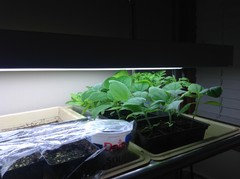
    I did order up new ratcheting hangers (which is much nicer in adjustability than traditional chains) and I ordered up a ~smart plug~ which is just a glorified WIFI controllable plug in which I have it set to turn on at 6 AM and turn off at 10PM. I don't have Alexa or Google, but these smart plugs can also be controlled by them,

    I think LEDS might be the future of light growing but OT, but LEDS for me are not replacing any of my traditional light sources@home. Even the $$$ LED drivers, etc - integration is not there, and for my eyes, High CRI LED bulbs or not, it's missing some magic than traditional Halogen, MR bulbs give me. I have succumbed to using LEDS in the kitchen, moreso for the immense noticable heat reduction, but the color is nowhere as good as a old skool Halogen.

  • 8 years ago

    We've been growing our annuals under lighting systems for 20 years. We usually wind up with about 65 flats of 48. Not only does it give us something for us to do for a few months before it's nice out but we grow varieties not generally available in stores/nurseries. If you grow this many it's definitely cost effective but if you don't need/want many it's probably not worth it.

  • 8 years ago

    I do.

    * It depends on what you want

    * It depends on how many you want

    * It depends on how healthy you want your seedlings to be.

    I have border/smaller flowered dahlias Bishops Children and Sunny Reggae on heat mats right now. Also have my favorite cosmos - Sonata White, Purity White and Xanthos light yellow getting a bit of warmth and sprouting away.

    Although readily available, I'll start alyssum in winter sow jugs (our 6 packs are always pot bound here and can't handle the early heat). I've also started annual Scarlet flax in WS jugs, sometimes the cosmos, calendula and zinnias.

    Don't know that I'm saving money (although the difference wouldn't be much) but I'm getting healthy starts of what I want in the colors I want at the right time for planting out.

  • 8 years ago

    ZM -

    Going to need to look into making either a enclosure or just buy one of those reflective tents as well --- the leds are way too bright and actually make you dizzy if you happen to look at the spillover light. Definitely can't run these like you would with CFL's in ~open enviroment~

  • 8 years ago

    Hi a1an,

    " ...the leds are way too bright and actually make you dizzy if you happen to look at the spillover light. "

    Interesting. I know that some of the HIDs (High Intensity Discharge) lights are comparable to Sun brightness, so that you have to wear eye protection (dark sunglasses) when you are around them. That is not the case with my T8 fluorescents. Even with 8 overdriven tubes over a 2' x 4' shelf, the light intensity is no more than 1000 foot-candles, and in some cases, no more than 500 foot candles. Direct Sunlight is 5000 to 8000 foot-candles.

    I am kind of surprised that my zinnias do as well as they do under my lighting setup, because zinnias are said to require 8 hours of direct sunlight per day (the gardening definition of "full sun"). The light they actually get isn't remotely similar to direct sunlight. I do have my timers set to give them 16 to 17 hours of light per day, so I guess that helps some. However, if I just transplant one of my indoor zinnias into an outdoors "full sun" location, the resulting sunburn can kill it. They need to be "hardened off" with gradual introduction to direct sunlight.

    I don't like the idea of an indoor "tent", because I like to have unfettered access to my indoor plants. But I do recognize that there are circumstances when some tent-like shielding becomes necessary. I just hope to avoid such indoor enclosures. And I do use transparent covers over flats of germinating seeds. Gardening remains a learning process.

    ZM

  • 8 years ago

    Zen_Man.

    Back to CFL's for now....have to rethink the LED setup . Mainly due to brightness, concerns about light exposure , etc. As well, and I have to do much more digging (UV A, UV B, etc), but the concerns about UV and it's effects on anything in the ~open environment~ I have as opposed to a ~enclosure~. Might now I have my seedling setup in my mechanical room.

    Lotsa poly insulation wrap, control wires, exposed romex, etc. The last thing I want is to cause harm to all above with the ~uv~ concerns I'm outlining below.

    In my brief readings on the cannabis forums....where these LEDS are popular, there are notes that while these LED's tout UV, it's so miniscule, etc. Others state the latter.


  • 8 years ago
    One more comment for the wiki

    The spillover light being referenced is not head on or looking under direct. The lights are about 4 foot high and one gets dizzy just looking at the - refracted light- .
  • 8 years ago
    last modified: 8 years ago

    Hi a1an,

    I have done a little exploration on the cannabis forums, where they used a combination of red light and blue light (the two colors that plants actually need) and that combination creates a hideous (to me) purple light, that makes things look unreal. I realize that the purple light is more efficient, but I am not willing to pay that price of purple light for the sake of efficiency. I use a mix of warm white and cool white T8 tubes for a good approximation to daylight.

    I am fortunate that the basement utility room I use for my plant shelves is somewhat narrow and has a concrete floor with sump gravity drainage (no dependence on an electric pump), so I don't need to create an enclosure. I keep an exhaust fan running all the time to prevent the buildup of anything harmful in the air that might come from the bactericides, viruscides, algaecides, fungicides and insecticides that I use.

    (Needless to say, I am not an organic gardener and many of those 'cides come from one product, Physan 20, that I use.) Some hospitals use Physan 20 in their mop water. And many greenhouses use Physan 20 to maintain a healthy degree of cleanliness and freedom from algae.

    And the final kicker for keeping that exhaust fan going is Radon. Many basements get some seepage of Radon from the geologic formations below, and an exhaust fan is the weapon of choice.

    ZM (not associated with any product mentioned)

  • 8 years ago

    ZM -

    I was chatting it up, and just wanted to update re: the LED and dizziness syndrome. Somewhat brought up a good point, when I said I'm not even looking into the LED light and it's just spillover light.


    The ~coloration~, between the blue, red, etc LEDS - is playing sensory mind games on my brain, and that is causing the ~mental discomfort~ that I'm describing. Sorta makes sense..

  • 8 years ago

    Hi a1an,

    Well, LEDs can put out nice white light. I have two flashlights that have LEDs, and they put out a nice cool white light. We have been replacing our tungsten and CFL household light bulbs with LED versions, and they have "civilized" light. My reason for continuing with my T8 fluorescents is that I have them and they work and they continue to last a long time. My T8 bulbs are rated at 20,000 hours, and they seem to be fulfilling that. Some have been in service since 2004.

    LEDs most likely are the "wave of the future". Lets face it, fluorescent tubes contain mercury. And so do CFLs. And an awful lot of those burnt-out CFLs just get tossed in the garbage, even though you aren't supposed to do that. CFLs are contaminating our landfills with Mercury, even though that is not supposed to happen.

    ZM

  • 8 years ago
    last modified: 8 years ago

    I have a boatload of LED based flashlights...EDC, portable worklights, even tripod mounted task lights. For the kitchen, we have High CRI LED' - mainly due to the heat reduction. I Still will want back Halogens for coloration, as it still does not come close IMO. I've ripped out $$ thousands in LED high hat as I could not get good intergration. I've stockpiled on Halogens and MR16 bulbs , etc, especially with how EPA laws are going and not knowing what might be ~next~ that is not available. Maybe I have golden eyes, but I still see the coloration difference and just prefer halogens.

    The red/blues.orange/green/violet that this led grow lights offers in color are supposedly more beneficial to the plants though...but I have not googled read up on it much. Just bought them as these are the wave of where plant growing lights are these days

  • 8 years ago

    Hi a1an,

    " I Still will want back Halogens for coloration, as it still does not come close IMO. "

    Yes, Halogens have a "warmth" of color that LEDs lack. Plants probably don't respond to psychologically pleasing lighting. I think their needs are met by Red and Blue light, and they appear Green because they don't need Green and simply reflect it. But I need Green and since I am working with the plants I insist on having reasonably balanced light.

    " I've stockpiled on Halogens and MR16 bulbs , etc, especially with how
    EPA laws are going and not knowing what might be ~next~ that is not
    available. "

    I can't afford to "stockpile" anything. I don't know what MR16 bulbs are.

    " Maybe I have golden eyes, but I still see the coloration difference and just prefer halogens. "

    However, I haven't seen anything to indicate that plants prefer halogens.

    " The red/blues.orange/green/violet that this led grow lights offers in
    color are supposedly more beneficial to the plants though... "

    The LED Grow Lights may be better than Halogens or T8 fluorescents, but the plants don't actually need anything beyond Red and Blue, which mix to a hideous Purple. Since "Grow lights" usually cost significantly more than fluorescent household 6500K (bluish white T8) and 3400K (red containing white T8) lights, I don't pay extra for "Grow lights".

    ZM

  • 8 years ago

    I start my own seeds for reasons stated above...varieties not available in nurseries, winter boredom hobby, and a plain love of seed-starting. I also love shopping for plants in spring.


    One winter I decided not to do it and found out I spent too much money buying all the plants, and also missed the indoor activity in the dead of cold and snowy winter, so lesson learned.


    There's gratification growing one six pak of each variety for my small garden. I have seeds leftover to use for years, too.


    I have a simple fluorescent light setup like Zen man that works perfectly well. I have no reason to switch to LEDs.

  • 8 years ago
    last modified: 8 years ago

    Leds are cheaper, cooler and in a few years, we will all be using them. looking back on the days of sodium halide and such, with huge ballasts and massive heat issues, with nostalgic wonder.

    Red and blue lights (or rather, the red or blue end of the spectrum) vary according to whether a plant is in vegetative mode (blue light) or flowering (red).

  • 8 years ago

    I like getting a jump on the season by starting indoors, even really easy stuff like sunflowers and tithonia (Mex. sunflower). My yield is a bit smaller this year due to some failures with seed. (My one and only internet purchase from a small seller, zero germination)

    I love the narrow leaved zinnias Persian Carpet and Jazzy Mix, rarely seen in garden centers. I'm also trying the new Sunny Lady impatiens. And an unusual short ageratum with white centers, called Leda; they do well here despite our intense 8a heat and humidity. Wave petunias continue to take over in garden centers, so I raise multiflora and grandiflora varieties like Celebrity. They hold up better here, esp. with afternoon shade.

    I saw a fabulous giant celosia called Dragon's Breath last year; a quart pot for $15, whew! So I bought a pricey packet of seed and with luck, will get 3 plants out fo the 10 seeds I purchased.

  • 8 years ago
    last modified: 8 years ago

    I've frequently thrown some fancy allysum and California poppies on the ground, and hoped for the best. Same with purported "self-sowers", none with tremendous success ( I'm looking at you, Verbena bonariensis ! ). This is my first year doing Zinnias indoors and under lights. For the most part I usually just start veg and sweet peas indoors, but annual flowers don't require quite as much planning.

  • PRO
    8 years ago

    I grow a lot of annual veggies and herbs.. and flowers right along with them. I tend to use more bulbs and perennials for my flowers, but always love a bunch of annuals tucked and bordered in all over the place. I do have a lot of space to grow out stuff though, including a solarium that I can overwinter some things and use as a season extender in a lot of ways.

    Like a lot of others have said, most of what I grow is the stuff that isn't available locally. I run into the same problems with the variety of what's available locally vs what I want to grow with most of my veggies and some of my herbs too. So I get the seed and do it myself. Like this year I'm growing a high-quality calendula instead of my usual marigolds- no one around here sells high-quality calendula.

    My most favorite annual is nasturtium, and I grow several kinds of it. The seed is difficult to find much outside a couple big box store seed racks maybe, and the plants are right out understandably. So I grow my own from seeds. Some a wee bit before frosts leave indoors for quick container planting after frosts are gone and also direct seeding.

    I also do some of it because it's cheaper sometimes. I do cuttings as well as seed. Pelargonium-AKA scented geraniums, fancier coleus, and mums are all expensive around here. And I use a lot of those. And they all propagate well from cuttings. Like a 6 inch tall scented geranium in a 3 inch pot is considered fair price at 5 bucks around here. I bought one in 2013 (a citronella/lemon) and have taken a hundred or more cuttings off it and it's daughters since then. I also have a rose scented one since 2016. I took 20 cuttings from them in Feb, and they will be 5 inch pot size for planting out by the time the weather is nice enough for it. I'd much rather take the time and effort since I can to grow out those for the buck or few worth of potting soil and pots than pay for 20 plants at 5+ bucks each.


  • 8 years ago

    I do a lot of of annuals. Most are not available on the trade easily. Many are esoteric natives. Some are natives from my area that I can get in the trade but I want A LOT of them to flesh out my woods and my neighbors woods. I have 5 flats of red Turkscap with multiple seedlings in each 4" pot. I think I have 100 Echiandea texensis. I am planting an area around a beehive. All of them are free to me. It makes gardening cheep for me. Grow native annuals that seed themselves like Palafoxia and Ipomopsis rubra, Blue bonnets. Also annual opium poppies grow on their own now.

    I do not have to do the indoors thing because of where I live. Nasturcioums and tomatoes, I start inside., but that is it.

    I do cuttings of Salvia greggii, Ageratina havanese amsonia longiflora and Mexican oregano every year.

    Seeds and rooting hormone same me oodles of money. I understand that buying an indoor setup cost money but much of that money , you will not have to spend next year.

    About LED and compressed fluorescents: I was reading a study about these lights and that their frequency cause macular degeneration and other issues. Some peoples skin have shown a sensitivity. My eyes have gotten worse this year so I have gone back old fashion tungsten light bulbs for my reading lights. I have something that is related to macular degeneration in one eye. I know we are talking plants and not our eyes . Sorry for being off topic.

  • 8 years ago

    Just a quick update re: the LEDS . I will say this. Veg have been growing, nice and bushy. Aka typically where I would have 3-4 inches of elongation - a slight stretch - the vegs have remained a nice constant low very bushy growth with the new light setup.

  • 8 years ago

    Oh Barbara - you tempted me - I also picked up seeds for that Dragon's Breath! Looks great (so does the Leda, but I don't need anything else at Baker Creek).

  • 8 years ago

    I am starting annuals from seed indoors under lights for the first time. I have an old light set up that I purchased ten years ago with standard old fashioned workshop bulbs. I actually like the heat produced by the old fashioned lights, since Minnesota tends to produce cold drafts, and I try to limit the use of my furnace. I have been pleased and surprised at my results.

    I have cosmos, zinnia, Mexican Sunflowers, Monarda, and verbena boniarensis. I need to pot up some, but don't have pots or soil, currently.

    Martha

  • 8 years ago
    last modified: 8 years ago

    hello docmom_gw ! Which is verbena bon?

  • 8 years ago

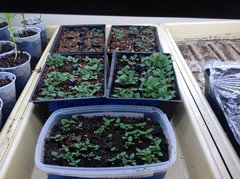
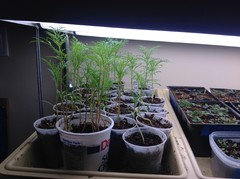
    The first photo, the front container are Verbena boniarensis seedlings.

Sponsored
Peabody Landscape Group
Average rating: 3.5 out of 5 stars8 Reviews
Columbus' Reliable Landscape Design & Contracting