Software
Houzz Logo Print
shawhop

snake plant soil

8 years ago

I was given a beautiful healthy snake plant with tightly packed soil in a pot with closed drainage holes. My question is, does this type of plant need loose soil or tightly packed soil. Should I open the drainage holes? I watered it today for the first time with a small amount of water and it sat on top of the soil, then slowly seeped into the soil.


Comments (14)

  • 8 years ago

    They grow naturally in sand. They will eventually rot away in a pot with no holes.

    Paulina thanked fawnridge (Ricky)
  • 8 years ago

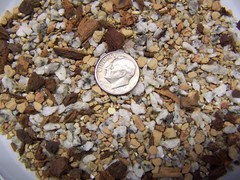
    In addition to Rina's good advice, I'd add that you could treat them like a succulent that doesn't tolerate a lot of direct sun well. Though they're not a plant I'm drawn to, I've grown some of the more unusual varieties, and the image illustrates what I use as a soil.

    Other fast draining, well-aerated media can be made to work well too. You'll find that it's easiest to keep this plant happy if you use a soil that doesn't support a soggy layer of soil (perched water table) at the bottom of the pot. Soil saturation = dead roots. When roots die, vitality is diminished and the plant is forced to spend energy that would normally have resulted in growth, to regenerate the roots killed by soil saturation. You can also use some very simple science (so simple a simian can do it) to limit the amount of excess water your soils can hold ...... which can be exceedingly helpful to maintaining a high level of vitality, which results in more eye-appealing plants and better growth.

    BTW - even though they might be found in sand where they naturally occur, you'd quickly find that what most of us think of as 'sand' when we hear the word, will end up being something barely sort of disaster in pots; this, because of compaction and the excess water it will hold.

    Al

  • 8 years ago

    Yes, please open the drain holes, excess moisture at the bottom of a pot can make any plant ill.

    The plant in question looks like S. trifasciata to me, which can be acclimated to being in the sun (outside) all day. There is no spot inside that would be too much sun for this plant though if one has subscribed to the false stereotype about this being a great plant for a dark corner, a sudden change from the dark corner to a nice south or west window might cause sunburn.

    When given plenty of warmth & sunshine, they can use as much moisture as any other plant of comparable size in comparable conditions.


  • 8 years ago

    Lets say this, As long as the plant stands up no need to pack it down too tight. That is using potting soil. I've never seen removable drainage holes.. are they ones you drill? or something like a cork to plug it?

  • 8 years ago
    Thank you all for your comments and advice. I have sinced "drilled 3 holes at the bottom. I put such a minuscule amount of water after receiving about 2 months ago.
    Once the weather warms up here in NJ a bit, I will repot with more appropriate soil.
    The plant is very healthy and shows no sign of distress. I just wanted to do my part to ensure it stays that way.
    Thanks again!
  • 8 years ago

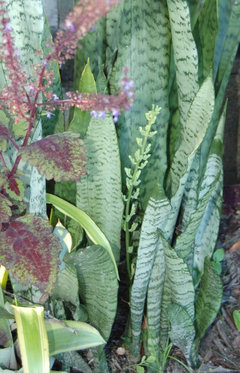
    @Tapla, would a large snake, such as the one posted by Paulina, be stable in your soil example? I'm considering repotting my snake into a similar soil mix that you mention, but I'm concerned the plant would not root properly and tip over.

  • 8 years ago
    last modified: 8 years ago

    ...not tapla here, but plants will eventually be anchored well even in very gritty mix (I do not use anything but gravel, perlite and turface). I have few sans as big as Paulina's, if not bigger in it, and much bigger jade too. I keep all succulents in that kind of mix, and root them too. I usually support them with larger roc or few if they don't have roots, or if they are just potted and are still wobbly. They grow healthy and strong roots.

  • 8 years ago

    I use bamboo skewers broken into appropriately sized stakes and stake the plants down in a kind of / \ around the plant/rhizomes

  • 8 years ago
    last modified: 8 years ago

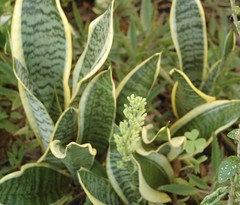
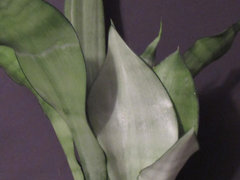
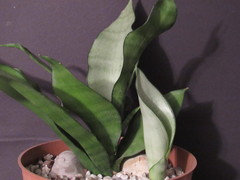
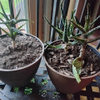
    Couple of divisions from a large pot of neglected Sansevieria 'Moonshine' given to me few years ago - original plants were supported by rocks; smaller, light-colored plants in both pots are new shoots that grew since. I didn't remove the rocks at the time photos were taken - and they were plenty enough to support newly potted plants in gritty mix (unless one has curious kitty around :) - but that is different problem):

  • 8 years ago
    Interesting! I have to try this "gritty" mix! Lovely plant!
    @rina, do you have a picture of your jade plant? My jade is tall and leggy. I want to propagate the jade (Is this the right place for jade discussions ?) but had a bad experience in the past with attempting to share a cutting with my mom. Her cuttings have since turned into a healthy beast of a plant while the host plant soon dropped leaves, shriveled and ...
  • 8 years ago
    last modified: 8 years ago

    Paulina

    I use gritty mix, many ppl don't. There are quite a few 'variations' of it, depending on what substrates are available to you. WHY to use it is extremely well explained in -this post - by tapla (AL), if you didn't read it. If you understand the principle, mix could be made using few of many different substrates.

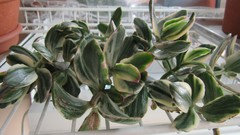
    I will get photo of some of my larger jades...started to do some pruning, and there are many cuttings! Here are just few from C.ovata Tricolor. There are many more coming:

    If it was warmer and if you were in Canada, I would share some with you :)

    There are may more discussions about jades and/or sans on Cacti & Succulents forum. You can start new thread about your jade, and/or read many existing threads like -this current one- for example. There is also separate Sansevieria forum.

  • 8 years ago
    last modified: 8 years ago

    Thing is gritty mix is not easy to get by. No one sells it. The ingredients and what is more of the exact size, are also hard to find.

  • 8 years ago
    last modified: 8 years ago

    There are few places that sell so called gritty mix - but I never bought any so can't say 'yay' or 'nay'. I am also too cheep to pay for it (and it would include postage and be just too expensive).

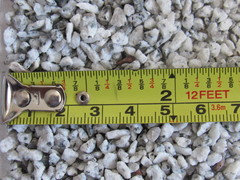
    I get chicken grit without any problems (approx. $10/50lb) - available in size I need:

    Buying Turface includes some driving but I bought 3x/50lb bags originally (under $20/bag) and do not use much, so am good for another 3yrs or more (and I have more than couple of hundred of pots :). Perlite is available all over the place, I buy in bulk that one too - it is less $ comparing to small bags, and I use lots of it. There is some work involved, but I rather make it myself than buying, since it would be huge amount of $$$ to buy enough for all my plants. It isn't easy to find pumice for me...but perlite works great instead (all prices are in Canadian dollars).

    There is also LechuzaPon - very inorganic mix; I never bought that either since am happy with what I have. But some ppl use it and highly recommend.

    Another solution is mixing Cactus&Succulent soil with coarse perlite (or pumice), in minimum 50/50 ratio. Could be more perlite. I do not use this mix, but again - many do and are happy with it. Many succulents could be grown in pure pumice, or grit, or mix of only two - or mix of more than 3 ingredients. So there are choices...all depends how many plants one has (could be pricey if bought pre-made, and if one has too many plants), and time and effort one can spend. If living in apartment, storing large amounts of extras could be big problem.