

Repotting sansevieria into a 111 gritty mix
Hi all,
I recently picked up a sansevieria zeylanica from my local home depot. The plant is in a plastic, 8.75 gallon pot and the leafs are between 12 and 25 inches long. This will be an indoor plant.
I am "overwhelmed" at the amount of information floating around about how repot this plant and would love some clarity on the following questions.
One interesting piece of information that I came across is repotting into a 111 gritty mix. Will a snake plant thrive in this mix? I'm concerned that this mix might not be ideal for taller plants such as this sansevieria. Thoughts?
Instead of mixing my own gritty mix, will bonsai jack's succulent and cactus gritty mix do? I hope links are allowed, here is the product in question Succulent and Cactus Soil Gritty Mix #111
Regards,
S
Comments (35)
 8 years ago
I am guessing this is probably actually an S. trifasciata you have. It seem like under moist, warm conditions and good lighting these guys can actually do fine in a heavier soil and with a fair amount of moisture, but drainage should be good especially if it is cool and dark. You could technically grow this in gritty mix, especially if you are familiar with these mixes. However these large flat leaved type Sans need a bit more moisture than most succulents, so a mix with some organic material seems to work better for most. For most people I think it would be easier to stick with a commercial potting mix with perhaps some added perlite to improve drainage.
snakeinapot
Original Author8 years agoIt's a Zeylanica, at least according to HD https://www.homedepot.com/p/Costa-Farms-Sansevieria-Zeylanica-in-8-75-in-Grower-Pot-10SANSZ/203380960
I'm worried about root rot/overwatering the plant, hence why I'm considering the gritty mix. I have shamefully killed at least two sans now, and I'm hoping that a gritty mix will solve that issue.
Would there be any concern for the snake not fully rooting and tipping over in a gritty mix?
Can you recommend a commercial potting mix for an indoor plant that won't see much light? And would perlite size matter?
Regards,S
Related Professionals
Fort Smith Landscape Contractors · Hot Springs Landscape Contractors · Westerly Landscape Contractors · Longview Landscape Contractors · Clarksdale Architects & Building Designers · Chambersburg Architects & Building Designers · South Bend Architects & Building Designers · Burlington Architects & Building Designers · DeRidder Landscape Architects & Landscape Designers · Ottumwa Landscape Contractors · Saginaw Landscape Contractors · Oshkosh General Contractors · Charlotte Landscape Architects & Landscape Designers · Mansfield Landscape Contractors · Anniston Interior Designers & Decorators- 8 years agolast modified: 8 years ago
I can tell you what I do with my Sans. I have at least 10-12 different varieties including hahniis, boncels (cylindrical), ballyii, fischeri, francisii, kirkii and other hybrids. I plant all of them in a mix that is approximately 1:1:1 sifted C/S soil, sifted and washed pumice (I buy from General Pumice Products) and washed Manna Pro poultry grit. (I also use plastic pots) On occasion, when I want to lighten the pot, I add sifted and washed perlite and make it 1:1:1:1. I am notoriously careful about watering and ONLY water when they are dry. Nothing kills Sans like overwatering. Sometimes I think a plant needs water, but it's cold here in FL and I'm afraid the roots will be wet and cold, so I just wait a few more days. I have never lost a Sans from UNDERwatering, but I have turned a few to MUSH with over-watering in just a matter of days. It's hard to refrain from over-watering, but try try try.
The other trick that is fantastic -- in summer, when it's warm -- I learned from Stush on the Sans forum. Type in "alfalfa, potassium, Sansevieria" into the search box, and you will get Stush's formula for a homemade "fertilizer" that is fantastic for root growth and leaf growth. I use it on my Sans in the summertime (growing season) with excellent results. I have also used it on Gasteria with wonderful results.
 8 years ago
Hi SnakeinaPot,
I doubt it matters what brand C&S Mix they used. I don't think gritty is for a plant like this, will not support a heavy plant like this in place.
Respectfully, I think you're overthinking & overworrying about this.
If you correct your mix but not your watering, the problem will continue. I'd suspect the problem is not the mix, it's your watering, which is the case for most folks. Was going to ask why you want gritty, but you clarified that. I'm w/ WoodNative on this, I'd stick to commercial C&S mix & Perlite (equal parts of each). Tho' I save it for my heaviest Sans., a terra cotta might help keep it drier for you & allay your fears a bit
I've been on these forums since 2001 & have grown Sans. longer than that. I sometimes use recycled mix for them, recycled from my Succulents, which I grow in pumice based mix I make. It's fast draining which is ALL the Sans. care about.
To correct overwatering, one needs to learn NOT TO WATER. Sans don't need watering more than once every 2 wks or so in Winter.
Are you new to Sans? How do you determine when to water & how do you water?
Thru the yrs. I've killed Sans. both by overwatering & under. We've all killed a few Sans, I'm sure, so pls don't feel badly or be so nervous, it's part of the learning curve sometimes & gets better as one becomes more experienced growing these plants. Also, pls remember they do well w/ benign neglect.
- 8 years ago
S- Where in the world are you located?? I mean geographically........Florida, Minnesota, Ireland....? In any case I am in temperate NJ. Soil mixes are kind of like cooking recipes.........play around with the ingredients a bit and figure out what you like. For me, I generally use about 1 part commercial potting mix.......either a commercial cactus and succulent mix or potting soil, 1 part perlite, 1 part good garden compost and some coarse river sand (maybe 0.5 part). Give or take.....no two batches exactly the same. This has worked well for me. I sometimes add a pinch of lime and/or Triple phosphate to a batch. Like Karen I don't particularly like the gritty mix, and it is important to know how you are watering (and determining when they need water). WHEN and HOW you water is also important. In winter especially I like to water on the MORNING of a SUNNY day. I try to avoid wetting the base of the leaves/crown. Excess water can evaporate before the cooler night. You want to soak the soil thoroughly but not have puddling. Excess water should drain out but some water should be retained by the mix. When Sans are actively growing in summer......long days and warm weather, they don't mind heavy soils or frequent watering at all. I love to get my Sans outside in summer. It can rain constantly on the for 3 days straight and they are VERY happy. In the winter, I keep them MUCH dryer.
snakeinapot
Original Author8 years agoWood, I'm in NYC.
Karen, this is my third snake plant, so I'm fairly new.
To determine if I need to water, I typically stick my finger two inches into the soil and water if dry. In the past this worked out to watering about every other week. I don't recall how much water I used, but I never soaked the soil until the water dripped from the bottom. This is a common watering technique I found online. Seems like overkill.
That said, both plants died from root rot, so in the end I somehow ended up overwatering them. The plants died in the pot/soil they came in. Perhaps the soil was bad?
The soil post by tapla, a member of these forums, was educational and made me consider the gritty mix. However, as you mentioned Karen, this soil might not support a heavy plant like this.
I'm definitely overthinking this, but at the same time I'd like to not kill another snake. Most importantly I'd like to learn from my mistakes, which I'm still not sure what they were =]
 8 years ago
"Sansevieria zeylanica – According to the University of Florida – “Most plants sold as Sansevieria zeylanica are Sansevieria trifasciata. True Sansevieria zeylanica has little appeal as an ornamental.” "
 8 years agolast modified: 8 years ago
Robin, can you link me to that Stush thread about alfalfa, potassium, Sansevieria?? This Houzz stinks!! Anytime I try and search anything, it says 0 results..Thank you
Believe it or not, you can even kill a Sans in the gritty mix. Yes, if you under water then over water you can still cause root rot. In fact, I have killed a many plant in the gritty mix. I like to use a lighter soil mix as described above, one that carries bark, perlite, and peat and even change it up a bit as Woodnative does. I find they like a light airy mix that maintains moisture but does not stay soppy wet. I also found that for me its easier to judge if a pot needs water just by the weight with lighter mixes and one that does not kill my plants within a day once the mix dried out. You can always use a wooden dowel to check the root well beyond the first two inches from the top, well into the root zone to see whether you mix you use is still moist. You might be surprised at what you discover when your finger alones tells you it's dry.
Don't forget, if you choose a mix with more organic material, make sure not to over pot and make sure you change the mix out every year or two so that it does not compact around the roots. Keep what ever mix you use open porous and airy...
Too, many people put their Sans in darker or cooler places which requires a mix that does not stay wet and cold. If you are providing lots of light and warmth, that is a whole different story...
So as I am sure Woodnative wood like to know under what conditions you will be growing these? Lot's of sunlight? Bright area? Long sunny days? Short sunny days? A dark corner? A cold room? Fans running? Rain or tap water? Under lights?
These all determine your mix, watering needs and success...
MIke
- 8 years ago
Temperature and light are also key factors in watering issues. Also, most know by now that one should not use a "drainage" layer of pebbles at the bottom of the pot as it is counter productive, creating a soggy anaerobic layer just above the "drainage", just saying.
- 8 years agolast modified: 8 years ago
Hi Mike,
OP's already said he's found an overwhelming amount of mix info. Pls. don't confuse things by adding yet MORE mix recipes (especially not bark, which would be BAD for Sans) to this discussion.
WoodN & I are trying to help simplifying things for him, & help this person along. You're not helping, the dowel comment sounds nice & I was going to get to that. But since you didn't explain how it works, that didn't help either.
S, the dowel, wooden chopstick or pencil are used to tell when to water. Stick the dowel down in the soil as far as you can, ideally to the bottom & leave it for a moment. Then remove the stick from the soil & see if it's got soil on it: if so it's still moist so you wait another couple of days & check again BEFORE watering. If it's clean & dry that shows it's dry all the way down the mix making it safer to water w/out risk to the roots.
Mike does mention one can sometimes tell when to water by the weight of the pot, but that's after one has learned pots, mixes & watering. It's not as simple as it looks but gets better as one see the effects of changing to better draining soils & observes the plants for their reactions.
Then again, among succulent growing folks, when it comes to watering we often say: when in doubt, don't.
'Cause succulents can often survive underwatering, but overwatering often leads to rot,
 8 years ago
I have a Sansevieria Trisciata in a mix of 2/3 turface and 1/3 orchiata pine bark from RepotMe. It took a long time to get established, but this winter it's sending out a bunch of pups. I have it next to my kitchen window, next to the heat radiator, and a couple of leaves dried out. In winter time I find it's best for me to water it every 5 days. I add about 1/4 of a teaspoon of Dyna-Gro Foliage Pro everytime I water. Will post pictures tomorrow morning. My plant is absolutely thriving in this gritty mix
 8 years agoI grew all of my Sans in gritty mix (the exact recipe) for a year and then my own variation - an even looser mix of 1:1:1 lava rocks, screened perlite, and pea gravel (photo of the mix attached). They flourished, and gave me a lot of leeway when if came to watering. Whether I watered every week or forgot for a full month, the Sans were fine. Fertilized maybe every third or fourth watering. This was in the Bay Area. It was perfect.
I only brought my S. trifasciata when I moved to NV and now use what probably breaks down to 2:1 potting mix of peat/coir to a mix of huge and smaller perlite. They’re fine, but I constantly sit on the ground in front of the plant thinking back to when I last watered, and whereas I watered when in doubt with my spin on GM, I now don’t water when in doubt. It’s also slightly over-potted, which didn’t make things easier but I hate repotting Sansevierias. I wanted to make sure it’d stay in its pot as-is for at least two years.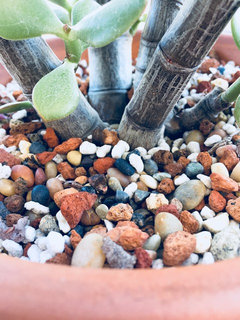
- 8 years ago
To Mike, regarding Stush's post about alfalfa and potassium -- finally found it.
Here is the actual text. I'm on my second year of using this blend with select plants and their growth has been extremely positive. Good luck if you try it.
Robin
Great winter growth
Stush2049 Pitts. PA, zone 6(Zone 6)November 14, 2013
Ok, giving this a lot of thought. Just to share so others don't have a hard time this winter.
I have been told by some very big nursery growers that Alfalfa is a growth stimulant for plants. Claiming to get two years growth in one year. And given the fact that most of my loss is due to root rot or base rot, decided to give Potassium only to encourage root development. Both of these were purchased in local stores. K-Mart had the Alfalfa 1300 mg. herbal supplement, 300 tablets for about $8. Then Walgreens had the Potassium Gluconate 595 mg. dietary supplement, 300 tablets for about the same cost. So in a 1 liter bottle, 3 tablets of Alfalfa with 1 tablet of Potassium. Mix well, then the next day, added to water can with another 1 liter more water and watered plants as normal. So far so good. Seeing new growth and vigor. After a few watering then back to normal watering.
Hope it helps.
Stush - 8 years ago
Have not done it yet.........but still think it would be fun to get a bunch of hahni pups the same size/age and plant them in different mixes and/or with different fertilizer regimes, side by side for a year or so to see differences in growth. Note If you do go for the pure gritty mixes you are essentially creating a hydroponic system.......the soil will not bind nutrients, so you do have to add them back in the form of fertilizer.
 8 years ago
Just a update on my Alfalfa mix. A most easier way is to just add a few tablets to the potting soil. Even well established plants. Just push a hole around the ends of the pot and insert the pills. It seems you can't over do with alfalfa.
Well long before I ever had a computer, I had some large snake plants in regular potting soil. Did well for me for over 40 years. Like the good advise given above, it's more of your watering skills than most anything else. For me, I do well with a more gritty mix but only on my smaller ones. My big tall 4 to 5 footers, anything.
snakeinapot
Original Author8 years agoThank you all for sharing your experiences.
I'm still on the fence of using a gritty mix vs a commercial mix with perlite. Seems that y'all have great success with various mix types, which translates to I'm overthinking the mix and watering/proper drainage is the real concern.
Which leads me to another point of confusion, watering. Assuming it's time to water, do I flood the pot until the water runs from the bottom, or do I just add a certain amount? I've seen both methods recommended, but the flooding method seems like a sure way to cause root rot. Thoughts?
My apartment usually hovers at about 70F. However the plant will not receive much sunlight.
Thanks all!
- 8 years ago
The inverse is actually correct regarding root rot and amount of water used while watering.
Water is a funny thing, physically speaking. We see it as a liquid that's not very viscous and slick. However, on a micro level, water is very sticky and loves itself more than dry (this has to do with the charge of the atoms repelling each other.) Without getting too technical, if you water with a set amount of water, unless it is of a large enough quantity, the water will do one of two things. The first thing it'll do is under the circumstance that the soil is too dry and so the water will rush around the edges following the path of least resistance and straight out of the pot. The second possibility is if the substrate hasn't dried enough yet to become hydrophobic.
With this second possibility, the water goes into the soil and stays there. By flushing the pots several times insures rewetting of the entire pot (dry spots kill plants or at least make them suffer) as well as removing as much excess water as possible. Due to the nature of water, that will move the saturation from the top of the pot, as seen with a small amount of water, to the bottom of the pot. This is called perched water and depends on the particle size as to how far up the pot the capillary action will hold the water in the substrate. We often recommend tipping the pot 45 degrees to reduce even further the perched (excess) water. This helps create a more oxygen rich environment for the roots. They need oxygen to "breathe" and it is the suffocation/drowning of the roots that leads to root death and eventual root rot once the plant's system is opened up to pathogenic microbes (like how it's easier to get tetanus from bacteria that's been injected into a wound, it has to be introduced into the body to become a problem.)
snakeinapot
Original Author8 years agolast modified: 8 years agoLaticaudo, I'm not sure I follow. Are you proposing thoroughly watering the plant several times until the water runs out the bottom?
- 8 years ago
Filling the pot full several times in a row while the water flows out the bottom of the pot. Over a drain or receptacle.
snakeinapot thanked laticauda snakeinapot
Original Author8 years agoGot it, thanks for clarifying. Would you recommend the same watering technique in the winter, just less frequently?
- 8 years ago
Yes, only water when the pot is dry all the way through. The time period will fluctuate but you're looking for the same level of dryness all throughout the year.
- 8 years ago
Snake, Are your plants going to be outside during summer or are they to be in the house year round? If outside in summer, I would soak the pot almost on a weekly basis. Spring and fall, cut back and winter, almost none. Always remember; water + cold = death
- 8 years ago
Well you picked the right plant. It loves sun but can tolerate less light. A good drench once in a while is good but I would water lightly most of the time.
- 8 years agolast modified: 8 years ago
Sorry to disagree w/ Lati, but I wouldn't flush out Sans.
I DO water 'til I see some come out the bottom. Not flood, but 'til I see a teaspoon or so of water after waiting a moment or 2 for it to drain.
But also, I elevate my Sans. pots, on a small ring of plastic (inner ring from tape dispensers), so that the pot is elevated a bit from the saucer, allowing some air to circulate near the roots.
snakeinapot
Original Author8 years agoKaren,
I like the elevation idea, will totally borrow it once I replant.
Since you stop pouring once water runs from the bottom, do you find that you're always adding the same amount of water, or does the water amount change due to seasons/soil resettling?
- 8 years ago
I agree with Karen. I do not water any plant pot after pot after pot full of water. But I do what she does -- water my Sans until water comes out the drainage hole. I let the plant drain thoroughly in a saucer and then empty the saucer. I have too many plants to elevate. I wish I could. That's a good idea. Sans are pretty flexible and can manage a fair amount of neglect. For me, it's over-watering that kills them.
- 8 years agoThat’s interesting, Karen. If you’re going to water until a little bit of water comes out of the drainage hole, what is the functional watering difference between that and flooding it profusely, aside from your method flushing the soil less?
I am too busy and too lazy to lug all of my indoor plants out to flush them constantly (though left to me, I would each time), but I do strive to do so every 2nd to 3rd watering, and then I water it thoroughly and abundantly about 2-3 times over half an hour, let it drain until nothing comes out when shaken, before putting it back in its place. - 8 years agolast modified: 8 years ago
I have difficulty with dry spots if I dont use enough water.
Also, overwatering typically refers to watering too frequently and/or letting the pot sit in standing water, not using copious amounts of water to flush the pots. You will always be limited to the amount of perched water allowed for the substrate being used.
- 8 years agoSo is that what Karen is disagreeing with—that flushing the soil is overwatering?
- 4 years ago
I have my sans in a custom mix with pine bark fines and they are thriving and my mix drains well why would anyone say bark is bad for sans?
the problem is you are watering on a schedule you can forget sans in the winter ESPECIALLY in low light conditions less light always means less water
i had NO noticable growth on my sans in low light, so while they survive in those conditions, they will not thrive in those conditions
i moved mine to a sunny location, water less than once a month in the winter, water more often in the growing season AND like someone else mentioned i use DynaGro foliage pro spring to September they shot up like crazy and sent me pups i keep all but one in clay potsI have a wood burning stove in the winter … my home is dry … i still don't water my sans more than once a month in the winter and mine are in a south window … for low light i would wait two months to water them
i just planted my new Sayuri in the gritty mix. how can anyone think the gritty mix can’t hold the weight of the plant???? Shes the tallest sans i have right now and shes sturdy in the grit
If you arent comfortable with the gritty mix, use Als 5:1:1 mix it has superior drainage and all my potted annuals absolutely thrived in it
i buy reptibark since i can’t find pine bark fines in my area
When i do water, i water thoroughly so as not to leave dry air pockets in my pots so in essence the roots are getting a good drench but drainage is the key no perched water


robinswfl