

Let's Recycle
Don't ever let anyone tell you any different. Gardeners were, are, and always have been, top-hands at recycling. Especially if they have German roots. (Use It Up, Wear It Out, Make It Do, Or Do Without).
And something else we are, is people with lots of friends. Combine the two, and you have friends saving all kinds of things for you. Nothing makes me happier than to get a call from someone saying, "I have things for you on my front steps. Come'n' Get It!!" Oh, you're singin' my song.... Sometimes while I'm there, they show me something they've saved and ask, "Can you use this for anything?"
The garden season begins in winter with plastic milk jugs for Wintersowing. IMHO, there's nothing better. Invest in some China Markers (Amazon sells them in black, white and red) and a wood-burning kit (got mine from Lowe's).
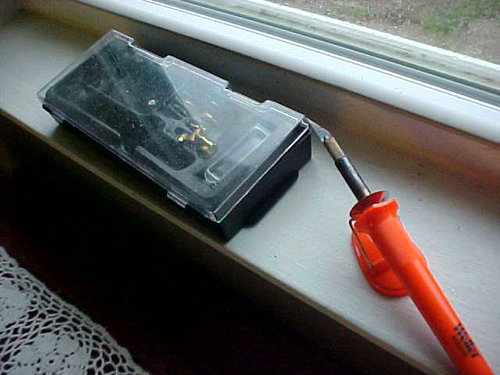
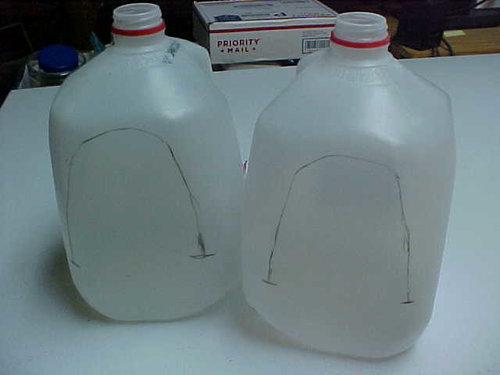
I draw my cutting line on the jugs, then when the wood-burner has heated up, make my cut. It goes like a knife in soft butter. I also make two drainage cuts in the bottom of the jug. Not all the way in the bottom, because it lets the water drain out a little too fast for the way things go here. Just maybe up about half an inch and in one of those recessed areas that are on most milk jugs.
Then I open up the "flap" I made and fill the bottom with potting soil. My mix is homemade, it's finished and screened compost, vermiculite, and peat in equal parts. If I don't want weed seeds and insect eggs coming to life, I'll bake the compost, a big pan of it about 350 for an hour. Less might do, I don't know. I use the stove that's in the garage for this task because if you do it in the house it's kind of stinky.
I like to add water to my potting mix before I put it in the jug, not quite up to where the cuts for the flap started. You want about 3" of depth. If I don't water it first, I water right after I've put the soil in the jug.
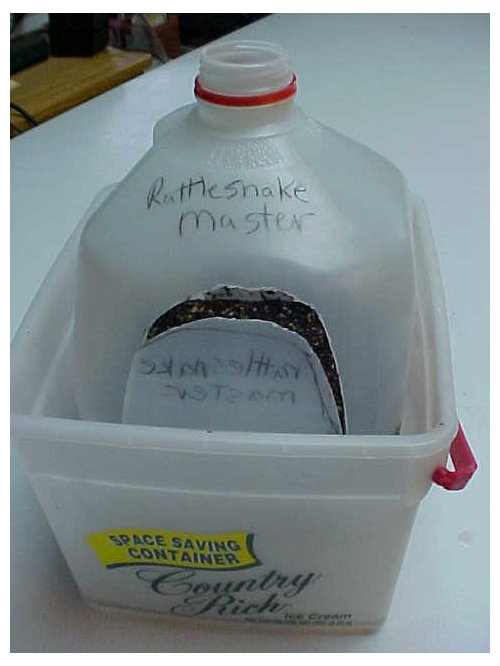
I write what's going to be planted on the outside of the jug, near the top, and on the inside of the flap. You'll see why in a little bit. Then I scatter my seeds on the surface of the soil. It doesn't take very many because nearly every seed germinates this way unless there's "human error". Unless they are tiny seed, I top off with a little dry potting mix before I pat it down with my fingers.
Then I set the jug outside in a semi-protected spot but out in the open enough where it'll get rained on and snowed on but not blown down the road to be found in my neighbor's pond at some future date.
On warmish days, when the sun starts heating things up, I may move the jugs to a shady spot. At some point, I fold the flap down so warm breezes can get into the jug. Seedlings will come up quickly and take a little babysitting at first. A late frost at this point might require me to bring the jugs inside for the night.
After they've sat with an open flap for awhile, it's time to cut off the top of the jug.
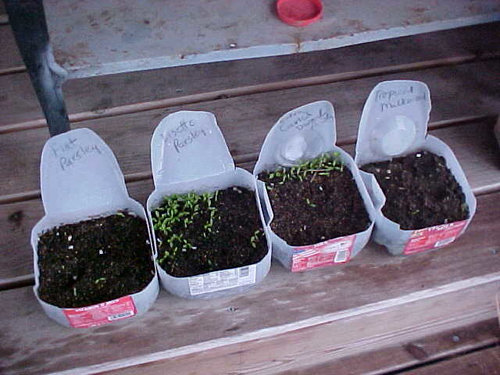
Now, aren't you glad we wrote on the inside of that flap? When they get a little bigger, I'll just slice down each corner and spread the container flat. If I have watered some beforehand, the potting mix will hold together enough that I can slide the "cake" gently out and directly into a dug-out area I've made in the garden of the same size. Usually, they don't even know they've been transplanted. Later on, when the plants are tall and crowding each other, I can dig some of them out gently and plant them in other places if I want to. Or pinch them out, if I don't.
This is just a sample of some of these things I like to recycle. I'll put other posts on showing you other things. But I bet you can think of lots of things you recycle, too? Don't be shy! Add your two cents if you want to. --Ilene
Comments (6)

User
Original Author8 years agoIt's me again with more things I recycle.
Here are those rectangular ice-cream containers again. They hold three to four plants each, and the handle is sometimes, but not always, a bonus! When moving plants, it's much easier to move 3 or 4 at one time than it is to move just one. Plus the containers catch any drainage. And the cups that are in the ice-cream containers? They're 32 oz soft-drink cups, mostly from Quik-Trip. This is not to say that I don't use Solo cups or even styro cups. Use what you can get your little-ole hands on, that's what I always say.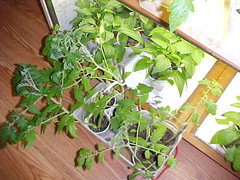 These are more QT cups, sitting in clear sweater boxes I bought at a garage sale for 25 cents each. Those stakes that are supporting the plants are sticks picked up in the garden from plants I grew last year.
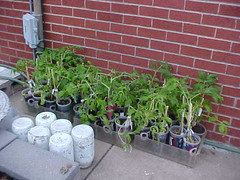
The white things are glass pickle jars that I painted so they'd let in light yet protect the cutting from heating up too much in the sun. They are bigger than a quart canning jar so work well for cuttings from bushes.
Old styro coffee cups for small things. I neglected to wash these out from last year but they've been stacked up inside a metal shed for almost a year so I'm thinking any insect egg or disease is probably long gone. Just isn't very pretty. Note the tags that identify the plant. They are cut from an old window mini-blind. I buy them at garage sales for, like 50 cents. They think they're pulling off a big one, selling some old lady a broken mini-blind. Hah! The last laugh's mine because I'm gonna cut 'em up, anyway. Use a grease pencil to write on them. If it's something that you're going to set out into the garden, the tag can be stuck in the ground or clipped onto a tomato cage with a clothespin.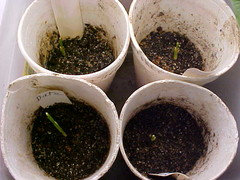
Oh! don't get me started on clothespins! Use them to fasten a loose vine to the trellis (fold a leaf over a wire on the trellis and the put the clothespin on, so you don't crimp the vine). When there's an okra pod I want to leave on the plant for seed, I clip a clothespin on the stem below it to remind me not to pick it. Clothespins secure netting to trellises and cages.
A used book that I bought on Amazon arrived in this. So now I have an extra pot for something.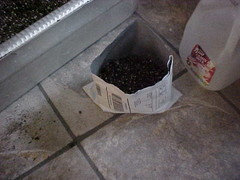
- 8 years agolast modified: 8 years ago
Clothespins are a jack-of-all-trades tool- cooking, gardening, clothes washing, etc. love 'em!! I notice you mention German roots at the beginning of the post; you guys got German ancestry? Our family has very strong German ancestry. My last name, Lockcuff, is from my German great-some grandfather who came over from Germany probably 100-200 years ago. My mother also has very strong German ancestry, an ancestry test rating her for over 60%! Nuts
My family teases me about my recycling habits. "Don't throw out that milk jug!!" or "Don't dare get rid of that banana peel" are common phrases lol. All food goes to the CHICKENS or compost pile, or both!! Milk jugs make great watering cans as well, punching holes in the cap and screwing it on the jug full of water. Maybe impractical for a large garden but very gentle stream for watering seedlings indoors or in a greenhouse. Countless uses. I especially like your ideas.
And CARDBOARD
Great post
Related Professionals
Fort Smith Landscape Architects & Landscape Designers · South Bend Landscape Architects & Landscape Designers · Minneapolis Landscape Architects & Landscape Designers · Bennington Landscape Architects & Landscape Designers · Wilmington Landscape Contractors · Jacksonville Landscape Contractors · Charleston Landscape Contractors · Dallas Landscape Contractors · Flint Landscape Contractors · Bemidji Landscape Contractors · Santa Maria Landscape Contractors · Daytona Beach Home Additions · Lebanon Home Additions · Temecula Home Additions · Liberal Home AdditionsUser
Original Author8 years agoSomething else that falls into "recycling", sort of, is to learn to "use what you've got".
I know people who take a tiller out to their garden every spring and till every single thing up. It doesn't matter if something came back up from the roots. It doesn't matter if the tiller shot a poor little toad out of the ground, now missing a leg. It doesn't matter if the tiller unearthed grubworms that scramble back into the soil and no one picks them up before they disappear. Stuff like that.I do a lot of walking around out in my garden. I look at things and see what came back up, I check the blackberry vines for signs of life, and the mulberry tree, and the thornless currant bushes. I actually rejoice in every little thing that's blooming, every little bud on an otherwise empty-looking stalk. Yeah, spring's the thing for me.
I've been kind of concerned about whether I'm going to have any kale growing in the garden this year. Summer of 2015 and 16, I had Red Russian kale. It was awfully big and coarse, but I tore the leaves up in little pieces and ate quite a bit of it those two summers. In 2016 it went to seed, and kale babies popped up nearly everywhere in the garden. But most of them weren't in good places and I admit I kind of ignored them. I had gathered plenty of the seed and I knew I could plant more if I wanted to. But I didn't really want to because I found a type of kale I liked better. It was Blue Vates, a nice blue-green curly beauty that was very prolific in 2017. I picked a lot of it and put it straight into the freezer in ziplock bags. After they were frozen I smushed the bag with my hands and the leaves broke into little pieces, perfect for tossing into beans or soups, scrambled eggs (with onion), or into a milkshake that also included some frozen strawberries. Yep, I got my money-s worth on that purchase of seed from a little country store in Chouteau, OK. Actually there was several years' worth of seed in that bag. Now, those folks know how to fill a seed package.
So today I went looking for little surprises in the garden.
Woo-hoo! There was this kale plant, and one other, coming up from the root of an otherwise couple to totally dead-looking stalks. I set about clearing away the tangle of Henbit and Baby Blue Eyes, so I could see if there was more, and there was (so far) no more in that bed, but there was another in the bed just across the path. I have cast some seed out there, just in case. I actually will need more than just two plants, anyway.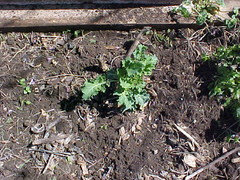 If you ignore the Henbit (which, by the way, Jacob, my chickens used to literally FIGHT over), you may be able to see the Cilantro near the upper left corner. I don't usually do much with my Cilantro except to give it to my neighbor who also takes my extra peppers. But this year, I think I will harvest some for myself. I would like to make some salsa if I end up with enough tomatoes and onions. Of course the Cilantro will be gone to seed and done by the time I harvest those. What's up with THAT, I wonder??? I have had really good luck freezing certain herbs that don't hold their color and flavor well when they are dried, such as basil. I'm thinking about actually doing my Parsley that way instead of drying it. And I think I'll do some Cilantro that way, also, just in case I get to make that salsa.
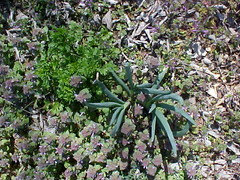
I'm sure you noticed the onions. I thought they were Candy onions that were actually too small to bother with last fall. These aren't large like Candy, so maybe they're something else. They divided, so that there were two fat "green onion"-type onions. I brought them in, cleaned them up and ate one in a Romaine lettuce wrap with a piece of sharp cheddar cheese wrapped in some Black Forest Ham. It was yummy but the onion was ~~~HOT!~~~ Really cleaned out the ol' sinuses. So I guess that confirms those weren't some of the left-behind Candy onions. No, they're not the Egyptian Walking onions either. Those are in another bed and they look different by quite a bit.
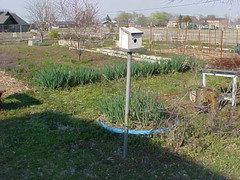
And hey, if you have Egyptian Walking onions, it's getting about time to pull some at the time when they are at their best.
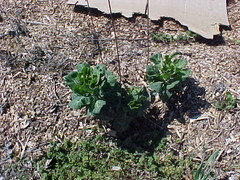
Some of the Brussels' Sprouts look like this. The stalk to these plants went hollow and dry and the tops of the stalks were brown. I didn't think there was any point in leaving those standing. So I cut them off at ground level with the loppers. Now, new plants are coming up from the root.
Here's one that chose another path to follow. Still green on the top. I think the ones that are like this will make seed this year. I'm going to be happy about that, because this variety is Roodnerf, an heirloom variety that is open-pollinated. I'm hoping to never have to buy seed for Brussel's sprouts again.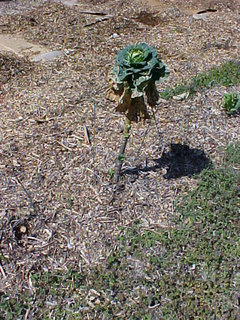
While I was in the garden I found several fat grubworms. I used to give them to my chickens and they would actually come out to the garden with me and stick their heads in the way while I was weeding. Sometimes one chicken would peck some of the others if they got too close, but they would all gather around, all beady-eyed like chickens do. I really loved my little chicken flock, but it was just too difficult to keep them in the winter, and if we had to be gone for a few days, we just didn't like having to ask a neighbor to put them up for the night and let them out in the morning.
So now I put the grubworms in a small basin near the birdbath and the birds have caught on quickly. So at least the grubworms serve some worthwhile purpose to make up for all the damage they do.I found the first fist-full of asparagus in the asparagus bed. I like to combine them with chopped onions and make Impossible Vegetable Pie, using swiss cheese instead of cheddar. https://www.bettycrocker.com/recipes/impossibly-easy-vegetable-pie/569664c4-c405-4f0b-9fb6-720fd41bae39
The weeds I pulled while I was out there went into the stock tank with some water. I'm taking a stab at making "weed tea".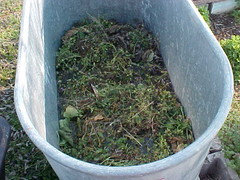
I have read it is very rich in minerals and other good stuff because those weeds go quite deep into the soil. When the "tea" is finished brewing, I'll give everything that's growing now a little nip. And the solids will go into the compost bin. I don't worry about weed seeds being in the "tea" as it's just too late to worry about something like that, my garden having been neglected too much in previous years. I don't put my kitchen scraps in the compost bin. Just weeds and garden flotsam and jetsam. I dig a hole in the garden and drop the scraps in, then cover it. Only now and then do I ever have anything digging into it, and I've never seen what it is or how it gets inside the fence.
That concrete block has either been free for the taking or priced low at garage sales or from ads in the newspaper. They are heavy and hard to work with but we use them in many ways.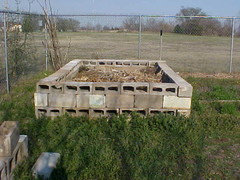
I'm down to one little Albion strawberry plant in the strawberry bed.
I dunno. I'm about to throw in the towel on this one. I can get strawberries by the flat at Aldi's during the spring. Watch the ads, that should be happening very soon. Their price has been better than anywhere else here for the last several years. I just clean and cut them up, stir in about half a cup of sugar for a gallon of berries, let them sit in the refrigerator till the juices have covered the berries, then I put into whatever size container I want, and freeze. They are not rubbery when thawed, this way. Hubs' favorite use for strawberries is Fresh Strawberry Pie. Here's a recipe that's not too much astray from the one I use: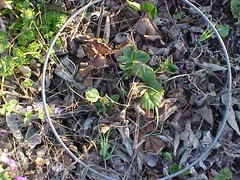
https://www.allrecipes.com/recipe/12156/fresh-strawberry-pie-i/
I wouldn't think the Splenda added would even be necessary, though.
Some things are just more expensive to grow than they are to buy after being grown by someone else. I think strawberries are that for me. One thing about being frugal is knowing "when to cut bait and go home".
- 8 years agolast modified: 8 years ago
That was a fantastic post. I'm going to be sowing some Brussel sprouts in May so I can let them grow all summer to crop this autumn, and I may just do what you showed with yours. Great idea. I love kale, no one else in my family does. I'm growing a Russian Red this year along with Alabama Blue collards.
Its true; recycling doesn't just mean saving boxes or cups lol. An example we have where we recycle a plant is mint. It has invaded our pathways, but it is delicious to put it in a jug of water in the fridge, to take out in the hot afternoons and drink cold. A favorite treat of mine, and a way to recycle mint.
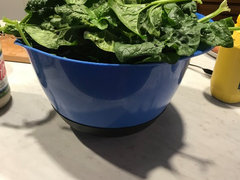
Another thing I like is the boxes that salad mixes come in from the store. I would imagine they'd make great planting containers for wintersowing having lids and all, but I use them to store salad greens. When stored in bags, my leaves always rot. When stored in those boxes, they stay crisp and fresh for a long times. This was the spinach harvest the other day from overwintered plants in about a 7x3' space, and I've been slowly eating it in salads.
Another way is crops that have multi uses. For example, I love shelling peas, like A LOT. So I grow a lot. To recycle the space they take up even more, I cut back on other salad greens to make space for other plants and eat tendrils and leaves off the pea plants!! I tried some off of last years peas and loved them, so this year I've cut back on other greens and I'm hoping to pick leaves off of all my peas, hopefully not enough to ruin production, considering I have 85' of peas for shelling, there should be plenty enough. Some plants have many uses.
Seriously, pea tendrils and leaves are so delicious.
User
Original Author8 years agoOh, peas are a 'way underappreciated garden crop as far as I'm concerned. I have eaten the leaves many times. When my daughter was a little girl, she always liked to chew on the pods when we were shelling peas. They are very fibrous, so some of it has to be spit out rather than swallowed, but sometimes I wonder, since peas are so full of protein, whether pea pods could be juiced, or at least whirred around in a blender with some water and would the strained juice be good to freeze or to can as a base for soups? Which reminds me, do you save the liquids that are left from cooked vegetables? That's what "vegetable broth" is, and it is so much richer and more flavorful than what can be bought at the grocery store.
It seems like Aldi always has really good prices on cantaloupe in the spring. When I put the rinds and seeds in a hole I've dug in the garden for the compost, there are always lots of little plants that come up from those seed, and so I thin those out and let the healthiest grow if I have room there. I always get cantaloupe from them by about June or July. Those thinnings are good in salad and taste very much like cantaloupe. Almost any vegetable thinning can be a salad ingredient. Think "baby vegetables". But what a waste "baby corn" is, since each cornstalk only puts on one or two ears, anyway. (Unless there's something about it that I do not yet know, such as whether the cornstalk will then put on a new one, or something) Did you know you can also eat sweet potato leaves? I saw that somewhere but I haven't had the courage to try it because we're definitely not supposed to eat the leaves of regular potatoes, or anyway, that's what I've always been told.
Here is how I keep salad greens fresh:
I don't have a source for salad boxes, but I do have a lot of canning jars! Talk about multi-purpose! Before I retired, I would use quart canning jars to bring salad to work for lunch. Put the dressing and the moist things, like tomato and carrot, in the bottom. Top off with the greens. When you're ready to eat, just shake the jar and eat the salad from the jar. Some people actually use their FoodSaver jar vac attachment to seal the jar with a used canning flat. I've done that before and it works well. But I find that if you're going to eat the contents within a few days, vacuum packing is really not necessary. By the way, put a FoodSaver on your Christmas Wish List. I vacuum pack a lot of things to make them stay fresh longer: dried herbs, dried fruit, extra lard (in half-pint jars), grains (after they've been freezer-treated for about a week). I went to FoodSaver's website and joined up for their email notices in the fall, and around Thanksgiving they alerted me about their products going on sale. It was still expensive but I've had mine for about five years now and use it a lot. When I open a jar of anything I've canned, I release the pressure without ruining the lid by prying up the edge with a piece of 1/4" wooden dowel that was left over from one of Hubs' projects. I started out with a chopstick, using the wide end, but I quickly wore that out. So I save all my used canning flats and use them for vacuum packing. Only once in awhile do I find a lid that won't hold the vacuum.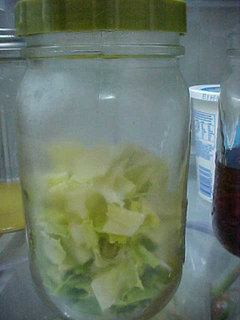
I love mint and I grow several varieties. You're right, there's nothing like a cold glass of spearmint tea on a hot summer's day. And hot, with honey, in the winter, it's medicinal yet pleasant-tasting. I bought something called "orange mint" from a local food co-op and was real disappointed in it because it didn't taste anything like "orange". In fact, I found out that sometimes it's called "perfume mint" but not sure why, because I don't think it smells like perfume, either. It's a medicinal smell. Maybe someone thought it tasted like perfume?? I don't know, as I've never tasted that. However, I have developed my own clone recipe for Absorbine Jr. that calls for some kind of strong mint as one of several ingredients. If I don't have enough peppermint I use this orange mint and now I actually prefer it in the recipe. So I get to save my peppermint for other things.






UserOriginal Author