Software
Houzz Logo Print
bahram03

Fig pot size

8 years ago

I am moving my fig trees to a 5-gallon soy sauce bucket. Could I keep it in there forever or will it need a bigger container?

I bought the fig as a cutting last summer. The seller said it is maybe 1-2 years old.

Comments (13)

  • 8 years ago

    You can keep it in the 5 gallon if you prune the roots every year... it would also limit the size of your tree.

  • 8 years ago

    Ariel,

    What variety is it?

    Moses

  • 8 years ago

    too small i guess

  • 8 years ago

    The tags say:

    1. Higo

    2. Kadota

  • 8 years ago

    I don't mind having to prune the tree. They are doing really well in their container right now. It might be 1-2 gallon pot. They were a few inches tall when I bought them and on a pot that could fit in the palm of my hand. Grew very rapidly during the summer and set a couple of fruits. I cut them off before they ripened to make the trees focus on growth over fruits for now.

    Its only been a few weeks that they broke out of dormancy and I see them setting fruit already. If we only get 50 figs a year, I think that would be great. Keeping it trimmed and small is good for my family.

  • 8 years ago

    Ariel,

    That sounds like a good plan. Every 2-3 years, root pruned once it gets pot bound, which it will do in about 2-3 years from now. Spring pruning will be heavy every year, but you have to get it in balance with its pot. The fig tree will not mind. They are very forgiving and like to grow as you found out with yours when you first got it.

    You know the 5-6 leaf, then pinch procedure, to get the earliest ripening figs, don't you?

    I wish you success.

    Moses


  • 8 years ago

    Ive never heard of the 5-6 leaf and then pinch. This is my first time growing fig. I bought it because it was cheap and wanted to try growing them

  • 8 years ago
    last modified: 8 years ago

    Ariel,

    We in colder climates, to get the earliest ripening figs, tip prune during the growing season. In your zone 7, any fig beginning to form after mid-July does not have enough time to ripen. Such late forming figs are a waste of the tree's energy.

    It takes 90-120 days, depending on the fig tree's variety, to ripen its figs, counting off the days, from the time they, as big as a pepper corn, begin forming at the base of a leaf. Figs usually appear at each leaf base on current year's new growth.

    Fig trees do not form all their figs at once. As growth elongates, figs form at the base of just about every new leaf (on a mature tree), so there is a succession of older, larger figs at a stem's bottom, with smaller and smaller figs, in size order, going up the stem. All the figs, older, bigger ones to the smaller figs, will enlarge and ripen at the end of their individual 90-120 day period.

    In a warm climate all the figs will ripen in due time, but not so for us in colder climates. The figs higher up that began forming from mid-July and on don't have time enough to ripen. That is why we tip prune.

    Forcing a fig tree to produce its figs as early as possible is what we do. This gets them started forming figs earlier than they would if not pinched.

    When a new shoot has reached its 5-6th. leaf, we pinch the tip, starting in spring as soon as new growth gets to the 5-6 leaf stage. This forces figs to form much sooner on the leaves below the pinch, giving them time to ripen. They usually start to ripen in late July at the very earliest in your zone 7. Being colder here in W. PA., my earliest figs begin to ripen about August 7.

    Your figs will continue to ripen until mid-October.

    What to do about new shoots that form at the pinch? When these new branching shoots get their 3-4th. leaf, pinch them to make them grow earlier ripening figs, too.

    There comes a point after mid-July, that any new figs beginning to form are very iffy. Even if they ripen in mid-October and on, even if the fall is hot, dry, and sunny, the short days and cool nights can cause these late figs to be dry, tough, and lacking in sweetness and flavor. If they are ripe (soft, hanging down, crack lines, and shriveled a bit), they are still edible, just not as nice as the prime August through September figs.

    If you pick off the the figs that begin forming from mid-July and on, which is hard to do psychologically, you will send the fig tree's energy into the older figs, making a better fig that ripens in perfect time. Finger pick these late guys when they are the size of medium blueberries, no sooner or you may damage the leaf where they formed at the base of. All leaves nurture the tree, and consequently the figs on it.

    A mature fig tree, well cared for, can easily feed/sustain one fig for every large sized leaf it grows. Most, 90%, of fig leaves on a fig tree are large sized.I

    A hard pruned tree such as yours will be, Ariel, to keep it in balance with the pot, will grow large leaves, the same large size as your tree would grow in the ground, in S. California.

    Just because your fig tree is being kept small by good, careful pruning, much like bonsai, it will mature, at about 4-6 years, but still produce respectable crops before then. The quality and number of figs produced increases with its reaching maturity.

    Moses

  • 8 years ago

    Thanks. I've been watching videos on the pinch method.

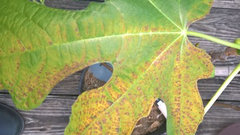
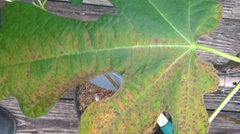
    i put rhe figs outside yesterday. It was 65-50 degrees during the day and night with no rain. The leaves started to develop some brown spots on it. Should i be concerned?


  • 8 years ago
    last modified: 8 years ago

    Ariel,

    How old are those rusted (fungus), leaves? If they are old leaves, which they would have to be at this time of year, that have been around for a number of months their rust outbreak is not a major issue. The rust fungus is ever present in the environment, waiting for the perfect conditions and perfect place to grow = older fig leaves during cool and damp weather.

    The lifespan of a fig leaf, under normal conditions, is about 6 months. If a very young leaf 2-3 months or so old, gets rust diseased, the fig tree is in trouble. The leaves are a fig tree's 'mouth'. Without an efficiently functioning mouth the tree cannot 'eat,' efficiently. The young leaves are the most actively feeding leaves.

    Also, a well cared for fig tree: good soil, good fertilizing, lots of sun, good and hot temperatures....makes it harder for disease, rust, to get a foothold. Still, old, run down leaves get nasty, rusty looking naturally, before they fall off. That's normal.

    Rust is an issue with figs only when all the young leaves get hit. If only old leaves that are soon to drop off (die), from old age are rusted, no sweat. Old leaves are more rust susceptible having a reduced immunity due to their age, hence they get rusted. Young leaves, not as susceptible to rust.

    It is my opinion that your fig trees are not in any trouble.

    Rust comes and goes. It is weather related, too. Cool damp weather favors it. Some fig varieties get rust more than others. I occasionally have had weather related rust, but never had a significant case, nor was anything done other than keeping up with good management.

    I have found rust to form on leaves of baby fig tree's that I let continue to grow on the windowsill over winter (to get size on them), when I put them outside in the spring. The indoor grow leaves did not have the strength to resist rust. As these baby figs grew new outside leaves, the rust did not hit these leaves, and the rusted, inside grown leaves, just dried up and fell off. The figs grew fine.

    I believe your climate, although winter warmer zone than mine, is otherwise very similar, humid and hot summers, so expect rusting NOT to be a major issue.

    On a different sugject:

    May I suggest you find a means to keep your figs cold and dormant during winter. Keeping a fig tree inside where it is warm and it is in leaf and growing a bit will probably considerably effect it's fruiting ability the following growing season outside. After a couple frosts in fall, and their leaves have dropped, they should be kept between 45°F. to 30°F., until brought out in spring. Garages, sheds, cold cellars, fruit cellars, barns, unheated sun porches, etc. are places people who grow figs in pots in the north use to winter over their figs. The storage place needs no light since the trees are dormant. I have an old house with a fruit cellar. It is perfect for my fig trees.

    BTW...Those rusted leaves in your photos were nice big, healthy leaves in their hayday!

    Moses

  • 8 years ago

    Moses thank you for the lengthy response!

    The leaves are under 2 months old. I keep them indoors during the winter because they are young. The room we keep them in gets down to 50 degrees during the winter and there is a slight draft from the window I keep it by. Its not that cold but its the only place I have that I feel safe to not kill them right now. Our garage door doesn't close so well and I honestly have never gone inside it during a real cold winter day to know what it is like in there.

    The fig went dormant inside. It had no signs of growing till about when spring hit. Very interesting because it was still pretty cold by then but it just knew to break dormancy around the first day of spring.

    I think I remember thats how some of the leaves looked when fall came around and all the leaves fell of looked something like that.

    Do you think I should let nature take its course of cut of those leaves now, since its early in the growing season? They do have a handful of figs that have started to grow.


  • 8 years ago
    last modified: 8 years ago

    Ariel,

    Knowing the additional information you provided, I would remove those leaves. Cut them leaving an inch leaf stem stub still attached on the stem upon which they grew, so their forming figlets will not be accidentally damaged. These forming figlets may fall off anyway, not having a leaf there to feed them, but who knows, fig trees are very resilient and want to grow and thrive.

    I would expect the new, outdoor grown leaves to be healthier, and be better able to resist disease.

    Winterize your figs in your garage is still my advice. A Chicago container fig gardener, Martin Dieseler, winters his figs in a very cold Chicago garage with great success. You can monitor the temperature and act accordingly. The figs need some winter cold, but not deadly cold. It's necessary for their proper growth and proper fruiting.

    Look at it this way. You are in Queens, zone 7. Just by putting them in the most protected spot in your garage, with a big old quilt or blanket wrapped around them will be equivalent to them being wintered in a one zone warmer climate, zone 8. Fig trees are grown in ground with no winter protection in zone 8. I ever know of a huge, productive, in ground fig tree (variety unknow), growing in the Baltimore, MD area. It thrives outside, no protection given.

    Moses

Sponsored
AIS Renovations
Average rating: 4.5 out of 5 stars15 Reviews
Custom Craftsmanship & Construction Solutions in Franklin County, Ohio