Software
Houzz Logo Print
karenr__sternberg

Fast Sans. Propagation

8 years ago
last modified: 8 years ago
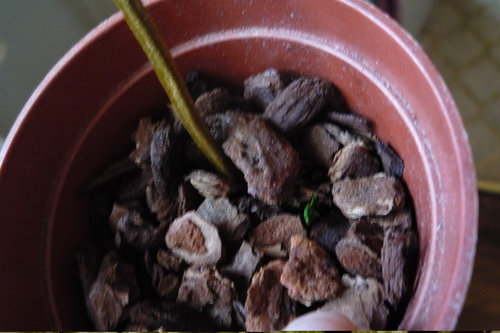
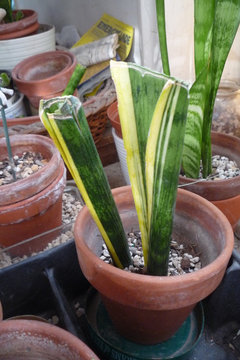
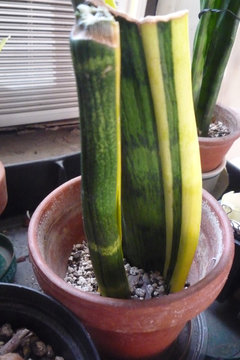
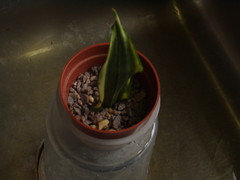
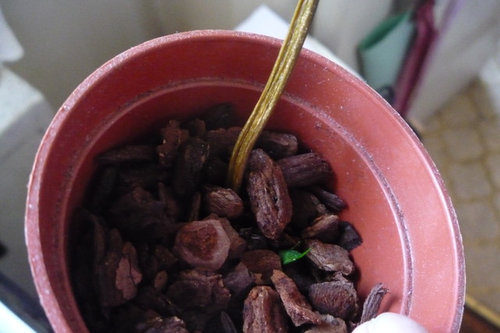
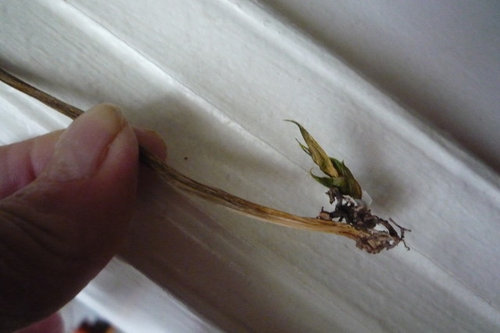
Wanted to show how quickly this appeared, was in all bark (an odd experiment of mine), in front of hot radiator.


Sorry for the blur, but that's about 6 wks I was surprised.


Sadly, I accidentally let it dry out & ultimately lost it. I'd taken it out once to check on it & wish in retrospect I hadn't disturbed it.


Surprised me to see it had grown pretty well. Sorry to see it was toast; past time to toss it.


Should I try propping in bark again, I'll use a pebble tray to protect from this.


Comments (16)

  • 8 years ago
    last modified: 8 years ago
    Karen,

    I am currently experimenting with the use of grani grit to try to root a S. Morganstern leaf - too soon to tell but the leaf has survived all winter. This technique has been successful for rooting Euphorbia. Stush taught me this little trick. The grit might solve the problem of too damp that Russ is speculating might have been your reason for pup failure.

    I am also attempting to root a Haworthia fasciata in orchid fines- this seams to be working but is also too soon to tell.

    Fred

  • 8 years ago

    Fred, what size is each grit particle? I assume this is feed store type poultry grit, so should be maybe an eighth inch?

    I think grit is like perlite in that it looks the same wet or dry, so how are you deciding when to water?

    I would think orchid fines holds quite a bit of moisture, so it'll be interesting how that works out.

    Keep us posted.

    Russ


  • 8 years ago
    last modified: 8 years ago
    Russ,

    For the Sansevieria I use the look at the leaf to see if it is starting to shrivel method combined with a splash of water on Saturday and maybe a quick short spray from my spray bottle on Wednesday. So far so good. But now with the heat turned off, my house is holding at 64- not good for rooting. The grani grit is poultry grit from TSC- I love the stuff! It looks wet for a short time after watering, but that is not a good measure of interior moisture in the pot. Oh I am using a 2 inch plastic square pot for this. The leaf is 4 inches long. Over last winter the leaf only got short sprays (of the stone not the leaf) a few times per week

    The Orchid fines, I am only giving a short spray once per week.

    I'll take pictures sometime this week.

    Fred

  • 8 years ago
    last modified: 8 years ago

    Russ,

    This was just an experiment since I had the super hot radiators, almost tropical. I am an underwater-er w/ Sans. as a rule. Practiced at it, almost, over time. I really think this one dried out, no sign of rot at all & I've rotted some Sans a few times.

    I tend to use Pumice based mixes, makes very fast draining mix.

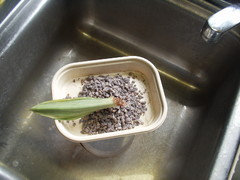
    Here's some other, sturdier leaves set to root near same spot. They show some of my porous mix.

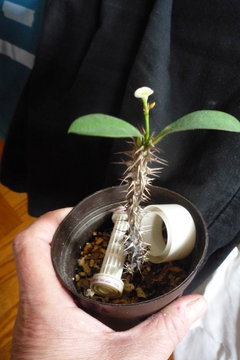
    It's so hot about 1 ft. above that, on top of the AC that this Euph milii type cutting not only rooted in 6 wks, it bloomed. I was floored.

    I plan on continuing w/my regular mix, but I did recently start another experiment of a few Sans. leaves in all Pumice. I don't know how I'll know when to water them, hum.

  • 8 years ago

    Thanks for all those pics and comments Karen. I'd use pumice if I had an economical source, I have so many sans that it would cost a fortune. I buy perlite in 6 cubic foot bags, I think it's $12 or $13.

    Are those leaves from Laurentii or another variety? I assume your getting trifasciata from them but you never know when an oddity will show up.

    I like the E. millii types, I have white, red and I think a yellow flowered. I don't know if the huge Thai hybrids are millii's but they're interesting if only for their size.

    Russ


  • 8 years ago

    Fred, I assume TSC is Tractor Supply Co. I didn't realize they'd have grit so I'll see if there's one in my area. Wish I could find a source for a pickup load of large-grained sand around here.

    Russ

  • 8 years ago
    last modified: 8 years ago

    I thought some time ago somewhere around here I read of a Pumice source: General Pumice, does anyone remember seeing this?

    If so, I just checked, how does this quote sound:

    a 15 lb bag for $27, I didn't check out shipping, which I suppose is the issue. Offers 3 different sizes & a sampler of the 3 as well. (I don't know cubic ft, just lbs.)

    I was fortunate I had a long time Pumice source, but my supply is finally finishing & I need to think about getting more. Big difference 'twn us, am in apartment, grow smaller, so my Pumice goes far.

    I don't grow Laurentii 'cause I strongly dislike the yellow stripe & to date, have had none.

    These leaves have a Story:

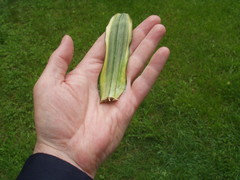
    They're from no ID leaf, from a woman I met on the Subway, holding this Enormously Tall Sans, in a narrow handful of a package, as tall as we are. So bizarre, Plant was given to her Boss when his daughter was born 20-something yrs. ago. So Boss gives it to this Woman & she's taking it home.

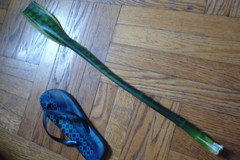
    I offered her care & culture suggestions & then asked for the 1 broken leaf, which was broken abt 1/2 height of the plant she was carrying. So she looks at me & asks 'How'? I said just reach down to the bottom of the plant & pull it off, which she did. When I got it home, it measured 30" long! I cut it in about quarters & potted up. So that's what you see in the pix. Let's see if I can find some pix.

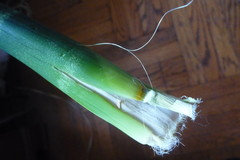
    (My SIze 8 flip flops) Look how amazingly fibrous the base was.

    Just another one of my wacky experiments.

    Guess I'll just water the Pumice once in a while to start? Maybe once every 3-4 wks, 'til they root?

    How would you Folks assess that? Suggestions?

  • 8 years ago
    last modified: 8 years ago

    Here's the thread on General Pumice, including comments from a company representative (down a ways):

    https://www.gardenweb.com/discussions/3211677/does-pumice-interest-you?n=134

    Back then it was $20 shipped. It's now at $27. I've bought from them twice and am satisfied. I got the 3/16" first, and then the 1/8". The smaller size has a fair amount of dust that I sift out. I like the uniform size.

  • 8 years ago
    last modified: 8 years ago

    Interesting story about your new leaf Karen, plant people are always so generous. I believe your leaf is Laurentii, although the narrow parallel stripe might indicate Lillian True aka Slipped Stripes.

    Thanks to you and Jeff for the info on pumice but it's too expensive to order, especially the shipping. I envy the folks on the left coast where it's fairly cheap to get it locally and in quantity.

    Yes, sans leaves are very fibrous. If synthetic fibers hadn't been invented back in the '50s, the experimental USDA sans fiber program would have continued and much of our fiber might be coming from sansevierias to this day. Some of our present hybrids still survive in botanic gardens and private collections from that program.

    Keep us posted on progress with your leaves.

    Russ

  • 8 years ago

    I also think it was the heat. "Sitting in front of a radiator" is what it feels like all summer here, 90-100 every day for months, & Sans leaves do propagate very quickly. I don't let them dry out, except when first-cut, before they go into a pot or in the ground.

  • 8 years ago

    Russ,

    Here are some photo's of my experiment with straight grani grit


    It seams I have lost some of the pictures I took- they showed the current cuttings potted up. Guess I have to get the camera out yet again, LOL.

  • 8 years ago

    Those are good pics Fred. How do you tell when the grit is dry and needs watering? Is there a color difference?

    Russ


  • 8 years ago

    Must still be cool up there, you're wearing long sleeves.


  • 8 years ago
    last modified: 8 years ago

    When the picture was taken it was still in the 60's- temperatures have warmed up since then. The stones are darker when damp. I use a plastic pot with drain holes so there is less humidity loss- it is much akin to using bark for orchids. I am still experimenting with this on Sansevieria- the thick leaved Morgenstern worked, but the Laurentii stem I am experimenting with is only 10 days or so in the stones and my average room temperature is 68. Temperature, Humidity, Light, plant Health are all factors in both success and speed with which the rooting takes place. Those 2 Morgenstern cuttings took some 8 months to yield those small roots. Though it is possible I could have had roots for a long time and just did not know it, I tend to think it did take the 8 months. I might try another cutting and keep it outside in the shade, but currently night time lows are near 50, so I'll hold off till July. This technique works very well with Euphorbia.

  • 8 years ago

    Fred, with your cool temps inside and out, ft to sounds like you need a heat pad to speed things up. In 8 months with heat you'd probably have a fair size plant. That's good about the grit being darker when damp, perlite is same color wet or dry so I add Miracle Gro that changes color when moist and has a wetting agent that plain peat moss doesn't have.

    Please post pics on progress.

    Russ


Sponsored