Software
Houzz Logo Print
zensojourner

Identify my orchid? And newbie info needed

8 years ago
last modified: 8 years ago
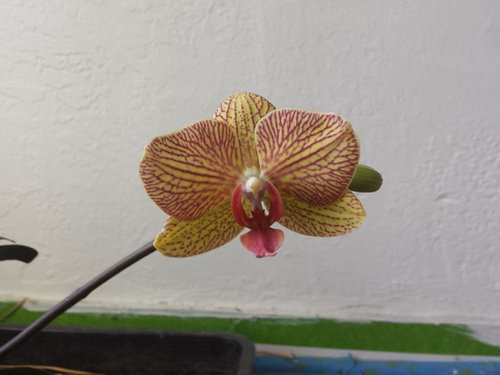
I've never had orchids because everything I ever learned about them came from Agatha Christie and Nero Wolfe, and those "sources" indicated they were REALLY hard to grow and you could only afford to grow them if you were a millionaire.

But recently the local Buddhist temple gave me some to take home from the alter after they bloomed. They are in clay pots with drainage holes, with a tiny amount of bark in with the runners, and I'm sure they are whatever common varieties the Big Box stores carry. One has rebloomed and one other has some buds, the rest are just tooling along with no buds showing. It just says "4" orchid" on the one label that is still on one of the pots. The leaves all look the same so I'm guessing they're all the same kind of orchid.

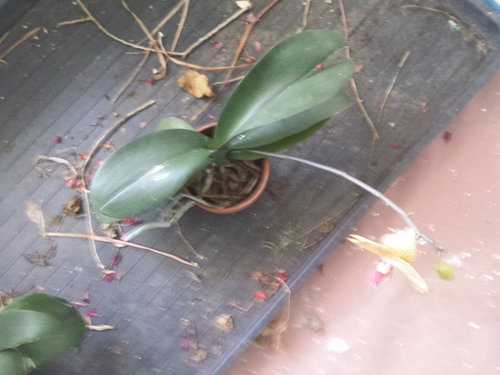
Here's my bloomer (please ignore the painting detritus, LOL!):

Here's a top down picture of the leaves (flower is TOTALLY out of focus but I do think focus on the leaves is good enough to tell what you're looking at)

So firstly what have I got here?

And secondly what am I supposed to be doing for it? Because right now I water them randomly, and by floating them in a bucket for an hour or so. I have no idea when/if to repot them, nor what the light requirements actually are, or any darn thing at all about them.

They are currently in a southwest facing window where they get bright but indirect light throughout most of the day. These are ancient windows that are NOT blocking UV (other than whatever plain glass usually filters out sort of by accident). They don't get light for the full natural day length because there is a mountain range over there that basically means twilight comes an hour or two earlier for us here in its shadow than for those not living under its looming presence, LOL! I've lost a leaf on one of them, it just sort of seemed to dry up and is in the process of falling off. I'm GUESSING it was underwatered but obviously I don't know that. I live in a desert region of the Sierra Nevadas. I normally put my plants outside on the patio when it is reliably no colder than 50F at night here, which is about ... now (but overnight frost potential exists here well into June sometimes so I watch it). I'm at about 5500' in elevation. I keep the house at 67F all winter but they probably get a little cooler than that at night due to being right in front of the windows there (which go almost all the way to the floor). The orchids have lived much in the shadow of the much larger M. koenigii that I kept in the same window in the same tray (they are outside now). They seem to have done fine with that so ... I'm guessing direct sun is not what they need. Did I guess right? >:D

Please to educate me!

Comments (6)

  • 8 years ago

    Here is a link to the American orchid Society cultivation notes for your orchid.

    AOS Phalaenopsis culture notes

    Orchid looks in pretty good condition, so maybe only minor changes are needed to your culture routine.

    Many past threads for more information.

  • 8 years ago

    ""sources" indicated they were REALLY hard to grow and you could only afford to grow them if you were a millionaire."

    You might start out as a millionaire but will wind up a pauper!! I assure you, most orchid people are not rich!

    Sounds like you are doing everything right. Your plants are Phalaenopsis orchids. Please read the link from Arthurm. It will give you the basics of growing these orchids.

    Jane

  • 8 years ago

    Soooo ... no way to tell any better than just "phalaenopsis"? No guess at the particular type of phalaenopsis?

    No suggestions for how to treat this in a desert climate?

    I already googled before I came here. (I GUESSED they were phalaenopsis from the leaves but wasn't sure). Anything dealing with being in a desert was along the lines of "when I moved to Arizona I lost 100 of my orchids, they need to be specially treated in a dry climate, you'll have to guess how" or "here is how I set up my $250,000 greenhouse to auto mist in my desert climate".

    Neither of which help me all that much, LOL!

    I did stumble across a LOT of information about Growstone and orchids. From what I've read, I might try it some day but only in combinations with peat moss to counteract the alkalinity of the Growstone. Not going to try that right out of the starting gates though. I spent years trying to find a good soil mix for my potted plants (indoors and out) because I hadn't been able to get coarse vermiculite for decades and any kind of bark that would be useful for a potting mix was also getting harder to find (and in fact 3 years ago ALL the local big box stores stopped carrying anything except shredded cedar, rubber, and dyed ground up old houses in anything approaching an appropriate potting mix size).

    Growstone and peat (the crappy finely milled peat that is all I've been able to find here in the last couple of years) has made an EXCELLENT potting mix for everything I grow, but ... maybe not these orchids, so much, LOL!

  • 8 years ago

    Firstly, the numbers, there are more than 26235 registered Phalaenopsis hybrids recorded by the Royal Horticultural Society in England. So, unless you have a widely distributed mericlone ( copy) your chances of getting a name are almost Nil.

    The ancestors of the modern hybrids grew/grow in Northern/Tropical Australia through to tropical SE Asia. Minimum low temps about 60F/Maximum High Temps about 90F. Moderate Humidity Levels are required.

    The main culture recommendation for Micro-Climate, Zone 10b Sydney, Australia is never ever put them outside.

    "They" spend all year in this room next to a window where the sun is filtered by a match stick blind. It is 8:07am and the temp is 18C and the humidity is 51%. (on top of a heated 600 litre tropical fish tank)

    Difficult here and only a minor component of the orchids displayed at orchid society shows and meetings.

    So any advice is good but you have to be aware of where the hobbyist lives and adapt the advice to your conditions.

    Pyewacket thanked arthurm2015
  • 8 years ago

    As Arthur stated, it is impossible to know exactly which Phal you have without a name tag.

    The culture notes would be the same.

    Living in a dry environment, I would grow your orchid indoors if you have decent bright light. It would be similar to growing in the Northeast where winter temps are dry due to the central heating.

    I grew many Phals in NY. In winter I covered the exposed roots with sphagnam moss to hold moisture. I called it their winter coats. I removed it when Spring arrived.

    Humidity levels in my growing area dipped as low as 8% over the winter months. The Phals did not seem bothered by it. I kept my orchids together on tables to promote humidity from plant to plant. They were also on drip trays.

    For other orchids, not the Phals, I ran a few vaporizers near them. It really only raised the humidity a few degrees.

    I learned most orchids can take low humidity without a problem.

    I wouldn't worry too much, try various things and you will figure out what works.

    Light and air movement are more important, in my opinion.

    Jane

    Pyewacket thanked jane__ny
Sponsored