Software
Houzz Logo Print
three4rd47

Vincas died under maple tree

8 years ago
last modified: 8 years ago

Hi,

We had a landscaper create a flower bed under a large maple tree last summer - dug it all out, new soil, mulch, etc. and then he filled the bed with hostas and (variegated) vincas. The hostas are coming up fine, but it appears all the vincas died. Somehow I didn't expect this, being that vincas seem to be one of the tougher perennials around. Any thoughts? Worst part is that the guy who did the work is nowhere to be found. I've tried emailing and calling to no avail. I would think he guarantees his plants for at least a year. Paid a pretty good buck for them too! I did a bit of research here and am finding that it's a bit difficult to find things that will survive under a maple tree. Wish he would have told me that before we came up with the idea (actually was his idea). A good amount of ground was added (maple is in a sloped area) - he really graded it up so it's not like the plantings were in the original ground surface around the maple. There is a rock wall around the whole thing, so it's sort of like a separate elevated bed around the tree. I'd think that should help matters unless those maple roots just push up and interfere with whatever is planted anyway. (?)

Comments (19)

  • 8 years ago

    Also, small spring bulbs can be nestled among the maple roots and will do their thing before the tree leafs out. Winter aconites, snowdrops, squills, cyclamen, leucojum and small narcissus

  • 8 years ago
    last modified: 8 years ago

    Sorry for not supplying more detailed info. We're in PA (zone 6b). Funny part is, relative to variegated (vinca minor) hardiness, I have no problem with it. I've had these things in other beds around the house for years. Not sure why the new plantings around the maple apparently didn't make it. There is soil added but I'm fairly certain he was careful not to bulk up against the trunk - I seem to recall this concern being raised when the idea of creating the bed was proposed. And so in order to not push the soil up against the tree, that's why he had to grade it out over a really large area, so the slope could be graduated and leveled enough to create the bed near the tree, but also without creating much elevation beginning right at the trunk. On the side of the tree near the top of the slope, less soil had to be added of course, but then on the opposite side of the tree, it really took major regrading of the whole area. Hope that makes some sense. Thanks for suggestions. I may indeed need to look at other options. Unfortunately I'm fairly certain that this project also brought us the lovely problem of having springtails in the swimming pool (not too far away from the maple). To do the job, a huge pile of decades-old compost, etc. had to be removed and so I'm thinking that helped to create the (never before had) issue with springtails hopping around all over the place. In retrospect, while the stone wall and hostas look nice around the tree, I'm ultimately not sure it was really all that worth it if additional issues were generated as a result. Also, literally thousands of small maple saplings came up this spring that I've been trying to keep under control by mowing and weedwacking.

  • 8 years ago

    pull one or two up .. AND FIND OUT WHAT HAPPENED ....


    snap us a pic or 2.. and maybe we can figure it out ...


    a flat of vinca shouldnt be all that expensive ... and you could probably replant them ...


    sound like you need a mulch ... rather than more compost.. to cover the soil ... and retard the growth of seedlings ...


    ken


  • 8 years ago

    I have a Norway maple in the front yard. We removed the half dead lawn, added soil and planted perennials in the area maybe 15 years ago. Besides bulbs, the true survivors are Geranium macrorrhizum, Veronica peduncularis ‘Georgia Blue’, some hostas, digitalis lutea (self sower) and Solomon’s seal. A yellow epimedium kind of holds its own, but does not spread at all. Colchicum ‘Waterlily’ is great planted through G. macrorrhizum ( if you can live with the foliage in spring).

  • 8 years ago

    If the failed plants are still present your best bet is to show the carcasses to somebody there in your area. As in having a garden consultant come out and view them on site or taking samples of the remains to a USDA Cooperative Extension branch office or Master Gardener clinic.

  • 8 years ago

    Wonder if he didn't plant the annual vinca vine in error?! :) Actually, I think vinca under trees is a pain. Leaves, weeds, seedlings etc gets trapped in there and it becomes a maintenance headache. I put it under a tree years ago and it lasted exactly 2 yrs before I had anyone and everyone come on over and take some away!

  • 8 years ago
    last modified: 8 years ago

    it becomes a maintenance headache

    Much of the point in establishing ground cover is you aren't then grooming the surface of exposed soil all of the time.

  • 8 years ago
    last modified: 8 years ago

    jama7.....the vincas certainly look like what I have in other beds - same leaves, and the way it puts out long runners, etc. Given how they spread and root themselves, he sort of overdid it a tad - there must be about a dozen of them planted in a circular area that's only about 6 feet across or so. Oh well, guess it's not overcrowded anymore. Worst part is not being able to contact the guy. I just have a hard time with these contractors, etc. that simply never get back to you. I once actually mailed a guy (who did a major house renovation for us) a letter just to tell him to call me....didn't work.

    Thanks to all for the advice. I appreciate the alternative plant suggestions and ideas, and will likely replace the vincas with something else.

  • 8 years ago
    last modified: 8 years ago

    Embothrium(Pugetopolis I really don't groom bare ground but it IS easy to rake, treat, remove weeds etc vs trying to do all of that with a mess of vinca. Groundcovers do not keep out weed or grass seeds which is the myth that's bandied about. I had to shovel out 75 SF of my vinca bed last year to remove grasses that kept poking up all over. I'd had it after 3 yrs of trying to get it out. It wouldn't hand pull, it didn't respond to my "painting it" with grass killer so I finally bit the bullet and dug it all up, removed all the grass and replanted the vinca 5 months later when I was sure all the grass was gone. That was not fun. Low maintenance it's not.

    I guess I should add that I don't have much bare ground. I have mulch where I don't plant (which is really not very much..lol) It's much easier to work with. If I were to do a large scale evergreen groundcover, I'd do sedum. Easy to pull, work with.

  • 8 years ago

    Any chance of a picture of the situation? Could be that the problem is more fundamental than the plant selection per se.

  • 8 years ago
    last modified: 8 years ago

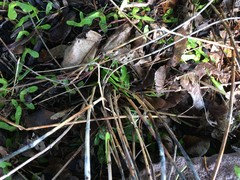
    A few pics.....first an overview of the bed the contractor created. The long runners that the (now dead) vincas put out can be seen interspersed with the hostas. Bed was also mulched before he was done.

    Close up of one of the vincas....sorry for all the maple seedlings...haven't gotten around to doing much cleaning up of this bed yet. Didn't want to dig around too much yet in hopes that these vincas would still come up.

    As per Ken's suggestion...I dug a few up....actually roots don't look bad...not sure why they didn't survive. They all came out with having to pull up on the roots a bit - so not like the roots rotted out and nothing was left.

    The sole survivor (out of probably at least a dozen planted)...came off of one of the runners that rooted itself....I wanted to add this pic to show the type of vinca used

    Hope these pictures help! Guess it's time to yank all of them out - hardly worth keeping this die-hard I suppose. I've got plenty of these things in other beds. Would like to try something else though. The hostas are not very evenly planted now that you see them without anything else in there.

  • 8 years ago
    last modified: 8 years ago

    Embothrium...the goal here was not really to establish ground cover, per se, but rather to actually have some sort of shade bed around the maple.

  • 8 years ago

    Probably the simplest solution (if hostas are going to do ok there as seems the case so far) would be to fill in with more hostas and possibly just add some impatiens wherever there is extra room (?)

  • 8 years ago
    last modified: 8 years ago

    When you first posted this I too thought perhaps this guy put too much soil on top and near the trunk (anything within 10' of it isn't good) but it seemed from your response that you thought was OK. Looking at this latest picture, I do not see any trunk flare at the bottom....it's been covered with soil which is a NO, NO, NO. To plant those hostas he had to have put a significant amount of soil there....it doesn't have to be a lot. 6" can create serious problems.

    We moved into our house 4 yrs ago and inheirited a young but poor looking Bradford Pear with lots of dead branches. I don't much care for them as they're short lived due to limb damage but because it screens an ugly, we decided to leave it for the time being. Noticing that soil and mulch had been piled on over the years by this "landscaper" I started digging....and this is what I found. And I still wasn't down enough in this shot. I dug out as much as I could back to about 5' and watered well. It has improved quite a bit the past 2 yrs.

    You should take off the soil and mulch until you find the flare....if I am seeing the photo correctly...a little shadowy. You'll never have much success here as the roots will come right up again and FAST....maybe just mulch and call it good?

  • 8 years ago

    Yes, as I suspected. That's why I asked for a picture. The bed has been piled up too high around the tree. That needs fixing before thinking about planting.

  • 8 years ago
    last modified: 8 years ago

    Fixing in what manner? Start taking soil back out? As much as I've said about him not responding to recent attempts at communication, in his defense the guy has a degree in forestry and I recall discussing at some length the pros and cons of putting soil against a tree and specifically asked him about it. He explained it all and assured me that the way he did it is fine and does not jeopardize the health of the tree. What you can't tell from either my descriptions or pictures is how it looked before. There was significant erosion within probably 8-9' of the tree in nearly all directions. Loads of large, exposed roots. So while all that was covered up, I just went out and checked and it appears that I'm seeing the original ground surface level right at the base of the tree. There has definitely been erosion since he did it. Right around the base, it looks to already be eroded to what it always used to look like - very dry, pebbly dirt. Like I said, there was a very significant slope that had to be graded. Even so, the lower side of the bed you see in the pic is significantly lower than the opposite side. I don't think there is a problem with the tree. I had him do alot of trimming on the maple as part of the whole job since it's really getting a bit too big for being as close to the pool as it is. The pic does not show the detail around the base. It undoubtedly looks like it's piled up higher against the tree than it really is. I'm not gonna worry about it.

    Actually, based on some quick research (since I had no idea what was meant by the "flare") I don't EVER remember seeing the flare on that maple. If it ever was visible, it was probably covered up in '89 when we had the pool put in. Once again, the entire area (including where the maple is) had to be graded to create as little slope down from the pool as possible. I basically always recall seeing a solid trunk right down to the ground level. So, if the tree has lasted nearly 20 years post-pool construction and landscaping, I would imagine it will continue on. I'd gladly ask this guy about it, IF I could ever get ahold of him!

  • 8 years ago

    I actually think it is a good thing your vincas didn't make it in this spot because if they had lived, they would eventually be taller than your hosta and your hosta would suffer. These are pictures from my front yard a few years ago. It's hard to tell, but the vinca is taller than my knees when I step into it. I plant Red Flash caladiums (they're tall caladiums) in 3 gallon black pots and put the pots on top of the ground around the tree. The vinca is tall enough to hide the black pots and the legs of the caladiums. I'd guess the vinca is about two feet tall.

    Also, I personally wouldn't bother lowering the soil level around your tree. The new soil is still settling and will probably continue to thin down this next year as the compost your landscaper used decomposes. It is always best to plant hosta "high" for this reason. But that is just my humble opinion.

  • 8 years ago
    last modified: 8 years ago

    Thanks to all who responded. As it turns out, the flare is quite visible. I can see how the soil the guy added has already settled - nearly down to the point of where it was around the tree before the work even started. So far so good with the hostas. Pulled out all the dead vincas and just planted 4 new hostas to fill in some empty spots. I can see where it can be hard to get stuff to grow under these maples though. The first place I attempted to dig a hole for the hosts resulted in encountering a huge maple root (guess that's why the guy didn't have anything planted there). With reports of how the maple roots will steal moisture, I guess I really should keep the hostas well watered - especially the new ones. Given that they came back from last year, hopefully they'll continue.

    Just had to add this...went out to check on the hostas this morning and discovered that overnight something dug one of my newly planted ones right out of the ground! Not a single leaf or part of the root ball eaten or damaged, but the entire plant had been carefully dug up, removed from the hole, and was laying on the ground! I had to do a double-take at first, wondering if I forgot to plant that one - but then specifically remembering watering all of them after I got done last night. So then, after replanting, I applied some Shake-Away to the whole bed (I'm a firm believer in the effectiveness of this product).

Sponsored
Peabody Landscape Group
Average rating: 3.5 out of 5 stars8 Reviews
Columbus' Reliable Landscape Design & Contracting