Software
Houzz Logo Print
lehua49

Lemon Tree Question

8 years ago
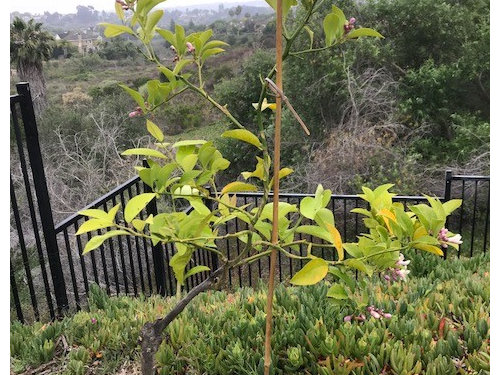
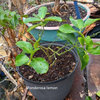
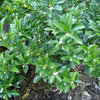
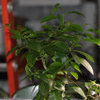
The lemon tree (Meyer) has light green leaves. I found out recently that the water does not move through the soil well. So I punched holes in the surrounding soil to help get the water to the roots as well a acid fertilizer. It still doesn't green up well but it has more new growth. Shouldn't it be a darker green. See pic below. Any further suggestions on what to do?


Comments (24)

  • 8 years ago

    It should be darker green. after the fruits form and are about marble size they need to be removed so the tree can put energy in to growth.

  • 8 years ago

    Do you know the pH of your soil? Over 7.5 pH citrus roots do not absorb iron; and that could be your problem. In soils over 7.5 pH it is best to apply chelated iron.

  • 8 years ago
    last modified: 8 years ago

    Site can't be too terribly wet with that succulent ground cover being on it.

  • 8 years ago

    Keep fertilizing it. It may drop the yellow leaves and new growth may appear pale but will green up.

  • 8 years ago
    last modified: 8 years ago

    Check the pH as was suggested above. Real lemons and limes are particularly sensitive to high pH. I would guess meyers could be too. Not so much with oranges, grapefruit and many mandarins. Also, do you know the rootstock? Rootstock plays a huge role in high pH tolerance. Fertilising often with nitrogen in the form of ammonium sulphate will help in case the issue is due to high pH.

  • 8 years ago

    "Not so with oranges, grapefruit"... try telling that to the grapefruit growers in the Rio Grande Valley, Texas. Their soil is pH 8; and their water is 8 or more. They put chelated iron every year; without it the tree looks like the one in the OP photo.


  • 8 years ago
    last modified: 8 years ago

    I'm saying it because I have been growing citrus for 25 years in calcareous soil varying up to pH 8.5 and watering them with well water of pH8. If citrus could not be easily grown in pH > 7.5 conditions there would not be much of a Med citrus industry nor would the Med had been the centre for distribution of citrus to the New World. I have lemons, limes and other citrus growing side by side and I can easily tell the difference between lemon/lime tolerance vs orange and the rest. Now you can choose to believe me or not. It makes no difference to me and I couldn't care less, since I have personal and local experience and you haven't.

    Best stock for such conditions is Seville Orange btw, if one does not grow citrus in a Tristezza affected area.

  • 8 years ago
    last modified: 8 years ago

    It is hard to see from the picture, but without seeing a close up of a deficient leaf, I will agree with Johnmerr, that the problem is most probably an iron deficiency. As Johnmerr suggested use an iron chelate as a foliar spray. Never use iron sulfate as a foliar spray on a citrus tree. Iron chelate should solve your trees problem. You might have to reapply it every now and then, if you find that the soil has a high pH.. I really do not think it is a water/root problem. I also don't think any fruit present on the tree has anything to do with he yellowing of the foliage.

  • 8 years ago

    The famous Med has calcareous soil on the surface; but deeper down it is not; because the only soil that citrus will not thrive in is calcareous.

  • 8 years ago
    last modified: 8 years ago

    Chelated iron applied foliarly will only give limited and very temporary relief and only if diluted with non alkaline water. Chelated iron applied to alkaline soil of pH > 7.5 needs to be of EDDHA chelation which makes it a very expensive proposition, at least in my part of the world. Best way is to apply ammonium sulphate as the nitrogen fertiliser, distributing the yearly dose into many smaller doses and try to more permanently lower the pH near the drip area a bit by applying sulphur. Sulphur may work or it may not depending on the lime content (hence the buffering capacity) of the soil.

  • 8 years ago
    last modified: 8 years ago

    johnmerr, so you know better about Med soils than me. Good for you mate. Interesting since you come from the States and you have been growing a meyer monoculture in Guatemala only for the past few years. Well, I need to tell you that you are very wrong. Wherever Med soil is alkaline, it is usually so until you hit the bedrock which is most often limestone (which the soil has resulted from).. Only in the most rich alluvial soils this is not the case. Sadly these exist mostly outside the coastal citrus growing zone.

    When we get soil samples for testing we do it from various depths up to about 60cm for citrus. Well, at about 60-80cm there is limestone bedrock in my garden..

    Citrus will grow adequately for commercial production (very well for backyard growing) in alkaline soils given an appropriate rootstock (hence the almost exclusive use of Seville Orange until Tristezza was imported to Spain from South America) but lemons and their relatives not so well. Still you can get a very good fruitload out of a lemon tree even if it appears somewhat chlorotic compared to the ideal.

    I have never seen a chlorotic looking orange, grapefruit, willowleaf or clementine tree wherever I have been in Greece and Italy while most of lemon trees appear mildly to heavily chlorotic.

    Anybody who needs to see pictures of my garden to support the above just say so.

  • 8 years ago

    Nik,

    You might be surprised about what I know of soil science; and my degree in Agriculture from the finest agricultural university on the planet, was not given to me by my Fairy Godmother. BTW, a much better way, and more commonly practiced to lower soil pH is the application of soil sulfur. Repeated applications of NH3SO4 only results in an imbalance of Nitrogen; and in citrus a reduction in yield. Or is that somehow different in Greece? Good for grass and pretty green plants; but no citrus grower I have ever known would make such a recommendation. Maybe it is just that your 25 garden plants are treated differently. I have double that in my 4 gardens; and I know for sure they are treated differently than I or any commercial grower would treat them.

  • 8 years ago

    Thanks for the comments. Very educational. I will add more information. The plant is in the coastal southern Californian area zone 10a. The natural soil here is Caliche (bad stuff). The Caliche was removed for the tree and replaced with a peaty potting mix that seems to be somewhat of poor drainage quality. The tree was planted many years ago but my renters shut off the water due to drought conditions existing in SoCal at the time. I performed a soil test with a nursery bought soil kit that tested ph, n,p and k. It showed ph of 7.0, almost no n, p, or k. I have punched holes in the root zone and made sure water was in the root zone by a metal probe. I used MG Plant Food for Azaleas, Camelias and Rhods. N-30%, P-10%, K-10% with boron, Copper, iron and mang and molybd and Zinc from chelat44ed sources. I will give it some time and test the ph again. I have been thing of taking the tree out and redo the planting with a good drainage pipe underneath. The tree is planted on the edge of a slope. Unfortunately I am in the middle of building an Art Room which takes up most of my time. I think everyone is correct and the ph has to come down. Thanks again everyone. I will post at another time for an update.

  • 8 years ago

    If your soil is pH7 your issue is not the soil's pH. Unless you are prepared to fertilise extremely heavily, almost as if the tree were in a pot, pure organic soil is not good for citrus. Citrus need mineral soil with a few percent organics in it. I guess your tree suffers from general undernourishment.

  • 8 years ago

    lehua49, it would have been VERY helpful if you would have told us all that additional information from the very beginning. Humans do need good information about a situation in order to come to the proper conclusions.

  • 8 years ago

    I'm with Silica... lots of knowledgeable people here willing to help. The more information and photos we have the better will be the advice you receive.


  • 8 years ago

    All,

    Thanks for the help and comments.

  • 8 years ago

    As a former resident of SoCal (Long Beach) I'm curious to know where you live. This because there never was any mention of caliche in So Cal when I took my Soils classes at Cal Poly.

    Beyond that, I wonder if the original planting is the problem - "The Caliche was removed for the tree and replaced with a peaty potting mix that seems to be somewhat of poor drainage quality."

    In effect, the tree is in soil that "doesn't drain" simply because the surrounding soil doesn't allow it. Sort of like a plant in a pot without drain holes.

  • 8 years ago
    last modified: 8 years ago

    John,

    I commend you for your degree. As for the rest I have to say again 'What the heck are you talking about?'

    Seems that your reading and comprehension skills are lacking. At least when you are commending in this forum. This is taught in primary school.

    Didn't you read I mentioned twice about applying soil sulphur above? Don't you know that sulphur may not do what is expected of it (ie meaningfully lower soil's pH) if lime content is excessive because of the soil's buffering capacity? You might not know it but you should have read my comment.

    Did you read about my recommendation to distribute the yearly dose of N in many small doses of ammonium sulphate? I never said to increase the yearly N nor that these doses should be equal..

    The reason the above practice works for the backyard grower is because the pH of the soil solution in the root area is temporarily increased and the plant has a window of opportunity to absorb Fe along with the nutrients provided to it with the fertiliser applied.

    Don't you realise I have been talking to a backyard grower? Don't you understand that commercial practices (and target outcomes) which I'm sure you are well versed in, regarding growing meyers in Guatemala soil that is, are often irrelevant to the backyard grower because many factors are either beyond his control and many practices are prohibitively expensive, too time consuming or even detrimental to one's health and illegal to practice in the home garden?

    Seems like you took your degree but failed to learn to read and understand context before commenting and objecting. You even mistook my 25 years of growing and learning about citrus for growing 25 trees..

    In fact the best way for growing acid loving plants in higher pH soils is acidifying fertigation water with nitric, phosphoric or sulphuric acids, in a similar spirit to the practice of diluting vinegar in the watering can often practiced by pot citrus growers. Similarly to what you are doing with phosphoric acid for your available phosphorus deficiency but for other reasons (note: see, I do read the whole of your comments). This can only be done properly with appropriate equipment in commercial orchards with fertigation practiced and is rarely needed for citrus. Not a practice I would recommend to a backyard grower in any case.

    Enough said. There, I again spent half an hour of my precious time responding to you just because you can't read well enough..

  • 8 years ago

    Nik,

    I also have a minor in chemistry and a minor in psychology; the latter makes me ask.... Don't you have something better to do than criticize me???

  • 8 years ago

    Jean,

    I live about 2 miles in from the coast on the Encinitas/Carlsbad border along a ridge of La Costa Valley.

    From U od AZ Ext Service, "Impenetrable caliche layers restrict water movement. Water applied to the soil can not move into or through soil with a tight caliche layer. Water perched on top of the caliche can contribute to problems associated with inadequate root aeration. In addition, soils with poor drainage due to the presence of caliche will have a tendency to become saline as salts can not leach out of the soil and build up in the rooting zone." I agree with you and need to put a french drain or pipe out the bottom of the tree pit. My thoughts are dig up the tree and redo the whole set up. Fortunately, I am on the edge of a valley an can drain into the valley. The soil it was planted in was very peaty but probably no drainage. Double whammy in my opinion. Thanks.

  • 8 years ago
    last modified: 8 years ago

    You have already been given some great advice. Google Soil PH nutrient uptake. At different PH certain nutrients are no longer available. Buy a ph meter. They are about $10. Yellow leaves are often an indication that iron is either missing or unavailable. Try adding chelated iron. Ideal PH is dependent on the particular root stock. Typically for citrus a Ph of 6 to 7 is where you want to be. Proper citrus fertilizer is going to have sulfur which will lower PH. When planting citrus if you have a $5 plant dig a million dollar hole.

  • 8 years ago

    Soil pH meters are worthless because they are so inaccurate. Instead, use a pH aquarium kit and adjust your water to pH of 5.5 to 6.5., if necessary, with, give or take, about 1 Tb vinegar/gal water.

Sponsored
Landscape Management Group
Average rating: 4.9 out of 5 stars33 Reviews
High Quality Landscaping Services in Columbus