Someone said, “You have not lost the battle until you have given up”. It's that way with growing squash in Oklahoma.
When I gardened in my back yard raised beds in town, I believed squash bug eggs were laid on leaves by some kind of moth that fluttered in, and so I covered my squash plants with sheer curtain panels that I bought at garage and estate sales for something like a quarter a panel. It seemed to do the trick but not for the reasons I thought.
After we moved to the country, however, I had to totally rethink my methods because what I had used in town didn't work, and I couldn't keep a squash plant alive enough to make anything to save my soul.
So that's when I learned that squash bugs fly in as.... well.... adult squash bugs. They hide under things that are on the ground, part of the time. The rest of the time they spend climbing up the squash stems, where they feed by sucking juices out of the squash plant. If the squash plant is still small when they arrive, they can overwhelm and kill their host. Pretty short-sighted, in my opinion. They mate and then eggs are laid in neat rows, usually within two connecting veins on the under-side of a leaf. The eggs hatch into tiny black spider-looking creatures, which quickly fatten out into grey nymphs, and they progress in stages till maturity. The eggs are easy to find and pick off the leaves but this is rather time-consuming. The nymphs are often found on the leaves huddled together. They move fast but can be squashed if you are a little faster. Sometimes when the plant is being watered, squash bugs can be seen crawling up the stems to get away from the water.
There is almost always a preferred plant type. Once all specimens of this type have been killed, they will progress to second choice, and so on. It seems, just from observation, that those plants that have large hollow erect stems, like summer squash and zucchini, are always the first choice, and the smaller, vining stems, like cucumber, or melon, are almost always last.
Every year, I try to grow squash, cucumbers, and gourds or melons or pumpkins. Generally, I have found that they love the nest egg gourd and cushaw winter squash, maybe moreso than summer squash and zucchini. And as long as I had some of those growing, I was able to get pretty far into the season before they graduated to Long Island Cheese, which is, in my opinion, the best pie pumpkin there is. My second choice would be the Futsu, which also is not particularly favored by the bugs.
I always do a little research during the winter months and last winter I learned that if you can manage to get your squash plants to a decent size before the squash bugs find them, they have a fighting chance of living through an infestation. That's if you are also diligent about picking eggs off the leaves and killing any new hatchlings and nymphs that you can. It's harder to smash the adult bugs, but the best time is when there is fruit on the plant. They like to lounge around on the fruit, and when it's hot, if there are any on the ground, they like to be under the fruit. If the fruit are hanging on a trellis, they like to be on top, where the stem is, under the leaf canopy.
I also learned that, as with many things, you have to “give” if you want to “get”. And so you put in plants that you never intend to get anything from. These are called “trap crops”. It's like, if you were hungry, what would you eat first, given a variety?
So this year, I started some yellow trombocini squash and some zucchini inside, under lights, about in early March, and set the plants out in May. It took a little fine-tuning, such as cutting out the bottoms of plastic 3# (or so) coffee tubs and settling one down around each squash plant, to protect against the wind that we commonly get a lot of in the spring here. These are also nice to have in place after the plant has grown some and it's otherwise hard to tell just where it is that it is coming out of the ground, so that you can put your water where it will do the most good.
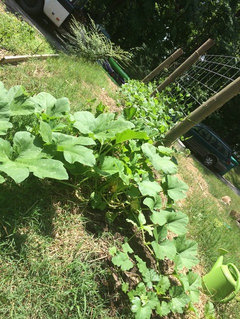
It's now mid-July and I still have squash plants alive. Some are not looking very good because they have been fighting the good fight, and we have had hot, dry periods -- too many for this time of year yet. I have harvested enough young zucchini and trombocini squash to keep me and one of my neighbors in as much squash as we can stand. And so far, the Crunchy Muncher cucumbers and the cantaloupes, growing in other parts of the garden, have gone untouched. I'll be getting my first ripe cantaloupe soon (if nothing ELSE happens) and have been harvesting cukes for a couple of weeks.
I've had some issues with immature fruits dying on the vine and luckily I found a guy on YouTube who was showing how to prune squash plants by cutting off leaves that obscure the visibility of open flowers. According to him, sometimes pollinators have too much trouble finding the flowers if there are too many leaves, and if the flowers don't get pollinated, that's what causes shriveled new fruits. I did not know that. I thought that was when the flower just fell off leaving a bare stem. So I did that this morning, and picked off eggs, and smashed hatchlings and nymphs and actually found a couple of adults that were where they could be smashed.
I don't remember the adults ever looking this ominous.
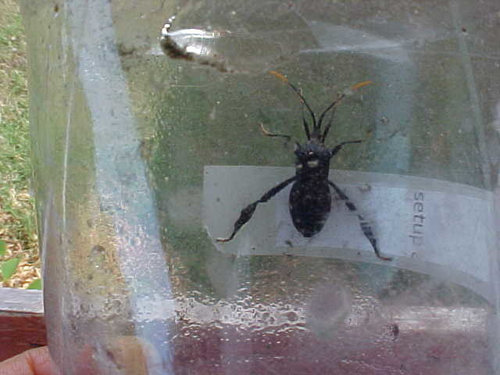
Is it that I just haven't seen mature ones, or are they the males, or is this a new strain of squash bugs? They still smell the same when they are crushed. (evil laugh).


 8 years ago
 7 years ago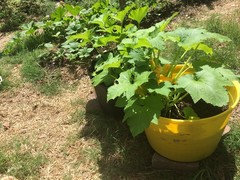





UserOriginal Author