Software
Houzz Logo Print
wilhaines

Kentucky Bluegrass Questions - Central Indiana

8 years ago
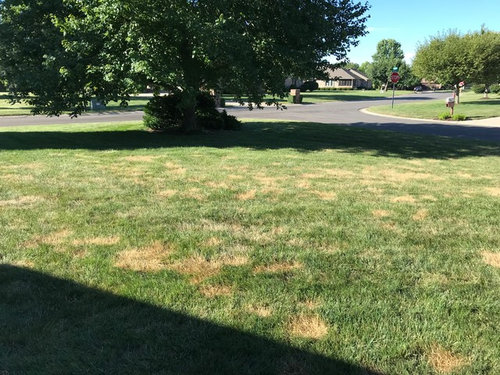
During the past couple of years, I have been trying to get a bluegrass lawn established. My lawn has a full lawn sprinkler system as well. Late last fall, I overseeded with bluegrass (after aerating) and hoped that the seed would germinate in the spring. To some extent, this happened, but not as well as I was hoping for. Because of the new seed, I did not use a preemergent this past spring and weeds were more noticeable as a result. Now, I have used Roundup (or equivalent) to kill all of the weeds and undesirable grasses, including some crabgrass. My plan is to dethatch in areas, start watering in about 7-10 days (as necessary), to soften the ground and then aerate prior to sowing seed. I'm hoping to get this done while the weather is warm enough to germinate bluegrass (3-4 weeks as I understand it). I've been told that a total bluegrass lawn may not be a smart idea, but I've also read that a bluegrass lawn is fine, once you get it established and overseed every few years. There is no lawn traffic to speak of. Without other recommendations, I plan to use Pennington's Argyle, Blue Bonnet, and Aries mix. I am also planning to overlay the new seed with a light coat of quality screened topsoil/compost, and water as necessary to keep the seed moist until germination.

Any opinions about how to go about this project? Thanks for your replies.

Comments (8)

  • 8 years ago

    Thanks mishmosh. If I hear you correctly, I should wait until Sept./Oct. and overseed again at that point, rather than now. So my question is: should the seed germinate prior to the cold weather or just let it go and it will germinate in the spring? I assume I won't water after seeding if the germination is supposed to take place in the spring. I do plan to overseed the large bare spots now and then get water to them until they germinate trying to keep weeds down to a minimum. I can overseed the entire lawn then at a later date in the fall if that is more appropriate. I'm also in the process of getting a Logan soil analysis done to see what the soil is like presently to help with fertilizer options. And, I normally water once per week with one hour at each zone with a smart controller that senses when to move to the next zone and then come back later to achieve the full one hour. The system puts out about 3 gallons per minute. Does that sound like enough water for deep watering? Of course, nature also waters some, but we never know when that will occur. Thanks for your quick reply. I really appreciate it.

  • 8 years ago
    last modified: 8 years ago

    no, what I am saying is, skip the overseeding. let the kbg do it's thing...spread.


    how big are the large spots. my kbg will fill a dinner plate in two growing seasons...ie spring and fall.

  • 8 years ago
    last modified: 8 years ago

    Oh my!! You are waaaaay overthinking this. We're going to save you a lot of time starting with mishmosh's info about KBG spreading by itself. You can dispense with overseeding from now on. Overseeding is a fescue and rye grass thing, not a KBG thing. The only reason to overseed KBG is to bring in some different cultivars which might be more cold tolerant, disease tolerant, more heat tolerant, or have a deeper green color. But once you have it down, it will take over. So now you have your fall back. Oh and don't top dress with soil unless you have low spots that fill with water when it rains. The soil you have is fine. If you don't think it's fine, we can help you with that, but don't get into the top dressing habit. I've seen lawns raised 10 inches above the designed level from 40 years of topdressing. Wanna see some pictures?

    KBG is one of the sod-forming type grasses that spreads by itself without any need for overseeding. If it becomes thin for some reason, assuming it is in relatively full sunlight, it will refill the thin areas without ever overseeding.

    Spring is not the time you want grass seed to germinate. If you were to seed in the early fall, which is what is recommended for cool season grasses, then water it lightly 3x per day, it would germinate in 3 weeks. That's all there is. When grass germinates in the spring, the tender roots often die in the summer heat. You ran into the other reason for not seeding in the spring - weed pressure. You don't have crabgrass and other summer annual weeds germinating in the fall.

    There is a rule about KBG and many other ground covers. The first year it sleeps, the second year it creeps, the third year it leaps. Just be patient and you will be rewarded.

    mishmosh mentioned deep and infrequent watering. What that means is one inch of water all at one time. Then don't water again until the lawn needs it. Put some tuna or cat food cans in the yard and turn on the sprinklers. Time how long it takes to fill all the cans. My oscillator sprinkler takes 8 hours on a full sweep. Your sprinklers likely will go much faster, but I like a long, slow soak. If you get runoff before filling the cans, stop watering and stop the clock. Give the water 15 to 30 minutes to soak in and resume watering (and the clock). The runoff problem will eventually go away. Remember the time it takes to fill all the cans, because that will be your watering time from now on. In the hottest heat of summer you should water about once a week. As it cools off change that to once every 2 weeks, 3 weeks, and then monthly for the cool months until about April.

    This coming Labor Day you can put down some fertilizer. I use organic fertilizer all the time, but if you want to use chem I'm not going to fight about it. I would suggest using an organic at least once a year to keep your soil in good health. I believe the KBG folks like to fertilize 3 times in the fall. The last one is the most important one for next year. They wait until the grass stops growing but is still green. Then they use a fast acting, high N, fertilizer like urea. The idea is to force feed the roots but not force the plant to grow. The new growth would be susceptible to freeze, so wait until it is no longer growing. Then in the spring you do NOT have to fertilize again until Memorial Day. The only thing to do in the spring is early preemergent herbicide. Apply when you first see forsythia blooming in your neighborhood. Then in April you can spot spray any broadleaf weeds with Weed-b-Gon or Weed-b-Gon Chickweed, Clover, and Oxalis Killer. That should do it for chemicals. Put the RoundUp away. If you think you need it, please ask here first. There are plenty of alternatives for specific issues.

    Always mulch mow at the mower's highest setting.

    I would not reseed, dethatch, aerate, or topdress. If you are doing everything right, you should never need to do any of that. All you have to do is water, mow, and fertilize for the rest of the year. This plan should save you a lot of time and money over what you were planning.

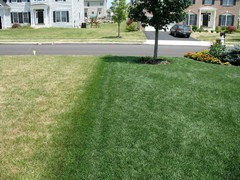
    Here are a couple of motivational pictures. First is a bunch of KBG lawns.


    Thanks for morpheuspa for posting this summertime picture several years ago. The main difference between the green one and the rest is the green one was watered once a week while the rest were watered daily. Morph uses only organic fertilizer, by the way.

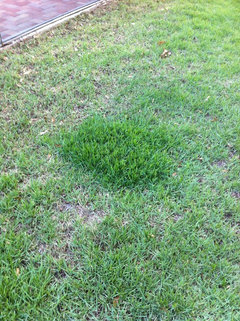
    This next picture shows the effectiveness of organic fertilizer.

    The green spot was caused by alfalfa pellets. They were applied to this zoysia lawn in mid May and the picture was taken in mid June. It takes about 3 weeks for organic fertilizers to work, but they clearly do work. Thanks to mrmumbles for posting this.

  • 8 years ago

    Very large blank areas would be a good reason to seed KBG, though that doesn't seem like a major issue in your lawn. I had an initial invasion of P. trivialis before we had Tenacity, so I ended up taking out garbage-can-lid sections of grass to stop it.

    Good feeding and keeping it damp closed those up by the end of the season. My KBG was elite varieties, which do tend to spread faster and send more rhizomes, however.

    These days, minor holes close themselves, which is what's great about bluegrass. And it also invades the gardens quickly and easily, which is what's not great about bluegrass...

  • 8 years ago

    Wow. Thanks dchall_san_antonio and morpheuspa. Who says you can't teach an old dog new tricks. This is fantastic information and I appreciate it very much. I inherited a lawn that was not well cared for, even though the front 1/2 was already hooked into a sprinkler system. I added the rest of the property two years ago and then overseeded last year. I still have some areas that need topsoil for leveling only. I don't seem to have any drainage issues. I also have a widow neighbor who has never done anything to her lawn in the last three years. I help mow her lawn, but the wind normally blows my way; hence all the unwanted dandelion and other unwanted volunteers. I may use a preemergent on her property next year in a selfish sort of way, if you know what I mean. I cut with a mulching Hustler, keep the length 3 1/2 to 4", and mow often enough to keep from cutting more than 1/3 of the blade length, on average. In the fall the final cut is much shorter. I deep water with a Rachio controller and an option that moves the watering times around to help keep from getting a lot of runoff without saturation. I'll follow the advise from both of you. Great information. Couple of more questions though, if you don't mind. For KBG (love the shorthand), what is a typical mixture of fertilizer. I'm always afraid of burning the lawn with too much nitrogen; hence the Logan testing lab exercise. Your recommendations would be appreciated. I like the sleep, creep, and leap theory and did not know about it. You seldom get this kind of information online with many of the other lawn sources. Again, my many thanks for your kind replies.

  • 8 years ago

    Hi Wil. Looks like you are doing a great job! I do see what looks like a heavy fungal attack, or something, in that photo. Here's the thing about fertilizers:

    Typical inorganic store ferts are things like 10-10-10 or 24-0-8 and so on. Those are the NPK percentages, nitrogen, phosphorus and potassium. Which one should you use? That depends on what your soil needs. Get the Logan test done and post the results in a new thread and people here will help you. If you are low in P or K there are products you can buy to boost only those minerals. In most soils, once you get the P and K minerals at a good level, they tend to stay there. So you don't need to keep adding more and more by using ferts with high second and third numbers. Nitrogen is what causes the lush green growth that people associate with fertilizer. So if your minerals are good then all you need to add is nitrogen. You can get any inorganic fert with a high first number and low or zero second and third numbers.

    Alternatively, you can add organic ferts like Milorganite which provide nitrogen in an organic form, which is easier on the grass and provides a more even feeding over time rather than all at once.

    Bottom line, get the Logan test and post here. You will know where to go with fertilizers after that.

  • 8 years ago

    Thanks danielj_2009. Great information. Yes, I am in the process of getting the Logan test and will post the results when I can access them. I like your suggestion for Milorganite also since it would work better over time. I did burn parts of my lawn last year with too much Nitrogen and was lucky to bring it back with heavy irrigation. Even so, there may be some residual sod damage and I'm hoping to find all of that out with the Logan test. I overseeded with KBG late last fall. I may have a fungus, but am not sure. I mow a neighbor widows 1/3 acre lawn which is not well cared for and I probably should be using her old Dixon, rather than my Hustler to help keep from tracking back things onto my yard. The old Dixon is like riding a bucking bronco, comparatively speaking, but it is a very good old mower. But, life is short, and I enjoy helping a friend in need. Thanks again and I will post my results as soon as I get them.