Software
Houzz Logo Print
deepzhouse

help me save this Ficus Benjamina

8 years ago
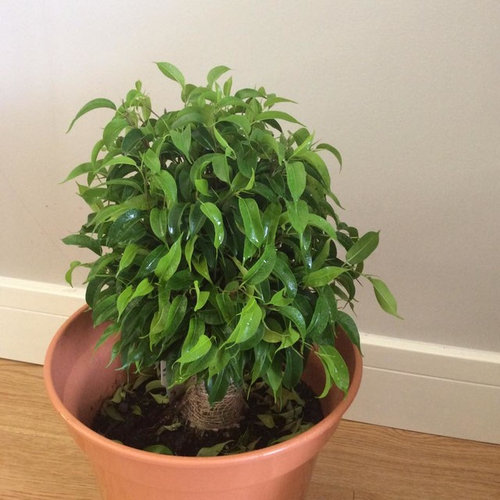
please bear with me, I really need help with this.

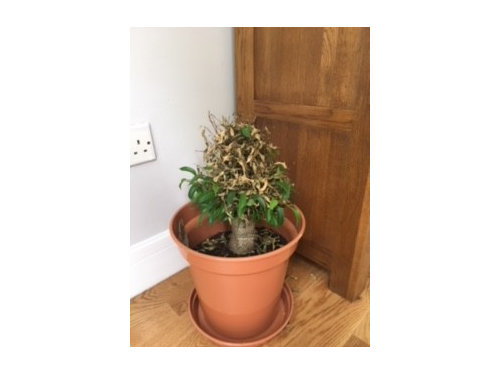
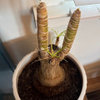
I am very new to indoor plants, bought a lovely ficus two months ago. I have read and re-read websites about the care. I kept it near my TV where there is light but not much, but was rotating it around to mist ( some websites says important to mist in summer and it was 27-28 degree C then).Watered only once a week. It started going dry in the middle and shed loads of leaves, but left it as I have read it as a common fig problem. Then I moved it near patio door, probably just under a meter away from the door, but more sunlight there. It didn't shed any more leaves, but can't see any more new leaves or anything. do you think it is still savable? In my desperate situation, I have ordered a better bigger fig of the same category, determined to keep the second one alive.

So, asking before the new one gets delivered.

1) should I repot it on arrival to a big one? I did with the above

2) when everyone say bright indirect sunlight, does that mean somewhere light falls, but not all the time? I am clueless,planning to keep this new one near the patio door where the old one is placed. It will be autumn in two months (in UK)and soon radiators will be ON and no sunlight, to come through. but other than this place, I have windowsills all of which is really bright and sunny, my peace Lilly went brown placed on on of it. Any suggestions welcome

3) how often do I water, "only when the soil goes dry " does means watering only once in three weeks with the old one. Is that enough? it always look really black and wet.

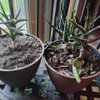
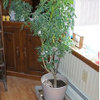
4) This is the one I have now, first week pic and today's pic , what should I do to keep it alive please?


Comments (4)

  • 8 years ago
    last modified: 8 years ago

    Where to start? I wish I had that stump! ;-) Have you fertilized? If yes, with what and how much - please provide the fertilizer's NPK %s.

    Misting entirely unnecessary for this plant, though you can spray it down from time to time to rinse dust off the leaves. Your plant was likely over-potted/over-watered. I can't say if it's salvable or not, I'd guess yes, but if the root damage is bad, one side of the tree might die - not the end of the world. I'd depot it, inspect the roots, and put it in a much smaller pot with a very fast-draining soil. Soil choice is extremely important in determining what kind of opportunity you'll be able to offer your plant to realize as much of its genetic potential as possible.

    I have at least 15 F benjaminas in pots, some having been in my care for 30 years or more, so I'm very familiar with their needs and tendencies. A progression of one of my trees from needing a pruning to after-styling:


    1) should I repot it on arrival to a big one? I did with the above. I'd say no, even though I would. The tree will likely arrive with a very congested root mass that potting up won't fix, Repotting involves bare-rooting and root pruning, which will almost certainly need to be done asap, but you should first learn how to repot and what to avoid. Potting up ENSURES limitations associated with that practice UNTIL you repot and correct the problem roots. More on that later if you're interested in what I'm sharing.

    2) when everyone say bright indirect sunlight, does that mean
    somewhere light falls, but not all the time? I am clueless,planning to
    keep this new one near the patio door where the old one is placed. It
    will be autumn in two months (in UK)and soon radiators will be ON and no
    sunlight, to come through. but other than this place, I have
    windowsills all of which is really bright and sunny, my peace Lilly went
    brown placed on on of it. Any suggestions welcome.
    Ficus B will withstand the photo load (light level) coming through any windows, but it may not be able to withstand the passive heat build-up in leaves in a room without a fan to move the air and cool leaves down. At a minimum, it should be very near a very large window on the W or S elevation. We can worry more about siting the plant in the future, but it shouldn't be near a heat source. Ask if you wish to know why.

    3) how often do I water, "only when the soil goes dry " does means
    watering only once in three weeks with the old one. Is that enough? it
    always look really black and wet.
    "Always black and wet" means your definitely over-watering. Use a "tell" to determine when it's time to water. More about that below.

    4) This is the one I have now, first week pic and today's pic , what should I do to keep it alive please? I'll link you to 2 threads I wrote that will provide you with a general idea of how to avoid common problems hobby growers all encounter at one time or another. One thread is specifically written about Ficus b. But first, you'll see info on using a tell. The links will be at the bottom of this reply.

    Using a "tell": Over-watering
    saps vitality and is one of the most common plant assassins, so
    learning to avoid it is worth the small effort. Plants make and store
    their own energy source – photosynthate - (sugar/glucose).
    Functioning roots need energy to drive their metabolic processes, and
    in order to get it, they use oxygen to burn (oxidize) their food.
    From this, we can see that terrestrial plants need air (oxygen) in
    the soil to drive root function. Many off-the-shelf soils hold too
    much water and not enough air to support good root health, which is a
    prerequisite to a healthy plant. Watering in small sips leads to a
    build-up of dissolved solids (salts) in the soil, which limits a
    plant's ability to absorb water – so watering in sips simply moves
    us to the other horn of a dilemma. It creates another problem that
    requires resolution. Better, would be to simply adopt a soil that
    drains well enough to allow watering to beyond the saturation point,
    so we're flushing the soil of accumulating dissolved solids whenever
    we water; this, w/o the plant being forced to pay a tax in the form
    of reduced vitality, due to prolong periods of soil saturation.
    Sometimes, though, that's not a course we can immediately steer,
    which makes controlling how often we water a very important factor.

    In
    many cases, we can judge whether or not a planting needs watering by
    hefting the pot. This is especially true if the pot is made from
    light material, like plastic, but doesn't work (as) well when the pot
    is made from heavier material, like clay, or when the size/weight of
    the pot precludes grabbing it with one hand to judge its weight and
    gauge the need for water.

    Fingers
    stuck an inch or two into the soil work ok for shallow pots, but not
    for deep pots. Deep pots might have 3 or more inches of soil that
    feels totally dry, while the lower several inches of the soil is 100%
    saturated. Obviously, the lack of oxygen in the root zone situation
    can wreak havoc with root health and cause the loss of a very
    notable measure of your plant's potential. Inexpensive watering
    meters don't even measure moisture levels, they measure electrical
    conductivity. Clean the tip and insert it into a cup of distilled
    water and witness the fact it reads 'DRY'.

    One
    of the most reliable methods of checking a planting's need for water
    is using a 'tell'. You can use a bamboo skewer in a pinch, but a
    wooden dowel rod of about 5/16” (75-85mm) would work better. They
    usually come 48” (120cm) long and can usually be cut in half and
    serve as a pair. Sharpen all 4 ends in a pencil sharpener and
    slightly blunt the tip so it's about the diameter of the head on a
    straight pin. Push the wooden tell deep into the soil. Don't worry,
    it won't harm the root system. If the plant is quite root-bound, you
    might need to try several places until you find one where you can
    push it all the way to the pot's bottom. Leave it a few seconds, then
    withdraw it and inspect the tip for moisture. For most plantings,
    withhold water until the tell comes out dry or nearly so. If you see
    signs of wilting, adjust the interval between waterings so drought
    stress isn't a recurring issue.


    An Overview of Good Growing Practices

    Ficus Care in Containers

    Al

    Need Houseplants thanked tapla (mid-Michigan, USDA z5b-6a)
  • 8 years ago

    To add to what Al said, I’d resist the temptation of ordering a new larger one until you get the idea for how to care for these down a bit better.

    Need Houseplants thanked Dave
  • 8 years ago

    Thanks Al and Dave!! Sorry couldn't respond to this sooner. I had already ordered and collected it before I saw your post, Dave. But happy to say, this time I haven't messed it up- yet

    Al. Guess what I have read your post sometime ago somewhere else while researching Ficus care, I think it was a reply to a guy from Dubai asking about two/four huge Ficus in his balcony. Thank you ever somuch for taking time to write all that down. I really appreciate your help, being teacher myself, I really love the way you explain things for everyone to understand. Needless to say, Botany or anything plant related is not my subject, so I will have to re-read your links several times before saying I know what I am doing. Will definitely try to follow what you said.

    Happy to report back that my little stump had new growth, I removed all the old leaves carefully and left it with out watering until the soil feels dry. It is getting new life as of now, hopefully will be able to update with leaves sometime soon. Other new one is a trooper, haven't shed its leaves, and I am carefull with watering this time around, basically not hooveing around the plant anymore, lesson learned

    I just left it as it came, so repotting or anything. About the fertilisers, i haven't done anything yet, I don't have anything at home other than the ones Roses outside. I don't think NPK is mentioned there, just suitable for roses We are heading to Autumn soon, so would please let me know how much or how often do I fertilize? Many Thanks

  • 8 years ago

    Solution strength and intervals between fertilizing work in conjunction with your watering habits and soil choice to determine what might be the best way to approach nutritional supplementation. No one can give meaningful advice about how to fertilize without a feel for what your soil is like and how you water. I CAN say that it's ridiculously easy, monkey easy in fact, to put together a fertilizing regimen that gives you nearly 100% control of what your plants get and when they get it, if, you're using a soil that can be watered to beyond the saturation point, at will, without need to worry the soil will remain soggy for periods so long that root function and/or root health pay a steep price. If you can't water correctly, maintaining some semblance of control is difficult, at best.


    Al