Software
Houzz Logo Print
misssherryg

I Saw a Butterfly!

8 years ago
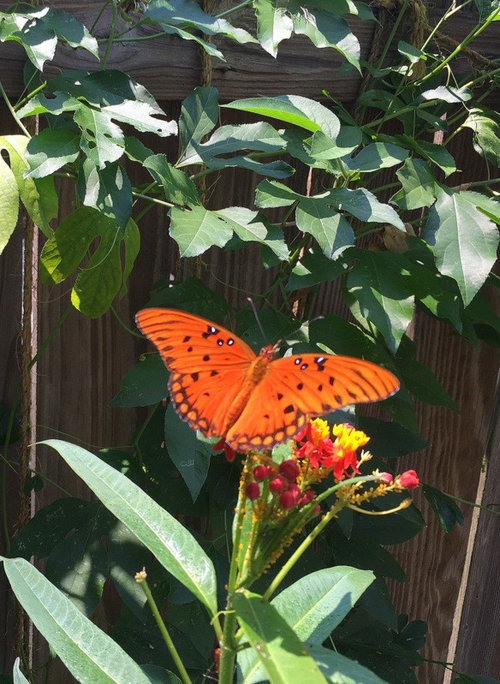
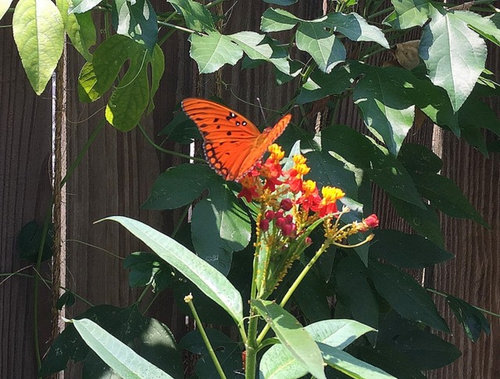
There was a time when that would have been a ridiculous title, but things are different in town. Actually, I saw a red-banded hairstreak the other day and was happy to see it! But today I saw a beautiful, apparently newly emerged, undoubtedly male, gulf frit! He flew around the passionvines and nectared on the milkweed growing there -


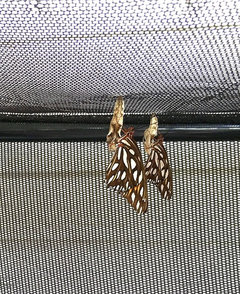
The four gulf frit eggs I got from my former country home have hatched and have grown a great deal every day. That's one of the best things about this butterfly, they go through all their life stages quickly, don't make you wait. So, even though this was a male, I'll surely get at least a few females from my five chrysalides and four caterpillars, and hopefully, they'll mate and lay some eggs on my vines.


You can see the aphids on the milkweed. :( I haven't seen any MW around here (there could be some in people's back yards, I don't grow mine in the front yard either) but I've seen several oleanders near my house, and, since these are oleander aphids who suck on both oleanders and MW, that's probably where they came from.


Excuse my excitement about a mere gulf frit, but I'm butterfly starved, and you have to admit, male gulf frits are striking butterflies!


Sherry

Comments (33)

  • 8 years ago

    Yay! That’s really wonderful! At this point I would be jumping up and down seeing a Gulf Fritillary. Last year at this time there were at least a dozen at any given time. This year I have just seen two altogether.

  • 8 years ago
    last modified: 8 years ago

    Sherry, I'd be excited too, if that beautiful frit was nectaring on my flowers. I was wondering if those butterflies prefer certain species of violets for host plants. I can't grow passionvines in my zone, so the best I can do for frits is have lots of violets. I've never seen any cats on my violets, but I was reading that they like to use Viola nutillii as a host plant. It's a native yellow violet with lance shaped leaves. I'm sort of shocked, because I haven't had any cats of any kind for years, and I just got back from outside where I counted 7 Monarch cats, and one BS cat. There are some common milkweeds in the yard that blew in on the wind, and there's cats on them. I thought earwigs were eating my tropical milkweeds, and my swan milkweed, but upon investigating I discovered more Monarch cats.This is incredible, I feel so blessed. :)

  • 8 years ago

    I go gaga anytime something flutters around in the yard -- which explains why I'm so often and easily faked out by a leaf falling! :p

    A gulf frit has been visiting here and there this past week. And just yesterday, a monarch FINALLY made an appearance, bouncing from MW to MW, laying eggs. 10 of my current batch of 17 monarchs chrysalised today, with the remaining 7 imminent. Perfect timing, as I'll harvest the newly laid eggs in the next couple of days to begin raising the next batch. You'd think with all the butterflies I've released (and will), more would hang around my yard.

  • 8 years ago
    last modified: 8 years ago

    Javi, I counted 3 unhatched eggs too. I looked for tuille at the fabric store with no luck.Then I ordered the wrong kind of tuille which was 3 inches wide, what good would that do? Then I ordered a floating row cover online, because none of the major stores like Home Depot, Wallmart, and Menards carry them, or even have mosquito netting. The row cover hasn't even shipped yet, so I bought a shear drape to cover the milkweeds, but I need to figure out how to go about it. I suppose it's a good idea to suspend the tuille from sticks so the cats don't get crushed when it rains. I had heard that Monarch cats love the African Swan milkweed, and I was surprised to find a cat on my plant, which is still kind of small. I think my BS cat is about ready to pupate. If I could get some Painted Lady cats on my nodding thistle I'd be over the moon. lol

  • 8 years ago

    Jay, variegated frits are the only violet using frits in this area, and they prefer P. incarnata to violets - they only use violets when the gulf frits have totally taken over the vines or very early in the spring when the vines haven't popped up yet. Variegated frits won't use the white blooming primrose leaf violets that grow here, only common violets. I'm guessing you'd have more success with great spangled frits, meadow frits, and aphrodite frits if you had common violets, the ones with heart-shaped leaves and purple flowers. But you need to research which type violets those three fritillaries prefer.

    Congrats, congrats on the monarch and BS caterpillars!!

    Sherry

  • 8 years ago
    last modified: 8 years ago

    Thanks, actually I haven't seen any frits in my area for a very long time. Even as a kid they were rare back then. So I don't know if it matters whether or not I have host plants, but I'm still growing that pretty yellow violet next year, just in case, and I love that plant. I'm going to try to find that caterpillar guide. I try to grow host plants for all butterflies and moths. It's so interesting finding out about all the hostplants that they use.

  • 8 years ago
    last modified: 8 years ago

    Jay: I'm the repurpose queen over here, and actually saved all the sheers from the house when we took them down. Never thought they'd come in handy for protecting my MW seedlings and root cuttings from the harsh sun as they grew. I built a very simple frame out of 1/2" PVC and assorted elbows and connectors, then draped the sheers over them. You could try that for your MWs with cats, using tulle instead (my preference as I love to watch the cats grow).

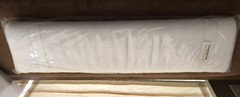
    I ended up ordering a 40-yard bolt of white tulle off Amazon for ~ $9.99 -- free shipping. Look around, but you'll find something close. An entire bolt looks like this:

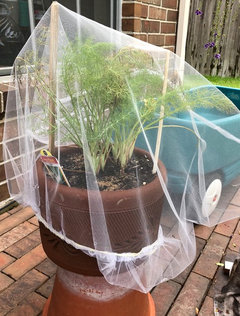
    I started off sewing a bunch of drawstring bags in different sizes and shapes as my needs dictated. Some examples (ignore the poor fit: right now, I'm just trying to keep the butterflies from laying eggs while my fennel/dill recover):

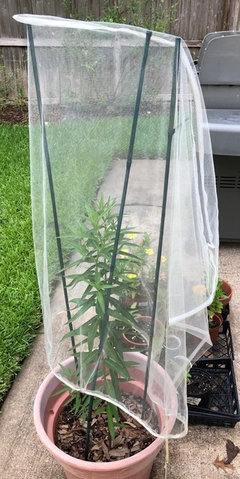
    This is a bad fit, but I was in a hurry to cover my potted A. incarnata; again, to keep monarch butterflies from laying eggs on it until it gets larger and can support more than one cat. I didn't have time to cut the bamboo sticks to size, so just jammed in what lengths I had. :)

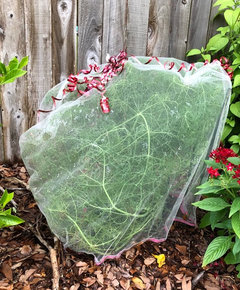
    For your MWs in the yard (right?), this might be a better application -- sew a drawstring bag large enough to cover each whole MW plant. Here, I've covered a large fennel bush as an Eastern black SWT laid a ton of eggs. I pulled ~ 30 eggs indoors (onto my purchased parsley sprigs), but left quite a number on the bush. I have to cover the plant all the way to the mulch to fully protect from both lizards and wasps (which could easily get underneath the netting if I don't take it to the ground, then cover all the way around with a thick layer of mulch).

    Up until this afternoon, the curling ribbon wasn't there. From inside the house, I noticed an odd flurry of activity: looked up and saw a mockingbird jumping up and down on the netting, trying to peck at the 1" cats underneath!!! Ugh. Ran outside and clipped the ribbon on top as a deterrent. (You'll note the mockingbird's pouncing pulled the bottom of my netting up out of the mulch. I'll need to fix that tomorrow and cross fingers no lizards cruise by in the meantime.) Honestly, I don't think raising three kids was this much work! :)

    PS Do you sew? :)

  • 8 years ago

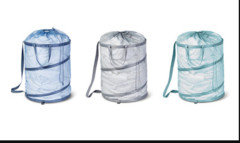
    Jay: In case this helps, I see these mesh pop-up hampers on sale at our local Aldi store this week @ $5.99. Dimensions are 18x18x22. Depending on the size of your plants, it might be easier to purchase something like this, flip over and place atop your MWs:


    Walmart, Target, BBB, etc. all sell versions of this, and with school starting soon, this would be the time of year for them to go on sale. HTH.

  • 8 years ago

    Javi, thank you so much for all your help. I'm going to find those hampers and use them.

  • 8 years ago

    Javi, I just bought 4 hampers from Aldi. Thanks for the tip.

  • 8 years ago

    Good luck!

  • 8 years ago
    last modified: 8 years ago

    Oh, nice! Wasn't sure there'd be an Aldi in your area, and almost felt like it was a bit of a tease to share the sale with you. Yay! Pics, please. :) Just think it'd be a cute pic, seeing a bunch of colorful, upturned hampers in the garden.

  • 8 years ago

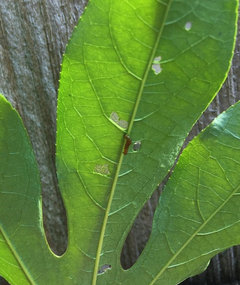
    I went out to the vines (here in Hattiesburg) and noticed what looked like a gulf frit hatchling on a leaf, then another, and then another! I stopped counting at three. If these are indeed gulf frit hatchlings (how could I not notice those yellow eggs?) then the wife of that male that visited must have visited earlier! I had a hard time making a picture, holding the leaf to show the caterpillar and my phone with the other. I need to start using my actual camera again -

    Sherry


  • 8 years ago

    Love it, Sherry!


  • 8 years ago

    This is great!

  • 8 years ago

    Yes, I just cut off the leaves they are on, stuck them in holes in the top of a leftovers container that's filled with water, and put them in a cage for safety. There was a dangerous looking, large bug out there on the vines, don't want to lose any cats.

    I'm really glad I've planted a wild black cherry, a wafer ash/Ptelea trifoliata, and a redbay, and dug up and am rooting some false nettles. These plants host multiple types of butterflies. There are giant water oaks on the edges of this property that create shade on about half of the back yard, but I don't ever see any frass below them, even though there are moths that might use them. Maybe I'll be fortunate and find cats on my new plantings one day.

    Sherry

  • 8 years ago

    A great sight!

    Sherry

  • 8 years ago

    Sherry, amazing, what a miracle! You all in the South, and West get more butterflies than here in the Midwest. What kind of butterflies are those Sherry?

  • 8 years ago

    They're gulf fritillaries, like the one in the pictures at the beginning of this thread, Jay. They have a lot of silver spots on their undersides. There were actually three of them in all, 2 females and 1 male - I released them earlier. I also found quite a few more little cats on the vines, and a female has been laying more eggs for the past 2 days. When gulf frits find you, they REALLY find you!

    Sherry

  • 8 years ago
    last modified: 8 years ago

    Sherry, I read that frits sometimes lay their eggs on the tendrils. Does that happen often with your visitors?

  • 8 years ago

    Yes, they frequently lay eggs on the tendrils, probably just as often as they lay their eggs on a leaf. They also lay eggs on some really strange places. I watched this same female lay two eggs on the wooden fence that the vines grow on, and in my old house they laid eggs often on the chain link fence around that big garden.

    Sherry

  • 8 years ago

    Thanks Sherry, that's interesting. I never realized just how many species of Fratillaries there were, and I bet you know all of them by heart.

  • 8 years ago

    No, I don't know all of them by heart, Jay, just the ones down here and the most common ones seen in other parts of the country.. Actually,gulf frits aren't true fritillaries, but longwings. The longwings must be closely related to the true fritillaries, though, because variegated frits use both passionvines, like longwings, and violets, like the true frits.

    I love them all!

    Sherry

  • 8 years ago

    Posted by Jay:
    > suspend the tuille from sticks so the cats don't get crushed when it rains

    Another reason is that the caterpillars much less frequently walk around on
    the covering when there is enough separation. Wasps sting caterpillars
    through the mesh, and birds and/or lizards do mangle caterpillars that are
    on the covering.

  • 8 years ago

    What an interesting thread! I haven't been on here for a while but am glad that I checked out this post.

    Sherry, I'm glad to see that you're getting your butterfly population up at your new place :) The Gulf Frits do lay their eggs in weird places. I have often watched them lay their eggs on the siding and window screens near the passion vine an totally ignore the vine :)

  • 8 years ago

    Yes, I'm working on upping the butterfly/moth population here, Rhonda! I released 5 gulf frits the other day. There are probably 7 or 8 chrysalides hanging in a cage on my front porch and about the same number cats still eating. Also have a few pipevine cats eating, one real big, and at least 5 sleepy orange cats that were on a Senna/Cassia oblongifolia/sicklepod that I dug up from my old garden in the country. Sicklepods used to come up in the exact same spots in my country garden, so I'm going to see if these come back (in a pot) next spring - they're supposedly annuals. Hopefully, by that time, I'll have the area I've planned as a butterfly garden ready to plant, and I can plant a sicklepod on each end. If you fertilize them, they'll make a big fat bush that cloudless sulphurs, sleepy oranges, and little yellows will use readily. I know that S. bicapsularis will return in spring, but it has a weird tall, skinny growing habit, and the sulphurs would only use it if nothing else was available in the country.

    I've also planted a redbay, wild black cherry and a wafer ash. 'Have other plans too lengthy to mention now.

    Sherry

  • 8 years ago
    last modified: 8 years ago

    Wafer ash for the giants. Sherry, is your Senna oblongifolia or obtusifolia? I know they call S. obtusifolia sicklepod, and I think there's an S. oblongifolia from Brasil, but it's hard to get any info or photos of that species. I just found out from Iris that the butterflies all lay eggs on her S. obtusifolia, and ignore her S. hebacarpa. I've been growing S. hebacarpa for years with the hope of getting visiters, but have never seen any cats on them, so I'm trying out the S. obtusifolia next year for sure. I'm so happy that you've been gifted with so many cats this year.

  • 8 years ago

    Sherry, I picked up the Peterson First Guide To Caterpillars. For a little book, it sure is packed with a lot of useful information. Thank you for tipping me off about it.

  • 8 years ago

    Oops! I meant S. obtusifolia, Jay. I'll blame it on chemo brain - chemo kills cells, including brain cells! :/ Yes, S. obtusifolia is VERY attractive to sulphurs, at least the ones down here - I don't think S. hebecarpa even grows here. It might be that sulphurs like sicklepod because the leaves are tender, even the bigger, older ones. S. bicapsularis/Christmas cassia has thicker, tougher leaves - maybe S. hebecarpa has tough leaves, too. The only problem with S. obtusifolia/sicklepod is that those 'sickles' contain jillions of seeds, and it can spread as bad as partridge pea. So, I plan to cut the 'sickles' off as soon as they come out of the flower. This bed I'm planning is right by the back steps where I let my dogs out, so I shouldn't have much problem keeping things in check.

    I found another sleepy orange on the other sicklepod - their coloring hides them the best of any cat I've raised.

    Sherry

  • 8 years ago

    Sherry, I just made the rounds, and I now have 16 Monarch cats and 3 eggs. Your good fortune must be rubbing off on me. I haven't ever seen any cats on my Senna hebacarpa, but I read that the cats of at least one species overwinter in the seedpods. I have left the seedpods, but now have a lot of volunteers growing all around the garden. I'm going to the old garden today. I have a whole colony of A. syriacas over there. Hopefully not everyone of them has cats, because that would probably be more than I can handle. I will try to dig a nettle and pipevine sucker, and bring them to the new place.

  • 8 years ago

    Woohoo! What fun, Jay! I hope you continue to raise more and more caterpillars! You're like me, going to the old garden to stock the new one!

    Sherry

  • 8 years ago

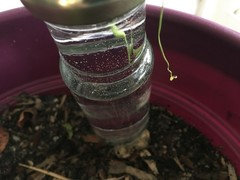
    Jay, I cut some stems of passionvine to feed the cats, and realized too late that one of the tendrils had an egg on it. I didn't want one of the caterpillars to eat it, so I punched a hole in the top of a little glass jar, filled the jar with water, stuck a passionvine leaf in the hole with the tendril, and put this away from the caterpillars. I thought about your comment -

    I saw a female laying eggs on the vines today. Can you see the little yellow egg?

    Sherry


Sponsored
Peabody Landscape Group
Average rating: 3.5 out of 5 stars8 Reviews
Franklin County's Reliable Landscape Design & Contracting