

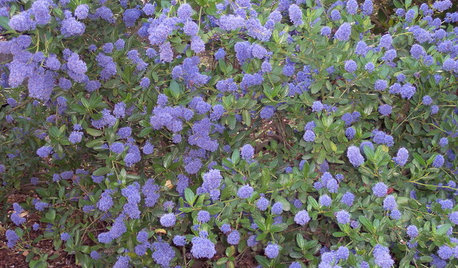
Need info about Ceanothus Thrysifloris Repens
A couple years ago I bought a few of these shrubs, and they did VERY well in my garden. But I had misunderstood just what kind of a plant it is; I thought it wouldn't get taller than about 30 cms,and boy was I wrong. I ended up having to shovel prune them; they were way too vigorous for the places I'd put them, and moving them is very chancy. But I was impressed by the way they shaded the soil beneath them,really helping with my out-of-control weed issues, so I'd like to try them again. However this time I want to get more information about them in advance so I will place them properly. I live in Tuscany, Italy,so it's a warm, Mediterranean climate. How tall should I expect them to get to be? How wide? I know they can take pruning. I'd like to plant them amonst mature climbing roses ,to act as a natural mulch/groundcover.How much space should I leave betwee the ceanothus and the roses? How much space betweeen the ceanothus plants themselves?This needn't be a permanent planting, either. It will be fine by me if they just "hold the fort" for me against the weeds for a few years; I might choose to replace them with perennials or some such. The roses are very, very big and vigorous (7 meters x7, 3meters x3, etc.) so I'm not too concerned about them being over-run. The old ones didn't seem to bother the mature roses, though I think they really did bother some young plants, but this area is all mature ones.
Thanks so much in advance for any help or comments.
Comments (17)

User
Original Author8 years agoAccording to this Dutch nursery from which I hope to buy the plants, they get to be 50cms high, more so if trained .
Related Professionals
Birmingham Landscape Architects & Landscape Designers · Toledo Landscape Architects & Landscape Designers · Clarksburg Landscape Contractors · Lewiston Landscape Contractors · Longview Landscape Contractors · New Bedford Home Builders · Marinette Home Builders · Missoula Home Builders · Wilmington Landscape Architects & Landscape Designers · Clearlake Landscape Architects & Landscape Designers · Abilene Landscape Contractors · Oneonta Landscape Contractors · New Braunfels Home Builders · Pittsburg Landscape Architects & Landscape Designers · Elkton Landscape Contractors- 8 years agolast modified: 8 years ago
That could be something to work from if they are actually describing what they have seen the clone they are offering do. Otherwise, of course there are lots of descriptions of repens around, that you could compare with one another. And in Britain and Northern Europe there could easily be a single horticultural clone being grown under the (botanical) name. Except that the Hillier description - although referring to the material being grown as an "it" - with its omission of a size designation, inclusion of the observation that the habit is variable makes it sound like there is more than one form present there.
User thanked Embothrium - 8 years ago
Here, the information is they should mound to two feet and spread slowly to fifteen feet. Does it have to be that cultivar or are there other creepers available? Perhaps one of the others may be a better size for you? I don't know about in Europe, but here in California, we have a large number of species and hybrids available.
User thanked roseseek - 8 years agolast modified: 8 years ago
Bart, I was looking at them, last night. They are beautiful. Here is a clip like they have all kinds of Ceanothous.of heights in CA by UC Davis. Not sure but I post anyways :)
Jin
User thanked Plumeria Girl (Florida ,9b) User
Original Author8 years agoThis is so helpful, and thanks so much for the heads up about the clone thingie,Embothrium. I looked up the description of the plant given by the nursery from which I bought them, and, in fact, they describe it as growing to a maximum height of 100-150 cm, which would concord with what I observed of their clone in my garden (they were going for 100 cms for sure, and I'd even pruned them back). Most other nurseries that I see on-line state final height as 70-80 cms.
Kim, I am thinking about ceanothus because of the following reasons 1)I know it does well in my garden 2)it grows FAST 3) I know for a fact that it can get by-nay, even thrives-on NO ADDITIONAL WATER. Even as first year plants they don't require much 4)It is evergreen. The blue flowers are decidedly a plus, since my garden revolves around cool colours. But I would be delighted for any suggestions anyone can give on alternatives, even if they don't have the blue flowers.As I said, this is not necessarily going to be a permanent planting.
User
Original Author8 years agoWell, I've been looking around on Internet, comparing the descriptions on the sites of different on-line nurseries of the plants they offer as "Ceanothus thrysifloris repens" and it is indeed clear that different plants are known by this name. The ones I had were from "Pollici Rosa" ; they describe a shrub that blooms in late spring (May) and grows to a height of 100-150 cms. Meilland's plant is described like this, too. "Le Georgiche" instead describes their plant as growing to about 100 cms tall, but blooming from mid-summer to autumn. "Priola" instead describes their plant as growing only about 30-35 cms tall, and blooming from May to August. This last one sounds like the one I'd be wanting, though I have some perplexities about the accuracy of their description,since they also offer the stupendous ceanothus "Concha", but say it only gets to be 80-100 cms tall, whereas my oldest plant of this type is going for 2 meters (but Rose Barni says that Concha gets to be max 150 cms as well). Also I don't really believe that any ceanothus will bloom for 4 months- at least not in my garden, lol!
I've found also the description of a Ceanothus prostratus ("Pine mat", "Squaw carpet","Mahala mat" are listed as common names.) This seems to be truly ground-hugging, getting no more than 15 cms tall. It's flowers and leaves look rather different from other ceanothuses. But I can't find it available here in Italy. A French nursery does offer a plant they call "Ceanothus prostratus" ,but both the description they give and the picture make it seem like they are talking about a plant similar to that offered by Priola,not the "Mahala Mat" plant.
- 8 years agolast modified: 8 years ago
Multi-month bloom time on supposed Ceanothus thyrsiflorus* repens I would wonder about also. Of course a lot of the commercial accounts you are reading may be based on information from outside sources and not on what vendors have seen their own particular stock do. Especially those that offer large assortments or will not be personally familiar with mature examples of each item offered for other reasons.
In my area the horticulturally prevalent flat one that grows vigorously and willingly is a light blue-flowered clone of Ceanothus gloriosus. Whereas about C. prostratus Fross/Wilken say in their book Ceanothus (2006, Timber Press, Portland) that it has been found to be "maddeningly difficult" to grow, with even California native plant expert Lester Rowntree not having been able to tame it. So the French material belonging to this species does seem highly unlikely.
The preceding authors also say 6-9 ft. high and wide is typical for 'Concha', with in addition British conditions having produced at least one example measuring 21 ft. by 24 ft.
Speaking of Britain if you can possibly order from companies there you should be able to find many different kinds to choose from. Also the RHS ran a ceanothus trial 2004-7, you might be interested in the resulting report:
http://apps.rhs.org.uk/planttrials/TrialReports/Ceanothus%202004-2007.pdf
*Note spelling
User thanked Embothrium - 8 years ago
I don't blame you at all for choosing Ceanothus, Bart. I love them. My next door neighbor has a Ray Hartman standard as a shade tree which hangs over my back fence. It has self seeded in the rock path in my yard and I have five seedlings growing happily from it. One has made an 8' standard in a fifteen gallon can in the two years since germination. One of the smaller leaved ones appears to want to repeat. And, I've just bought a Cliff Schmidt, an Arboreus selected by Native Sons Nursery, which is just a few miles from here, so I know if they report it does well, it should do so here. It's a larger leaved, felt leaf type with spring, some summer and then reliable fall flowering. I'm training it as a standard. I want a "blue" lawn tree without having to resort to a Jacaranda. They're gorgeous, but they stink and the litter stains everything. My question was to see if there might be another ceanothus cultivar available to you which may remain shorter and better suited to your desires.
User thanked roseseek User
Original Author8 years agoWhat a great idea to grow a ceanothus as a tree! I must try it! Concha might be too stiff, but I have these other ones (I think impressus Victoria) which are lax in habit,though they have never yet bloomed (hopefully they will next year). I wish that my Conchas would self-sow.
Embothrium, I took your advice and checked out some UK sites for ceanothus,but I'm not sure that it's be worth spending the extra money for shipping, plus loss on the exchange rate, to actually order from one of them, not to mention that they may or may not ship to Italy. The fact is, not all the nurseries even state precisely how tall their various varieties get, and those that do state it are obviously basing their observations on the height the plants obtain in the UK,whereas in Italy they might well grow bigger. It's really a shame that these beautiful shrubs are not more widely known and grown here in Italy; they are so adapted to this climate.
 8 years agolast modified: 8 years ago
I grew Ceanothus thyrsifloris repens in Cornwall. Cornwall has a mild, wet climate. Mine grew to a little under 3' in height and 15' across. It was a lovely evergreen, but only flowered for about a month in late spring/early summer.
Daisy
User thanked daisyincrete Z10? 905feet/275 metres- 8 years agolast modified: 8 years ago
Are there any other ground cover types easily available to you there, Bart? We can tell you what they should do here in the States. That may help you guess what to expect there.
User thanked roseseek - 8 years agolast modified: 8 years ago
'Victoria' has characters of Ceanothus thyrsiflorus* and C. velutinus and is not a C. impressus cultivar. It has a history of being by far the most commercially prevalent upright growing ceanothus in my region, resembles 'Skylark' which is shown and described in the R.H.S. trial report I linked to above. With the main difference between them apparently being that 'Skylark' is less erect in habit - if your plants are lax-growing they are not 'Victoria'.
*Note (everyone viewing the thread) again the spelling, which is not "thyrsifloris"
User thanked Embothrium User
Original Author8 years agoSpelling noted, Embothrium. Interesting to hear about the "Victoria" thing-so maybe what I have is "Skylark"?
Kim, there's lots of ground-covers available here. My first idea was to use evergreen perennials,but I can't afford to buy hundreds of plants at once, and I want to do something that will have a fairly fast impact on furthering weed control. Also, using ground-covering shrbs would have the added advantage of shading the ground but not actaully occupying too much soil surface, so I can continue the much-needed process of adding organic matter to the soil. As for other ground-covering shrubs, I'm quite open to suggestions. I think there's lots of low-growing junipers, etc, but don't know if there is any variety that would grow extremely short. And I know that ceanothus grow FAST; am not sure about other groundcovering shrubs. I'm open to suggestions!
 8 years agolast modified: 8 years ago
Hi Bart, as others have mentioned there are different cultivars of Ceanothus thyrsiflorus. You might enjoy looking at the listings of my favorite California native plant nursery, Las Pilitas Nursery.
Ceanothus thyrsiflorus
Coastal Mountian Lilac
Description/OrderCeanothus thyrsiflorus
Big Sur California lilac
Big Sur Lilac
Description/OrderCeanothus thyrsiflorus
Skylark Blue Mountain Lilac
Description/OrderCeanothus thyrsiflorus
Snow Flurry White Flowered Mtn. Lilac
Description/OrderCeanothus thyrsiflorus repens
Low Blue Blossom
If you click on the the green text 'Description/Order', it should take you to a description, also further information if you follow links from there. Perhaps you will find it helpful.
Bert Wilson, the former owner of the nursery, has more information about California native plants on his website than I have ever seen anywhere else. Browsing his posts and videos is an education. It can fill many fascinated hours!
Rosefolly
User thanked Rosefolly z5- 8 years agolast modified: 8 years ago
Looking again the last time I was there at the one I planted on Camano at the moment the central point is actually something more like 2 ft. high and the main hanging drape of branches is more like 4 ft. long.
If you have perennial weeds of much consequence you will have to clean them out before planting ground covers otherwise many of them may persist even after the planting fills in. Also you will want to choose ground-covering plants growing at least 2 ft. tall in order to minimize nuisance plants seeding into the planting even after it has been established for many years. For instance in my area red alder trees, more than one species of blackberry and giant morning glory (Calystegia) are examples of things that may often be seen to have come up through even quite dense ground covering plantings.
If you are thinking you have to be able to dig organic material into your beds it is actually better to simply apply it as mulch - as Nature does. The main exception is when ground is being worked and amended before the planting of annual flowers and annual vegetables. But plantings of longer lived subjects should always consist of loosening the existing soil, planting in it without attempting to modify the texture with any additives and then mulching well immediately after planting.
If an existing soil is thought completely unsuitable for a particular kind of woody or perennial plant then that soil needs to be replaced, rather than merely amended. As in digging out beds entirely and filling them with suitable soil, or placing layers (berms or mounds) or suitable soil on top of the existing soil. And planting in these added layers without blending them with the existing soil underneath. Which would defeat the purpose of bringing in different soil.
User thanked Embothrium



Embothrium