Software
Houzz Logo Print
nobasil

Help me design a shrub border!

We put in a ground mount solar array this summer- the neighbors don't like the way it looks from the back. What better reason to put in a new shrub border?


I've never designed a shrub border before and would love some feedback- especially with regards to layout.


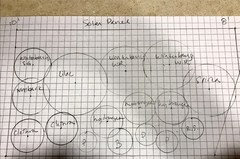
The solar array is 36' long and I have a 20' wide strip behind it covered with black plastic (bed will be 36x20). I want to leave the back 3' clear so we can get under the panels to weedwack etc. There's also a small triangle cut out of one corner that's needed to access a water pump. The solar array is 8-10' high. This border will be on the north side of it, but it does get pretty good light from above (there's nothing other than the array to make shade). Soil will be a mystery (generally our soil is very good, and this property was used to raise cows for decades, but there was an old barn on or near this spot and the soil may be more compacted than I'm used to).


I will post a drawing of what I'm thinking from my phone.

The shrubs shown are:

Lilac

Bridal wreath spirea

Winterberry, winter red and southern gentleman

Summer wine ninebark

Ruby colored clethra

Oakleaf hydangea

Peony

Baptisia

Russian sage


Thanks!

Comments (20)

  • 8 years ago

  • 8 years ago

    Way beyond anything in my experience but I do notice that you have no evergreen shrubs on your list. Have you considered winter appearance and screening?

  • 8 years ago

    That’s an interesting thought- the winter berry plants should provide winter interest. I didn’t mention it in the original post but I also very much want to focus on plants that support pollinators. I have to admit- I’ve largely given up on evergreens since there isn’t much that survives our winters that I like.

  • 8 years ago

    I'm pretty sure that Oakleaf Hydrangea will not be hardy for you. In their place you might consider one of the many H. paniculata varieties. Also, if deer are a problem, they love hydrangeas. And looking at your drawing, Ninebark will get MUCH larger than Ilex (Winterberry) and probably larger than most lilacs.

  • 8 years ago

    perhaps a better description of your location would help ...


    any chance at a pic or to of the location ...


    i dont understand the scale of your drawing .....


    BR spirea.. 5 foot max ... peony ... 2 footish ... maybe a bit higher


    ken

  • 8 years ago

    I'll try to post a picture later this afternoon. (The left side of the drawing has more space- it's the side where the panel is 10' tall whereas the hillside slopes up and there's 8' of height on the right side.)

    I wasn't intending to cover every bit of the panels- just to cover up a fair amount and provide something more interesting to look at.

    Each square on the graph paper is 1 foot.

    I haven't committed to a lilac but was aiming for something 10'.

    The ninebark is supposed to be a smaller one- listed as 5-6x5-6, although I'm assuming it may get a little bigger.

    I have another post about the hardiness of the hydrangeas- I have a ruby slippers planted in a different location that survived last winter and am hopeful... (that said I recognize there's a possibility I'll need to take them out and put in a paniculata variety).

    Fedco lists the spirea as getting to 5-9x6-8 and I feel like I've seen fairly large ones around?

    I put the perennials on the drawing mainly for fun- basically I was going to fill in the space at the front with them and am less worried about their placement since I can always rearrange them later.

    Do I have the shrubs placed at appropriate distances apart (assuming the info I'm using is correct and the circle represents their ultimate sizes)?

    Thanks

  • 8 years ago

  • 8 years ago

    for this MI boy.. new englad could be MA to north maine .... and thats a big difference .... give us a better idea.. plz ...


    trees and shrubs.. just dont stop growing at some magical height ... so dont fixate on those estimates to precisely ...


    i have seen hundred year old lilacs in front of centennial farms .. mind you at 55 mph .. lol ... that were easily 15 to 20 feet tall ... but more generally ... they are 8 to 10 feet ...


    but understand.. a properly cared for lilac ... is rejuvenation pruned.. over the years ... and by doing that you can keep the size down a bit ... you can google that term ...


    and you can use that type of pruning .. for just about any shrub .... so you can make things fit ...


    but one thing for sure.. never just give them haircuts.. imo ...


    as another example ... the spirea.. doenst stop growing.. but as it gets over 5 or 6 feet.. it starts collapsing.. for lack of a better term .. because its trunks.. never get thick enough to hold them up ... and dont get me going on ice storms ...


    good luck with it all ... i just wanted to give you some general shrub info to work with


    ken


    ps: if it were mine.. i would spray grass and weed killer under the thing once or twice a year... rather than weedwhip under it ... but i kinda march to my own drummer.. keep it in mind.. after you have been weedwhipping it every other week or two ....


  • 8 years ago

    We're in Vermont.

    That's good information about the spirea. It's not overly fussy is it? I don't mind pruning out dead/older canes but don't want anything overly complicated to maintain.

    I'm really more concerned with width of the plants and whether I've got them placed in good proximity to each other than I am with height. I did put taller plants on the side where the panels are higher, and put taller plants behind shorter ones, but beyond that the exact height doesn't matter.

    I want to put this together so everything has enough space and can be allowed to occupy the space it's naturally inclined to and not need anything more than basic maintenance pruning.

    We have a common lilac by our front door- it's probably been there 50 years. It drives me crazy because it wasn't planted with enough space. We've rejuvenation pruned it and I'm constantly trying to reshape it to keep it out of the gutter and off the roof.

    I'm looking at ludwig spaeth as the lilac (it looks like I can get it from a local grower), but whatever goes in there it'll be something labelled as 8-10 feet.

  • 8 years ago

    Thanks- that’s a lot of helpful advice.

    The clematis on the hydrangea is beautiful!

    How bad is the winter berry suckering? I don’t mind basic pruning, but don’t want to have to repeatedly battle something to keep it contained.

    Any suggestions for an evergreen that won’t get too big and truly tolerates zone 4?

    I’m also putting in a hedge across from this area with limelight hydrangeas. So I’d like to do something other than paniculata varieties in this bed. I can’t figure out if I just got lucky this winter with the ruby slippers oakleaf that I put in last fall but it’s flowering beautifully and I’m tempted to chance it.

  • 8 years ago
    last modified: 8 years ago

    Based on my experience, the winter berry will sucker enough to need at least annual attention if you want to keep it in bounds, and perhaps more. From tiny liner sized plants (rooted cuttings intended for the nursery trade to grow on to saleable size) in almost 10 years they have spread into surrounding plants to at least 4’x8’ and perhaps as much as 10’ or 12’, though I haven’t looked carefully in the last couple of months. You could try planting on an edge to see if they will be more likely to grow outward rather than towards the other plants.

    To,play devil’s advocate, having a couple of panicled hydrangeas in this bed will make it relate better to the planting across from it since there will be a bit of an echo.

    Do you have deer problems?

  • 8 years ago

    We certainly have deer. Most of the time they cause frustration but not total losses. That said, this planting is across the street from our house, and out of the range of our dog (most of the damage near our house tends to be limited to when we're away). The hydrangea hedge (which was started with small plants and has had at most a year's growth) has experienced nibbling but still seems to be thriving.

  • 8 years ago

    I have to admit I'm attached to trying the oakleaf hydrangea (and it seems like there's a safe enough back up plan that if they don't survive I can find a similar size paniculata variety).

    The clethra and winterberry would be easier to talk me out of. I suppose I could also change the clethra for a smaller winterberry too- they'd probably be easier to control?

    Any ideas for evergreens that wouldn't get beyond 6-8 feet in height/ width? (I have to admit I'm hesitant though on the evergreens- they look terrible if they're partially damaged- we took out some old junipers from our front door a few years ago after the voles had gotten into them over the winter- they looked awful after the damaged areas were removed.)

    Thanks

  • 8 years ago
    last modified: 8 years ago

    For evergreens with deer, no yew and no arborvitae, so I would look at spruce. I don’t have much personal experience with what there is as far as spruce that will stay reasonable small, but you can ask on the conifer forum for suggestions. Be sure to tell them about deer.

    https://www.gardenweb.com/discussions/conif

    Picea glauca 'North Star', north star white spruce

    Picea pungens 'R. H. Montgomery'

    Picea glauca ‘Conica’, dwarf Alberta spruce

  • 8 years ago

    Thanks- I'll take a look at those, and at the conifer forum.

    How easy is it to train the clematis onto a bush?

  • 8 years ago
    last modified: 8 years ago

    Not difficult, but it takes a bit of care to set up. To train a clematis into a shrub, you want to find a clem that has relatively long internodes (distance between leaves on the stem) so that enough sun gets to the shrub, and a shrub with stiff enough stems to support the extra weight such as Quickfire or Pinky Winky panicled hydrangea, or Donald Wyman lilac (Syringa prestoniae which doesn’t sucker.) You want them sized so that the clematis is smaller than the shrub so the shrub isn’t buried, so I avoid massive clems like sweet autumn or Betty Corning. Shrubs with light weight or floppy branches sag unevenly with a clematis, and evergreens may develop bare patches which won’t regrow, so I avoid those. I have also tried Cornus alternifolia, pagoda dogwood, a small tree, and found it needed small trellis or tripod for the clematis to reach the tree’s lower branches every year. Suckering plants like Ilex Winter Red or common lilacs or elderberry (Sambucus nigra) didn’t work too well because the clematis were overrun by the suckers.

    I plant the shrub one year and the Clematis the following year outside of the dripline/width I expect the shrub to reach, and for the first couple of years give the clematis a simple tripod for support while the shrub develops some size. And then I just let ‘em rip, tipping the tripod so that the clematis grows toward the shrub and eventually removing the tripod when the shrub grows wider.

    In addition to the three I have in my own garden mentioned above, I have seen this work with Viburnums, Sambucus Sutherland Gold, and one of the variegated Cornus shrubs.

    I would also consider rounding off the inside corner of the bed to make a long gentle curve rather than the right angled inner corner, both for aesthetics and for ease of mowing. Add a buried edging so that grass and weeds don’t grow into the bed and mulch well with cardboard covered by mulch.

  • 8 years ago

    Thanks- I may have to try that- I wonder if it would work on the limelight hydrangeas.

    I'm going to play with the design again a little- and may reconsider the Ilex/ try to add some small evergreens.

    I currently have everything under black plastic. When I pull that up, I was going to broadfork it, and then find a tree company to dump a truckload of chipped wood. (I don't have easy access to a large amount of cardboard, but hopefully between the plastic and the mulch I'll get ahead of the weeds.)

    (Sorry for my slow reply, we've been camping and had limited internet access.)

  • 8 years ago

    Grocery stores are a great source of cardboard.

  • 8 years ago

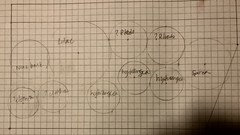
    Possible option B. Winter berry is replaced with rhododendrons, it also seems a little less crowded (though in part that may be because I didn’t draw in the perennnials at the front).