Software
Houzz Logo Print
bc99atl

Landscape Drainage Issue?

7 years ago

Hi Houzz Community,


This is my 1st time posting. I apologize for the length. I'm hoping someone will be able to provide advice.

My wife & I built a new home 18 month ago in a new subdivision. The builder's agent assured us our plot would be level with the adjacent plot. Unfortunately we learned we cannot rely on info provided by the builder.

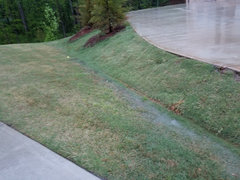
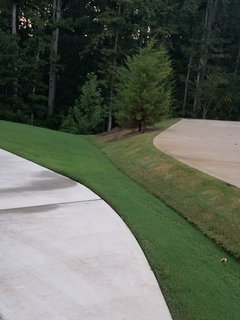
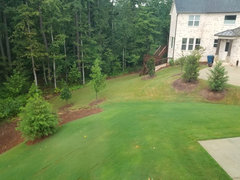
Our home is on a graded plot with a gentle slope down from the road at the front until you reach the rear of the house. Then there is a fairly steep slope appx. 50 feet down. The adjacent plot of land ( our neighbor's home) is graded at a higher elevation. The height differential begins at a few inches from the front of the house to appx 4-5 feet higher at the rear of the plot before the slope begins. Essentially the grading of the land had created a small channel between the our plot and our neighbor's plot of land.

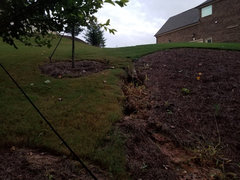
Over the last 6 months we noticed the soil on the slope in the channel is eroding away. After informing the builder, they refused to address the issue and only refilled the eroded soil.

The builder recommended we put down pinestraw and rocks to prevent further erosion.

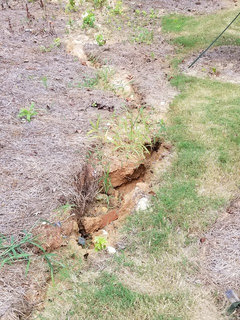
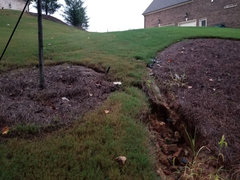
After a few months I discovered the pine straw and rocks had virtually washed away and the soil had eroded creating a trench measuring almost a foot deep by 6 inches wide and 6 feet in length.

The issues appears the force rainwater/ irrigation flowing off my neighbor's yard combined with the runoff from my yard.

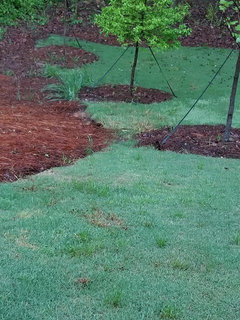
My neighbor has planted trees along the boundary of both our plots so the water is circumventing the trees and flowing into the channel.

I should mention the builder finished my neighbor's slope with grass but left my side of the slope with pinestraw.

What can I do to manage/ reduce/ prevent the erosion??

My concern is that the erosion will eventually weaken the integrity of the my plot and cause setlement of my home.

I will try to add pictures shortly.

Comments (21)

  • 7 years ago

    Landscape Drainage · More Info

    Landscape Drainage · More Info

    Landscape Drainage · More Info

    Landscape Drainage · More Info

  • PRO
    7 years ago

    Agreed ... pictures are necessary. Usually, the best way of preventing erosion is natures way .... with a solid covering of plants such as lawns or beds of groundcover. Their above ground portion shields the exposed soil from washing water and below ground portions strengthen the soil, as rebar in concrete strengthens it.

  • PRO
    7 years ago

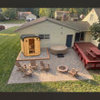
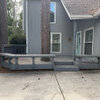
    I see your pictures came while I was writing. I can't tell which side your property is. The last picture that shows the wound, it is too close up so we cannot see how it's fitting into the overall scene. Is it same as second picture? Why are there trees just OUTSIDE of an adjacent mulch island? Seems like the tree areas should be incorporated into the island, if it's going to be that close.

    So far, I don't see anything that couldn't be remedied just by planting with lawn or groundcover.

  • 7 years ago


    Landscape Drainage · More Info


    Landscape Drainage · More Info


    Landscape Drainage · More Info


    Landscape Drainage · More Info


  • PRO
    7 years ago

    You've got to establish lawn or groundcover wherever there is washing water. And it may be difficult to do if water washes out your new plantings before they have a chance to develop and create cover. It's like vandalism. As soon as the graffiti shows up, you've got to wash it off or paint over it. If you don't, all the competing gangs will send their graffiti artists over in order to show who is dominant in the neighborhood.

    Mulch only on a slope is not stable. In my mind mulch alone is not a finished product, but a temporary condition waiting to be finished. It should be some type of low plantings or, in most cases, groundcover. It will not only look better and be stable against washing, but it will mean the end of annual mulch replenishment. What type of groundcover is used will mainly depend on if there's a precedent in the neighborhood, the light available, the size of the area, the soil moisture available, and the climate.

  • 7 years ago

    Thank you for the advice!

    The feedback from the builder was to use pine straw and some rocks with low growing bushes.

    I would have expected the builder to have done this as they would have knowledge and experience with these types of issues. However they're more concerned about cost savings than providing value for money.

    My landscaper said I should install a box at the top of the hill to catch the runoff and then have a drain to channel to water down and away from the slope. Is this worth the expense?


    I'm very grateful for the advice!


  • 7 years ago
    If your end goal is just to control erosion and you're less concerned about the look, just use bigger rocks.

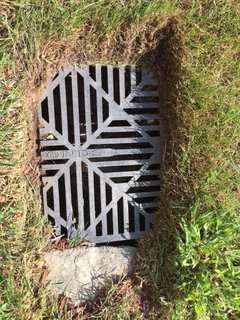
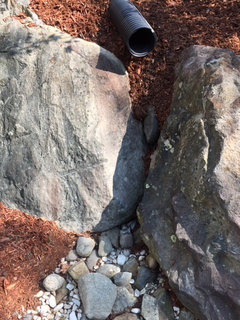
    I have a similar problem, but the jumping off point is in the middle of the back lawn, so I dug a trench with pick axe and shovel, put in a drain head at the low point of the lawn, and used plastic drain tubing terminated well downhill where I have a small rock field to catch the water, then backfilled it.
  • 7 years ago
    Hi Sofapud, could you post some pictures?
    thank you!
  • PRO
    7 years ago

    "My landscaper said I should install a box at the top of the hill to catch the runoff. ... Is this worth the expense?" It depends on your long range vision. Do you envision that the mulched areas will never be planted and will always remain as mulched areas? If you have a lot of water coming off of the drive, then "Yes," catching as much water as you can before it has a chance to wash mulch and soil away, makes sense. I suggest that the look of large mulched-only areas is not that great to begin with. And that after the fourth or fifth time of replacing all the mulch, it will become tiring and burdensome. Nature's way of planting the soil to prevent erosion looks better and ends mulching permanently.

  • 7 years ago

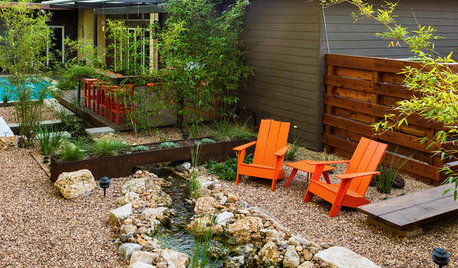
    Another option may be to actually work with the water flow and design and implement a dry stream bed. This will direct the run-off to an appropriate area when rains are heavy yet will remain dry and a landscape feature at other times of year. And prevent any further erosion.

    Dry stream beds do look best when accompanied by complimentary plantings so you might want to get a designer in to help you if this is an option that apeals.

    I would also say that builders/developers typically have little understanding of landscaping and do little more than assure that any drainage or water run off is away from the house (if that). What happens in the yard/garden is pretty much left up to nature after a very abbreviated or cursory planting.....typically a lawn.

    Mulch does have a place in the landscape and can be a valuable addition........depending on the situation :-) But I do agree that a large expanse of just mulched soil is not especially attractive and will need periodic attention. But sometimes just planting a groundcover necessitates mulching as well, if just allowing the GC to establish without the weeds overtaking or if the GC is not fully evergreen or doesn't spread and cover very rapidly.

  • 7 years ago

    Yardvaark & GardenGal48,

    Thanks for the advice!

    Yes, I plan to plant shrubs (various types of junipers) on the slope to increase the vegetation and strengthen the slope.

    As of now I'm trying to figure out what needs to done for the current situation, so I can approach the builder and see if they will contribute to the cost.

    I believe the issue wouldn't have arisen if the builder had not graded next door to flow into the channel and had not planted trees only on one side.

    The builder's foreman came out today to take a look and will follow up with the builder.


    Thank you to everyone!


  • 7 years ago
    IMO you have enough runoff area and slope that you need something to slow down and spread the water. The builder’s idea of rock, bushes and pine straw is a good one. Use rock to make one perpendicular to the water flow, slightly arched “eyebrow “ speed bump two feet above where the slope starts to drop off and put another a foot or so above the most eroded area. Plant bushes below the speed bumps and pine straw around them. If that doesn’t do the trick, add a few more speed bumps and plant some ground cover.
  • PRO
    7 years ago

    Typical groundcover plants and lawn do a pretty good job of holding against erosion. But some shrubs or trees may not hold ground surface well until the plants get some size and age. Generally speaking, a mass shrub area is not as easy to tend as a groundcover area. Just FYI.

  • 7 years ago
    What ground cover would you recommend?
  • 7 years ago

    Ferns

  • 7 years ago
    I assume ferns are deep rooted?
    Are there any that are more hardy?

    Thanks!
  • PRO
    7 years ago

    A groundcover is chosen based on knowledge of the yard's overall needs, as part of an overall plan. We can't know that based only on seeing a small section of the side yard and having no knowledge of your goals and objectives (outside of this one problem.) I could guess that you would need a groundcover that doesn't get too tall as a main groundcover. If your plan extends into the woods we see at the background, maybe you'd want a taller groundcover there. This is just something to be worked out in a plan. Ferns can make a great groundcover. They're used a lot down here in Florida. But they tend to be on the tall side (3' - 4'.) Some might work that are shorter. In order to do its job, a groundcover must be slightly aggressive, which means that one must come up with techniques for managing it. In most cases it's not difficult, but neither is it something that can be ignored. To begin with, I would look around your neighborhood/town and see what others are using for groundcover in similar situations. That way you could get an idea of what grows well and how it looks and performs.

  • 7 years ago
    The grate is obviously the collection point and the tube is the outlet about 30 ft away. guess i am lucky enough that the low spot for collection is small. some day I will get around to beautifying the outlet.
  • 7 years ago

    Unfortunately, the runoff comes from a broad area.

    I'm going to use river rock and a coupe of speed bumps to slow the flow and channel into a drain that I'll extend into the wooded area at the rear.

    I plan to use a combination for junipers and ornamental grasses to plan around the slope and along the drain.

    I'll post pictures when I complete the project.

    Thanks everyone for the advice!

  • PRO
    7 years ago

    Best of luck on whatever you do, but we can't say if what you do has a high or low probability of success, because it's in the form of words only ... not specific things in specific places ... a plan. Some junipers work OK as groundcovers, but they are not as good as other plants with dense root systems. Ornamental grasses have dense root systems but at the fore edge of a bed seems possibly tall, depending on your objectives.