Software
Houzz Logo Print
hzdeleted_21884067

Synstylae.... can you explain..?

8 years ago

I've never been sure about this... rosarians talk of it as if we all should know, and I've checked previous on this forum, google and books by Thomas and Beales, and I'm still not entirely sure what is meant by it..

The name refers to styles it seems, and it would appear this group has stamens that grow upwards like a funnel shape,.. what about those that are not funnel shaped?... but I've also seen references to bloom colours being white, pink and purple, and classes of roses, which seem to cover just about everything apart from hybrid teas..


It there one single common denominator? can I look at my roses and say, that's a Synstylae and that one is not?.. how do I do that?..


If anyone can explain rather simply - I am but a mere mortal - that would be nice...

Comments (27)

  • 8 years ago

    I don't understand the technical aspects either, so I just know them as hybrids of R. multiflora and R. setigera. There are probably other cluster flowered roses in the group, but those are the common ones to me.


    User thanked mad_gallica (z5 Eastern NY)
  • 8 years ago

    According to Classic Roses by Beale they are all flexible climbers.

    User thanked smithdale1z8pnw
  • 8 years ago

    A bit off topic but there sketches of the different hip shapes, leaf sets, prickles on the garden web forum and I can’t find it. Does anyone know what the topic was?

    With all the Rose books out there, one would hope this info would be more avalible. Malorena I to would like to know if a rose is synstale or not. I’d like to know all the terms to better identify roses. To see their key features and figure out what families they belong in.

    User thanked Seeingreen
  • 8 years ago
    last modified: 8 years ago

    The one thing in common are their united styles. It's like oaks being tiny plants in the east or towering tree in the west, or ferns being a forest floor plant or a new Zealand tree,but all oaks have recognizable acorns and all ferns have spores.. It's the sexual characteristics that define the species and they may not even be evident to the naked eye. Obviously other things such as leaves come into play for specific varieties. Excuse me if this wasn't your question. I'll have to go look at some of my roses that are synstylae, but I think many are species. This is a great thing to look up tonight and ask my resident expert! ; )

    seeingreen, I think that used to be in the roses FAQs section. I hate that the related forums are no longer at the top of the page. You can find that info in any rose key. https://gobotany.newenglandwild.org/dkey/rosa/      

    User thanked Vaporvac Z6-OhioRiverValley
  • 8 years ago

    Thank you... I didn't think it would be easy... I couldn't find anything on that rosy glossary thread either.... GS Thomas has a whole chapter on it in one of his books but I've never been any the wiser I'm afraid...

  • 8 years ago

    Marlorena, here is a link to one of our older nurseries here in Australia, it show some of the roses in the Section, this might give some idea of which roses fit the section, so some "google or Help me find" may need doing

    User thanked David_ in NSW Australia z8b/9a
  • 8 years ago

    I remember that, Claire! Good find!

    User thanked Vaporvac Z6-OhioRiverValley
  • 8 years ago

    I have recently tried to figure it out myself because that's the term I most often encountered when looking for rambler roses and their different classes. The only definitions I found are related to their "styles" which "are united in a column". Not really sure what it means as I am not a botanist nor a breeder and I don't exactly understand how this might (or not) be related to their growth habit, but by rule just about all ramblers belong to this group and, I think, also some once-blooming climbing shrubs.

    Best known are hybrid multifloras and h. wichurana (now, this is the one that has all kinds of spellings!), but also hybrids of r. setigera (the only North American species in this group, I believe), r. arvensis and r. sempervirens (European origin), and many other species mostly Asian by origin such as r. moschata.

    I realized that I can grow them along our vastly long fences and even up a couple of trees, and the best thing is that they are mostly done blooming when the Japanese beetles hit the area. I already have a couple of mutlifloras (Ghislaine de Féligonde, Veilchenblau), just recently planted one h. wichurana (Excelsa) and look forward to my first setigeras next year (Erinnerung an Brod and Baltimore Belle, finally!). Sempervirens might be just borderline hardy for my area but I am very much tempted by the glorious photos of Félicité-Perpétue.

    User thanked vesfl (zone 5b/6a, Western NY)
  • 8 years ago
    last modified: 8 years ago

    vesfl… that's what I understood it to mean, styles united in a column... I sort of know what that looks like, I'm sure I have one that does this but can't place which it is.. but of my roses you would think I have more than one that's considered 'synstylae'...

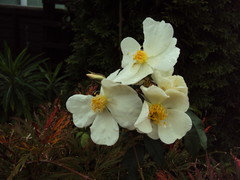
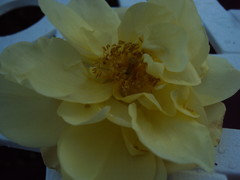
    ..this R. moschata variant seems to have the necessary...

    ..but lots of my roses are like this one, and I'm not sure this qualifies.. that's what I don't understand about it.. Jane - smithdale PNW tells us that Beales says they're all flexible climbers so I suppose that's it..?.. so where does the styles come into it..?

    I love the look of Baltimore Belle too, hope it does well for you there...

  • 8 years ago
    last modified: 8 years ago
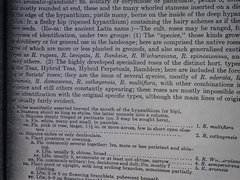
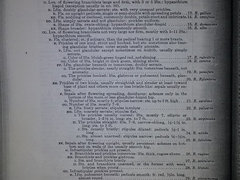
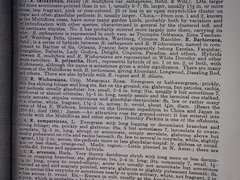
    1. You have to slice through the flower (longitudinal trans-section) and look at it with a hand lens. The other characteristics are not defining ie. flexible climbers or colours necessarily. I'll try to find a picture.... google images is useless so I'll look in one of my books.... I think Bailey has one. Whether or not they have fused styles is the primary defining feature of different roses. After you know that, you can look at the other features to ID. I'll take a pic of my Rosa Key from Bailey and add it here in a second.
    2. r. arvensis
    3. Note that each separate line beneath the terminal globe are separate styles that are fused. Normally they are distinct as in this picture.
    4. I don't know why these comments are numbered. Sorry.
      P.S. Syn just means "fused" and apo means "free". Think of a vinca periwinkle.... that is synpetalus (fused petals), vs. roses which have separate ie. free petals.
      Bailey's key: click for a large and clear picture.


    Bailey actually uses the term exerted which isn't the same so this may need further investigation. Although when you look at the Rose all of those that are exerted are considered synstylae. The plot thickens! ; )

    User thanked Vaporvac Z6-OhioRiverValley
  • 8 years ago

    vaporvac… thanks so much for going to this trouble... I think I can see what you mean by those fused styles.. I've been getting things mixed up with stamens and styles..

    the R. arvensis picture suddenly became clearer to me, it's not something I had looked at properly before.... with this information I shall be checking my roses more thoroughly... I'm so grateful, thank you...

  • 8 years ago
    last modified: 8 years ago

    I'm just happy I could contribute as a way of thanking everyone for helping me! :-)

    Be sure to do a close reading of the key. You'll see the fused styles are right at the top underneath exerted styles. Those Roses that have that characteristic apparently can be climbing or bushy but it seems those that do not have this characteristic are in the main bushy... aren't keys fun?

    User thanked Vaporvac Z6-OhioRiverValley
  • 8 years ago

    Thank you, Vap. Your explanations and links are very helpful, giving a good direction to demistify synstylae.


    Marlorena, you should be having at least one rose in this group, 'Ghislande de Féligonde'. I know it because your gorgeous GdF inspired me to grow mine.

    User thanked vesfl (zone 5b/6a, Western NY)
  • 8 years ago

    Vap, your *very* educational post yesterday made me go on a quest, determined to figure this out "once and for all" :-) At their Center for Biodiversity, University of Wisconsin (Green Bay) gives botanical info with illustrations for roses that have been naturalized there. Among others, they compare their two types of styles. Here are the links:

    Rosa rugosa ("styles not raised in a column") and r. setigera and r. mutliflora ("styles united to form a column raised above the hypanthium").

    Looking at Bailey's classification, I wonder why it has not been adopted among rosarians, or some simplified form of it, because it makes so much sense. The only puzzling one to me is what he calls R. cathayensis, but the rest of the classes perfectly fall into their logical place.

  • 8 years ago

    vesfl... that is so much help, I think I've finally sorted out the column business from those links.. I've been through my books and no one has explained it this way before... I've learnt some botany today... I shall be studying my roses much more closely after this...

  • 8 years ago

    vesfl, I think while some botanists may be rosarians, not all rosarians are botanists! I would expect other rose keys to follow Bailey's, but who can explain the lack of botanical info on roses in rose books. I guess most figure noone is really interested or it doesn't impact their culture too much or it's amazing if anyone recognizes anything other than a HT or KO in the first place. I'll try to remember to look up some others and see if they differ much, although his sets the standard, It's an old book, but not much has changed, unless there's been a re-classification of some sort. I carry the rose section around; it helps get a general classification when out and about which helps figuring out where a particular rose might do well. Marlorena, I think we'll all be looking at our spent blooms a little more closely! : ) Maybe I'll dissect one tomorrow and see if I can get a good pic with my micro lens. I've been looking for a reason to use it! ; ))

    User thanked Vaporvac Z6-OhioRiverValley
  • 8 years ago

    Vap, I think it was very helpful learning, for example, that r. wichuraiana, r. sempervirens and r. arvensis share a prostrate and creeping habit. Of course, their hybrids might be different depending on the rose they are crossed with, but ramblers, especially the older varieties, seem to be closer to the species than more modern climbers so I assume they share their characteristics. I am now considering to explore one or two Ayrshire roses and see if I can let them ramble as ground cover because I have a perfect area for it in my yard. And that's just one of many insights I got from Bailey's key you kindly shared.

    P.S. If you can understand what he means by r. cathayensis, the group for which he mentions some known ramblers, please let me know. Of course, only if you also have an interest in it.

  • 8 years ago

    R. cathayensis is listed on HMF... little information other than it's considered the ancestor of the crimson rambler...

    I think I've just found my first synstylae rose in my collection... 'Ballerina'..... looking over my photos I can see the fused column of styles rising from the hypanthium..

    ..ooh, isn't this clever..

  • 8 years ago

    I'll take a look. That will be interesting Marlena, I wonder if quite a few of the hybrid musk's show that characteristic. I can't wait till tomorrow to check it out. I have some Prosperity that I need to trim and also a wind chimes.

  • 8 years ago

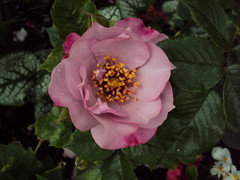
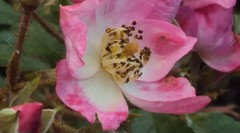
    Oh my goodness I'm so excited, I've just found another synstylae amongst my roses.. and who wudda thunk it?... an Austin 'Blythe Spirit'... and a charming rose in itself with its semi double musky scented flowers that bloom all summer... a much underrated rose I think... I was studying it closely and managed to take a close up of the fused column... I had to remove the bloom as it's so windy today...

    I do hope I've got this right...


    'Blythe Spirit'

    'Ballerina'

  • 8 years ago

    Good going! Try to take a pic after they've lost their petals.

    User thanked Vaporvac Z6-OhioRiverValley
  • 8 years ago

    These roses look perfect for bees, Marlorena. Beautiful details captured by the camera. I especially like the pink edging on Ballerina.

    User thanked Krista_5NY
  • 8 years ago

    vaporvac, any chance of a link to "bailey's" classification chart/ list please, many thanks David.

  • 6 years ago

    Regarding the query on Synstylae roses - I stumbled upon this article earlier today - from an old Canadian Rose Society Annual, printing an article by Graham Stuart Thomas - very interesting and informative - https://archive.org/stream/canadianrose1978cana/canadianrose1978cana_djvu.txt

    User thanked Robbie Collie
  • 6 years ago

    Here is a quote from the article (you have to scroll down through to the article by GST) : " Practically all other rambling species, hardy in this country,
    belong to a group known as Synstylae, because the styles in the
    centre of the flower are united into a column, and are not dis-
    posed loosely bunched as in other roses. They may otherwise be
    called the race of Musk roses. All but one of them, R. setigera
    from North America, have flowers of white or cream, are ex-
    tremely sweetly scented, and are scattered, other than R. setigera,
    through the Old World, from Madeira, North Africa, Europe,
    Turkey, Syria to Afghanistan, and away to North India, the
    Himalayas, China, Formosa, Korea and Japan. Many of the
    Chinese species, RR. filipes, brunonii, helenae, longicuspis, rubus,
    and soulieana are superb for flinging over overgrown hedgerows
    and into small and large trees. "

  • 6 years ago

    Thank you, Robbie. That is a lovely addition to this thread. It also reminds me to take a look at Gold Blush this season as it is a cross between R.Moschata Hem. and Abraham Darby. : -)