

Miele Gas Range Self Clean Issue with DuPont Zodiac Quartz backsplash
We have a less than 2 year old Miele 36” natural gas range purchased during our kitchen remodel. We have DuPont Zodiac countertops and a one piece Zodiac backsplash behind the stove.
We had heard about the possibility of the oven glass door breaking when using the self clean function. During one of the service visits for our range, the Miele authorized repairman said while this issue is rare, it would be a good idea to self clean the oven while still under warranty.
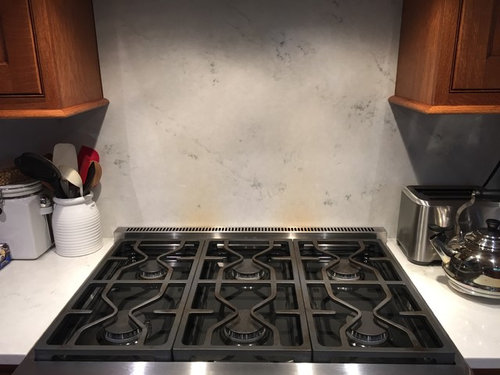
Well we did it and the glass door was fine, but our backsplash developed 2 bark brown spots about 4 inches wide and about 6 inches high. There is also a small crack in the middle of each spot. We called DuPont and they said the polymers must have been scorched and there is no way to repair it.
One of the main features of the oven is unusable for us. Potential damage was not mentioned by anyone at Miele and no cautions listed in their manuals.
Wondering if anyone else has experienced this and also a word of caution to those of you with a Miele self cleaning oven that vents at the back.
Comments (88)

Michael A
Original Author6 years agoAs I mentioned before after our incident I’ve found cheaper ranges that provide spaces for the back of the stoves with rear venting so obviously other manufacturers are aware of this issue, but Miele and all the “Experts” on here think it should be the purchasers fault
- 6 years agolast modified: 6 years ago
When people do self designs, and don’t do their homework, yeah, it kinda IS their faults. If you hired a Kitchen Designer, that would be their job, and their fault, if they didn’t do the research. You can’t have it both ways and want to design for just the kudos and none of the pain.
That’s not how designers got to be designers. They paid in mistakes. One off self designed projects get to pay in those mistakes too. Step up and take that responsibility. You’ll know next time. You’ll just make a different mistake next time.
Which is why a lot of people hire designers. Most of the mistakes are over and done with by the time your project comes around. If not, stepping up and assuming responsibility is the right thing to do, so the client gets taken care of. 🤷🏻♀️
A tiny little 2” spacer filler won’t provide the typically needed 6” clearance to combustibles. You still need a complete non combustible wall assembly. This is where you have to know appliance specs and building and fire codes.
Related Professionals
Newport News Kitchen & Bathroom Designers · Medford Kitchen & Bathroom Designers · Dayton Bathroom Remodelers · Ogden Bathroom Remodelers · Kennewick Bathroom Remodelers · Covington Kitchen Remodelers · Lynchburg Kitchen Remodelers · Middletown Kitchen Remodelers · Victorville Kitchen Remodelers · Macon Kitchen & Bathroom Designers · Madison Kitchen & Bathroom Designers · Zanesville Custom Countertops · Redding Custom Countertops · Olympia Custom Countertops · Anchorage Custom CountertopsMichael A
Original Author6 years agoI think if you look on this website you will find some pictures of professional designers with i think Miele ranges pushed up against the back wall. I know what you are saying but I also think salespeople who work with and sell the products every day should be knowledgable enough to at least the question.
Also the pre-inspection was done by a Miele employee who only did pre-installation inspections where he identified the opening for the fridge was 1/8 too small. So yes I expect them to say the range we picked shouldn’t be used against the wall- 6 years ago
I think if you look on this website you will find some pictures of professional designers with i think Miele ranges pushed up against the back wall.
It is possible to install a high-BTU gas range in this way. But it requires special care when constructing the wall. Your general contractor would have had to plan this from the beginning. Most obviously, it requires something other than quartz for the backsplash. But it also requires interior changes to the wall that might not be obvious from glossy pictures. Outside of the US, this actually is more common, as even interior walls are built from brick. In the US, the same problem would usually be addressed by using steel studs, appropriate backer board, and a natural-stone backsplash.
Also, and that is rather unfortunate, there are plenty of "designers" who publish absolutely gorgeous but utterly dysfunctional kitchens. Unfortunately, as these designs look so stunning, they gain a lot of popularity online. I remember a poster a while ago who got really mad, because they had seen a pretty kitchen on a TV cooking show and couldn't understand why they couldn't make the same design choices for their own kitchen. Of course the for-TV kitchen is all show, uses fancy camera angles, and only vaguely recognizes building codes. It's not designed for the real world.
So, some of the blame is certainly to be placed on popular designers and high-gloss magazines setting unrealistic expectations.
- PRO6 years ago
Bad ideas are all over the Internet. That doesn’t alleviate anyone from doing their due diligence in either eating Tide pods or putting quartz behind a range.
 PRO6 years ago
Responsible party is the person who knowingly mixed combustable material with the gas range but didn't review install instructions IMHO. One would have to recognize the material made to look like stone was in fact not. That stuff should have warning labels on it.
It could be the GC.
Internet/magazine photos are not always code.
- PRO6 years ago
Inspectors started checking clearances to cabinets above ranges (often 36" min to combustibles) and cabinet height above the range to each side (usu 18" min required) in the late 90s, so since then I've been reading installation specifications. The adjacent cabinet height requirement of 18" caught many unaware with expensive redos. I haven't seen a range without clear install clearance requirements.
The two quartz products mentioned above do mention to not place hot pans, use a trivet etc. but could be more clear about backsplashes as I don't find much. - 6 years ago
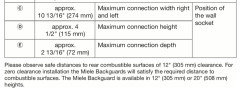
The zero clearance installation using Miele Backguards is documented in the Miele installation instruction manual for my HR1724DF. Page 59.
- 6 years agolast modified: 6 years ago
Reading comprehension isn’t what it once was in this country. People sure want to play the blame game without assuming any of that responsibility for themselves though. Failure to read and understand the product specifications, and other space planning requirements, is the #1 failure of self designing. All people worry about is if it will be pretty. Not about of it will burn your house down.
- 5 years ago
We moved into a newly built home 2 months ago. It has a 36" Miele gas range as well as Quartz (I don't know what make) counters and backsplash. Last week I ran the self clean on medium and was shocked to discover large yellow scorch marks on the backsplash. The kitchen certainly did look beautiful and was one of the reasons why we bought the house. I was not aware that putting quartz behind a self-cleaning gas range was a bad idea and am wondering what to do now.
- 5 years ago
Your best bet is to have the builder come back, have them fix it under warranty, and install a raised backguard for the range. This might be an uphill battle as they probably still don't realize that the range was installed incorrectly.
 5 years ago
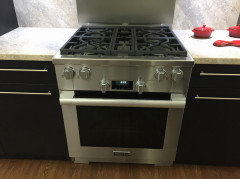
This is what people should find when they look for installed Miele ranges. This has the appropriate backguard.
- 5 years ago
If it's the manufacturer provided backguard, then yes, it should work. If it's an improvised piece of sheet metal, then it likely isn't good enough.
The official backguard is likely at least a double layer of metal with some air in between. It also, will have vents that direct hot air away from the back - 5 years ago
Thank you. Does this piece go all the way up to the hood fan? Can it be installed on top of the quartz?
- 5 years ago
But that isn’t as pretty. What has to be done to have the pretty stone there? Would real marble do the same thing?
Michael A
Original Author5 years agoWe haven’t done anything yet. Obviously we haven’t run the self clean and noticed when you run the oven above 350 for a while the discoloring comes back since the quartz is permanently damaged
We are considering the Miele 12” backsplash which for the short term will hide the damaged quartz.
Allow me to vent on the “professionals“ who post in here about the buyer should have known better.
There was nothing in the Miele literature as of the time of our purchase that this model was not suitable to be installed against a backsplash.
We talked salespeole at ABT, Pirch and also visited the Miele showroom and NO ONE asked how it would be installed.
Just like when when you buy a car or make other major purchases, you expect the sales staff to be knowledgeable about the use of the product.
You see commercials where they tell you not to do things like drive a car crazy or not jump off a building but Miele doesn’t need to plainly this model should not be against a backsplash? Even some basic stoves that vent out the back supply a spacer.
As for the “professionals” responses on here, they only seem interested in letting you know how smart they think they are.- 5 years agolast modified: 5 years ago
I bought a hair dryer once that had a giant list of instructions. One if them was “do not use while sleeping”. I figure that there was a duh story behind that.
No one should have to be told to not use a hair dryer while sleeping. Or to not use plastic rock behind a flame. Even though the very clear instructions do say that. For those who can understand specs.
- 5 years ago
I think most consumers would intuitively grasp this concept, if they actually saw a slab of plastic mounted behind their range. But unfortunately, quartz manufacturers heavily market their products as "man made stone". That's highly misleading, as about a third of the product (by volume) is resin. But they don't want you to know that.
So, unfortunately, this type of accident will happen over and over again. Blame bad marketing by both the appliance and the countertop manufacturers -- and of course, sales people who only care about sales and are rarely educated on the technical details.
The best we can do is document these issues in forums such as on Houzz. And hopefully, more people will read about it. Michael A
Original Author5 years agoI believe another person in Canada posted a similar issue around the same time with their Miele range and they had a stone (not sure if they said granite or marble) backsplash. So it doesn't seem to be limited to just Quartz
- 5 years ago
Actual stone shouldn't scorch. But it certainly could crack and/or get grimy. So, yes, island trim isn't really a good option directly against a wall. But if the wall is made from fire proof material, at least it shouldn't deteriorate the same way that resin-filled materials do.
 5 years agolast modified: 5 years ago
Interesting observation living with my kitchen remodel from 3 years back: I have island trim against an unsealed brick veneer backsplash. Steel studs and cement board behind it with a custom 4 inch deep shelf. I cook daily, deep frying, wok cooking with 28k burners, etc. I have never cleaned the backsplash minus dusting now and then.
The brick looks flawless...and I‘m not exactly sure why. I was anticipating at least some grease stains for an aged look, but there is not one drop. I think it might have something to do with the strength of my hood. Of course being brick there are no scorch marks of any kind, and given the way the oven vents the brick right against the oven get extremely hot. Anyway thought that was fascinating.
- 4 years ago
Same happened to me. Replaced a $4,000 3 yo samsung range (plug due to anger) that died and never thought about a self cleaning oven that burns backsplashes. But Miele does just that. I’ve had dozens of stoves that are not harmful to my house why would I even think that. Amazing they couldn’t master a self cleaning stove for a normal kitchen. (My backsplash is glass so it just burned the grout. )
- PRO4 years ago
Lets be clear: island trims don't mix with quartz (manufactured w resin) backsplashes.
Michael A
Original Author4 years agolast modified: 4 years agoLets be clearer Salespeople that sell appliances and quartz should be knowledgable enough about products they sell to ask customers about the planned usage and help them pick the correct products
At the time of our purchase, there was nothing in the Miele literature noting this stove was not to be used against a backsplash
i have noted since then that a number of mych cheaper rear venting ranges include a spacer to move the range away from the backsplash
if these lower price manufactures can do this, shouldn’t Miele be expected to list warning or provide a spacer?- 4 years ago
As shown earlier in this thread, the installation instructions tell you to use the raised back guard.
Sales people unfortunately don't care nor have the training to verify if parts fit together as ordered. They'll just sell you whatever makes them the most money. That's not exactly a new revelation.
The general contractor should be used to reading specifications and installation manuals though. If they didn't, that's the person you need to go after. - 4 years ago
If you had the required backguard, it would be a non issue. Didn't you read the specs?
Michael A
Original Author4 years agoLike i said there wasnt anything in the documentation when we installed the stove
do you realky think it is the job of the customer to investigate this before the purchase?
we shopped at ABT and Pirch both high end appliance stores you dont think they should be advising tbeir customers?- 4 years ago
Of course it’s your job to read and understand the specs. A firebreathing dragon is going in your house, and its your family’s safety that is at risk from fire and fumes. Assumptions kill.
Do you not read the owner’s manual on your car either and just rely on a salesman’s spiel for info about airbag deployment with people of small stature? AKA kids? Michael A
Original Author4 years agoDo you investigate the specs on everything before yo purchase purchase?
we contacted Miele after the incident and thry couldnt show any dicumrntstion thst saud dont install this stive agaist a backsplash thry did show the raised vent as an option but nothing about it bring required
i wlould have expected that a salesperson wpuld know enough to ask if the stove was being installed against a backsplash and a quartz salesperson to ask where the stove vents when you say you want a quartz backsplash PRO4 years ago
This subject comes up all the time. There is plenty of blame to go around - starting with the person who designed the kitchen, then whoever sold you the top, maybe the appliance person, and the templater of the top.
The reason I say " maybe the appliance person" is because they may not have the knowledge or the training to ask the proper questions ( not an excuse but... ) . People ask me about appliances all the time - I am not a salesperson so all I do is pull things up online to have a look and send them off to an appliance specialist. HOWEVER, I just spent 5 minutes reading the Miele install book and found these:
Look in box on top right:
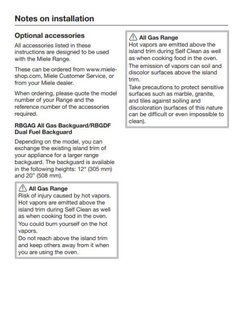
Look at note below the box:

It is clearly stated that there should be concern.
With this info readily available - I start the blame with the designer. They are the one who is putting everything together. I read every appliance install manual before finalizing a design to make sure their selections will work .
I am sorry this is happening to people. I would be crushed if I spent hard earned money and time to have this go wrong!
We can only hope things get better .....
- 4 years agolast modified: 4 years ago
Of course I read the specs and instructions for how to operate things before purchasing them, and again before using them. You go through life assuming other people will babysit you and do it for you? Are you 9?
And you still havent installed a backguard? And are allowing the noxious vapors of burned plastic to pollute your home and family’s health? Did you at least vent the range properly? Put in a MUA system with a HRV?
- PRO4 years ago
Miele has clear instructions, but buyers insist on island back regardless.
Quartz manufactures have the language in their literature, you may get too bored to find it on page 30ish etc. This practice by manufacturers is intentional IMHO.
Clients who insist on this set up are notified of lack of warranty and their assumption of liability.
Having the failures here in a common public discourse makes this information more readily available to consumers. Michael A
Original Author4 years agolast modified: 4 years agoHey Verbo
i dont need to be babysat and i am not 9 years old if you are in the Chicago area or ever get here please let me know id love to meet you in person
- 4 years ago
Consumers should assume that all quartz products, no matter the brand, are all similar.
Page 4 of the Caesarstone Fabrication guide."Caesarstone is not suitable for exterior use, or any areas that are exposed to direct sunlight UV radiation or excessive heat over 300o F."
- 4 years ago
The issue that started this thread was scorching, but few comments here bring up the fundamental problem: The distance to combustibles means all the way through the wall and including the picture hanging on the other side. Even if fire brick were the surface of the wall, the combination of island trim and wood studs in the wall is in violation of code. (Whether code properly addresses the conditions of self-clean versus other conditions that might have led to its adoption is another issue.) The reason for the significant distance into the wall is not so much threat of direct ignition, but long term deterioration of the wall material making it weaker and more flammable. Island trim is for islands, but can be used against walls if the walls are properly constructed.
Resin based surfaces such as Corian that have extremely fine fill of aluminum oxide (sapphire) can be sanded, and this may reduce scorch marks if the marks are not too deep. A tall back guard will otherwise cover them.
- 4 years agolast modified: 4 years ago
When we did a full kitchen remodel, the architect, the general contractor, the electrician, the plumber, and myself poured over the installation manuals and technical specifications for all the appliances and materials used and verified every small detail. Took weeks to come to an agreement between the lot of us. And we had to change out several of the choices while making these decisions.
The appliance dealer is one of the more reputable local businesses, but all he wanted was the itemized list of whatever we decided on. And he offered to get us whatever documents that we needed from the vendor(s).
I would have thought that for high-end kitchens, this is normal procedure. If you take short cuts, that's going to come back and hurt you. But if you hire trustworthy contractors, they would know this. These documents are very technical, but that doesn't mean you can just ignore them. They are written for professionals. That's why we keep telling you to go back to your GC and complain. If they did their job, they should never have greenlit this particular configuration. And that's why they charge ~20% overhead, so that they can make you whole when mistakes have been made.
Now, if you bought low-powered mainstream appliances and put them into an all IKEA kitchen, things might be different. None of these choices are pushing the envelope very much. And honestly, people's expectations are much lower too. If things start failing after three to five years or there are minor cosmetic blemishes, that's just par for the course.
So, yeah, you can just go and talk to a sales person and whatever they make the most profit on is going to be what you buy; and it'll probably work within the limited expectations. I feel absolutely confident, that I can put together a budget kitchen for you by spending an afternoon in the showroom picking out cabinets, appliances, and materials. And honestly, even if you cut out all the professional contractors, it'll be "fine". Not spectacular, but perfectly serviceable.
Your mistake is having high expectations, shopping for specialty materials that come with specific constraints, but then skipping the crucial step of hiring professionals that know how to work with these materials.
- 4 years ago
Wait, what? It’s been 4 years and you still haven’t installed the required back guard? Do you realize that the studs inside the wall are getting their ignition point lowered with every use of the range? It’s called pyrolysis, and it is why the whole wall is required to be a “non combustible assembly” or to have the back guard.
- 4 years ago
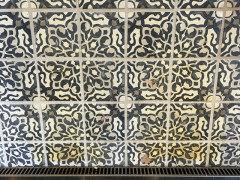
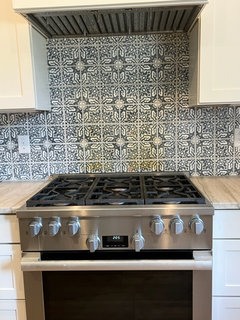
We completed a large scale kitchen remodel with high end architect and construction company. We heavily researched 36" gas ranges and selected a Miele 36" gas range because we do a lot of baking and because of the self-clean function. The oven doesn't reach temperature. We have to use an oven thermometer and constantly adjust the temperature to bake. The gas takes a bit to come out and once it does, it comes out with a vengeance and the burners click for about a minute every single time you turn it on. This has happened since the first day it was installed. Like the OP, we also hear the loud noises during baking. We have had 5 repair people out, including Miele reps and still no resolution. But- the worst part has been the same as the OP- scorched backsplash. The manual for the gas range has changed since we received the range- our manual does NOT mention anything about vapors, scorching or trim. The architect/designer and construction company have had multiple people through our house to figure out what is going on and all point fingers to the range. We even asked about a backguard. When we brought this to Miele's attention, they blew us off. After using the self-clean function, our tile backsplash looks like a mess. We don't know how to resolve the issue because the oven doesn't work properly and the backsplash issue isn't a quick fix. We aren't blaming anyone. We just wanted to share our experience and hope that maybe someone might have some constructive comments to help us come up with a solution.
- 3 years ago
Ge Wen, what material is that behind your stove? It looks like porcelain but I figured porcelain was a heat resistant material, so I'm not sure. Very curious as I'm in the planning stage right now. Thank you!
 PRO3 years ago
The sealer on cement tile, or natural stone, or the resin on natural stone, can also be damaged by heat. It is just another rason to purchase, install, and use, the back guard. And adequate ventilation, plus make up air.
- 2 years ago
After getting scorch marks on the quartz backsplash the first time I used the self clean function on our new Miele 36" gas range, I had a Miele backguard installed. It covered the marks and doesn't look too bad. I've never used the self clean again
- 2 years ago
Advice I've been given by ALL repair professionals:
"NEVER use the Self-Clean Function" - the amount of heat used to incinerate the oven contents is so much, that in these ovens with electronics, you're just counting the days until one of the many electronics melt, get steam in them, short out, and those are the only parts of these good brands you'll have to replace... All the gas powered parts will last forever. And just learn how to clean the oven thoroughly without that function.
- 2 years ago
My GE range (electric, not gas) is 20 yo. The electronic panel hasn't failed after any of the self-clean cycles I've run on it.
- 2 years ago
Sorry, let me clarify... I'm referring to Ranges from more recent production, especially last 10-15 years.
There was a huge drop-off in 1. Oven insulation, and 2. over-chinese-ificaiton of electircal components.
If I had a 20 yr old stove, I would be fine. Having said that, I've been through 3 ovens in 7 years as a home baker...
1. GE cafe - poorly made and sprayed insulation through the fan system, faulty igniters (got rid of quickly)
2. Thor Duel Fuel - cooking bread weekly actually melted the relays and wiring (almost burned down house)
3. Thor Gas Oven (company dicount replacement) - cooked @ 75 degrees below temp, went through 1 thermostat and 2 gas regulators.
Multiple Local appliance servicers and sellers I've consulted over a year before buying have all said the same thing regarding buying and using newer appliances.
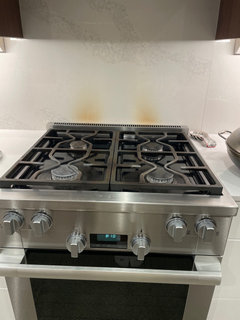
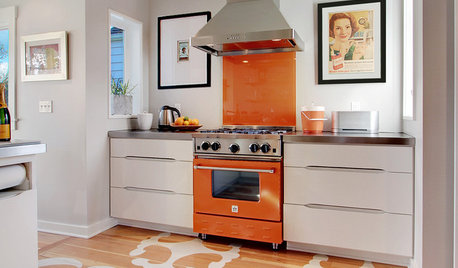
Avoid the self clean feature to elongate life of the electrics of the range, especially ovens that are common brands and lighter to move. The higher brands of Miele Viking Wolf are much heavier because of the better insulation and even bake hotter than temp at times. But the servicers have still advised against the self clean function to promote for extended life of appliance. I'm only the messenger... Just bought my Miele today, and super excited, can't wait to bake at temp finally.



Shannon_WI