Software
Houzz Logo Print
publickman

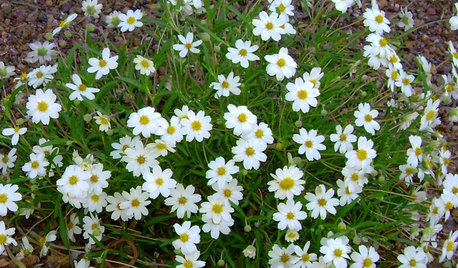
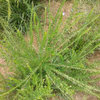
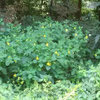
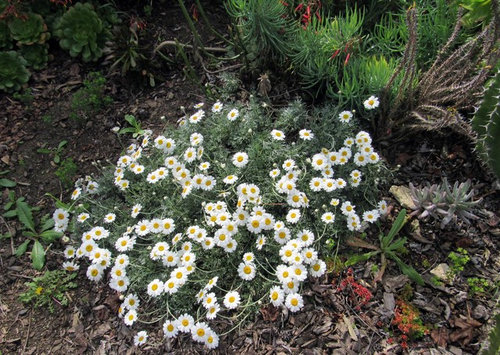
Plant with flower that resembles daisy

7 years ago
last modified: 7 years ago
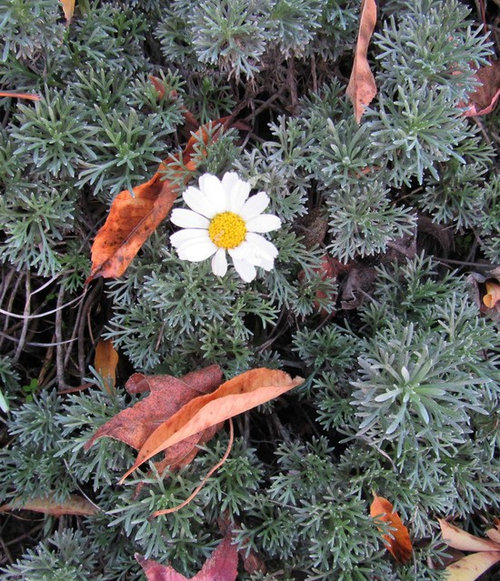


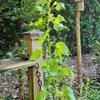
Photo taken this week to show close-up of leaves.


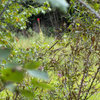
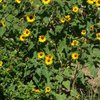
Photo taken last March to show more flowers.

This plant starts blooming in November, and then flowers throughout the winter and into March. Someone on the succulent forum told me that it might be a sort of Anacyclus and that it was definitely not a succulent. I had thought it was a type of ice plant.

I'm in coastal Los Angeles.

Comments (23)

  • 7 years ago

    Compare with Anacyclus pyrethrum. It isn’t any kind of succulent.

    Lars thanked floral_uk z.8/9 SW UK
  • 7 years ago

    It does look like that, but I also read that that is hardy in zones 4-8 or 9, and I am not in one of those zones. Maybe this is why it blooms in the winter for me instead of the rest of the year.

    Is it a medicinal herb that I can use?

  • 7 years ago

    Look at the "Silberkissen" variety of A. pyrethrum. They have the grey foliage. It's a Mediterranean plant so should be happy in your area.

    Being a Californian, I won't swear to it, but I think hardiness just means it won't outright die forever in those zones when winter hits.

    Lars thanked Fori
  • 7 years ago

    Where are you located? The zone ratings given refer to the average winter low temperatures the plant can survive. So they’re not relevant to summer heat. It’s native to North Africa so it can take high temperatures.

    No idea about herbal uses. You’ll need to research it.

    Lars thanked floral_uk z.8/9 SW UK
  • 7 years ago

    Lars, winter hardiness zones only apply to winter cold. If it survives winter in a colder zone, then it can and should survive winter cold in a warmer/milder zone!! I am not sure why any plant comes with a hardiness range to it - all it needs is the lowest zone it will tolerate. Anything more is just confusing....as your post indicates :-))

    Of course there are valid reasons why a plant may not do well in a warmer hardiness zone, including lack of adequate chill hours, summer heat or humidity, rainfall levels, etc. But none of these are addressed by the USDA hardiness zones. That is where the Sunset zones can be useful, as they take various other factors - besides just winter cold tolerance - into consideration. FWIW, Anacyclus is listed as fully suitable for Sunset zone 24.

    Lars thanked gardengal48 (PNW Z8/9)
  • 7 years ago
    last modified: 7 years ago
    In short the USDA Hardiness Zones are just that and the Sunset zones are climate zones.

    Other variables encountered are that the Canadian hardiness zones don't dovetail perfectly with the USDA ones and also an AHS Heat Zone system was developed along the way. Which some references refer to also.

    Basically the USDA system tells how far north a plant will live and the AHS one how far south. And, yes, the USDA zoning presenting a range for each plant (instead of a single figure) seems to be it saying how far south a plant will live due to the heat - as though more than just cold hardiness is being addressed. Because if a plant is winter hardy much farther north then it's not cold that is determining how far south it can function.

    Lars thanked Embothrium
  • 7 years ago

    In my case then, the Sunset zone 24 is more applicable, as I am in a coastal region of southern California with a Mediterranean (somewhat) climate, although the climate is actually more similar to South Africa. Anyway, we do not have excessive heat in the summer - it is extremely rare to get above 90°F (32°C), but summers are dry while winters tend to be wet.

    I think some plants have a limit, such as zone 8 for the highest zone because if planted in zone 10 or above, they can become invasive. My housemate planted some vines like that, and they were very difficult to control because we never had a frost to kill them back. This plant, however, is not invasive at all, and it seems to do just fine in my front yard, but it is happier in the winter, it seems.

  • 7 years ago

    Just an FYI but invasveness has really very little to do with hardiness zones. It is far more a case of the overall climate and growing conditions :-) And a plant's ability to reproduce.

    It is not a viable assumption that if a plant is grown in a higher hardiness zone, it will automatically become invasive in that zone. It just doesn't work that way:-)

  • 7 years ago

    Thanks, Hoovb! It definitely is a good plant for here and makes a nice ground cover.

    I never assumed that if a plant grown in a higher hardiness zone, it would automatically become invasive in that zone, but some do - especially vines. I was referring to vines. Clematis is a good example of a vine that is listed for zone 3-8 or 9 that will become invasive in zone 10 and above. Carolina jasmine is another vine that I found difficult to control, and it is particularly offensive to me because I am allergic to it, especially when blooming, and it blooms all the time here. If I want a vine, I will plant something like a Solandra Grandiflora (Golden Chalice vine) that is easier to prune and to control. The one I had in Venice (CA) got very large, but it was easy to make it go where I wanted, and if it went somewhere I did not want it to, it was easy to make it stop. Other vines I've had were almost impossible to get rid of.

  • 7 years ago

    "Clematis is a good example of a vine that is listed for zone 3-8 or 9 that will become invasive in zone 10 and above."

    I'd love to see some documentation to support this. I have been growing and working with clematis for many years and there are few that are even inclined to grow in a zone 10 or higher, let alone become invasive!! And those that do grow in the higher hardiness zones...a few semitropical species.....cannot be grown successfully in lower zones.

    FWIW, very few species of clematis are invasive anywhere. Also, the vast majority of those grown in gardens are hybrids with minimal inclination to self seed (oh, don't we wish!!) And while CA does have one of the most lengthy and comprehensive lists of invasive species, the only clematis that appears on it is C. vitalba. And that is considered invasive pretty much everywhere.

  • 7 years ago
    last modified: 7 years ago

    I'm sorry I don't have photos to document the invasive Clematis that I had to live with, but it was definitely what I would call invasive. I did not plant it, and so I do not know which variety it was. All I remember was that it had reddish flowers and started growing over everything. It may have been invasive with the help of my friend who planted it. I was constantly removing it from my mango tree.

  • 7 years ago

    We might be working with different definitions of "invasive". One being "will spread over everything in your yard" and the other being "will reproduce and spread entirely new plants all over your yard. And the neighborhood. And the park.".

  • 7 years ago

    That sounds plausible, Fori. Could be a question of semantics. It is the nature of Clematis to climb and scramble. That’s why people grow them. If you don’t manage them through appropriate training and pruning they may appear to be ‘out of control’. But that is a question of lack of gardening know how. It doesn’t make Clematis invasive. And I agree with GG that it’s hard to imagine any Clematis which would grow well in z11.

  • 7 years ago

    Just to say, Clematis paniculata is extremely invasive here.

  • 7 years ago

    lacey, I think you mean sweet autumn clematis, Clematis ternifolia (SAC). C. paniculata is one of those semi-tender, semi-tropical species (NZ) that cannot be grown in most of the US. SAC was misidentified under that species name decades ago and unfortunately, it stuck and many resources still refer to SAC incorrecty. But they are very different plants; one being very hardy and common and with an ability to self seed freely in some areas (SAC) and the other being extremely uncommon and requiring a very mild winter climate to even survive (paniculata).

  • 7 years ago

    Wouldn't some pics of these Clematis help. It could be virgin bower they're talking about.

  • 7 years ago

    Not with reddish flowers :-)

  • 7 years ago
    last modified: 7 years ago

    In defense of Lacey I was just reading an online article about New Jersey ground covers and it's stated clearly in the article that sweet autumn clematis is C. paniculata and that it is invasive in New Jersey. I believe everything you are saying gardengal but there is misleading info out there.

    https://www.nj.com/homegarden/garden/index.ssf/2008/03/picking_a_groundcover.html

  • 7 years ago

    Yes, there is, unfortunately, but a misidentification is still a misidentification :-) Clematis paniculata, despite what many sources may state, is NOT sweet autumn clematis, never has been. It is not surprising that many gardeners, including lacey, are confused.

    From a clematis monograph: C paniculata (orginally known as indivisia lobata and synonymous with C. maximowicziana) is an introduction from New Zealand and needs a sheltered position or grown in a conservatory. Pure white individual flowers with 6-8 sepals and pink stamens. Evergreen with leathery foliage. Flowers in May and June. Grows to 15 feet and requires no pruning (Pruning Group 1)

    I would also add that with this species, there are separate male and female vines with males having larger, showier and slightly earlier flowers. None of these characteristics fit SAC/C. terniflora. To my knowledge C. paniculata is not sold in the US nor is it grown anywhere here outside of a couple of collections. A rather rare and uncommon plant.

  • 7 years ago

    In researching it, I saw that the OP's plant is now called Rhodanthemum hosmariense

  • 7 years ago

    Fiori, neither of those are the definition of invasive. Those are both the definition of aggressive. Invasiveness requires an exotic species displacing native species in wildlands. Neighbors gardens, parks, sidewalks, etc are all human disturbed sites, not wildlands.

  • 7 years ago

    Actually Nil13, the official defintiion also includes "causes economic harm". And that relates directly to agricultural areas and production, which are definitely 'human-disturbed sites' :-) So invasiveness is not just limited to wildlands and displacing native plants!

Sponsored
Bella Casa LLC
Average rating: 5 out of 5 stars17 Reviews
The Leading Interior Design Studio in Franklin County