Software
Houzz Logo Print
lowwarbler

LED Question. Bob? Anyone?

7 years ago

I’m growing under Sylvania 250 watt equivalent, 3000K spots. Rooting and spiking activity has been striking. Lack of foliage growth I suppose could be seasonal. Here’s the thing. On researching these lights, apparently they begin life as blue LEDs. (And indeed they are available in 5000K). For the 3000 version I’ve been told that a yellow polymer(?) has been added to amend the color for a warmer appearance. The same source also said that there would be very little “red” (for flowering and fruiting). So this makes no sense to me. Why would a blue LED brought into the yellow range be much good for anything? And if it was good for something it seems to me that it would be for foliar growth not for flowering and fruiting. So thats the “thing”. Here’s the question. Is it likely that a daylight appearing bulb that clearly is triggering roots and spikes really be so deficient as not to support foliar growth? I guess time will tell but in the meantime, how about an old fashioned reality check on all the spectrum theory flying around. Thanks!

Comments (10)

  • 7 years ago

    Generally you want light in the 6000K or at least upper 5000K. The yellow spectrum has no real value for the plant. Instead, they are adding the yellow for YOUR benefit .... to make it more pleasing colorwise to the human eye.

  • 7 years ago

    Paul,

    My experience has been different. I feel that the 5000K range shows a more natural white light than the 'darker/yellower' 3000K? If everything should be 5000K or higher, what do you think is "bloom inducing light" as far as kelvin degrees?

    Again, I don't look at this like rocket science, here is my simple/basic philosophy: Mix the colors/K for the full range benefits and add/remove/lower/raise lights to get the right intensity.


    Bob

  • 7 years ago

    I read on another chat list that Kelvin was never intended to designate lighting values for growing plants. I can't remember the argument but I will look it up. You know, you read so much about this stuff and it all starts to run together. Maybe because the red spectrum that is good for plants isn't visible to humans? I remember when I grew under two HID bulbs, the one recommended for flowering and fruiting (HPS) was yellow in appearance. One guess I would make is that it is easy to manipulate the color of a lightbulb, even LEDs. So just because a manufacturer warmed up a blue LED to make it whiter, or warmer, doesn't mean that the bulb is emitting any red spectrum.

  • 7 years ago
    last modified: 7 years ago

    John, you are correct that Kelvin was not intended for that purpose but it can give one an idea of what to aim for. Far more useful, though rarely included on most common lights, is the PAR (Photosynthetic Active Radiation) rating. This site has some nice general info >>>> here. But in lieu of that, Kelvin will at least give you a crude, albeit less accurate, measuring stick. Plants simple do not make much use of the light that falls in the yellow and green part of the spectrum. So light in the 3000-4000K range is generally not very useful for plants.

    John B thanked Paul MI
  • 7 years ago
    last modified: 7 years ago

    John,

    I feel Kelvin is a good measure of what causes flowering and/or vegetative growth. As far as color and what does what, this is from WIKIPEDIA (buyer beware): Compact fluorescent bulbs are available in warm/red (2700 K), full spectrum or daylight (5000 K) and cool/blue (6500 K) versions. Warm red spectrum is recommended for flowering, and cool blue spectrum is recommended for vegetative growth. I find it hard to find reasonably priced LED bulbs under 3000K or higher than 5000K.

    Along those same lines, I trust lumens (higher is better in most cases) as far as strength of light emitted. I always try to buy the highest lumen vs. electricity usage bulbs/set-ups I can afford.

    So I use Kelvin rating and lumens along with positioning to determine light usage/needs for my grow room. For example, if I had an area of @ 5' x 5', I think I could cover it with 6/2500 lumen (23-27 watts each, pretty low total electricity usage) mixed 3000 and 5000 kelvin LED floods quite adequately. If I were to use 1000 lumen bulbs, I'd need 2 or 3 times as many light set-ups to get the same light in that 5'x5' area (imagine the wiring nightmares). The angle of the flood plays a factor also, I like wide angle floods best (>30 degrees).

    In a perfect set-up, I would probably have separate areas for growth and blooming, but I don't have that currently so I use the mix/full spectrum method for the entire room.


    Bob

    John B thanked westoh Z6
  • 7 years ago

    Paul, thanks. Yes, I’m familiar with the PAR scale, but as you say the information isn't generally available for "common lights." I think the reason that success is reported from lights that are concentrated in the "green" area of the spectrum is that they do include content from other sectors of the spectrum as well. As Bob says (or words to this effect) the proof is in the pudding. Also, apparently the jury is still out, or at least redirected to consider the assumption that because plants reflect the green that we see doesn’t necessarily mean that they don't utilize it. This I believe is the rationale towards increasingly popular full-spectrum LEDs, which yield light that people can stand to live with. I have been impatient for results and frustrated that I can’t get an analysis of my 3000K 2650 lumen bulbs. The information I am receiving from those who purport to know about light is not in the least promising. Nevertheless, my orchids are rooting and spiking, and this morning I could tell without a doubt that my apparently stalled Cattleya trianae seedling has begun to grow. This gives me enough evidence to proceed hopefully and realistically. I think in six months to a year from now I’ll be in a better position to evaluate. For now I am aware that the performance I’m seeing in some, but not all cases could be explained from hold-over energy received from the vendor’s culture.

  • 7 years ago

    Thank you Bob. I am *grabbing* at your encouraging assertion on behalf of Kelvin!! I think if I had a large square or rectangular area to grow I would investigate “serious” grow lights. I may even go with CMHs, just because of the improved intensity factor that would enable growing taller cattleyas and vandas, and whatnot. LEDs as a growth technology are doomed (IMHO) to lag behind in light fall-off rate as a function of distance– similar to fluorescents even though they excel in other ways. But that’s not now. Now I have that narrow window ledge, perfect for these LED spots that you told me about. Mine are 2650 lumens and not cheap, but they last for a good long time, are and proving themselves rather spectacularly. I’d try the 3500K if I could find them. I might try mixing in a coupleof the 5000K versions after I've had the setup for awhile. Don't want too much change too soon.

  • 7 years ago

    FWIW: I believe that I have flowered every orchid I currently grow (@70 of which 10-15 are currently blooming) using this set-up plus summering outdoors on an east facing patio. Oh wait, I still haven't flowered that darn Den. aggrevatum ;). As you said, the proof is in the pudding.


    Bob

  • 7 years ago
    last modified: 7 years ago

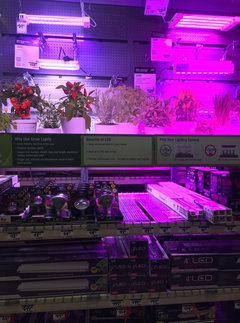
    At my local Home Depot tonight I noticed they added a grow light section.


    They had some pretty impressive fixtures. They had both full spectrum and the purpleish looking ones. Price ranges from $15 to $300.

    I thought is was worth resurrecting this thread since some of you may want to check kn your area.

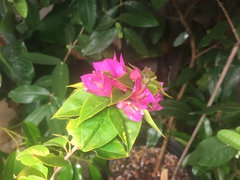
    On a side note, I’ve been using the purple light type for a few years in the basement during winter. This winter I was able to get a bougainvillea to flower.


Sponsored