Software
Houzz Logo Print
mjammjam

Marble shower floor not drying -- It's always Something!

7 years ago

Hi all,


I have marble floor tiles in this Guest Bathroom. The shower gets used on weekends, but doesn't ever entirely dry. I've asked my contractor if he waterproofed/insulated/pitched - whatever else I could think of --- And he said it's cold in there so the marble doesn't dry. I've left the shower door open so that it will hopefully dry so that I can seal it again. Any thoughts? My husband wants to kill me because he wanted a porcelain floor but the saleswoman told me the marble is more elegant, and I agreed.


I cannot possibly afford to rip this bathroom out.


P.S. This bathroom is on a slab with shower wall facing cold garage if this helps


Thank you,

xo

Comments (48)

  • PRO
    7 years ago

    Your husband was correct and he is entitled to a "I told you so"

    Unless you have in progress photo's to verify proper construction not much help can be offered. To seal it again could make it worse. It will not stop moisture from penetrating the stone but it can slow the drying process.

    mjammjam thanked Creative Tile Eastern CT
  • 7 years ago

    Thank you Creative,


    Ugh . -- I certainly don't have a photo showing a slope to the drain if that's what you mean.

  • 7 years ago

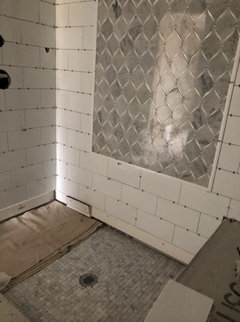
    I found this.... Let me look for something else .

  • PRO
    7 years ago
    last modified: 7 years ago

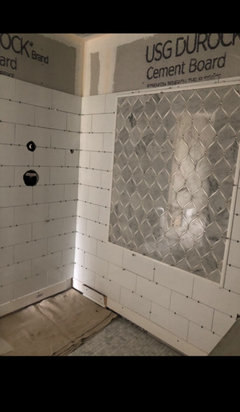
    Your photo shows cement board on the seat and curb with fastener heads visible. Corners are not taped with alkali resistant mesh.This indicates that the waterproofing and CBU installation was not done properly. First thing to note is cement board is NOT waterproof. The liner under the shower base continues over the curb and now has holes in it. Probably the same scenario with the seat. A preslope is required under the liner to evacuate water to the weep holes in the drain. If this was not done water will just sit in the liner. A likely cause of the issue you're having. Earlier in progress photo's would be very helpful. If the shower was not constructed properly it should not cost you a dime to have it redone. (without a marble floor)

    https://www.google.com/search?q=tcna+shower+base+detail&tbm=isch&tbo=u&source=univ&sa=X&ved=2ahUKEwj7y6S1s9bfAhULoYMKHbNyBmcQsAR6BAgBEAE&biw=1138&bih=516&dpr=1.2#imgrc=bSbtMcJjsGbzEM:

  • 7 years ago

    I don't know WHY your shower isn't drying but it isn't because you installed marble instead of porcelain or ceramic.


    I just remodeled bathrooms with marble tile and mine dry even with daily showers so it is not the marble but that the water is not completely going into the drain and therefore there is too much water to evaporate. To me it's the difference between a few drips of water on any surface and spilling a large amount of liquid. When I walk with wet feet or the towel leaves a wettish surface in the bathroom, it dries pretty quickly and doesn't leave a puddle versus if I spilled a cup of water which would have to be dried up because it wouldn't evaporate dry in the normal scheme of things.


    You DON'T owe your husband an I owe told you so but your contractor needs to know that someone screwed up the floor or drainage system.

  • PRO
    7 years ago
    last modified: 7 years ago

    I do believe your issue is due to not following approved methods for shower construction as stated above.

    With that being said.

    Marble discoloration due to absorption is such a common problem that a cover letter has been added to the TCNA Reference Manual explaining it is not possible to know if your specific stone will show these characteristics and there is no where to place blame. Even if the shower is constructed properly this issue can arise. Strictly buyer assumes risk. Sounds like your husband was aware and preferred not to take the risk. ( again not saying this is the cause of your specific problem) For anyone following this thread. The best you can hope for is a professional salesperson to explain this and avoid online forum opinions vs facts. Researching from credible sources is key. Product manufacturers, trade organizations etc. You Tube is full of bad information as is Houzz.

    Helen was fortunate with her project others are not so lucky.

  • 7 years ago

    Creative Tile, you seem to be assuming a lot that her husband was aware of moisture absorption issues with marble. Wondering whether you would assume the same if a husband was posting and the wife wanted porcelain. Maybe he just liked the look of porcelain.

    For what it’s worth, I’m the handy one in my family and would never put in marble tile. My husband would probably pick based on what the tile person told him, just like the op did.

    OP, please contact your contractor and ask about the waterproofing method used during construction. As Creative Tile explained, if the shower wasn’t properly waterproofed, your contractor had a redo.

  • 7 years ago
    last modified: 7 years ago

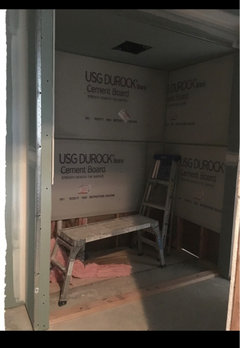
    I don't see any waterproofing on the cement board. So let's hope this job was done old school and there is a poly sheet vapor barrier behind the cement board, however, the lack of tape, thinset and waterproofing on the seat is a big worry. The wetness might be due to a poor slope on the floor so I'd get a level and check for any areas that don't slope towards the drain. As marble is porous it will act like a sponge and soak up any standing water. Your comment about the shower wall facing a cold garage might be important as the floor is wet on that side. If the wall is cold you might get condensation that continually drips down onto the floor or into the floor from the vapor barrier. So check the insulation.

  • 7 years ago

    The use of marble isn't the root cause of this issue, but it will highlight it as discoloration might occur. Marble can look amazing, but it's not the most practical shower surface. Ceramic tile is a better as it's not as porous, but that still has grout lines. For the most practical I'd probably use a solid surface product.

    mjammjam thanked Jeff Meeks
  • 7 years ago
    last modified: 7 years ago

    Ok Guys, Thank you and please tell me what to expect:


    Creative: Hypothetically -- If you were to come here, what would it cost me to repair this issue? Soup to Nuts -

    If I do nothing, what would happen eventually?


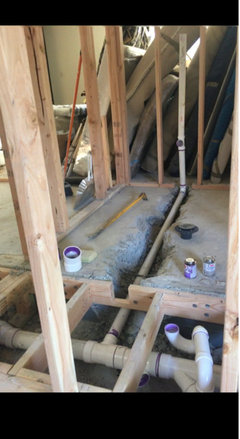
    I found some more pics I took from my phone. Do these help??

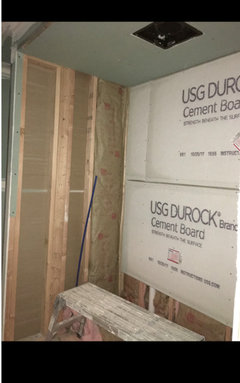
    The 2nd photo shows the seat area of shower where the fat pipes are.


  • PRO
    7 years ago
    last modified: 7 years ago

    @my_four_sons. No reason to wonder. You bet I would post the same response. If you believe you have come across someone with a issue perhaps it was in the mirror.

    I have not assumed anything. I have been involved with this OP's posts since Jan 2018. Maybe earlier. [https://www.houzz.com/discussions/should-i-seal-my-marble-shower-floor-and-walls-myself-before-grout-dsvw-vd~5130032[(https://www.houzz.com/discussions/should-i-seal-my-marble-shower-floor-and-walls-myself-before-grout-dsvw-vd~5130032)

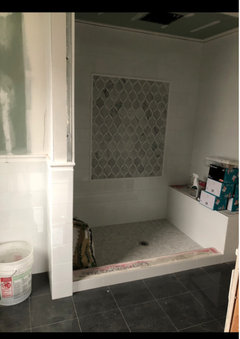
    mjammjamIs this the same shower as previous post photo's?

    The best advise I can give you is bring in a local Professional Tile Setter. You will need a written detailed quote to move forward regardless of what you decide.

    This link will provide you with questions to ask.

    https://www.ceramictilefoundation.org/homeowners-guide-to-hiring-qualified-tile-installer

    mjammjam thanked Creative Tile Eastern CT
  • 7 years ago

    Creative ---

    I have been searching high and low for that old post. I don't know how to find my prior posts. Thank you so much for that link.


    Yes -- Same shower . -- My contractor said it was fine at the time. I even had a builder/designer come in to look and she also said it was fine. I honestly don't know what to do sometimes. I hire professionals, I speak with their customers, I read their reviews, and still, I get it wrong.

    I'm just a homeowner with no construction skills. Sometimes I luck-out with whom I hire, and other times I Don't!

  • 7 years ago
    last modified: 7 years ago

    Use of green board in non wet areas of the bathroom is good as it's mould retarding.

    The thinset on the cement board joints looks ok, but the screw heads in the field have not been covered.

    However, what's happening with the framing in the 2nd photo. I see a sill plate that has been cut right through and a joist thats's got a notch 3/4 of the way through.

    I don't see any waterproofing or poly vapor barrier behind the cement board, just paper faced insulation. The paper face is a vapor barrier so it will stop the insulation getting wet, but the wood is exposed. So that then makes me wonder exactly how the shower pan was constructed, that's critical. Was a pre-slope, shower plan and final dry pack bed installed? Do you have any pictures?

    mjammjam thanked Jeff Meeks
  • 7 years ago

    Jeff -- I don't know what any of that means. Pictures of the floor? I don't know how to know anything about what you ask. My husband thinks there's no silicone around the edges or around the drain. He doesn't know anything about what you're asking me either.

  • 7 years ago
    last modified: 7 years ago

    Can I copy this to send to my contractor? What should I add? Does it make sense the way it is? I've combined comments from Creative and Jeff


    Cement board on the seat and curb with fastener heads visible. Corners are not taped with alkali resistant mesh. The thinset on the cement board joints looks ok, but the screw heads in the field have not been covered. The lack of tape, thinset, and waterproofing on the seat is a big worry. The wetness might be due to a poor slope on the floor so I'd get a level and check for any areas that don't slope towards the drain. The liner under the shower base continues over the curb and now has holes in it. Probably the same scenario with the seat. A preslope is required under the liner to evacuate water to the weep holes in the drain. If this was not done water will just sit in the liner. A likely cause of the issue you're having. As marble is porous it will act like a sponge and soak up any standing water. The use of marble isn't the root cause of this issue, but it will highlight it as discoloration might occur.

    I don't see any waterproofing or poly vapor barrier behind the cement board, just paper faced insulation, that doesn't meet minimum construction standards and you will get mold and wet wood and insulation. So that then makes me wonder exactly how the shower pan was constructed, that's critical. Were a pre-slope, shower plan, and final dry pack bed installed?


  • PRO
    7 years ago

    NO. Have the contractor go online to this forum and read it directly. After all we are discussing his/her workmanship. It could get distorted if you try to compose your own version. You still need a professional in your corner.

    To get to your posts - upper right corner click on "Your Houzz"

    Then go to "activities"

    You will see options for comments & posts

    mjammjam thanked Creative Tile Eastern CT
  • 7 years ago

    Consider landfills and waste while your at it next time you hire and do not settle for attempt at repairs here..


    What?!


  • 7 years ago
    last modified: 7 years ago

    Reading the previous thread I see a vinyl pan is mentioned. so the question then becomes whether it was correctly installed. I'd go back to simply looking at the slope of the floor in the areas you think it's wet. Use a bubble level or just pour some water in and see if it pools anywhere. Also your nose is useful...does the shower smell mouldy or stale? If not you might be ok as you might just be looking at discoloration. Leave the shower unused for a few months and see if anything changes, then maybe take up a couple of the floor tiles and see what's happening.

  • 7 years ago

    I am a homeowner, not a pro. I am wondering if the contractor who built your shower has been back to look at it and tell you what he is going to do. I don't think it can be fixed. It needs to be rebuilt if the pros above are correct about the lack of waterproofing and maybe lack of pre-slope. It's the contractor's responsibility to rebuild it, but they will probably refuse. Have a meeting with them and ask them what the waterprooing materials and methods were and ask them if they installed a preslope, ask if they taped the seams, ask if they puncuted the liner. etc. Show them your pictures, and ask them to explain the waterproofing (or lack of) that they see there.


    This happened to me and we had to have it rebuilt by a better pro, but we had to pay for it because the contractor refused. In my case the contractor did not install a pre-slope, didn't tape seams or cover screws with thinset, placed liner on subfloor, punctured the liner, installed 2 vapor barriers and used spot setting for the tile. It was a mess. It is great now, but since the contractor refused to rebuild it, we had to hire a new person to do it on our $$$. It was a hard lesson to learn, but at least now I have found a true professional for all my future projects.


    I think the comment about the landfills above means that it's bad that all this material is going to end up in a landfill; and that it can't be repaired, so don't believe your contractor if they try to talk you into a repair. It probably needs to be rebuilt completely, not repaired.


    I'm sorry this happened to you. First step is to have the contractor come out and have a meeting with them. Ask them how they plan to move forward with the demo and rebuild. Let them talk. Try to get them to agree to rebuild. If you can't, ask for the shower part of your money back so that you can use that to rebuild. If they refuse that you are at an impass. From there you probably have to pay for the rebuild yourself and then it will be up to you whether or not you take the legal route to try to recover your loss.

  • PRO
    7 years ago
    I see two pro opinions above & they agree.

    My licensed tile contractors have installed hundreds of tiled showers for me, perhaps 50+ using pourous stone without ever seeing this including my 13 year old stone floored shower I use daily.

    As previously stated, it's likely a sub drain issue.

    more... I'm just spotting the Douglas fir or pine framing has been attached directly to the concrete flooring. . if this is not pressure treated material you have more issues.

    Investigate.

    permitted? licensed?
  • 7 years ago

    Good catch Jeffrey! "...the Douglas fir or pine framing has been attached directly to the concrete flooring".


    And this is why you need to bring in a fresh set of eyes.

  • 7 years ago
    last modified: 7 years ago

    Yes either pressure treated lumber on the sills or at least something like roofing felt underneath and what's the deal with the framing beneath the level of the concrete floor?

  • PRO
    7 years ago
    last modified: 7 years ago

    Use the felt. There should not be pressure treated in a tile shower build.

  • PRO
    7 years ago

    Following.....


  • 7 years ago
    last modified: 7 years ago

    Thanks all,

    The floors are not wet - just looks wet -- There's no smell; the room is fairly new.

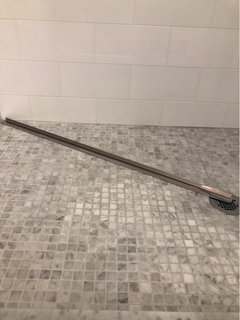
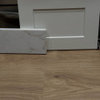
    I don't have a level, but I put this metal corner piece in the shower and poured water at the far end, It did roll down toward the drain. You can see if you zoom in. I texted my contractor the pic of the floor, and we'll see what he says next. I Ideally, I would find a tile guy/plumber who can rip this out and do it over right.

    I thought I did find the right guy the first time around. Now to find someone else who will know what to do,.....


  • 7 years ago

    So if the tile isn't actually wet on top and water flows well to the drain you might just be dealing with some discoloration. But why is that happening? What is annoying is that for $100 the whole shower could have been coated with something like Hydroban or Redguard and I bet with a ceramic mosaic tile you would not be seeing any of this.

  • 7 years ago

    I really don't know --- I'm still not sure what the biggest problems is--- No waterproofing on the walls? Shower pan? Something under the floor missing??


  • PRO
    7 years ago

    You were told a year ago that this was built incorrectly and would need to be redone. What happened with the contractor that that still hasn’t occurred? Because that’s still the right answer.

  • 7 years ago
    last modified: 7 years ago

    You might be just seeing surface staining, but you might be seeing something to do with the construction of the shower pan. I don't know if the shower pan was done correctly so it's all just speculation. I think you'll have to take up some tile to check things thoroughly, but the walls are not how I've seen others done and not how I had my shower done and I would worry about the longevity of your shower with the cement board screwed directly into the studs without a vapor barrier between and sitting below the surface of the shower pan. FYI here is how my shower looked after I had my cement board installed. The insulation behind the board doesn't have a vapor barrier because the board's surface is covered with a topical waterproof membrane (Hydroban). This makes the entire shower surface waterproof.


  • 7 years ago
    Thank you Jeff

    So are you saying that you either use plastic insulation or paint with this green Hydroban as shown in your photo?
  • 7 years ago
    last modified: 7 years ago

    No. Using a ploy membrane behind cement board is old fashioned, it was standard practice before better systems were developed. If you get a shower installed today you should insist on one of the many waterproofing systems available. That might be cement board with a waterproof sheet or rolled on membrane like I have or a waterproof foam core tile backer board. Companies that make such products are Schluter Kerdi and Laticrete, although there are many more. Just put those names into Youtube and you'll find lots of information.

  • 7 years ago
    Great - I will.

    Thank you!
  • 7 years ago

    The additional year's worth of mold behind the walls is going to add to the redo costs. And now you are beyond the one year standard labor warranty. This should have been ripped out way back at the first post about it.

  • 7 years ago
    I got a second opinion from a builder who said it was fine. Believe it or not —. The bathroom was only completed 3 months ago when it was used for the first time.
  • 7 years ago
    last modified: 7 years ago

    You didn't call a certified inspectoral, did you? Well, you have to now.


    https://www.tcnatile.com/images/pdfs/TCNAHBGuidelines_QualifiedContractor.pdf 


  • 7 years ago
    Just spoke to the guy who installed the shower. It was subbed out from contractor He said he used Redguard paint and a flexible vinyl sheet under floor tile. I told him I didn’t see any Red color on the cement board He seemed to be trying to remember and the. Said maybe it was just on the seat. He said he has pics in his phone and will send them to me when he finds them. Who knows
  • 7 years ago
    Livewire -

    I do have plumbing inspection
  • 7 years ago
    last modified: 7 years ago

    A plumbing inspector has no standing to inspect tile installations. He is about the pipes. You need a CTI. https://www.ceramictilefoundation.org/find-certified-tile-installers?hsCtaTracking=06d1659e-f04b-46e0-a727-dc0e2b1379e6%7Cb66628b5-5091-4731-bdf1-ccdfb908d202

  • 7 years ago
    Live wire -

    Oh I see. I would have no idea to hire such a person
  • 7 years ago
    last modified: 7 years ago

    Perhaps it’s semantics but the plumbing inspector came out several times to check the construction of the shower including approving waterproofing method as well as needing a 24 hour flood test to check the integrity of the shower pan. And of course the installation of the rough as well as the fixtures had to be approved as well.

    Based on my understanding it seems as though it is the construction of the unseen elements that impacts the functionality and waterproofing of the shower. Perhaps I’m not understanding but theoretically one could have an ugly tile job but a waterproof shower.

  • 7 years ago
    last modified: 7 years ago

    Building inspection requirements will vary with where you live and often the building code will give minimum requirements that are behind the latest solutions recommended by the national and international trade organisations.

  • 7 years ago
    Wow what a crap shoot of beans in this post my word.
  • PRO
    6 years ago

    Hello,

    Bellow is the link to my recent article that summarizes the research we have done on the subject of marble moisture discoloration on shower floors:

    https://www.houzz.com/discussions/5956434/marble-moisture-discoloration-don-t-blame-the-stone

  • PRO
    6 years ago

    @Star Tile - I recently received your link from CTEF. Great reading and I appreciate the time and effort you put into testing. Agreed epoxy is the way to go for a bonded system. My comment on this thread above was based on the TCNA Reference manual and a phone call to the Training Director. I wanted to verify where they stood and ask if there were any anticipated updates. None at that time. Hopefully discussions will take place to approve this method for the Handbook. Thanks for commenting. #Respect

  • PRO
    6 years ago

    @Creative Tile Eastern CT thank you for your support. I think you were referring to the NTCA Reference manual. TCNA doesn't have a Reference Manual. Their document is called TCNA Handbook and it doesn't cover the subject of natural stone moisture discoloration. Next edition of NTCA Reference Manual will be released in August 2020. There is a chance that their chapter about Natural Stone in Wet Areas will be revised using some information from our research.

  • PRO
    6 years ago
    last modified: 6 years ago

    For those who are interested, see bellow the link to my recent article on how to properly install marble shower pans with the traditional water-in, water-out method including the limitations it has for resin-backed stone, impregnating sealers and why.

    https://www.houzz.com/discussions/5956524/carrara-marble-and-water-in-water-out-shower-pan-method

  • PRO
    6 years ago

    Always look forward to the Reference Manual. Yep l flipped TCNA & NTCA. Not the first time and won't be the last. Hopefully a revision will be considered for the Handbook as it updates every odd numbered year. This topic needs to be discussed further.

Sponsored
AIS Renovations
Average rating: 4.5 out of 5 stars15 Reviews
Custom Craftsmanship & Construction Solutions in Franklin County, Ohio